
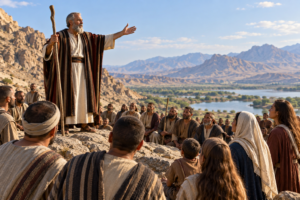
 Deuteronomy 5–7 records Moses’ instruction to Israel as the nation prepares to enter the land which the LORD had promised. The immediate audience is Israel under the Mosaic covenant. These chapters emphasize the authority of God’s Word, exclusive worship of the LORD, obedience from the heart, diligent instruction of children, separation from idolatry, remembrance of God’s redemption, and confidence in His covenant faithfulness.
The broader setting is stated earlier in Deuteronomy:
“On this side Jordan, in the land of Moab, began Moses to declare this law.”
— Deuteronomy 1:5
The plain reading therefore keeps Israel, the land, the covenant, and the nations of Canaan in their proper historical setting. The church is not Israel, and Israel’s national covenant promises and conquest commands should not be transferred directly to the church. Nevertheless, “all scripture is given by inspiration of God” (2 Timothy 3:16), so these chapters contain abiding instruction concerning God’s holiness, truth, faithfulness, obedience, worship, family instruction, and separation from false religion.
Chapter Summaries
Deuteronomy 5 — The Covenant Recalled and the Commandments Restated
Moses begins with a direct call to Israel:
“Hear, O Israel, the statutes and judgments which I speak in your ears this day, that ye may learn them, and keep, and do them.”
— Deuteronomy 5:1
The wording gives a clear pattern: Israel was to hear, learn, keep, and do what God had commanded.
Moses then reminds the people:
“The LORD our God made a covenant with us in Horeb.”
— Deuteronomy 5:2
He also states:
“I stood between the LORD and you at that time, to shew you the word of the LORD.”
— Deuteronomy 5:5
This establishes Moses’ role as the one through whom God’s words were communicated to Israel.
Deuteronomy 5:3 says:
“The LORD made not this covenant with our fathers, but with us, even us, who are all of us here alive this day.”
The safest conclusion is the one directly stated: Moses emphasizes the responsibility of the living generation standing before him. Scripture does not require us in this verse to go beyond that statement and construct a more detailed identification of the “fathers” than the immediate text provides.
The LORD then restates the commandments given at Horeb.
He begins by identifying Himself as Israel’s Redeemer:
“I am the LORD thy God, which brought thee out of the land of Egypt, from the house of bondage.”
— Deuteronomy 5:6
The commandments that follow include:
- No other gods before the LORD.
- No graven images for worship.
- No taking the name of the LORD in vain.
- Keeping the sabbath day as commanded to Israel.
- Honoring father and mother.
- No murder.
- No adultery.
- No stealing.
- No false witness.
- No coveting.
The order moves from Israel’s relationship with God to responsibilities toward other people. The final command concerning coveting also demonstrates that God’s standard reaches inward to the desires of the heart, not merely outward behavior.
The sabbath command is specifically connected with Israel’s deliverance from Egypt:
“And remember that thou wast a servant in the land of Egypt, and that the LORD thy God brought thee out thence through a mighty hand and by a stretched out arm.”
— Deuteronomy 5:15
This is important dispensationally. The sabbath ordinance in this passage belongs to Israel under the Mosaic covenant. The New Testament church is not placed under Israel’s sabbath law. Colossians 2:16 says:
“Let no man therefore judge you in meat, or in drink, or in respect of an holyday, or of the new moon, or of the sabbath days.”
The chapter then recalls the solemnity of God speaking from the mount:
“These words the LORD spake unto all your assembly in the mount out of the midst of the fire, of the cloud, and of the thick darkness, with a great voice.”
— Deuteronomy 5:22
The people asked Moses to receive the words of God for them:
“Go thou near, and hear all that the LORD our God shall say: and speak thou unto us all that the LORD our God shall speak unto thee; and we will hear it, and do it.”
— Deuteronomy 5:27
The LORD responded:
“They have well said all that they have spoken.”
— Deuteronomy 5:28
One of the central verses of the chapter follows:
“O that there were such an heart in them, that they would fear me, and keep all my commandments always.”
— Deuteronomy 5:29
The text joins together the heart, the fear of God, and obedience.
The chapter closes with the command:
“Ye shall walk in all the ways which the LORD your God hath commanded you.”
— Deuteronomy 5:33
Israel was not authorized to obey selectively. God’s commandments were to govern the whole course of their national and personal life.
Deuteronomy 6 — Love for God, His Word in the Heart, and Teaching the Next Generation
Deuteronomy 6 emphasizes wholehearted devotion to the LORD and the responsibility to keep His words continually before the family.
Moses says that Israel was to learn God’s commandments:
“That thou mightest fear the LORD thy God, to keep all his statutes and his commandments.”
— Deuteronomy 6:2
In this context, the fear of the LORD is repeatedly connected with obedience.
The great declaration of this chapter is:
“Hear, O Israel: The LORD our God is one LORD:”
“And thou shalt love the LORD thy God with all thine heart, and with all thy soul, and with all thy might.”
— Deuteronomy 6:4–5
The LORD alone was to receive Israel’s worship and devotion.
The command is not merely to acknowledge that God exists. Israel was commanded to love Him wholly and without divided allegiance.
The next verse establishes an important order:
“And these words, which I command thee this day, shall be in thine heart.”
— Deuteronomy 6:6
Before the words were taught to the children, they were first to be in the heart of the one doing the teaching.
Then comes the direct command:
“And thou shalt teach them diligently unto thy children.”
— Deuteronomy 6:7
The instruction was to be woven into everyday life:
“when thou sittest in thine house, and when thou walkest by the way, and when thou liest down, and when thou risest up.”
The text plainly places major responsibility for spiritual instruction within the home.
For believers today, the Mosaic covenant details remain distinct from the church, but the principle of parents instructing their children in the things of God is also taught in the New Testament:
“And, ye fathers, provoke not your children to wrath: but bring them up in the nurture and admonition of the Lord.”
— Ephesians 6:4
Moses then warns Israel concerning prosperity.
The LORD would bring them into cities they did not build, houses they did not fill, wells they did not dig, and vineyards and olive trees they did not plant.
The warning is:
“Then beware lest thou forget the LORD.”
— Deuteronomy 6:12
The text directly identifies forgetfulness of the LORD as a danger in the midst of abundance.
Israel is then commanded:
“Thou shalt fear the LORD thy God, and serve him.”
— Deuteronomy 6:13
And:
“Ye shall not go after other gods.”
— Deuteronomy 6:14
The reason includes the truth that:
“the LORD thy God is a jealous God among you.”
— Deuteronomy 6:15
God’s jealousy here concerns His rightful demand for exclusive worship from His covenant people. It should not be confused with sinful human jealousy.
Verse 16 commands:
“Ye shall not tempt the LORD your God, as ye tempted him in Massah.”
This verse is later quoted by the Lord Jesus Christ during His temptation:
“Thou shalt not tempt the Lord thy God.”
— Matthew 4:7
The chapter then turns again to the instruction of children.
Moses anticipates the question:
“What mean the testimonies, and the statutes, and the judgments, which the LORD our God hath commanded you?”
— Deuteronomy 6:20
The answer begins with what God had done:
“We were Pharaoh’s bondmen in Egypt; and the LORD brought us out of Egypt with a mighty hand.”
— Deuteronomy 6:21
The children were not merely to be told what God commanded. They were also to be taught how the LORD had delivered Israel.
The chapter closes:
“And it shall be our righteousness, if we observe to do all these commandments before the LORD our God, as he hath commanded us.”
— Deuteronomy 6:25
The immediate subject is Israel’s covenant obedience.
This verse must not be used to teach justification from sin by law-keeping. Scripture plainly teaches:
“And he believed in the LORD; and he counted it to him for righteousness.”
— Genesis 15:6
And:
“Therefore we conclude that a man is justified by faith without the deeds of the law.”
— Romans 3:28
Deuteronomy 6:25 therefore concerns Israel doing what was right under the covenant God had given them. It does not teach salvation by works.
Deuteronomy 7 — Separation From Idolatry and Confidence in the Faithful God
Deuteronomy 7 prepares Israel for contact with the nations dwelling in the land.
Seven nations are named:
- Hittites
- Girgashites
- Amorites
- Canaanites
- Perizzites
- Hivites
- Jebusites
The text describes them as:
“seven nations greater and mightier than thou.”
— Deuteronomy 7:1
Israel’s coming victory therefore was not presented as the result of natural national superiority.
The LORD commands concerning those nations:
“thou shalt smite them, and utterly destroy them; thou shalt make no covenant with them, nor shew mercy unto them.”
— Deuteronomy 7:2
This was a specific command of divine judgment given to Israel concerning particular nations in Canaan.
It must not be transferred to the church as authorization for religious violence.
The New Testament states:
“For the weapons of our warfare are not carnal.”
— 2 Corinthians 10:4
The church’s commission is to preach the gospel, not to carry out Israel’s conquest of Canaan.
The reason for the removal of the Canaanite nations is further clarified later in Deuteronomy:
“for the wickedness of these nations the LORD thy God doth drive them out from before thee.”
— Deuteronomy 9:5
That explicit biblical statement should govern the interpretation rather than speculation about motives not stated in Scripture.
Israel was also commanded:
“Neither shalt thou make marriages with them.”
— Deuteronomy 7:3
The text immediately supplies the reason:
“For they will turn away thy son from following me, that they may serve other gods.”
— Deuteronomy 7:4
The stated danger is religious apostasy and idolatry.
The passage therefore does not authorize making race or ethnicity the central doctrinal issue. The concern explicitly stated in the text is being turned away from the LORD unto false gods.
For the believer today, the related New Testament principle is:
“Be ye not unequally yoked together with unbelievers.”
— 2 Corinthians 6:14
Israel was also commanded to destroy the instruments of false worship:
“Ye shall destroy their altars, and break down their images, and cut down their groves, and burn their graven images with fire.”
— Deuteronomy 7:5
The LORD permitted no blending of His worship with Canaanite idolatry.
Verse 6 says:
“For thou art an holy people unto the LORD thy God: the LORD thy God hath chosen thee to be a special people unto himself.”
The immediate subject is Israel as a covenant nation.
The verse does not state that every Israelite was individually regenerated or eternally saved. It therefore should not be used as proof of Calvinistic individual election unto salvation.
The text continues:
“The LORD did not set his love upon you, nor choose you, because ye were more in number than any people.”
— Deuteronomy 7:7
Instead:
“But because the LORD loved you, and because he would keep the oath which he had sworn unto your fathers.”
— Deuteronomy 7:8
Israel’s national position rested upon God’s love and His faithfulness to the oath He had made.
The great doctrinal declaration follows:
“Know therefore that the LORD thy God, he is God, the faithful God.”
— Deuteronomy 7:9
God is faithful to His Word and covenant.
The chapter then connects Israel’s obedience with covenant blessings in the promised land. Those blessings include fruitfulness, increase, health, and victory.
These promises belong directly to Israel in the Mosaic covenant and should not be automatically claimed as guarantees of material prosperity for the church.
Moses then addresses fear of the nations:
“If thou shalt say in thine heart, These nations are more than I; how can I dispossess them?”
— Deuteronomy 7:17
The answer is remembrance:
“Thou shalt not be afraid of them: but shalt well remember what the LORD thy God did unto Pharaoh, and unto all Egypt.”
— Deuteronomy 7:18
Israel was to face the future by remembering what God had already done.
Verse 21 says:
“for the LORD thy God is among you, a mighty God and terrible.”
The conquest would not occur all at once.
The text explicitly says:
“And the LORD thy God will put out those nations before thee by little and little.”
— Deuteronomy 7:22
The reason is also explicitly stated:
“lest the beasts of the field increase upon thee.”
Because Scripture supplies the reason, there is no need to create an additional symbolic or allegorical meaning.
The chapter closes with a warning concerning the idols of the nations:
“Thou shalt not desire the silver or gold that is on them, nor take it unto thee.”
— Deuteronomy 7:25
And:
“Neither shalt thou bring an abomination into thine house.”
— Deuteronomy 7:26
Israel was not merely to reject the worship of idols publicly. They were forbidden even to covet and bring into their homes that which was connected with the abomination God had condemned.
Key People and Places
Moses
Moses is the human speaker and teacher throughout these chapters. He reminds Israel of Horeb, restates God’s commandments, commands wholehearted love for the LORD, warns against idolatry, and prepares the nation for entering the land.
The LORD God
The LORD is the central Person of the passage. He is presented as Israel’s Redeemer, Lawgiver, faithful God, jealous God, mighty God, and the only rightful object of worship.
Israel
Israel is the covenant nation directly addressed throughout Deuteronomy 5–7.
The Children of Israel
Deuteronomy 6 gives special attention to passing God’s words to the next generation. Parents were commanded to teach their children diligently.
Pharaoh
Pharaoh is mentioned in Deuteronomy 7:18 as part of Israel’s remembrance of the LORD’s mighty deliverance from Egypt.
The Hittites
One of the seven nations named in Deuteronomy 7:1.
The Girgashites
One of the seven nations named in Deuteronomy 7:1.
The Amorites
One of the seven nations named in Deuteronomy 7:1.
The Canaanites
One of the seven nations named in Deuteronomy 7:1.
The Perizzites
One of the seven nations named in Deuteronomy 7:1.
The Hivites
One of the seven nations named in Deuteronomy 7:1.
The Jebusites
One of the seven nations named in Deuteronomy 7:1.
Horeb
The place associated with the covenant recalled in Deuteronomy 5.
Egypt
The land from which the LORD delivered Israel. Their redemption from “the house of bondage” is repeatedly used as a reason for remembrance, obedience, and trust.
Massah
Mentioned in Deuteronomy 6:16 as the place connected with Israel’s tempting of the LORD.
Moab
The broader setting of Moses’ declaration of the law is “in the land of Moab” according to Deuteronomy 1:5.
The Promised Land
The land into which Israel was preparing to enter dominates the practical setting of Deuteronomy 6–7.
Main Doctrinal or Spiritual Themes
The Authority of God’s Word
Deuteronomy 5 begins with:
“Hear, O Israel.”
God had spoken, and Israel’s responsibility was to hear, learn, keep, and do what He commanded.
The Word of God was not subject to revision by popular opinion, surrounding culture, or human preference.
The Holiness of God
The LORD does not treat idolatry as harmless religious variety.
He demands exclusive worship and condemns false gods, images, and pagan worship.
The Oneness of the LORD
Deuteronomy 6:4 declares:
“The LORD our God is one LORD.”
Israel was commanded to worship the true God alone.
Wholehearted Love for God
The command is:
“thou shalt love the LORD thy God with all thine heart, and with all thy soul, and with all thy might.”
— Deuteronomy 6:5
Biblical love toward God is wholehearted and is repeatedly connected with obedience.
The Fear of the LORD
Deuteronomy repeatedly connects fearing God with keeping His commandments.
Biblical fear is therefore not presented merely as emotion. It is reflected in reverence, submission, and obedience.
The Word of God in the Heart
“These words…shall be in thine heart.”
— Deuteronomy 6:6
God’s Word was to govern the inner life before it was taught outwardly.
Parental Responsibility
“Thou shalt teach them diligently unto thy children.”
— Deuteronomy 6:7
The home is presented as a major place of biblical instruction.
The Danger of Forgetting God
“Then beware lest thou forget the LORD.”
— Deuteronomy 6:12
Prosperity can become spiritually dangerous when God’s gifts are enjoyed while God Himself is forgotten.
Separation From Idolatry
Israel was commanded to reject pagan gods, pagan worship, pagan religious alliances, and objects connected with idolatry.
The church does not carry out Israel’s conquest, but believers are still commanded to separate from false religion and spiritual compromise.
God’s Faithfulness
“He is God, the faithful God.”
— Deuteronomy 7:9
God remains true to His Word.
Israel’s Distinct Covenant Position
Deuteronomy 5–7 concerns Israel under the Mosaic covenant.
Israel and the church must not be confused.
The land promises, conquest commands, sabbath command in its Mosaic form, and national covenant blessings belong to Israel in their stated context.
Salvation Is Not Earned by Law-Keeping
The heavy emphasis upon obedience in these chapters does not teach salvation by works.
The law reveals God’s righteous standard, but justification before God is not earned through human obedience.
“Therefore by the deeds of the law there shall no flesh be justified in his sight.”
— Romans 3:20
And:
“But to him that worketh not, but believeth on him that justifieth the ungodly, his faith is counted for righteousness.”
— Romans 4:5
Salvation is by grace through faith, apart from works.
Practical Applications or Lessons
Hear the Word of God With the Intention to Obey
Deuteronomy 5:1 does not stop at hearing.
Israel was to hear, learn, keep, and do.
Bible study should produce submission to God, not merely accumulation of information.
Give God Exclusive Worship
The first commandment says:
“Thou shalt have none other gods before me.”
— Deuteronomy 5:7
Nothing should be allowed to take the place in the heart that belongs to God.
Treat the Name of the LORD Reverently
“Thou shalt not take the name of the LORD thy God in vain.”
— Deuteronomy 5:11
God’s name is never to be treated carelessly, dishonestly, profanely, or irreverently.
Honor God-Ordained Family Authority
The command to honor father and mother establishes the seriousness of proper respect within the family.
Guard the Desires of the Heart
The command against coveting shows that sin is not limited to outward actions.
God is concerned with what a man desires within.
Put the Word of God in Your Own Heart
Deuteronomy 6:6 comes before the command to teach children.
A parent or teacher should first be personally governed by the truth he teaches.
Teach Children Diligently
Biblical instruction in the home should be deliberate, regular, and woven into everyday life.
The passage does not present spiritual instruction as merely an occasional activity.
Remember the LORD During Prosperity
Abundance can tempt a person to become spiritually careless.
The warning remains powerful:
“Beware lest thou forget the LORD.”
Do Not Mix True Worship With False Religion
Israel was forbidden to combine the worship of Jehovah with the religions of Canaan.
Believers should likewise reject doctrinal compromise that treats contradictory religious systems as though all were acceptable before God.
Avoid Unequal Spiritual Alliances
The stated danger in Deuteronomy 7:4 was being turned away from following the LORD.
Strong relationships that pull a believer away from biblical truth should be avoided.
Remember What God Has Done
Israel was told to remember Egypt when facing stronger enemies.
Remembering God’s acts recorded in Scripture strengthens confidence in His power and faithfulness.
Do Not Add Meaning Where God Has Already Given the Reason
Deuteronomy 7:22 explicitly says the nations would be removed “little and little” so that the beasts of the field would not increase.
This provides a useful interpretive lesson: when Scripture gives the explanation, the interpreter should accept it rather than replace it with speculation or allegory.
Keep Spiritual Corruption Out of the Home
Deuteronomy 7:26 says:
“Neither shalt thou bring an abomination into thine house.”
The immediate subject concerns objects associated with Canaanite idolatry.
A sound practical principle is that believers should not knowingly invite spiritually corrupting influences into their homes.
Overall Message
Deuteronomy 5–7 presents a unified call to covenant faithfulness.
Deuteronomy 5 emphasizes hearing and obeying the God who redeemed Israel.
Deuteronomy 6 emphasizes loving the LORD wholly, keeping His words in the heart, and teaching them diligently to the next generation.
Deuteronomy 7 emphasizes separation from idolatry, confidence in God’s faithfulness, and refusal to compromise with false worship.
The heart of the section is expressed in Deuteronomy 6:4–5:
“Hear, O Israel: The LORD our God is one LORD:”
“And thou shalt love the LORD thy God with all thine heart, and with all thy soul, and with all thy might.”
The practical burden is also clearly expressed in Deuteronomy 5:29:
“O that there were such an heart in them, that they would fear me, and keep all my commandments always.”
These chapters show that God desired more than outward ceremony. He required Israel’s heart, worship, home, conduct, memory, and national life to be governed by His words.
For the Christian today, the passage must remain in its literal setting concerning Israel and the Mosaic covenant, while its doctrinal instruction concerning God’s holiness, His exclusive right to worship, obedience to His Word, faithful teaching of children, separation from false religion, remembrance of His works, and confidence in His faithfulness remains deeply profitable.
Tags
Deuteronomy 5, Deuteronomy 6, Deuteronomy 7, Moses, Israel, Children of Israel, LORD God, Jehovah, Horeb, Moab, Egypt, Massah, Promised Land, Canaan, Hittites, Girgashites, Amorites, Canaanites, Perizzites, Hivites, Jebusites, Ten Commandments, Mosaic Covenant, Law of Moses, Hear O Israel, love the LORD thy God, fear of the LORD, obedience, holiness, separation, idolatry, biblical parenting, teaching children, covenant faithfulness, promised land, KJV Bible study, King James Bible, conservative Baptist, Independent Baptist, dispensationalism
Comments are closed