David and Absalom: God’s Providence and the Cost of Rebellion
 Second Samuel 17-18 records the defeat of Absalom’s rebellion and David’s grief over his son’s death. The chapters move from competing counsel in Jerusalem to David’s refuge at Mahanaim, then to battle in the wood of Ephraim. Throughout these events, Scripture reveals both God’s sovereign government and the serious consequences of human choices.
The background includes Nathan’s warning that trouble would arise from David’s own house because of his sin concerning Uriah and his wife (2 Samuel 12:9-12). David had received forgiveness, but the Lord had also announced consequences within his household (2 Samuel 12:13-14). These chapters must therefore be read with both truths in view: God’s forgiveness is real, and forgiveness does not mean that every earthly consequence of sin is removed.
Chapter Summaries
2 Samuel 17: Counsel Overturned and David Sustained
Ahithophel proposes an immediate attack.
Ahithophel asks Absalom for twelve thousand men so that he can pursue David that night. His plan is to strike while David is weary, frighten away his followers, and kill the king alone. He promises that the people will then return to Absalom in peace (2 Samuel 17:1-3).
This is Ahithophel’s proposed outcome, not a divine promise that his plan would succeed. Nevertheless, his advice pleases Absalom and the elders of Israel (2 Samuel 17:4). Absalom’s willingness to approve a plan aimed at his father’s death shows the deadly direction of his rebellion.
Hushai counters Ahithophel’s counsel.
Absalom also calls Hushai and asks for his judgment. Hushai replies:
“The counsel that Ahithophel hath given is not good at this time.”
2 Samuel 17:7
Hushai describes David and his men as mighty warriors, deeply provoked and dangerous. He warns that an initial defeat could discourage Absalom’s followers. He then recommends gathering Israel from Dan to Beersheba into a great army, with Absalom personally leading the campaign (2 Samuel 17:8-13).
These statements belong to Hushai’s argument before Absalom. They should not all be treated as independent descriptions supplied by the narrator. Hushai had returned to Jerusalem at David’s request to defeat Ahithophel’s counsel (2 Samuel 15:32-37).
Absalom and the men of Israel prefer Hushai’s advice. Scripture then gives the decisive explanation:
“For the LORD had appointed to defeat the good counsel of Ahithophel, to the intent that the LORD might bring evil upon Absalom.”
2 Samuel 17:14
The description “good counsel” concerns the effectiveness of Ahithophel’s military advice. His proposal to kill David was not morally righteous. Likewise, the “evil” brought upon Absalom in this setting is the calamity of judgment, not moral wrongdoing committed by God.
The passage explicitly identifies the Lord’s purpose behind the rejection of Ahithophel’s counsel. God’s rule over events does not remove the responsibility of the people making these decisions.
A warning reaches David.
Hushai reports both plans to Zadok and Abiathar, the priests. He urges them to warn David not to remain that night in the plains of the wilderness but to pass over quickly (2 Samuel 17:15-16).
Jonathan and Ahimaaz wait near Enrogel, where a woman carries information to them. A young man sees them and tells Absalom. The messengers escape to a house in Bahurim and hide in a well. The woman of the house covers its opening and spreads ground corn over it. When Absalom’s servants arrive, she directs them elsewhere, and the search fails (2 Samuel 17:17-20).
The narrative records the woman’s concealment and misleading answer. It does not explicitly command believers to imitate every method used in this incident. The clear result is that the messengers escape and deliver the warning.
David and everyone with him cross Jordan before morning:
“There lacked not one of them that was not gone over Jordan.”
2 Samuel 17:22
David’s prayer concerning Ahithophel’s counsel in 2 Samuel 15:31 and the Lord’s stated action in 2 Samuel 17:14 show God’s intervention. The account also records the practical work of counselors, priests, messengers, and those who sheltered them.
Ahithophel dies, and the armies assemble.
When Ahithophel sees that his counsel has been rejected, he returns home, puts his household in order, and takes his own life. He is buried in his father’s sepulchre (2 Samuel 17:23).
Scripture states what he did and the circumstance preceding it. It does not explicitly explain every thought behind his decision. Claims that he certainly foresaw execution or knew precisely how the rebellion would end go beyond what this verse says.
David comes to Mahanaim. Absalom crosses Jordan with the men of Israel and appoints Amasa over the army in Joab’s place. Absalom and Israel encamp in the land of Gilead (2 Samuel 17:24-26).
Friends provide for David’s company.
Shobi, Machir, and Barzillai bring bedding, vessels, and abundant food for David and his people. Their stated concern is practical:
“The people is hungry, and weary, and thirsty, in the wilderness.”
2 Samuel 17:29
The chapter closes with provision rather than battle. David’s company needs ordinary necessities, and these men supply them. Their assistance illustrates how material generosity can meet real needs during a spiritual and national crisis.
2 Samuel 18: Victory in Battle and Sorrow in the King’s House
David organizes his forces.
David numbers his people, appoints officers, and divides the army into three parts under Joab, Abishai, and Ittai the Gittite. He intends to accompany them, but the people urge him to remain behind because of his importance to their cause. David accepts their counsel and stands beside the gate as the troops depart (2 Samuel 18:1-4).
Before the army leaves, David commands the three leaders:
“Deal gently for my sake with the young man, even with Absalom.”
2 Samuel 18:5
All the people hear this instruction. David’s concern for his son is therefore publicly known before the battle begins.
Absalom’s army is defeated.
The battle takes place in the wood of Ephraim. David’s servants defeat the people of Israel, and twenty thousand men fall that day. The fighting spreads over the countryside, and Scripture adds:
“The wood devoured more people that day than the sword devoured.”
2 Samuel 18:8
The text does not explain all the ways the woodland caused these deaths. Its stated point is that the wood accounted for more of the losses than the sword.
Absalom is caught in an oak.
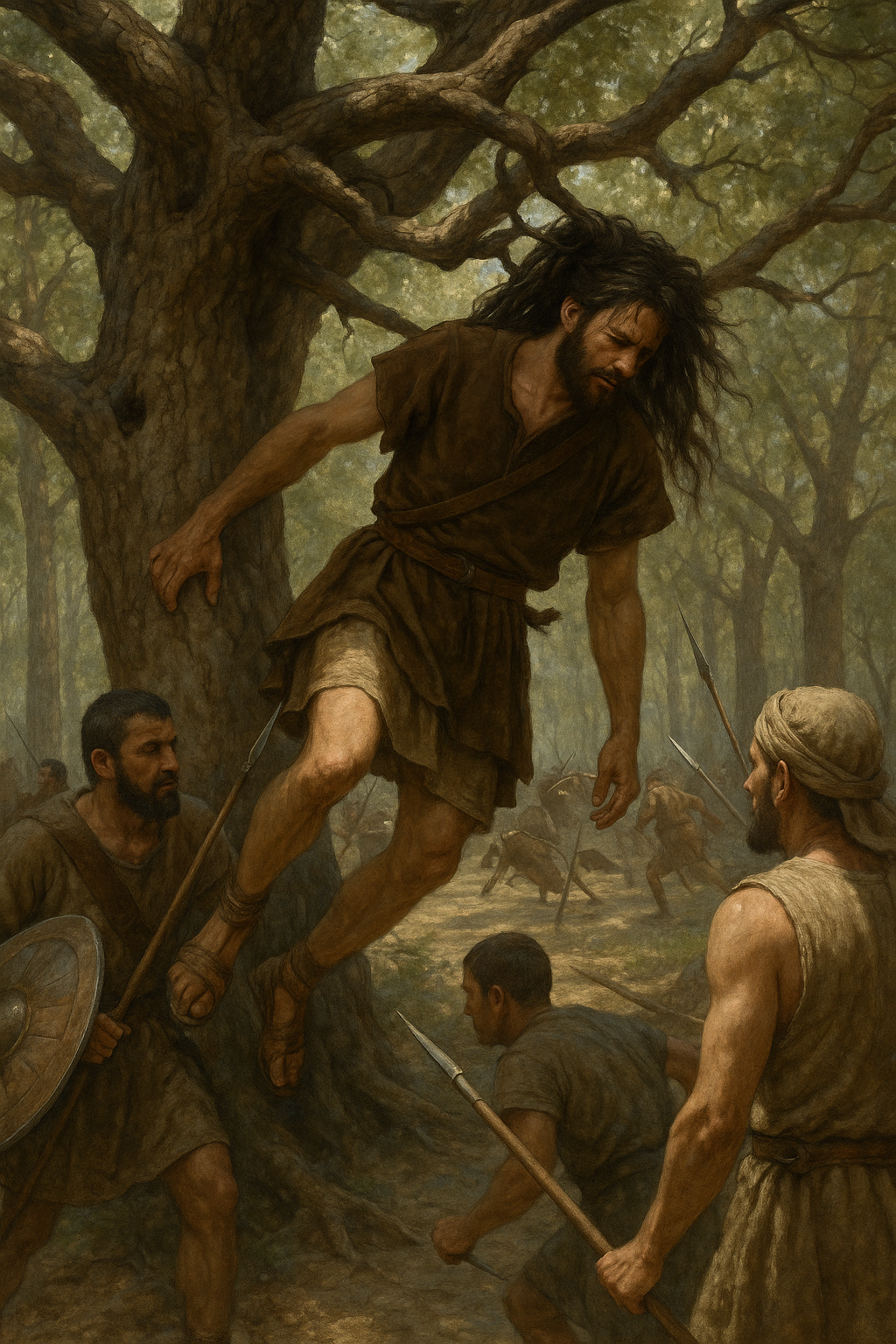
Absalom encounters David’s servants while riding a mule. As the mule passes beneath the thick branches of a great oak, Absalom’s head catches in the tree, leaving him suspended while the animal continues onward (2 Samuel 18:9).
The wording matters: the KJV says his head caught in the oak. It does not say that his hair caught in the branches. Although Absalom’s hair is described in 2 Samuel 14:25-26, that earlier description does not establish the mechanism of this incident.
A man reports Absalom’s position to Joab. When Joab asks why he did not kill Absalom, the man refers to David’s command and refuses to take the king’s son’s life, even for a large reward (2 Samuel 18:10-13).
Joab then takes three darts and thrusts them through Absalom’s heart while he is still alive in the oak. Ten young men who bear Joab’s armor surround Absalom, strike him, and kill him (2 Samuel 18:14-15).
Joab’s action violates David’s explicit instruction to deal gently with Absalom. The fact that Absalom’s defeat fulfills God’s stated purpose does not turn every human action contributing to that defeat into an act of obedience.
The rebellion collapses.
Joab sounds the trumpet and stops the pursuit. Absalom’s body is cast into a great pit in the wood, and a very great heap of stones is laid over him. The Israelites flee to their tents (2 Samuel 18:16-17).
The narrative then recalls the pillar Absalom had erected in the king’s dale to preserve his name. He had said:
“I have no son to keep my name in remembrance.”
2 Samuel 18:18
Second Samuel 14:27 records that three sons and a daughter were born to Absalom. Scripture does not explicitly explain the relationship between that statement and his words concerning the pillar. It is therefore unwarranted to present the deaths of his sons as an established biblical fact.
The passage places Absalom’s chosen memorial beside the account of his humiliating burial. His effort to preserve his name could not protect him from the consequences of rebellion.
David receives the news.
Ahimaaz wants to carry news of the victory, but Joab first sends Cushi because the king’s son is dead. Ahimaaz continues to request permission, receives it, and outruns Cushi (2 Samuel 18:19-23).
When Ahimaaz arrives, he announces that the Lord has delivered up those who opposed David. David’s immediate question concerns Absalom’s safety. Ahimaaz says that he saw a great tumult but did not know what it was (2 Samuel 18:28-30).
Joab had already told Ahimaaz that the king’s son was dead (2 Samuel 18:20). His answer therefore does not communicate all the information he had received. Scripture does not explicitly explain his motive for answering this way.
Cushi then arrives with news of the Lord’s deliverance. Asked about Absalom, he replies that the king’s enemies should be as that young man is (2 Samuel 18:31-32). David understands the meaning and goes weeping to the chamber over the gate:
“O my son Absalom, my son, my son Absalom! would God I had died for thee, O Absalom, my son, my son!”
2 Samuel 18:33
The chapter ends with a father’s anguish. David’s forces have won the battle, but David mourns the loss of his son.
Key People and Places
- David: The king opposed by Absalom’s rebellion. He organizes his army, requests mercy for Absalom, and grieves over his death.
- Absalom: David’s son, who receives counsel against his father, leads the opposing forces, and dies after becoming caught in an oak.
- Ahithophel: The counselor whose plan for a rapid attack is rejected. He returns home and takes his own life.
- Hushai: David’s friend, whose counsel Absalom accepts. He also arranges for David to receive a warning.
- Zadok and Abiathar: Priests who receive Hushai’s report and participate in the communication network supporting David.
- Jonathan and Ahimaaz: The messengers who carry the warning to David. Ahimaaz also runs with news after the battle.
- Joab: One of David’s commanders. He attacks Absalom despite David’s instruction and afterward stops the pursuit.
- Abishai and Ittai the Gittite: Commanders of the other two divisions of David’s army.
- Amasa: The man Absalom appoints to command his army.
- Shobi, Machir, and Barzillai: Men who provide food and supplies for David and his people at Mahanaim.
- Cushi: The messenger whose answer informs David of Absalom’s death.
- Enrogel and Bahurim: Locations involved in the messengers’ dangerous journey to warn David.
- Jordan: The river David and his company cross before morning.
- Mahanaim and Gilead: Mahanaim is David’s place of refuge; Absalom’s forces encamp in the land of Gilead.
- The wood of Ephraim: The setting of the battle and Absalom’s capture in the oak.
- The king’s dale: The location of Absalom’s memorial pillar.
Main Doctrinal or Spiritual Themes
God’s Providence Governs Human Affairs
Second Samuel 17:14 explicitly identifies the Lord as the One who appointed the defeat of Ahithophel’s counsel. Political influence, military planning, and popular approval cannot place human beings beyond God’s government.
David had prayed that God would turn Ahithophel’s counsel into foolishness (2 Samuel 15:31). These events show that prayer and practical action belong together. David prayed, Hushai counseled, messengers traveled, and David crossed Jordan.
Forgiveness Does Not Cancel Every Earthly Consequence
Nathan declared that the Lord had put away David’s sin, while also announcing severe consequences (2 Samuel 12:10-14). God’s forgiveness must never become an excuse to treat sin lightly.
These chapters do not authorize us to identify every hardship in a believer’s life as punishment for a particular sin. In David’s case, however, Scripture provides a specific prophetic warning concerning trouble within his household.
Human Responsibility Remains Real
Absalom is responsible for his rebellion. Joab is responsible for disregarding David’s command. God’s declared purpose does not erase the moral significance of their conduct.
A favorable result cannot, by itself, establish that every method used to obtain it was right.
Rebellion Cannot Secure Lasting Greatness
Absalom gains followers, assembles an army, and erects a memorial. Yet none of these things secures his life or establishes his kingdom.
His history warns against seeking advancement through disloyalty and violence. Public recognition cannot substitute for righteousness before God.
Compassion and Grief Do Not Make Sin Harmless
David’s mourning reveals his love for Absalom, but that love does not make Absalom’s rebellion innocent. The passage holds together the reality of wrongdoing and the sorrow of losing the wrongdoer.
David wishes that he had died for his son. The text records a grieving father’s desire; it does not present David’s words as an accomplished substitution or a direct prophecy. The gospel’s saving substitution rests on the explicit testimony that “Christ died for our sins according to the scriptures” (1 Corinthians 15:3).
Practical Applications or Lessons
Pray when circumstances exceed your control. David could not personally control the counsel given in Jerusalem, but he could bring the danger before God. Believers likewise should bring specific concerns to the Lord rather than surrender to fear.
Act responsibly while trusting God. David’s company responds to the warning and crosses Jordan. Depending on the Lord is consistent with receiving sound warnings and taking appropriate action.
Measure counsel by truth, not confidence or popularity. Both counselors speak persuasively. Ahithophel’s first proposal pleases Absalom and the elders, yet they subsequently prefer Hushai’s plan. Agreement among influential people does not make a course morally right.
Meet practical needs. Shobi, Machir, and Barzillai provide what weary people actually need. Food, bedding, hospitality, and material assistance can be meaningful expressions of Christian care.
Do not excuse disobedience because it appears useful. Joab’s treatment of Absalom directly disregards David’s instruction. Believers must evaluate their conduct by God’s revealed commands rather than by results alone.
Take family sin seriously. David’s household troubles demonstrate that wrongdoing can wound relationships deeply. Parents should combine affection with truthful instruction and consistent discipline, as commanded in Ephesians 6:4.
Read Scripture more carefully than familiar retellings. Absalom’s head, the unexplained statement about his sons, and the limited information about Ahithophel’s motives all require restraint. Faithful Bible teaching distinguishes what God has written from what readers may suppose.
Show compassion without approving rebellion. David’s sorrow reminds us that the death of someone who has done wrong can still bring profound grief. We can speak truthfully about sin while treating grieving people with tenderness.
Comments are closed