2 Samuel 21-22: God’s Justice and David’s Song of Deliverance
 Second Samuel 21-22 brings together solemn accounts of judgment, covenant obligations, personal sorrow, military conflict, and thanksgiving. Chapter 21 shows that Saul’s violence against the Gibeonites had consequences for Israel. It also records Rizpah’s faithful watch and the help David received when he became faint in battle. Chapter 22 turns our attention to David’s praise of the LORD as his rock, refuge, strength, and deliverer.
These chapters teach us to take God’s holiness seriously, honor our obligations, acknowledge our weakness, and give God the glory for His mercies.
Chapter Summaries
2 Samuel 21: Famine, Covenant Obligations, and Help in Battle
The famine and God’s answer: 2 Samuel 21:1-2
A famine continued in David’s days for “three years, year after year.” David inquired of the LORD, and God identified its cause:
“It is for Saul, and for his bloody house, because he slew the Gibeonites.”
2 Samuel 21:1
The text establishes a direct connection between this famine and Saul’s bloodshed. It does not establish that every famine or hardship results from a particular person’s sin.
The Gibeonites were not Israelites. Second Samuel 21:2 describes them as “of the remnant of the Amorites” and states that Israel had sworn an oath to them. Joshua 9:15-20 records the agreement to preserve their lives and the leaders’ recognition that breaking their oath would bring wrath upon Israel.
Saul nevertheless sought to destroy them “in his zeal to the children of Israel and Judah” (2 Samuel 21:2). His zeal did not excuse violating an obligation made under oath.
David’s agreement with the Gibeonites: 2 Samuel 21:3-9
David asked the Gibeonites what he should do to address the wrong. They rejected silver and gold and requested seven male descendants of Saul. David agreed and delivered seven men to them, who were put to death at the beginning of barley harvest.
David spared Mephibosheth, Jonathan’s son, specifically because of the oath between David and Jonathan (2 Samuel 21:7). The Mephibosheth included among those delivered to the Gibeonites was a different man, a son of Saul and Rizpah (2 Samuel 21:8).
This difficult passage requires careful restraint. God explicitly identified Saul and his bloody house as the reason for the famine. However, the chapter records the demand for seven men as the Gibeonites’ request and David’s agreement. It does not record a separate divine command specifying those seven individuals, nor does it describe each man’s personal involvement in Saul’s violence.
Deuteronomy 24:16 prohibits putting children to death for their fathers’ sins. Therefore, we should neither invent individual crimes for these seven men nor turn this account into a general authorization to punish descendants for an ancestor’s wrongdoing. Scripture does not supply every detail needed to resolve every question about their individual responsibility.
David’s use of the word “atonement” in 2 Samuel 21:3 concerns addressing this offense against the Gibeonites. It does not teach that human executions can purchase forgiveness or provide the redemption accomplished by Jesus Christ (Hebrews 10:10-14).
A textual distinction concerning Michal: 2 Samuel 21:8
The KJV describes five sons of Michal whom she “brought up for Adriel.” It does not say here that she bore them. First Samuel 18:19 identifies Merab, Saul’s daughter, as Adriel’s wife, while 2 Samuel 6:23 states that Michal had no child unto the day of her death.
The explanation should preserve these distinctions. We can repeat that Michal brought up the five sons for Adriel without inventing circumstances explaining how that arrangement came about.
Rizpah’s watch and the burial: 2 Samuel 21:10-14
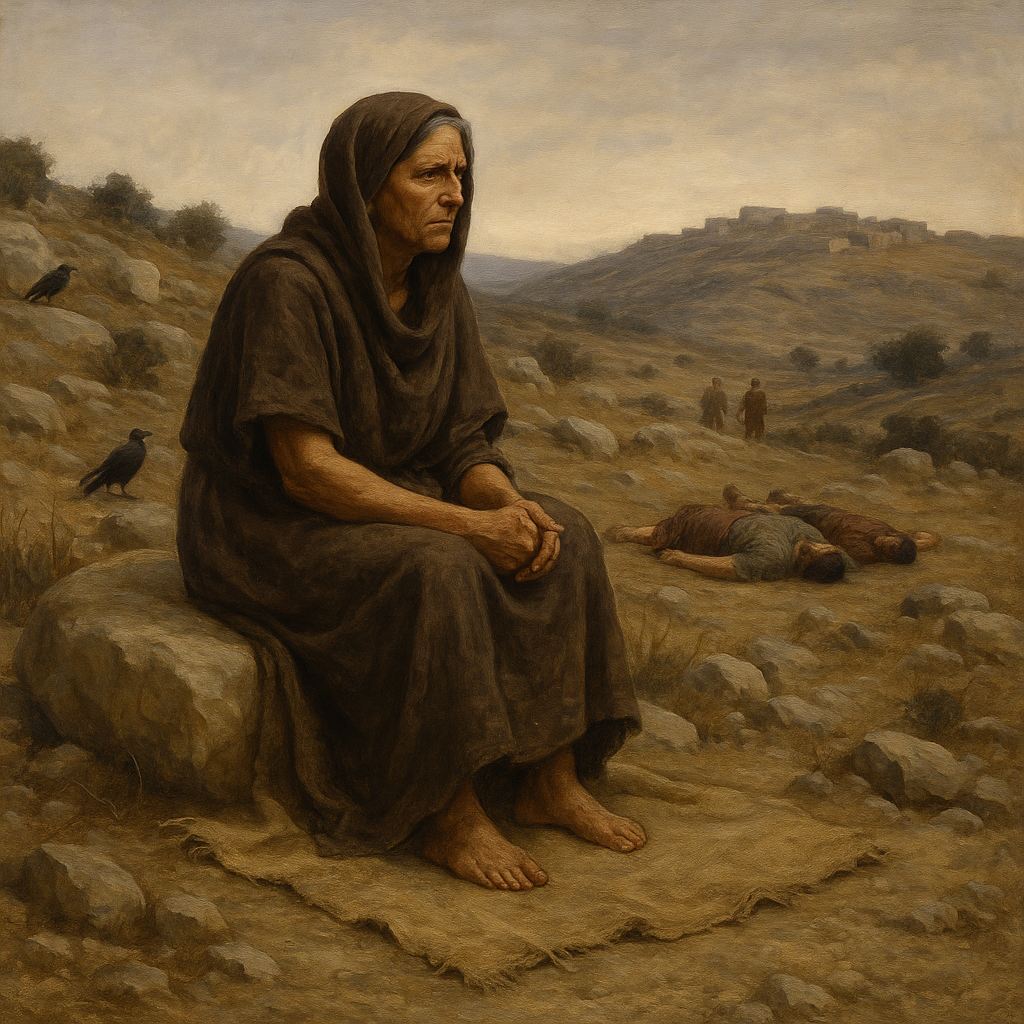
Rizpah spread sackcloth upon a rock and kept birds and beasts from resting on the bodies. Her watch continued “from the beginning of harvest until water dropped upon them out of heaven” (2 Samuel 21:10).
Her actions demonstrate persistent care for the dead. Scripture does not record a speech from her, identify her private thoughts, or state the exact number of days she remained there.
When David heard what Rizpah had done, he retrieved the bones of Saul and Jonathan from the men of Jabeshgilead. The bones of those who had been hanged were also gathered. Saul and Jonathan were buried in the sepulcher of Kish at Zelah, in Benjamin.
The account concludes:
“And after that God was intreated for the land.”
2 Samuel 21:14
The narrative records both the seriousness of the wrong and God’s response concerning the land. We should retain its sequence without claiming that Rizpah’s watch itself earned the rain or God’s favor. The chapter does not say that. kingjamesbibleonline.org
David’s weakness and his servants’ victories: 2 Samuel 21:15-22
During another war with the Philistines, “David waxed faint” (2 Samuel 21:15). Ishbibenob intended to kill him, but Abishai came to his aid and killed the Philistine.
David’s men then declared:
“Thou shalt go no more out with us to battle, that thou quench not the light of Israel.”
2 Samuel 21:17
They recognized the importance of preserving their king. The passage explicitly identifies David’s faintness; it does not state his precise age or give a medical explanation.
The remaining verses record victories by other servants of David:
- Sibbechai killed Saph at Gob.
- Elhanan killed the brother of Goliath at Gob.
- Jonathan, the son of David’s brother Shimea, killed a man of great stature who defied Israel at Gath.
The KJV identifies Elhanan’s opponent as “the brother of Goliath” (2 Samuel 21:19). First Chronicles 20:5 names that brother as Lahmi. This is distinct from David’s killing of Goliath in 1 Samuel 17.
The chapter closes by crediting these victories to David and his servants collectively. Its individual accounts make clear that David did not personally strike down every opponent.
2 Samuel 22: David Praises the LORD His Deliverer
The occasion and foundation of praise: 2 Samuel 22:1-4
David spoke this song to the LORD when the LORD had delivered him from his enemies and from Saul. A closely corresponding song appears in Psalm 18.
The opening words establish the foundation of David’s confidence:
“The LORD is my rock, and my fortress, and my deliverer;”
2 Samuel 22:2
David also calls God his shield, high tower, refuge, and Savior. These descriptions emphasize God’s strength and protection. David’s confidence rests in the LORD Himself.
The chapter identifies the occasion in terms of deliverance. It does not specify David’s physical location when he spoke the song or state that he composed it immediately after the final battle recorded in chapter 21.
Distress, prayer, and divine intervention: 2 Samuel 22:5-20
David describes the dangers surrounding him through expressions such as “the waves of death” and “the floods of ungodly men.” His troubles were real, and his fear was real.
His response was prayer:
“In my distress I called upon the LORD, and cried to my God.”
2 Samuel 22:7
The song describes God’s mighty intervention with the language of trembling earth, thunder, lightning, darkness, and waters. These are the expressions of an inspired song celebrating God’s power and wrath. The chapter does not identify a separate historical incident corresponding to every description, so we should not invent one.
David plainly acknowledges that his enemies exceeded his own strength:
“He delivered me from my strong enemy, and from them that hated me: for they were too strong for me.”
2 Samuel 22:18
Deliverance did not prove that David was sufficient in himself. It demonstrated that the LORD was his support.
Righteousness and God’s dealings with men: 2 Samuel 22:21-28
David declares that the LORD rewarded him according to his righteousness and the cleanness of his hands. He speaks of keeping God’s ways and having God’s judgments before him.
These statements must be read alongside Scripture’s record of David’s sins. Second Samuel 12:9 condemns his conduct concerning Uriah and Bathsheba, and David confesses, “I have sinned against the LORD” in 2 Samuel 12:13.
Consequently, 2 Samuel 22 cannot properly be read as David claiming lifelong sinlessness. His refusal to kill Saul provides a clear example of righteous conduct toward an enemy (1 Samuel 24:6; 26:9-11). However, chapter 22 does not explicitly restrict every statement about righteousness to those particular occasions.
Nor is David teaching salvation by works. Romans 4:6-8 expressly uses David’s testimony to explain the blessedness of the person to whom God imputes righteousness without works.
The song affirms that God distinguishes between uprightness and perversity. He saves the afflicted and brings down the haughty (2 Samuel 22:26-28). His mercy never requires Him to treat pride and obedience as morally equivalent.
God supplies light, strength, and stability: 2 Samuel 22:29-37
David’s confidence continues:
“For thou art my lamp, O LORD: and the LORD will lighten my darkness.”
2 Samuel 22:29
In chapter 21, David’s men call him “the light of Israel.” In chapter 22, David identifies the LORD as his own lamp. Israel’s king himself depended upon God.
David praises the perfection of God’s way and the reliability of His Word:
“As for God, his way is perfect; the word of the LORD is tried: he is a buckler to all them that trust in him.”
2 Samuel 22:31
David attributes his strength, sure footing, and ability in battle to God. He also declares, “thy gentleness hath made me great” (2 Samuel 22:36). His greatness gives him reason to acknowledge God’s gracious dealings, not to boast in independence.
Victory, thanksgiving, and enduring mercy: 2 Samuel 22:38-51
David recounts the defeat of enemies and his preservation through conflict. These verses describe warfare associated with his kingship. They do not authorize Christians to attack personal opponents or advance the gospel through physical violence. The New Testament directs believers to love their enemies and declares that the weapons of our warfare are not carnal (Matthew 5:44; 2 Corinthians 10:4).
The song rises to a declaration of praise:
“The LORD liveth; and blessed be my rock; and exalted be the God of the rock of my salvation.”
2 Samuel 22:47
David promises thanksgiving among the heathen and closes by praising God’s mercy to His anointed, “unto David, and to his seed for evermore” (2 Samuel 22:51). kingjamesbibleonline.org
This concluding statement should be read alongside God’s promise concerning David’s house and kingdom in 2 Samuel 7:12-16. Luke 1:32-33 explicitly identifies Jesus as the One who receives David’s throne and whose kingdom has no end. The connection rests upon Scripture’s own promises, rather than an invented symbolic meaning for every detail of David’s experience.
Key People and Places
People
- David: King of Israel, who inquired about the famine, dealt with the Gibeonites, received help in battle, and praised God for deliverance.
- Saul: Former king whose killing of the Gibeonites was identified by God as the cause of the famine.
- The Gibeonites: People protected by Israel’s oath whom Saul sought to destroy.
- Rizpah: Saul’s concubine and mother of Armoni and Mephibosheth, who guarded the bodies from birds and beasts.
- Mephibosheth, Jonathan’s son: Spared because of the oath between David and Jonathan.
- Armoni and Mephibosheth, Rizpah’s sons: Two of the seven men delivered to the Gibeonites.
- Michal and Adriel: Named in connection with the five sons whom Michal “brought up for Adriel.”
- Jonathan, Saul’s son: David’s covenant friend, whose bones David brought for burial with Saul.
- Abishai: Son of Zeruiah, who rescued David from Ishbibenob.
- Sibbechai, Elhanan, and Jonathan the son of Shimea: Servants whose victories over formidable Philistine opponents are recorded.
- Ishbibenob, Saph, Goliath’s brother, and the unnamed man of great stature: Opponents associated with the giant in Gath.
Places
- Gibeah of Saul: The location named in the Gibeonites’ request.
- Jabeshgilead: The community from whose men David retrieved Saul’s and Jonathan’s bones.
- Bethshan: Where the Philistines had displayed Saul’s and Jonathan’s remains.
- Gilboa: Associated with Saul’s death in battle.
- Zelah in Benjamin: Location of Kish’s sepulcher, where Saul and Jonathan were buried.
- Gob: Location of the battles involving Sibbechai and Elhanan.
- Gath: Location of the battle involving the man with six fingers on each hand and six toes on each foot.
- Bethlehem: Elhanan is identified as a Bethlehemite.
Main Doctrinal or Spiritual Themes
1. God’s holiness and accountability for bloodshed
God expressly identified the injustice behind this famine. National identity and religious zeal did not make Saul’s actions righteous. God’s people must measure their conduct by His commands, not merely by their intentions (2 Samuel 21:1-2).
2. The seriousness of promises
Israel’s oath to the Gibeonites and David’s oath with Jonathan both matter in this chapter. Faithfulness includes honoring obligations when circumstances make them inconvenient (Joshua 9:19-20; 2 Samuel 21:7).
3. Human weakness and dependence upon help
David became faint, and Abishai assisted him. Chapter 22 likewise acknowledges enemies too strong for David. Faith does not require pretending to be self-sufficient (2 Samuel 21:15-17; 22:18-19).
4. God’s faithfulness and the reliability of His Word
David calls God’s way perfect and His Word tried. Trust rests upon God’s character and truth, even when the believer cannot explain every circumstance (2 Samuel 22:31-33).
5. Obedience matters, but redemption is not earned
God takes righteous conduct seriously. Nevertheless, David’s testimony must be understood alongside his confessed sins and the Bible’s teaching of justification apart from works (2 Samuel 12:13; Romans 4:6-8; Ephesians 2:8-10).
6. Deliverance should produce thanksgiving
David directs his song to the LORD and credits Him with preservation. Matthew Henry likewise emphasizes that those who receive God’s preserving mercies should give Him the glory. This supports the plain emphasis of the song itself (2 Samuel 22:1, 47-51). kingjamesbibleonline.org
7. God’s promise concerning David reaches to Christ
The closing reference to David’s seed belongs alongside the Davidic covenant and the explicit announcement of Christ’s everlasting kingdom (2 Samuel 7:12-16; 22:51; Luke 1:32-33).
Practical Applications or Lessons
Seek the LORD in trouble without inventing explanations.
David inquired of God during the famine. We should pray and examine ourselves, but we should not claim that another person’s hardship proves a particular hidden sin. John 9:1-3 warns against that assumption.
Keep your word.
Promises made before God deserve careful attention. This applies to marriage, church responsibilities, ministry commitments, business dealings, and ordinary agreements. Psalm 15:4 commends the person who keeps an oath even when doing so is costly.
Do not confuse zeal with obedience.
Saul’s zeal for Israel and Judah did not excuse his treatment of the Gibeonites. Strong feelings about a cause cannot make disobedience acceptable.
Show practical compassion to the grieving.
Rizpah’s actions place personal sorrow before the reader. A fitting Christian application is to accompany those who mourn and offer practical care, consistent with Romans 12:15.
Accept help when strength fails.
David needed Abishai. Past faithfulness does not remove present limitations. Believers should be willing both to receive assistance and to bear one another’s burdens (Galatians 6:2).
Support those who carry responsibility.
David’s men recognized the importance of protecting him. Christians can apply this principle through prayer, encouragement, and practical help for those who labor among them (1 Thessalonians 5:12-13, 25).
Let God’s Word govern your response to uncertainty.
Some details in chapter 21 remain unexplained. Faithfulness requires holding firmly to what Scripture states while refusing to fill its silences with confident assumptions.
Give God specific thanks.
David remembered distress, prayer, help, and deliverance. Remembering particular mercies can deepen our gratitude and keep us from treating God’s kindness as something ordinary or deserved.
Remain humble when God gives success.
David attributed his strength and greatness to the LORD. Whatever responsibilities or opportunities God grants us, they should become occasions for gratitude and faithful service.
Comments are closed