David’s Last Words, Mighty Men, and Costly Worship – 2 Samuel 23-24
Chapter Summaries
2 Samuel 23 – David’s Last Words and His Mighty Men
David’s testimony and the character of righteous rule – 2 Samuel 23:1-7
 The chapter begins, “Now these be the last words of David” (2 Samuel 23:1). The passage presents an inspired declaration concerning righteous government, God’s covenant, and the judgment of wicked men. It does not describe David’s death, which is recorded in 1 Kings 2:10.
David is identified as “the son of Jesse,” the man raised up on high, “the anointed of the God of Jacob,” and “the sweet psalmist of Israel” (2 Samuel 23:1). These descriptions place his family background beside the position God gave him.
David states the source of his message:
“The Spirit of the LORD spake by me, and his word was in my tongue.”
2 Samuel 23:2
This is an explicit testimony to the Holy Spirit’s work in communicating God’s Word through David. His message carries authority because it comes from God, not merely because it comes from a king.
The central requirement for a ruler follows:
“He that ruleth over men must be just, ruling in the fear of God.”
2 Samuel 23:3
Justice and the fear of God belong together. A ruler is accountable to the Lord for the way he exercises authority. Verse 4 compares righteous rule to the brightness of a clear morning and the flourishing of tender grass after rain.
David then acknowledges the condition of his own house while declaring his confidence in God’s covenant:
“Although my house be not so with God; yet he hath made with me an everlasting covenant, ordered in all things, and sure: for this is all my salvation, and all my desire, although he make it not to grow.”
2 Samuel 23:5
David does not claim that his household perfectly reflects the righteousness just described. Nevertheless, his confidence rests in the covenant God has established.
The covenant promises concerning David’s house, kingdom, and throne are recorded in 2 Samuel 7:12-16. That passage includes both chastening for iniquity and God’s promise concerning the establishment of David’s throne. God’s faithfulness must therefore never be interpreted as approval of sin.
The New Testament explicitly connects Jesus Christ with David’s throne. Luke 1:32-33 declares that the Lord will give Him “the throne of his father David” and that His kingdom will have no end. This provides a clear biblical foundation for understanding the ultimate fulfillment of the royal promise in Christ.
David’s declaration closes with a warning concerning “the sons of Belial,” who are compared to thorns that must be thrust away and burned (2 Samuel 23:6-7). The passage contrasts righteous rule with wickedness that brings judgment.
The mighty men and the victories God gave – 2 Samuel 23:8-12
The chapter next records the names and deeds of David’s mighty men.
Adino the Eznite is associated with the slaying of eight hundred at one time (2 Samuel 23:8). Eleazar the son of Dodo stood against the Philistines when the men of Israel had gone away. He fought until his hand was weary and “clave unto the sword” (2 Samuel 23:10).
The account does not leave the credit with human strength:
“And the LORD wrought a great victory that day.”
2 Samuel 23:10
Shammah the son of Agee defended a field full of lentils when the people fled from the Philistines. He stood in the midst of the ground, defended it, and slew the enemy. Again, Scripture declares that “the LORD wrought a great victory” (2 Samuel 23:12).
These accounts recognize courageous service while identifying the Lord as the giver of victory. Human responsibility and dependence upon God appear together.
The water from Bethlehem – 2 Samuel 23:13-17
Three of the thirty chief men came to David during the harvest, when he was at the cave of Adullam. The Philistines were encamped in the valley of Rephaim, and a Philistine garrison was in Bethlehem.
David expressed a longing:
“Oh that one would give me drink of the water of the well of Bethlehem, which is by the gate!”
2 Samuel 23:15
The three mighty men broke through the Philistine host, drew water from the well, and brought it to him. The passage records David’s desire, but it does not record a direct command for these men to undertake the mission.
David refused to drink the water and poured it out unto the Lord. He explained:
“Is not this the blood of the men that went in jeopardy of their lives?”
2 Samuel 23:17
The water was not literally blood. David’s own explanation connects it with the lives the men had endangered. His action may indicate that he regarded something obtained at such risk as too costly to consume for his personal satisfaction.
The passage does not explicitly identify these three men by name. They should not automatically be equated with the three warriors described in verses 8-12.
Abishai, Benaiah, and the remaining warriors – 2 Samuel 23:18-39
Abishai, the brother of Joab, is honored for lifting his spear against three hundred and slaying them. The account carefully distinguishes his honor and position from those of the first three.
Benaiah the son of Jehoiada is described as a valiant man who performed many notable acts. These included slaying two lionlike men of Moab, killing a lion in a pit during snowy weather, and overcoming an Egyptian with the Egyptian’s own spear. David set him over his guard (2 Samuel 23:20-23).
The remaining verses name other warriors who served David. The list concludes with “Uriah the Hittite” and the total, “thirty and seven in all” (2 Samuel 23:39).
Uriah’s inclusion must be read alongside 2 Samuel 11. David arranged for him to be placed where the battle was hottest and then abandoned so that he would die. The record of David’s honored servants does not erase the record of David’s sin against one of them.
2 Samuel 24 – The Census, Judgment, and Altar
The numbering of Israel and Judah – 2 Samuel 24:1-9
The chapter opens with the Lord’s anger against Israel:
“And again the anger of the LORD was kindled against Israel, and he moved David against them to say, Go, number Israel and Judah.”
2 Samuel 24:1
The parallel account states:
“And Satan stood up against Israel, and provoked David to number Israel.”
1 Chronicles 21:1
Both statements must be retained. Second Samuel places the event within God’s judgment against Israel, while First Chronicles identifies Satan as the one who provoked David. Scripture also declares that God does not tempt anyone with evil (James 1:13).
These passages establish God’s authority, Satan’s hostile activity, and David’s personal responsibility. They do not explain every detail of the relationship between those actions, and an explanation should not claim more than they reveal.
David instructed Joab to number the people from Dan to Beersheba so that he might know their number. Joab objected and expressed his desire that the Lord would multiply the people a hundredfold. Nevertheless, David’s command prevailed.
Joab and the captains traveled through the land and returned after nine months and twenty days. Second Samuel records eight hundred thousand valiant men who drew the sword in Israel and five hundred thousand men in Judah (2 Samuel 24:9).
The parallel account gives different totals in 1 Chronicles 21:5 and states that Levi and Benjamin were not counted (1 Chronicles 21:6). Scripture does not explicitly provide a complete reconciliation of the totals.
The Bible does not teach that every census is sinful. God commanded a numbering of Israel in Numbers 1:1-3. In this particular case, however, David confessed that his action was a serious sin. Pride or reliance upon military strength may be suggested by the circumstances, but 2 Samuel 24 does not explicitly name either as his motive.
David’s confession and the announced judgment – 2 Samuel 24:10-14
After the numbering, David’s heart smote him. He confessed:
“I have sinned greatly in that I have done: and now, I beseech thee, O LORD, take away the iniquity of thy servant; for I have done very foolishly.”
2 Samuel 24:10
David did not excuse his conduct by blaming Joab, Satan, or the people. He acknowledged his own guilt.
The Lord sent the prophet Gad, identified as David’s seer, with three alternatives: seven years of famine, three months of fleeing before enemies, or three days of pestilence (2 Samuel 24:11-13). The parallel account reads three years of famine in 1 Chronicles 21:12. The KJV wording of each passage should be reported accurately without presenting a proposed harmonization as an explicit biblical explanation.
David answered:
“Let us fall now into the hand of the LORD; for his mercies are great: and let me not fall into the hand of man.”
2 Samuel 24:14
David’s hope was not that judgment was undeserved, but that God’s mercies were great.
The pestilence and God’s restraint – 2 Samuel 24:15-17
The Lord sent a pestilence, and seventy thousand men died from Dan to Beersheba. When the angel stretched out his hand upon Jerusalem to destroy it, the Lord commanded:
“It is enough: stay now thine hand.”
2 Samuel 24:16
The angel was by the threshingplace of Araunah the Jebusite.
The statement that the Lord “repented him of the evil” concerns His restraint of the announced calamity. It does not mean that God confessed moral wrongdoing. The immediate context describes His command to stop the destruction.
David saw the angel and again confessed his sin:
“Lo, I have sinned, and I have done wickedly: but these sheep, what have they done?”
2 Samuel 24:17
He asked that God’s hand be against him and his father’s house. His words express his concern for the people and his acknowledgment of responsibility. They should not be used to declare Israel entirely innocent, since verse 1 explicitly states that the Lord’s anger was kindled against Israel.
The purchased threshingfloor and the altar – 2 Samuel 24:18-25
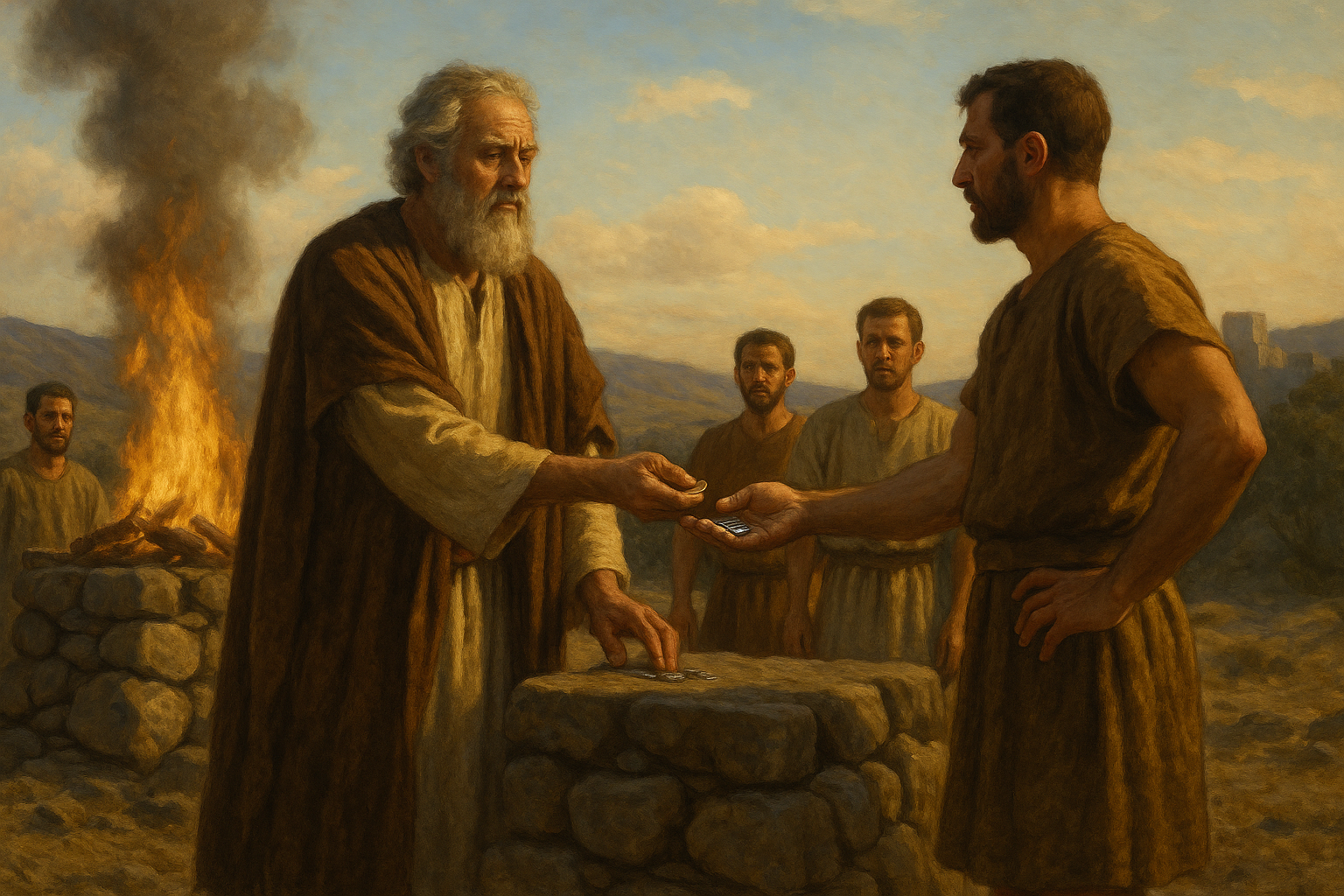
Gad instructed David to erect an altar unto the Lord at Araunah’s threshingfloor. David obeyed.
Araunah offered the threshingfloor, oxen, and implements for the sacrifice. David refused to receive them without payment:
“Neither will I offer burnt offerings unto the LORD my God of that which doth cost me nothing.”
2 Samuel 24:24
David bought the threshingfloor and the oxen for fifty shekels of silver. He built an altar and offered burnt offerings and peace offerings.
The book closes with God’s gracious response:
“So the LORD was intreated for the land, and the plague was stayed from Israel.”
2 Samuel 24:25
The parallel account calls the owner Ornan. Second Chronicles 3:1 explicitly identifies the threshingfloor of Ornan the Jebusite as the location where Solomon began building the house of the Lord in Jerusalem, on Mount Moriah. This connection is stated in Scripture rather than supplied by tradition.
Key People and Places
- David: King of Israel, speaker of the inspired declaration in chapter 23, and the king who confessed his sin concerning the census in chapter 24.
- Adino the Eznite: A mighty man associated with slaying eight hundred at one time.
- Eleazar the son of Dodo: A warrior who stood against the Philistines when the men of Israel had gone away.
- Shammah the son of Agee: The man who defended the field of lentils.
- The three unnamed mighty men: The men who risked their lives to bring David water from Bethlehem.
- Abishai: Joab’s brother, honored for his courage and military deeds.
- Benaiah the son of Jehoiada: A valiant warrior whom David placed over his guard.
- Uriah the Hittite: A named member of David’s mighty men and the man whose death David arranged in 2 Samuel 11.
- Joab: The military commander who objected to the census but carried out David’s order.
- Gad: The prophet and David’s seer who delivered God’s messages concerning judgment and the altar.
- Araunah the Jebusite: Owner of the threshingfloor David purchased; called Ornan in the parallel account.
- Adullam: The location of the cave where three chief men came to David.
- Bethlehem: The town whose well David longed to drink from while a Philistine garrison was there.
- The valley of Rephaim: The location of the Philistine encampment during the account of the water.
- Dan and Beersheba: Locations used to describe the extent of the numbering and the pestilence.
- Jerusalem: The city toward which the destroying angel stretched out his hand before the Lord restrained him.
- Araunah’s threshingfloor: The location of David’s altar, connected explicitly with the temple site in 2 Chronicles 3:1.
Main Doctrinal or Spiritual Themes
The Holy Spirit Speaks Through Scripture
David explicitly testified that the Spirit of the Lord spoke by him (2 Samuel 23:2). This agrees with the declaration that “holy men of God spake as they were moved by the Holy Ghost” (2 Peter 1:21).
Biblical authority rests upon God’s revelation. Human teaching must remain subject to what He has written.
Authority Requires Justice and the Fear of God
The ruler must be just and must rule in the fear of God (2 Samuel 23:3). Position does not place a person above moral accountability.
David’s own failure in chapter 24 demonstrates that royal authority did not make his decisions righteous.
God’s Covenant Is Sure, and Sin Still Matters
David called God’s covenant “ordered in all things, and sure” (2 Samuel 23:5). Yet God’s covenant with David also included chastening for iniquity (2 Samuel 7:14-15).
God’s faithfulness gives His people reason to trust Him. It gives them no permission to disregard His commands.
The Lord Deserves the Glory for Victory
Eleazar and Shammah fought courageously, but the Lord wrought the victories (2 Samuel 23:10, 12).
The text honors faithful service without making human ability the ultimate explanation for success.
Confession Does Not Make Sin’s Consequences Imaginary
David confessed his sin before Gad announced the alternatives of judgment (2 Samuel 24:10-13). His confession was necessary, but the account still records severe consequences.
The Lord’s forgiveness and His discipline must not be treated as contradictory. Hebrews 12:6 teaches, “For whom the Lord loveth he chasteneth.”
God’s Mercy Is the Sinner’s Hope
David appealed to God’s great mercies, and the Lord restrained the destruction (2 Samuel 24:14-16).
Mercy does not mean that sin is harmless. It means that hope rests in the character and compassion of God rather than in human deserving.
Worship Includes Obedience and Willing Sacrifice
David obeyed the instruction to build an altar and insisted upon paying for what he offered (2 Samuel 24:18-25).
This passage does not teach that money purchases forgiveness. Salvation is God’s gift, “not of works” (Ephesians 2:8-9). David’s payment demonstrates his refusal to make an offering entirely at another person’s expense.
Practical Applications or Lessons
Exercise responsibility in the fear of God. Whether serving in a home, church, ministry, or workplace, apply the standard of justice stated in 2 Samuel 23:3. Authority should lead to greater care about obedience.
Give God the credit for fruitful service. The mighty men acted courageously, yet the Lord gave the victories. Work faithfully while remembering that strength and success do not make anyone independent of God.
Treat people’s lives and service as precious. The men who brought the water endangered themselves. David’s response may suggest a valuable leadership lesson: personal desires should never make us careless about the sacrifices others make.
Receive correction instead of insisting upon your own way. Joab objected, but David’s word prevailed. Before pressing ahead with a decision, examine whether the objection exposes a moral problem that needs attention.
Confess sin plainly. David said, “I have sinned greatly” and “I have done very foolishly.” Genuine confession identifies personal wrongdoing instead of hiding behind circumstances or other people.
Remember that personal decisions can affect others. The census account records consequences reaching far beyond David himself. This calls for humility and caution, especially among those entrusted with leadership.
Seek God’s mercy without minimizing His holiness. David acknowledged guilt and appealed to the Lord’s compassion. Believers should likewise approach God with honest repentance and confidence in His revealed mercy.
Give willingly in worship and service. David would not offer what cost him nothing. The application is willing devotion, not a required financial amount or an attempt to earn God’s favor.
Place confidence in God’s promises rather than personal achievement. These chapters record remarkable victories alongside serious failure. David’s stated hope was God’s sure covenant. For the believer, confidence belongs in the Lord Jesus Christ, whom Scripture identifies as the promised King whose kingdom shall have no end (Luke 1:32-33).
Comments are closed