2 Samuel 14-16: Absalom’s Rebellion and David’s Humbling
Chapter Summaries
2 Samuel 14: Absalom Returns, but Serious Problems Remain
 The chapter opens with Joab perceiving that “the king’s heart was toward Absalom” (2 Samuel 14:1). Absalom had fled to Geshur after arranging the death of his brother Amnon, who had violated their sister Tamar (2 Samuel 13:14, 28-29, 37-38). David’s affection for Absalom forms the background for Joab’s intervention.
Joab brings a wise woman from Tekoah and instructs her to present a carefully prepared appeal. She describes herself as a widow whose two sons fought, leaving one dead. According to her account, the family now demands the surviving son’s execution, which would extinguish her husband’s remaining name and family line. This is a story Joab directed her to tell, not an independently established account of her household (2 Samuel 14:2-7).
David promises protection for her son. The woman then turns the appeal toward David’s own situation, asking why he has not brought home his banished son. Her argument includes these memorable words:
“For we must needs die, and are as water spilt on the ground, which cannot be gathered up again” (2 Samuel 14:14).
She also says that God “doth devise means, that his banished be not expelled from him.” These words belong to her appeal. They should not be treated as a declaration that God overlooks guilt or restores every person regardless of repentance and faith. Scripture elsewhere expressly joins God’s mercy with His righteousness. Through Jesus Christ, God is “just, and the justifier of him which believeth in Jesus” (Romans 3:26).
David recognizes Joab’s involvement and authorizes him to bring Absalom back. However, David initially commands:
“Let him turn to his own house, and let him not see my face” (2 Samuel 14:24).
Absalom returns to Jerusalem but remains two full years without seeing the king (2 Samuel 14:28). His physical return does not immediately include access to David.
The narrative emphasizes Absalom’s appearance. No man in Israel was praised more highly for beauty, and “from the sole of his foot even to the crown of his head there was no blemish in him” (2 Samuel 14:25). His hair was heavy enough that he cut and weighed it at the end of every year. He also had three sons and a beautiful daughter named Tamar (2 Samuel 14:26-27). These details describe his appearance and household; they do not establish godly character.
When Joab twice refuses to come at Absalom’s request, Absalom orders his servants to burn Joab’s barley field. Joab then comes, and Absalom demands an audience with David. He declares that if there is iniquity in him, the king should kill him (2 Samuel 14:28-32).
The chapter ends with Absalom bowing before David and the king kissing him (2 Samuel 14:33). Scripture records this reception, but it does not record Absalom confessing his murder of Amnon or expressing repentance. The king’s kiss should not be made to prove a spiritual change that the text does not state.
2 Samuel 15: Absalom Steals the Hearts of Israel
Absalom next prepares chariots, horses, and fifty men to run before him. He rises early and stands beside the way of the gate, speaking to people who come to the king for judgment (2 Samuel 15:1-2).
He tells each petitioner that his case is good and right, while claiming that the king has appointed no one to hear him. This is Absalom’s representation of the situation; the passage does not independently confirm that David had provided no judicial assistance. Absalom then promotes himself:
“Oh that I were made judge in the land, that every man which hath any suit or cause might come unto me, and I would do him justice!” (2 Samuel 15:4).
When someone approaches to bow before him, Absalom takes him and kisses him. The inspired account plainly states the result:
“So Absalom stole the hearts of the men of Israel” (2 Samuel 15:6).
His conduct illustrates how personal attention and promises can be used to draw allegiance away from rightful authority.
The KJV states, “And it came to pass after forty years,” before recording Absalom’s request to go to Hebron (2 Samuel 15:7). The verse does not explicitly identify the starting point of that period. There is no need to replace its wording or supply an unsupported chronology.
Absalom tells David that he must fulfill a vow made while he was in Geshur. David permits him to go in peace. Meanwhile, Absalom sends spies throughout Israel with instructions to announce his reign in Hebron when the trumpet sounds (2 Samuel 15:7-10).
Two hundred invited men accompany him from Jerusalem, but Scripture carefully protects them from an accusation of knowing participation:
“And they went in their simplicity, and they knew not any thing” (2 Samuel 15:11).
Absalom also summons Ahithophel, David’s counselor. The conspiracy grows stronger, and a messenger tells David that the hearts of the men of Israel are after Absalom (2 Samuel 15:12-13).
David chooses to flee Jerusalem. His stated concerns include being overtaken and having the city struck with the sword (2 Samuel 15:14). His departure is therefore presented as a deliberate response to danger, not merely an unexplained loss of courage.
Ittai the Gittite provides a striking contrast to Absalom. Although David offers him freedom to remain, Ittai declares:
“Surely in what place my lord the king shall be, whether in death or life, even there also will thy servant be” (2 Samuel 15:21).
As David’s company passes over the brook Kidron toward the wilderness, the country weeps. Zadok and the Levites bring the ark, but David instructs them to return it to Jerusalem. He does not make possession of the ark a guarantee of victory. Instead, he places his future in God’s hands:
“Behold, here am I, let him do to me as seemeth good unto him” (2 Samuel 15:26).
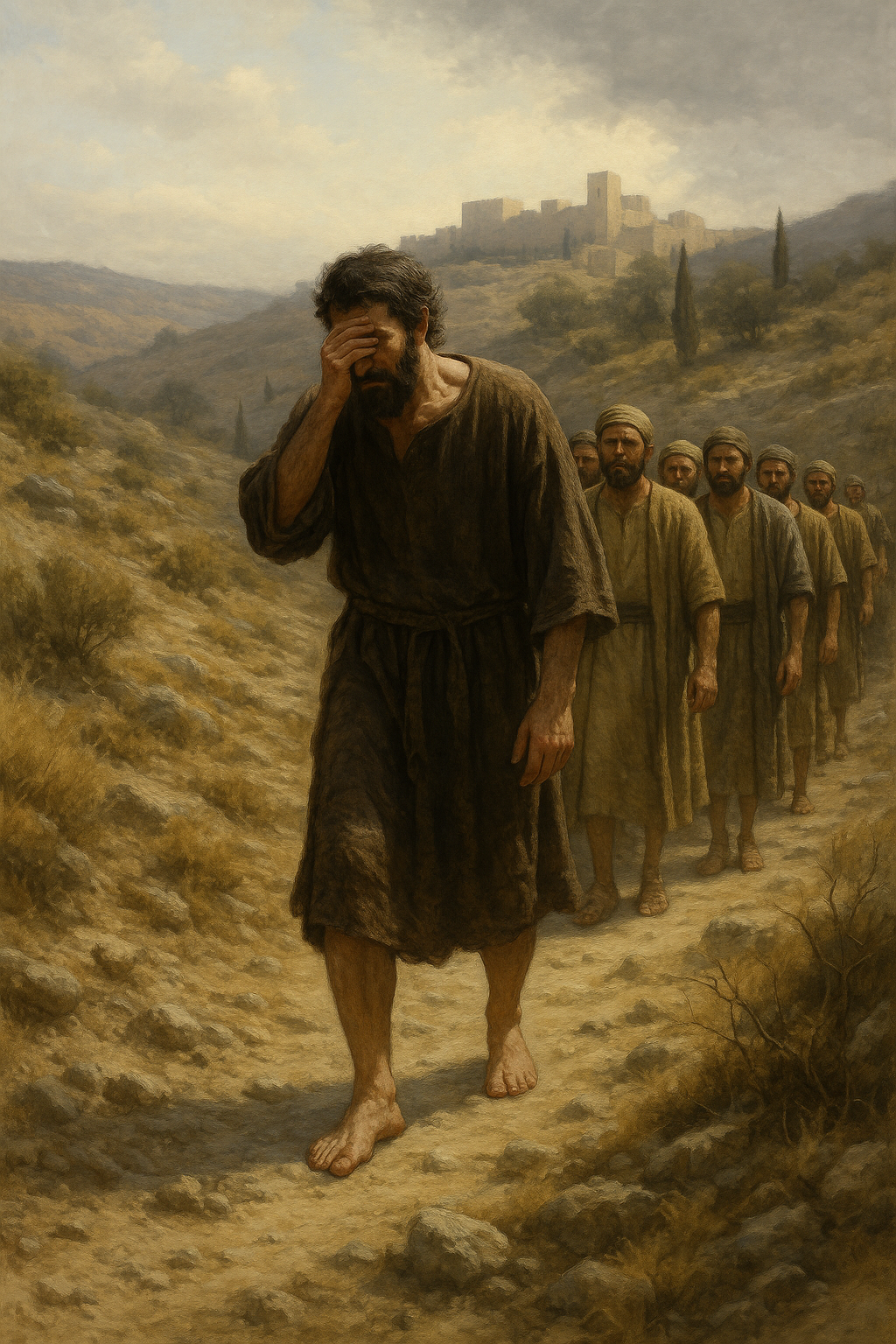
David ascends the mount of Olives weeping, barefoot, and with his head covered. Those with him also weep. When he hears that Ahithophel has joined the conspiracy, he prays:
“O LORD, I pray thee, turn the counsel of Ahithophel into foolishness” (2 Samuel 15:31).
David also takes practical action. He sends Hushai back to Jerusalem to counter Ahithophel’s counsel and establishes communication through Zadok, Abiathar, and their sons (2 Samuel 15:32-37). Prayer and responsible action appear together.
2 Samuel 16: Accusation, Cursing, and Wicked Counsel
Beyond the summit, Ziba meets David with asses, bread, raisins, summer fruits, and wine. He explains that these provisions are intended for the king’s household and those growing faint in the wilderness (2 Samuel 16:1-2).
When David asks about Mephibosheth, Ziba claims that his master has remained in Jerusalem expecting Israel to restore his father’s kingdom. David then grants Ziba everything belonging to Mephibosheth (2 Samuel 16:3-4).
The wording must be handled carefully: this chapter records Ziba’s accusation, not independent proof of Mephibosheth’s intentions. In 2 Samuel 19:24-30, Mephibosheth gives a conflicting account and says that Ziba slandered him. Readers should not present the charge in chapter 16 as an established fact about Mephibosheth.
At Bahurim, Shimei, a man of Saul’s family, comes out cursing David and throwing stones. He calls David a bloody man and attributes his troubles to bloodshed against Saul’s house (2 Samuel 16:5-8).
Shimei’s accusation is also a speaker’s claim, not God’s explanation of events. David had refused to kill Saul and had condemned the murder of Saul’s son Ish-bosheth (1 Samuel 24:6; 26:9-11; 2 Samuel 4:9-12). Although David was guilty of arranging Uriah’s death, that guilt does not validate every charge Shimei makes.
Abishai asks permission to kill Shimei. David refuses. He speaks of the LORD having bidden Shimei to curse and accepts the humiliation without authorizing retaliation. The narrative does not record a separate divine command delivered to Shimei; it records David’s words as he submits to the affliction (2 Samuel 16:9-11).
David then expresses hope:
“It may be that the LORD will look on mine affliction, and that the LORD will requite me good for his cursing this day” (2 Samuel 16:12).
“It may be” matters. David voices a hope in God’s mercy, not a claim that he has received a promise about the immediate outcome.
Meanwhile, Absalom enters Jerusalem with Ahithophel. Hushai meets him and presents himself as willing to serve. Readers know from the preceding chapter that David has sent Hushai to defeat Ahithophel’s counsel (2 Samuel 15:34; 16:15-19).
Ahithophel advises Absalom to commit a public sexual offense involving David’s concubines, whom David had left to keep the house. His stated purpose is to make Absalom’s breach with David unmistakable and strengthen the hands of his supporters. Absalom follows this wicked counsel (2 Samuel 16:20-22).
This public humiliation corresponds to Nathan’s earlier announcement of judgment upon David’s household (2 Samuel 12:11-12). God’s announced judgment does not make Absalom’s conduct righteous or remove his responsibility.
The chapter ends by describing the extraordinary authority Ahithophel’s counsel carried with both David and Absalom (2 Samuel 16:23). That reputation did not make his advice morally sound.
Key People and Places
People
- David: King of Israel and father of Absalom. These chapters record his reception of Absalom, flight from Jerusalem, prayer, and submission under affliction.
- Absalom: David’s son, who returns from Geshur, wins popular support, and organizes rebellion against his father.
- Joab: The man who arranges the woman of Tekoah’s appeal and brings Absalom back to Jerusalem.
- The woman of Tekoah: A wise woman instructed by Joab to present a story designed to influence David.
- Tamar: Absalom’s daughter, described as beautiful in 2 Samuel 14:27. She is distinct from Absalom’s sister Tamar in chapter 13.
- Ittai the Gittite: A follower who pledges to remain with David in life or death.
- Zadok and Abiathar: Priests whom David sends back to Jerusalem with the ark.
- Ahimaaz and Jonathan: Sons of Zadok and Abiathar, respectively, designated to carry information to David.
- Hushai the Archite: David’s friend, sent into Jerusalem to counter Ahithophel’s counsel.
- Ahithophel the Gilonite: David’s counselor who joins Absalom and supplies wicked advice.
- Ziba: Mephibosheth’s servant, who brings supplies and accuses his master.
- Mephibosheth: Jonathan’s son, whose loyalty Ziba challenges.
- Shimei: A man of Saul’s family who curses David and throws stones.
- Abishai: Joab’s brother, who asks permission to kill Shimei.
Places
- Tekoah: The home of the woman Joab recruits.
- Geshur: The place where Absalom had taken refuge.
- Jerusalem: David’s royal city, which he leaves and Absalom enters.
- Hebron: The location where Absalom launches the public announcement of his kingship.
- Giloh: Ahithophel’s city.
- The brook Kidron: The brook David and his followers cross during their departure.
- The mount of Olives: The ascent where David and his company weep.
- Bahurim: The place where Shimei confronts David.
- The wilderness: The direction of David’s flight from Jerusalem.
Main Doctrinal or Spiritual Themes
1. Forgiveness Does Not Remove Every Earthly Consequence
Nathan had told David, “The LORD also hath put away thy sin; thou shalt not die” (2 Samuel 12:13). Nevertheless, Nathan also announced continuing trouble within David’s house (2 Samuel 12:10-12).
These chapters must be read with both truths intact. God’s forgiveness is real, and sin can still bring grievous earthly consequences. Those consequences do not mean that God’s forgiveness was incomplete.
2. Outward Beauty and Popularity Do Not Establish Godliness
Absalom possesses remarkable beauty and wins the affection of many people, yet the text explicitly identifies his conspiracy and rebellion. Appearance, charm, and public approval are inadequate measures of spiritual character.
The governing principle is clear elsewhere in David’s history: “Man looketh on the outward appearance, but the LORD looketh on the heart” (1 Samuel 16:7).
3. Religious Language Can Accompany Wrongdoing
Absalom speaks of a vow and service to the LORD while preparing his rebellion (2 Samuel 15:7-12). His conduct warns readers that religious claims must be considered alongside actual obedience.
The passage does not condemn vows or worship. It exposes a conspiracy carried forward while its leader uses religious language.
4. Faith Submits to God’s Will
David desires restoration to Jerusalem, but he does not demand it as his right. His words concerning the ark express willingness to accept God’s decision (2 Samuel 15:25-26).
Faith can ask earnestly for deliverance while acknowledging that the Lord has authority over the outcome.
5. Human Counsel Must Be Tested by God’s Word
Ahithophel’s advice carried exceptional weight, but his counsel in chapter 16 promoted wickedness. Expertise, influence, and reputation cannot turn sin into righteousness.
The moral character of counsel matters more than the prestige of the counselor.
6. God’s Judgment Does Not Excuse Human Sin
Nathan’s prophecy and Absalom’s actions must both be acknowledged. God announced judgment upon David’s house; Absalom nevertheless acted wickedly.
God’s holiness must never be confused with approval of the evil conduct through which an announced judgment unfolds. “Neither tempteth he any man” remains the plain teaching of Scripture (James 1:13).
Practical Applications or Lessons
Deal Honestly With Sin in Family Relationships
David receives Absalom, but the account does not record a confession from Absalom. This distinction reminds believers not to assume that renewed contact or affectionate gestures necessarily establish repentance.
Love should seek restoration while taking truth and wrongdoing seriously.
Beware of Flattery That Cultivates Personal Allegiance
Absalom makes petitioners feel understood while presenting himself as the answer to their grievances. His example calls for discernment when someone builds influence through constant assurances and criticism of others.
Evaluate conduct, truthfulness, and obedience to Scripture.
Hear Carefully Before Reaching a Verdict
David makes a substantial decision after hearing Ziba’s accusation. Mephibosheth’s subsequent conflicting account demonstrates why the first report should not automatically settle a matter.
“He that answereth a matter before he heareth it, it is folly and shame unto him” (Proverbs 18:13).
Refuse Personal Revenge
David does not allow Abishai to kill Shimei in response to his insults. Believers likewise must guard against allowing wounded pride to govern their response.
“Dearly beloved, avenge not yourselves, but rather give place unto wrath” (Romans 12:19).
Combine Prayer With Responsible Action
David prays against Ahithophel’s counsel and then gives Hushai a practical assignment. His example supports praying sincerely while using available, appropriate means to address a problem.
Dependence on God does not require inactivity.
Be Faithful When Loyalty Becomes Costly
Ittai remains with David when David is leaving Jerusalem under threat. His declared willingness to share either life or death offers a clear example of steadfast loyalty.
Believers should value faithfulness that endures hardship rather than measuring relationships only by their immediate benefits.
Bring Grief Before the Lord
David weeps, walks barefoot, and prays. The passage records sorrow alongside dependence upon God.
A believer’s tears do not by themselves prove an absence of faith. In affliction, we can acknowledge pain honestly while continuing to seek the Lord.
Comments are closed