
 Zechariah 11–14 moves from Israel’s rejection of the true Shepherd, to the future repentance of Jerusalem, to the final conflict of the nations against Israel, and finally to the glorious reign of the LORD as King over all the earth. These chapters contain some of the clearest prophetic passages concerning the rejection of Christ, the betrayal price of “thirty pieces of silver,” Israel’s future mourning over the pierced Messiah, the cleansing fountain for sin, the smiting of the Shepherd, the preservation of a remnant, and the visible coming of the LORD to the Mount of Olives.
From a conservative Baptist perspective, these chapters should be read as real prophecy with both fulfilled and future elements. Some parts were fulfilled in the first coming of Christ, especially His rejection and betrayal. Other parts await future fulfillment, especially Israel’s national repentance, the defense of Jerusalem, the return of Christ, and the kingdom reign described in Zechariah 14.
Chapter Summaries
Zechariah 11 — The Rejected Shepherd and the Foolish Shepherd
Zechariah 11 begins with a prophetic picture of judgment: “Open thy doors, O Lebanon, that the fire may devour thy cedars” (Zechariah 11:1). The imagery of Lebanon, Bashan, and Jordan shows devastation sweeping through the land. The “howl” of the shepherds and young lions points to national ruin, especially judgment upon leaders who failed to care for the flock.
The prophet is then commanded, “Feed the flock of the slaughter” (Zechariah 11:4). The people are pictured as sheep being exploited by their possessors and shepherds. Their leaders do not pity them. This shows the tragic spiritual condition of Israel under corrupt leadership.
Zechariah takes two staffs: “the one I called Beauty, and the other I called Bands” (Zechariah 11:7). “Beauty” speaks of God’s gracious favor and covenant care; “Bands” speaks of unity, especially the brotherhood between Judah and Israel. The breaking of these staffs pictures the removal of favor and unity because of rejection and unbelief.
The key Messianic prophecy appears when the Shepherd says, “If ye think good, give me my price; and if not, forbear” (Zechariah 11:12). They weigh for His price “thirty pieces of silver.” The LORD then says, “Cast it unto the potter: a goodly price that I was prised at of them” (Zechariah 11:13). This is fulfilled in the betrayal of the Lord Jesus Christ by Judas Iscariot for thirty pieces of silver, and the money being connected with the potter’s field (Matthew 26:15; 27:3–10).
The chapter closes with the rise of a “foolish shepherd” (Zechariah 11:15). Unlike the true Shepherd, this false shepherd will not care for the lost, the young, the broken, or the needy. He will devour the flock. This points generally to wicked spiritual leadership and prophetically toward the final false ruler associated with the end times, often identified by conservative interpreters with the Antichrist.
Doctrinal flow: Israel rejects the true Shepherd; God removes favor and unity; false leadership follows; judgment comes upon the worthless shepherd.
Zechariah 12 — Jerusalem Besieged, Defended, and Brought to Repentance
Zechariah 12 opens with a majestic statement of God’s sovereign authority: “The burden of the word of the LORD for Israel” (Zechariah 12:1). The LORD is identified as the One “which stretcheth forth the heavens, and layeth the foundation of the earth, and formeth the spirit of man within him.” This establishes God’s right to judge, restore, and rule.
The central focus is Jerusalem. God says, “I will make Jerusalem a cup of trembling unto all the people round about” (Zechariah 12:2). The nations will gather against Jerusalem, but the city will become “a burdensome stone for all people” (Zechariah 12:3). Those who burden themselves with it will be cut in pieces.
This chapter looks beyond Zechariah’s immediate day to a future siege of Jerusalem. The LORD promises to defend Judah and Jerusalem. The governors of Judah will say, “The inhabitants of Jerusalem shall be my strength in the LORD of hosts their God” (Zechariah 12:5). God will make the leaders of Judah like “an hearth of fire among the wood” and “a torch of fire in a sheaf” (Zechariah 12:6).
The greatest moment in the chapter is spiritual, not merely military. God says, “I will pour upon the house of David, and upon the inhabitants of Jerusalem, the spirit of grace and of supplications” (Zechariah 12:10). Then comes the remarkable prophecy: “they shall look upon me whom they have pierced, and they shall mourn for him.” This points to the crucified Messiah, the Lord Jesus Christ. John 19:37 connects this prophecy directly to Christ: “They shall look on him whom they pierced.”
The mourning will be deep and personal. It is compared to the mourning for an only son and for a firstborn. Families will mourn separately: the house of David, Nathan, Levi, Shimei, and others. This shows personal conviction, national repentance, and recognition of the rejected Messiah.
Doctrinal flow: God preserves Jerusalem, defeats hostile nations, and brings Israel to repentance by opening their eyes to the pierced Messiah.
Zechariah 13 — The Fountain, False Prophets Removed, and the Shepherd Smitten
Zechariah 13 continues the repentance theme: “In that day there shall be a fountain opened to the house of David and to the inhabitants of Jerusalem for sin and for uncleanness” (Zechariah 13:1). This fountain points to cleansing from sin. From a New Testament standpoint, it harmonizes with the cleansing power of the blood of Christ. Israel’s future cleansing is not by works, ritual, or national privilege, but by God’s gracious provision.
The chapter also describes the removal of idols and false prophets: “I will cut off the names of the idols out of the land” (Zechariah 13:2). False prophecy will be so hated that even close family members will reject the false prophet. This is a picture of thorough spiritual purging. When God restores His people, He does not merely rescue them from outward enemies; He cleanses them from inward corruption.
Verses 4–6 describe the shame of false prophets. They will no longer wear the rough garment to deceive. One says, “I am no prophet, I am an husbandman” (Zechariah 13:5). The statement about wounds “in thine hands” has been interpreted various ways. In context, it most directly relates to the marks or wounds associated with false prophetic practices or discipline. Some have made a devotional application to Christ, but the immediate context is false prophecy.
The most important Messianic prophecy in the chapter is Zechariah 13:7: “Awake, O sword, against my shepherd, and against the man that is my fellow, saith the LORD of hosts.” This is a powerful statement of Christ’s deity and suffering. The Shepherd is called “my fellow,” indicating equality and closeness with the LORD. The verse continues, “smite the shepherd, and the sheep shall be scattered.” The Lord Jesus directly applied this to Himself and His disciples in Matthew 26:31 and Mark 14:27.
The chapter ends with refining judgment: “I will bring the third part through the fire, and will refine them as silver is refined” (Zechariah 13:9). A remnant will be purified. God will say, “It is my people,” and they shall say, “The LORD is my God.” This is covenant restoration language. Judgment does not destroy God’s promises; it purifies the remnant that will receive them.
Doctrinal flow: God opens cleansing for sin, removes idolatry and false prophecy, smites the Shepherd according to His redemptive plan, and refines a faithful remnant.
Zechariah 14 — The LORD Comes, Reigns, and Holiness Fills the Earth
Zechariah 14 looks to “the day of the LORD” (Zechariah 14:1). Jerusalem is attacked: “I will gather all nations against Jerusalem to battle” (Zechariah 14:2). The city suffers terribly; houses are rifled, women ravished, and half the city goes into captivity. Yet this is not the end.
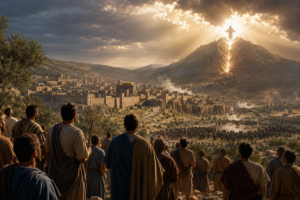
Then comes divine intervention: “Then shall the LORD go forth, and fight against those nations” (Zechariah 14:3). Verse 4 gives one of the clearest statements of the visible return of the LORD to earth: “And his feet shall stand in that day upon the mount of Olives, which is before Jerusalem on the east.” The Mount of Olives will split, creating a great valley. This passage is especially significant because Jesus ascended from the Mount of Olives, and Acts 1:11–12 says He will return in like manner.
The LORD comes with His saints: “and the LORD my God shall come, and all the saints with thee” (Zechariah 14:5). The chapter then describes unusual cosmic and earthly changes: “it shall come to pass, that at evening time it shall be light” (Zechariah 14:7). Living waters will go out from Jerusalem, half toward the former sea and half toward the hinder sea (Zechariah 14:8). This shows life, blessing, and restoration flowing from the place where God establishes His rule.
The great kingdom statement is Zechariah 14:9: “And the LORD shall be king over all the earth: in that day shall there be one LORD, and his name one.” This is not merely a private spiritual reign in the hearts of believers. It points to the open, visible, universal reign of the LORD.
The chapter also describes judgment on the nations that fought against Jerusalem. A plague consumes them, and confusion falls upon them. The enemies of God are overthrown.
The surviving nations will come up “from year to year to worship the King, the LORD of hosts, and to keep the feast of tabernacles” (Zechariah 14:16). Those who refuse will receive no rain. Egypt is specifically mentioned, showing that the nations will be accountable to the King.
The chapter ends with holiness everywhere. “HOLINESS UNTO THE LORD” will be upon the bells of the horses (Zechariah 14:20). Even common vessels will be holy. There will be no more “the Canaanite in the house of the LORD of hosts” (Zechariah 14:21), meaning uncleanness, trafficking, and profane intrusion will be removed from worship.
Doctrinal flow: The nations gather against Jerusalem; the LORD returns to the Mount of Olives; He judges His enemies; He reigns over all the earth; holiness fills the kingdom.
Key People and Places
The LORD of Hosts
The central Person of these chapters is the LORD Himself. He judges false shepherds, defends Jerusalem, pours out grace, opens the fountain for cleansing, smites the Shepherd, returns to the Mount of Olives, and reigns as King over all the earth.
The True Shepherd
The true Shepherd is rejected and valued at “thirty pieces of silver” (Zechariah 11:12–13). This points prophetically to the Lord Jesus Christ, betrayed for that amount. He is also the Shepherd smitten in Zechariah 13:7, which Jesus applied to Himself.
The Foolish Shepherd
The foolish shepherd of Zechariah 11 pictures wicked leadership that exploits the flock instead of caring for it. Prophetically, he points toward the final false ruler who will deceive and devour rather than shepherd.
The House of David
The house of David appears in Zechariah 12 and 13. It represents the royal line and the people of Jerusalem who will mourn over the pierced Messiah and receive cleansing.
The Inhabitants of Jerusalem
Jerusalem’s inhabitants are central in chapters 12–14. They suffer siege, receive grace, mourn in repentance, are cleansed, and are defended by the LORD.
Judah
Judah is connected with Jerusalem in the final conflict. God strengthens Judah and uses Judah in judgment against the nations.
The Nations
The nations gather against Jerusalem in Zechariah 12 and 14. They represent hostile Gentile powers opposed to God’s covenant people and God’s Messiah. They are defeated by the LORD.
Lebanon
Lebanon is mentioned in Zechariah 11:1 as part of the imagery of judgment. Its cedars picture strength and glory brought low.
Bashan
Bashan is known for strong oaks and fertile land. In Zechariah 11:2, it is included in the lament of judgment.
Jordan
The “pride of Jordan” in Zechariah 11:3 likely refers to the lush thickets and strong places near the Jordan River, pictured as being spoiled.
Jerusalem
Jerusalem is the prophetic center of these chapters. It becomes a “cup of trembling,” a “burdensome stone,” the place of mourning, the place of cleansing, the place of siege, and finally the center of the LORD’s kingdom reign.
Mount of Olives
The Mount of Olives is where the LORD’s feet stand in Zechariah 14:4. It is east of Jerusalem and becomes the site of dramatic divine intervention when the mountain splits.
Egypt
Egypt is mentioned among the nations that must come to worship the King and keep the feast of tabernacles. If Egypt refuses, it will receive judgment.
Main Doctrinal or Spiritual Themes
1. Christ as the Rejected Shepherd
Zechariah 11 clearly points to the rejection of the true Shepherd. The thirty pieces of silver show the contempt of sinful men toward the Messiah. Christ came unto His own, and His own received Him not. The betrayal price reveals the hardness of man’s heart and the humility of Christ’s suffering.
2. The Sovereignty of God Over Nations
These chapters show God ruling over Israel, Jerusalem, and the Gentile nations. The nations may gather in rage, but they cannot overthrow God’s plan. Jerusalem becomes a burdensome stone because God Himself has chosen to defend it.
3. Israel’s Future Repentance
Zechariah 12:10 teaches that God will pour out “the spirit of grace and of supplications.” Repentance is not manufactured by human effort. It comes through God’s gracious work upon the heart. Israel will look upon the pierced Messiah and mourn.
4. Cleansing From Sin
Zechariah 13:1 speaks of a fountain opened “for sin and for uncleanness.” This points to the only true answer to man’s defilement: God’s cleansing provision. Sin must be washed, not excused.
5. Judgment Against False Religion
Zechariah 13 shows idols and false prophets removed. God’s restoration includes doctrinal purity. False worship is not a harmless difference of opinion; it is corruption that must be judged and removed.
6. The Deity and Suffering of Christ
Zechariah 13:7 calls the Shepherd “the man that is my fellow.” This fits the New Testament revelation of Christ as both truly man and truly God. The sword falls upon the Shepherd, and the sheep are scattered. Christ’s suffering was not an accident; it was part of God’s redemptive purpose.
7. The Preservation of a Remnant
The refining of the third part in Zechariah 13:9 shows that God preserves a people through judgment. The remnant is purified, brought into covenant fellowship, and made to confess, “The LORD is my God.”
8. The Visible Return and Reign of the LORD
Zechariah 14 teaches the visible intervention of the LORD at the Mount of Olives. The final result is not defeat but kingdom victory: “the LORD shall be king over all the earth.”
9. Holiness in the Kingdom
The closing scene of Zechariah shows holiness extending even to ordinary things. “HOLINESS UNTO THE LORD” is not limited to temple vessels but marks daily life. God’s kingdom is holy from worship to work.
Practical Applications or Lessons
1. Do Not Despise the True Shepherd
Israel’s leaders and people valued the Shepherd at thirty pieces of silver. That is a warning to every heart. A person may be religious and still undervalue Christ. The believer must give Christ the preeminence in affection, obedience, worship, and service.
2. Bad Leadership Destroys the Flock
The foolish shepherd does not feed, heal, seek, or care for the sheep. Churches, homes, and ministries need shepherd-hearted leadership. A true spiritual leader does not use people; he serves them under the authority of Christ.
3. God Notices How Men Treat His People and His City
The nations gather against Jerusalem, but God does not ignore it. He sees pride, cruelty, and rebellion. No nation is strong enough to fight against God and win.
4. Repentance Is Personal
Zechariah 12 describes families mourning apart. True repentance is not merely national, public, or ceremonial. Each heart must face its own sin before God. Conviction cannot be delegated.
5. Sin Requires Cleansing, Not Covering
The fountain of Zechariah 13:1 teaches that sin and uncleanness must be dealt with God’s way. Men often try reform, excuses, religion, or denial. God provides cleansing.
6. False Doctrine Must Be Rejected
Zechariah 13 gives no soft treatment to false prophets. God’s people should love truth, test teaching by Scripture, and refuse spiritual deception.
7. God Refines His People Through Trial
The remnant is brought “through the fire.” Trials do not always mean abandonment. Sometimes they are the refining hand of God, purging dross and strengthening faith.
8. Christ’s Suffering Was According to God’s Plan
The Shepherd was smitten, and the sheep were scattered. The cross was not a failure of God’s program. It was the center of redemption. The believer can rest in the wisdom of God even when events appear dark.
9. The Lord Will Have the Final Word
Zechariah 14 reminds believers that history does not end with the nations raging. It ends with the LORD reigning. The final kingdom belongs to Christ, not to rebels, armies, politicians, or false shepherds.
10. Holiness Should Mark All of Life
The last verses of Zechariah show holiness on common things. The lesson for believers today is clear: God is not only interested in church services. He desires holiness in speech, business, family, habits, worship, and private life.
Conservative Baptist Emphasis
Zechariah 11–14 should strengthen confidence in the literal promises of God, the certainty of fulfilled prophecy, the centrality of Christ, and the future kingdom reign of the Lord. These chapters show both the suffering and glory of the Messiah. He is the Shepherd sold for thirty pieces of silver, the Shepherd smitten by the sword, the pierced One mourned over by Israel, and the coming King whose feet shall stand upon the Mount of Olives.
The believer should read these chapters with reverence, hope, and sobriety. God judges sin, removes falsehood, purifies His people, keeps His covenants, and will bring all nations under the rule of the Lord Jesus Christ.
Comments are closed