 Zechariah 6–10 moves from prophetic visions to direct messages of rebuke, restoration, Messianic promise, and future national blessing for Israel. These chapters keep a clear distinction between Israel and the Gentile nations, and they look forward to the coming Messiah, the restoration of Zion, and the future kingdom blessings promised to Israel under the LORD’s covenant faithfulness.
Chapter Summaries
Zechariah 6 — The Four Chariots and the Crowning of Joshua
Zechariah 6 opens with the eighth night vision, where the prophet sees “four chariots” coming “from between two mountains; and the mountains were mountains of brass” (Zechariah 6:1). The chariots are connected with “the four spirits of the heavens, which go forth from standing before the Lord of all the earth” (6:5). This shows divine government and judgment going forth under God’s command.
The horses go into various regions, especially “the north country” (6:6), and the LORD says, “Behold, these that go toward the north country have quieted my spirit in the north country” (6:8). This likely points to God’s judgment upon the powers that had oppressed His people, especially Babylon and the northern empires associated with Israel’s trouble.
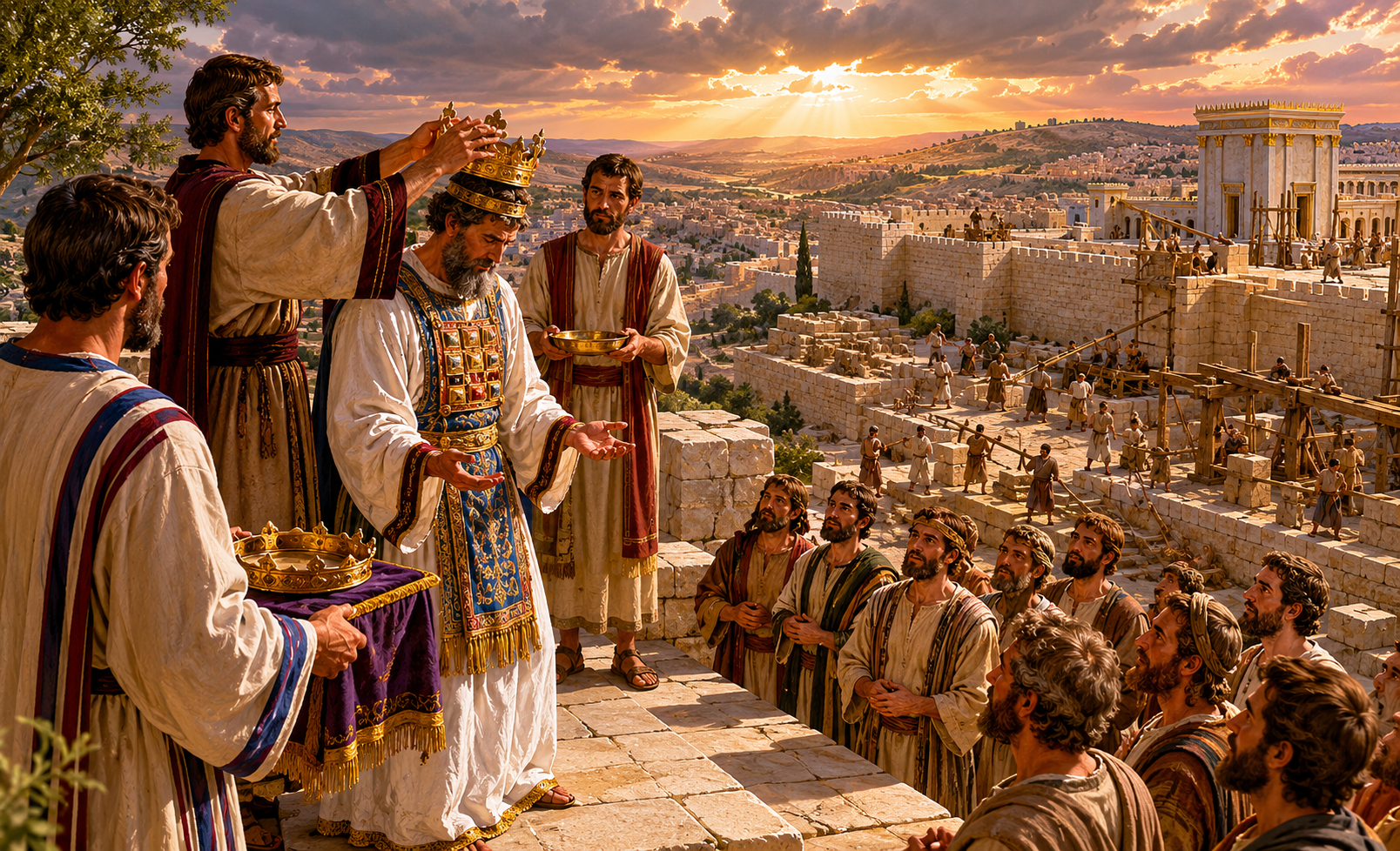
The chapter then shifts to a symbolic prophetic act. Zechariah is commanded to take silver and gold and make crowns, placing them upon the head of Joshua the son of Josedech, the high priest (6:11). This is unusual because Joshua is a priest, not a king. The act points beyond Joshua to the Messiah, called “the BRANCH”:
“Behold the man whose name is The BRANCH; and he shall grow up out of his place, and he shall build the temple of the LORD” (Zechariah 6:12).
This is a strong Messianic prophecy. Christ is both King and Priest. The verse continues, “he shall bear the glory, and shall sit and rule upon his throne; and he shall be a priest upon his throne” (6:13). In the present age, Christ is our great High Priest in heaven; in the coming kingdom, He will reign visibly as King. This agrees with the premillennial hope of Christ’s future reign.
The phrase “the counsel of peace shall be between them both” (6:13) shows no conflict between His priestly and kingly offices. In Christ, redemption and rule are perfectly joined.
Zechariah 7 — Empty Fasting and Disobedient Hearts
Zechariah 7 occurs “in the fourth year of king Darius” (7:1), when men come to ask whether they should continue fasting in the fifth month as they had done during the captivity. The LORD answers by exposing the heart behind their religious practice:
“When ye fasted and mourned in the fifth and seventh month, even those seventy years, did ye at all fast unto me, even to me?” (Zechariah 7:5).
The problem was not fasting itself, but formal religion without obedience. God reminds them of the message preached by the former prophets:
“Execute true judgment, and shew mercy and compassions every man to his brother” (7:9).
They were also told not to oppress “the widow, nor the fatherless, the stranger, nor the poor” (7:10). Yet the people “refused to hearken, and pulled away the shoulder, and stopped their ears, that they should not hear” (7:11).
This chapter gives a solemn explanation for the exile. Their fathers hardened their hearts “as an adamant stone” (7:12), so the LORD scattered them “with a whirlwind among all the nations whom they knew not” (7:14).
The doctrinal lesson is plain: outward religious observance cannot substitute for obedience to the Word of God. God is not impressed by ritual when the heart is rebellious.
Zechariah 8 — The LORD’s Jealous Love for Zion
Zechariah 8 is a chapter of comfort and restoration. The LORD declares:
“I was jealous for Zion with great jealousy, and I was jealous for her with great fury” (Zechariah 8:2).
God’s jealousy here is not sinful envy, but holy covenant zeal for His people and His city. He promises, “I am returned unto Zion, and will dwell in the midst of Jerusalem” (8:3). Jerusalem shall be called “a city of truth,” and “the mountain of the LORD of hosts the holy mountain” (8:3).
The chapter gives beautiful kingdom language. Old men and women shall dwell safely in Jerusalem, and children shall play in the streets (8:4–5). The LORD promises to save His people “from the east country, and from the west country” (8:7), bringing them back to dwell in Jerusalem.
The people are encouraged to strengthen their hands in rebuilding, because God’s purpose toward them has changed from judgment to blessing:
“As I thought to punish you, when your fathers provoked me to wrath… so again have I thought in these days to do well unto Jerusalem and to the house of Judah: fear ye not” (Zechariah 8:14–15).
The chapter also commands practical righteousness: “Speak ye every man the truth to his neighbour” (8:16), and “love no false oath” (8:17).
The fasting question from chapter 7 is answered fully: the fasts of mourning will become “joy and gladness, and cheerful feasts” (8:19). This shows God’s future restoration of Israel.
The chapter ends with Gentile nations seeking the LORD through His work in Israel:
“Ten men shall take hold out of all languages of the nations… saying, We will go with you: for we have heard that God is with you” (Zechariah 8:23).
This is not the Church replacing Israel. It is the nations recognizing God’s covenant blessing upon Israel in the future kingdom.
Zechariah 9 — Judgment on Nations and the Coming King
Zechariah 9 begins with “the burden of the word of the LORD” against surrounding Gentile cities and lands, including Hadrach, Damascus, Hamath, Tyrus, Zidon, Ashkelon, Gaza, Ekron, and others. These were real places and real enemies. God rules not only Israel, but all nations.
Tyrus is described as having “built herself a strong hold” and heaping up silver and gold (9:3), but the LORD says He will cast her out (9:4). Human pride, wealth, and military strength cannot stand before God.
Then comes one of the clearest Messianic prophecies in the Old Testament:
“Rejoice greatly, O daughter of Zion; shout, O daughter of Jerusalem: behold, thy King cometh unto thee: he is just, and having salvation; lowly, and riding upon an ass, and upon a colt the foal of an ass” (Zechariah 9:9).
This was fulfilled in Christ’s first coming when He entered Jerusalem meek and lowly. Yet the surrounding context also looks forward to His future reign, when “his dominion shall be from sea even to sea, and from the river even to the ends of the earth” (9:10).
The chapter also speaks of deliverance through “the blood of thy covenant” (9:11), and calls the prisoners “prisoners of hope” (9:12). God promises to save His people and make them victorious:
“And the LORD their God shall save them in that day as the flock of his people” (Zechariah 9:16).
Zechariah 9 therefore contains both first-coming and second-coming truth: the King comes lowly, but He will also reign universally.
Zechariah 10 — The LORD Regathers and Strengthens His People
Zechariah 10 begins with a call to depend upon the LORD:
“Ask ye of the LORD rain in the time of the latter rain” (Zechariah 10:1).
Rain was essential for Israel’s land and agriculture. Spiritually, the command teaches dependence upon God rather than idols or false religion. The chapter immediately condemns false sources of guidance:
“For the idols have spoken vanity, and the diviners have seen a lie” (10:2).
Because of false shepherds, the people “went their way as a flock” and were “troubled, because there was no shepherd” (10:2). God’s anger is against the shepherds who failed His people.
The LORD then promises to visit “the house of Judah” and make them “as his goodly horse in the battle” (10:3). From Judah comes “the corner,” “the nail,” “the battle bow,” and “every oppressor together” (10:4). This language points to strength, stability, leadership, and victory, ultimately fulfilled in the Messiah, who comes from Judah.
God promises restoration to both Judah and Joseph:
“I will strengthen the house of Judah, and I will save the house of Joseph” (10:6).
This is important dispensationally. The promises are national and covenantal. God has not forgotten Israel. He says, “I will hiss for them, and gather them; for I have redeemed them” (10:8). He will bring them again out of Egypt and Assyria, and into Gilead and Lebanon (10:10).
The chapter ends with strength in the LORD:
“And I will strengthen them in the LORD; and they shall walk up and down in his name, saith the LORD” (Zechariah 10:12).
This is restoration by divine grace, not human achievement.
Key People and Places
Zechariah — The prophet through whom the LORD gives visions and messages of rebuke, encouragement, and future hope.
Joshua the son of Josedech — The high priest crowned in Zechariah 6 as a prophetic picture of the coming Messiah, “the BRANCH.”
The BRANCH — A Messianic title pointing to the Lord Jesus Christ, who will build the temple of the LORD, bear the glory, and sit as both King and Priest.
Darius — The Persian king during whose reign Zechariah’s prophetic ministry continued.
Zion / Jerusalem — The covenant city of God’s earthly kingdom purposes; central to the restoration promises in chapters 8–10.
Judah — The southern kingdom, directly addressed in restoration promises; also the tribe from which Messiah comes.
Joseph / Ephraim — Represents the northern tribes, showing that God’s future restoration includes more than Judah alone.
Babylon / North Country — Associated with captivity and oppression; God’s judgment brings quieting in the north country.
Hadrach, Damascus, Hamath, Tyrus, Zidon, Ashkelon, Gaza, Ekron — Gentile regions and cities under divine judgment in Zechariah 9.
Egypt and Assyria — Former places of bondage and oppression, used in Zechariah 10 to describe God’s regathering power.
Gilead and Lebanon — Lands connected with Israel’s promised blessing and restoration.
Main Doctrinal or Spiritual Themes
1. The Sovereign Rule of God Over the Nations
The four chariots of Zechariah 6 and the judgments of Zechariah 9 show that God governs history. Empires rise and fall under His authority. No nation is outside His rule.
2. Christ as King and Priest
Zechariah 6:13 declares, “he shall be a priest upon his throne.” This points to the Lord Jesus Christ, who is both the sacrifice-providing Priest and the reigning King. His priesthood and kingship are not in conflict.
3. The Certainty of Israel’s Future Restoration
Zechariah 8 and 10 clearly promise the future blessing and regathering of Israel. These promises should not be spiritualized away. God will fulfill His covenant purposes for Israel.
4. Empty Religion Is Unacceptable to God
Zechariah 7 shows that fasting, mourning, and religious tradition mean nothing when the heart refuses obedience. God desires truth, mercy, righteousness, and submission to His Word.
5. The Messiah’s First and Second Coming
Zechariah 9:9 speaks of Messiah’s humble coming, “lowly, and riding upon an ass.” The wider context also points to His future worldwide dominion. The first coming brought salvation; the second coming will bring His visible kingdom rule.
6. God’s Word Stands Above Human Circumstance
The returned remnant was weak, surrounded by enemies, and rebuilding amid difficulty. Yet God’s promises were sure. The command was, “Let your hands be strong” (Zechariah 8:9).
7. False Shepherds Bring Ruin
Zechariah 10 condemns idols, diviners, and negligent shepherds. Spiritual leadership matters. False teachers scatter and weaken God’s people; faithful leadership points men back to the LORD and His Word.
Practical Applications or Lessons
1. Do Not Confuse Religious Activity with Obedience
The people in Zechariah 7 had fasted for years, but God asked whether they had truly fasted unto Him. A believer may attend services, give, pray, or keep traditions, yet still resist God in the heart. Obedience matters.
2. Strengthen Your Hands in God’s Work
The remnant needed encouragement to keep building. Believers today should not quit because the work is hard, the opposition is real, or the results seem small. God said, “Let your hands be strong.”
3. Trust God’s Promises Even When Fulfillment Seems Delayed
Many promises in these chapters look beyond Zechariah’s day. God’s timing is not man’s timing. The believer should rest in the certainty of God’s Word.
4. Beware of False Guidance
Zechariah 10:2 says, “the idols have spoken vanity, and the diviners have seen a lie.” God’s people must not seek direction from superstition, worldly philosophy, mystical experiences, or false teachers. The safe authority is the Word of God.
5. Rejoice in the Coming King
Zechariah 9:9 calls Zion to rejoice because her King comes. The Christian rejoices in Christ’s first coming for salvation and looks for His return to reign.
6. God Cares About Truth, Mercy, and Justice
Zechariah 8 commands truth-speaking and righteous judgment. Conservative Bible doctrine must produce holy living, honest speech, compassion, and separation from evil.
7. God’s Chastening Is Real, but So Is His Restoration
Zechariah 7 explains judgment; Zechariah 8–10 promises restoration. God chastens rebellion, but He remains faithful to His covenant promises. His mercy does not excuse sin, and His judgment does not cancel His faithfulness.
Doctrinal Summary
Zechariah 6–10 presents the LORD as sovereign Judge, covenant-keeping Redeemer, and restorer of Israel. The Messiah is revealed as the BRANCH, the Priest-King, the humble King riding upon “a colt the foal of an ass,” and the future ruler whose dominion reaches “unto the ends of the earth.” These chapters should be read plainly, with Israel’s promises left intact and Christ exalted as the center of God’s prophetic plan.
They also warn against dead religion, false shepherds, and disobedient hearts. The believer is called to truth, mercy, obedience, faith, and confidence in the coming King.
Comments are closed