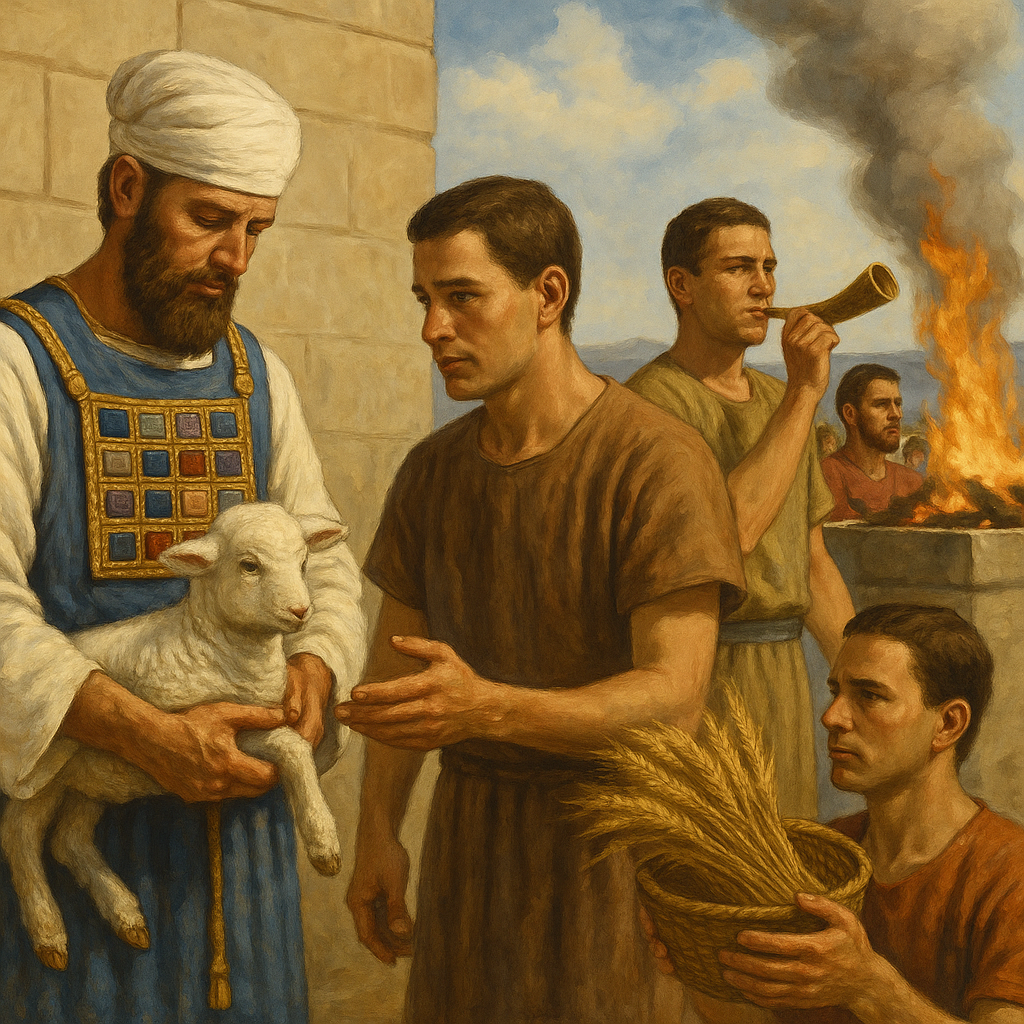
 Leviticus 22–23 brings together two closely related truths: God determines how holy things are to be handled, and God determines when and how Israel is to approach Him in its appointed worship. Chapter 22 concentrates especially upon the priests, holy food, and acceptable sacrifices. Chapter 23 sets forth the LORD’s appointed Sabbaths and feasts for the children of Israel.
The governing principle is expressed plainly in Leviticus 22:32:
“Neither shall ye profane my holy name; but I will be hallowed among the children of Israel: I am the LORD which hallow you.”
God was not permitting Israel to invent its own standards of worship. His holiness governed the priesthood, the sacrifice, the worshipper, and the appointed seasons.
Chapter Summaries
Leviticus 22 — Holiness in the Priesthood and Acceptable Offerings
1. Priests must not profane holy things — Leviticus 22:1–9
The LORD speaks to Moses concerning Aaron and his sons:
“Speak unto Aaron and to his sons, that they separate themselves from the holy things of the children of Israel, and that they profane not my holy name in those things which they hallow unto me: I am the LORD.”
— Leviticus 22:2
The instruction does not mean the priests were permanently to abandon the holy things. Verse 3 specifically addresses a priest approaching the holy things while having uncleanness upon him.
Certain forms of ceremonial uncleanness prevented a priest from eating the holy things until the prescribed cleansing had taken place. The chapter mentions leprosy, a running issue, contact with the dead, certain bodily conditions, and contact with an unclean creature or person.
Leviticus 22:6–7 says:
“The soul which hath touched any such shall be unclean until even, and shall not eat of the holy things, unless he wash his flesh with water. And when the sun is down, he shall be clean, and shall afterward eat of the holy things; because it is his food.”
This concerns ceremonial uncleanness under the Mosaic law. Scripture should not be made to say that every listed ceremonial condition was itself a moral sin.
The priest was nevertheless responsible to obey God’s prescribed regulations:
“They shall therefore keep mine ordinance, lest they bear sin for it, and die therefore, if they profane it: I the LORD do sanctify them.”
— Leviticus 22:9
The larger lesson is unmistakable: nearness to holy service did not give a man liberty to disregard God’s holiness.
2. Who may eat the holy things — Leviticus 22:10–16
God carefully defines who belongs to the priestly household for purposes of eating the holy food.
A stranger was not permitted to eat it:
“There shall no stranger eat of the holy thing: a sojourner of the priest, or an hired servant, shall not eat of the holy thing.”
— Leviticus 22:10
A servant purchased by the priest could eat of it, as could one born in his house.
The case of a priest’s daughter is also carefully regulated. If she married a stranger, she could not eat of the holy things. If she became widowed or divorced, had no child, and returned to her father’s house “as in her youth,” verse 13 expressly permitted her to eat of her father’s meat.
God even provided for the case of one who ate a holy thing unwittingly. He was required to restore it and add a fifth part.
This detail emphasizes that holy things belonged to God and were not to be treated casually merely because they were material objects or food.
3. Sacrifices offered to God must meet God’s requirements — Leviticus 22:17–25
The LORD next addresses acceptable animal offerings.
Concerning a burnt sacrifice, God said:
“Ye shall offer at your own will a male without blemish, of the beeves, of the sheep, or of the goats.”
— Leviticus 22:19
And concerning a sacrifice for a vow or peace offering:
“It shall be perfect to be accepted; there shall be no blemish therein.”
— Leviticus 22:21
Blind, broken, maimed, diseased, or otherwise defective animals were not acceptable in those offerings.
There is an important textual qualification in verse 23:
“Either a bullock or a lamb that hath any thing superfluous or lacking in his parts, that mayest thou offer for a freewill offering; but for a vow it shall not be accepted.”
Therefore it would be too broad to say that every animal connected with every type of offering had absolutely identical physical requirements. Verse 23 itself makes a distinction between a freewill offering and a vow.
The controlling truth remains that God, not the worshipper, determined what was acceptable upon His altar.
4. Additional requirements concerning sacrifices — Leviticus 22:26–30
A newborn bullock, sheep, or goat was to remain under its mother seven days. From the eighth day it could be accepted for an offering made by fire.
Verse 28 also commands:
“And whether it be cow or ewe, ye shall not kill it and her young both in one day.”
The chapter does not explain why this particular command was given. Therefore, assigning a specific emotional, agricultural, or symbolic reason would go beyond the explicit text.
Regarding a sacrifice of thanksgiving:
“On the same day it shall be eaten up; ye shall leave none of it until the morrow: I am the LORD.”
— Leviticus 22:30
Again, worship was governed by divine command rather than human convenience.
5. The purpose: God’s name must be hallowed — Leviticus 22:31–33
The chapter reaches its theological summit:
“Therefore shall ye keep my commandments, and do them: I am the LORD. Neither shall ye profane my holy name; but I will be hallowed among the children of Israel: I am the LORD which hallow you, That brought you out of the land of Egypt, to be your God: I am the LORD.”
— Leviticus 22:31–33
Israel’s obedience was tied directly to the character of the LORD and to His redemptive act in bringing them from Egypt.
God did not redeem them so that they could thereafter worship according to personal preference. The God who redeemed Israel was also the God who sanctified Israel and commanded Israel.
Leviticus 23 — The Appointed Feasts of the LORD
Leviticus 23 begins:
“Speak unto the children of Israel, and say unto them, Concerning the feasts of the LORD, which ye shall proclaim to be holy convocations, even these are my feasts.”
— Leviticus 23:2
The expression is important: they are “the feasts of the LORD.” They were divinely appointed observances given to Israel.
1. The weekly Sabbath — Leviticus 23:1–3
Before describing the annual feast days, the LORD restates the seventh-day Sabbath:
“Six days shall work be done: but the seventh day is the sabbath of rest, an holy convocation; ye shall do no work therein: it is the sabbath of the LORD in all your dwellings.”
— Leviticus 23:3
The Sabbath was therefore not merely private inactivity. It was called “an holy convocation.”
Under conservative dispensational interpretation, care should be taken not to transfer Israel’s Mosaic Sabbath legislation wholesale to the New Testament church. Colossians 2:16 KJV instructs believers:
“Let no man therefore judge you in meat, or in drink, or in respect of an holyday, or of the new moon, or of the sabbath days.”
The moral principle of setting God above earthly labor remains instructive, but Israel and the church must not be confused.
2. The Passover and Feast of Unleavened Bread — Leviticus 23:4–8
Verse 5 fixes the Passover:
“In the fourteenth day of the first month at even is the LORD’S passover.”
The fifteenth day began the Feast of Unleavened Bread:
“Seven days ye must eat unleavened bread.”
— Leviticus 23:6
The first and seventh days were holy convocations. Israel was to perform no servile work on those days, and offerings made by fire were presented throughout the seven days.
The Passover looked backward to God’s deliverance of Israel from Egypt, as Exodus 12 explicitly records.
The New Testament also gives a direct Christological application:
“For even Christ our passover is sacrificed for us.”
— 1 Corinthians 5:7
That connection is explicit Scripture, not an invented allegory. Christ is the believer’s Passover sacrifice.
3. The offering of firstfruits — Leviticus 23:9–14
This command was to operate when Israel entered the land:
“When ye be come into the land which I give unto you, and shall reap the harvest thereof, then ye shall bring a sheaf of the firstfruits of your harvest unto the priest.”
— Leviticus 23:10
The priest was to wave the sheaf before the LORD.
The people were not to eat bread, parched corn, or green ears until the offering had been brought.
This acknowledged that the harvest ultimately came from God.
There is also an explicit New Testament use of firstfruits imagery concerning the resurrection of Christ:
“But now is Christ risen from the dead, and become the firstfruits of them that slept.”
— 1 Corinthians 15:20
We may therefore safely recognize a biblical correspondence between firstfruits and Christ’s resurrection. We should, however, be cautious about constructing elaborate prophetic calendars beyond what Scripture itself states.
4. The fifty-day count and the new meat offering — Leviticus 23:15–22
Israel was commanded to count seven complete sabbaths:
“Even unto the morrow after the seventh sabbath shall ye number fifty days.”
— Leviticus 23:16
The people were then to bring a new meat offering.
Two wave loaves were specified:
“They shall be baken with leaven; they are the firstfruits unto the LORD.”
— Leviticus 23:17
Various animal sacrifices accompanied this observance, and the day was a holy convocation on which no servile work was to be done.
Elsewhere in the KJV this observance is called “the feast of weeks” (Deuteronomy 16:10). The New Testament uses the name Pentecost in Acts 2:1.
Acts 2 explicitly records the coming of the Holy Ghost upon the assembled disciples on the day of Pentecost. That historical connection is certain because Scripture states it.
We should distinguish that certainty from more elaborate claims that every detail of the two loaves, their leaven, or their number independently predicts particular New Testament doctrines. Leviticus 23 does not explicitly make those interpretations.
5. Provision for the poor and stranger — Leviticus 23:22
Amid the feast legislation God repeats a harvest command:
“And when ye reap the harvest of your land, thou shalt not make clean riddance of the corners of thy field when thou reapest, neither shalt thou gather any gleaning of thy harvest: thou shalt leave them unto the poor, and to the stranger: I am the LORD your God.”
This demonstrates that ceremonial worship did not excuse neglect of one’s neighbor.
Israel was to remember the poor even while enjoying God’s provision.
The pattern appears vividly in the later history of Ruth, where gleaning provisions played an important role, although Leviticus 23 itself does not mention Ruth.
6. Memorial of blowing of trumpets — Leviticus 23:23–25
On the first day of the seventh month Israel was commanded:
“In the seventh month, in the first day of the month, shall ye have a sabbath, a memorial of blowing of trumpets, an holy convocation.”
— Leviticus 23:24
No servile work was to be done, and an offering made by fire was to be presented.
The passage calls it “a memorial of blowing of trumpets.”
It does not explicitly state in Leviticus 23 what event was being memorialized. We therefore should not invent one.
Likewise, although some dispensational systems connect this feast with particular future prophetic events, Leviticus 23 itself does not explicitly establish such an identification. Any such proposal must remain subordinate to clearer prophetic Scripture.
7. The Day of Atonement — Leviticus 23:26–32
The tenth day of the seventh month was:
“a day of atonement: it shall be an holy convocation unto you; and ye shall afflict your souls, and offer an offering made by fire unto the LORD.”
— Leviticus 23:27
No work was to be done.
The command to “afflict your souls” is explicit. Leviticus 23 itself does not fully define every action included in that expression, so restraint is appropriate.
The seriousness of the day is emphasized in verses 29–30. Anyone who did not afflict his soul was to be cut off, and one who worked was subject to divine judgment.
The observance was:
“from even unto even.”
— Leviticus 23:32
The fuller sacrificial procedure for the Day of Atonement is given in Leviticus 16.
The New Testament book of Hebrews explicitly uses Israel’s high-priestly and sacrificial system to demonstrate the superiority and finality of Christ’s sacrifice. Therefore, seeing the atonement system as pointing to Christ is biblically warranted. Hebrews 9:12 says:
“Neither by the blood of goats and calves, but by his own blood he entered in once into the holy place, having obtained eternal redemption for us.”
Christ’s sacrifice is not an annual repetition. His saving work is sufficient.
8. The Feast of Tabernacles — Leviticus 23:33–44
The fifteenth day of the seventh month began the Feast of Tabernacles, lasting seven days.
The first day was a holy convocation, and offerings were made during the feast. Verse 36 additionally commands an assembly on the eighth day.
Israel was to rejoice before the LORD:
“And ye shall rejoice before the LORD your God seven days.”
— Leviticus 23:40
They were also to dwell in booths.
Here Scripture explicitly gives the reason:
“That your generations may know that I made the children of Israel to dwell in booths, when I brought them out of the land of Egypt: I am the LORD your God.”
— Leviticus 23:43
This feast therefore deliberately preserved historical memory.
Future generations were not to forget that Israel’s national history and preservation rested upon God’s acts on their behalf.
The chapter closes:
“And Moses declared unto the children of Israel the feasts of the LORD.”
— Leviticus 23:44
Key People and Places
- The LORD — The central Person throughout both chapters. He establishes what is holy, what may be offered, who may partake, and when Israel is to assemble.
- Moses — Receives the commandments from the LORD and declares them to Israel.
- Aaron — Israel’s high priest; chapter 22 specifically addresses regulations concerning Aaron and his sons.
- The sons of Aaron / the priests — Responsible for handling holy things according to God’s commands.
- The children of Israel — The covenant nation to whom the feasts and convocations of chapter 23 were given.
- The priestly household — Includes persons whose eligibility to eat holy food is carefully regulated in Leviticus 22.
- The poor and the stranger — Specifically protected by the gleaning command of Leviticus 23:22.
- The land of Egypt — Explicitly remembered as the place from which the LORD brought Israel (Leviticus 22:33; 23:43).
- “The land which I give unto you” — Leviticus 23:10 anticipates Israel entering the land and harvesting its produce. The verse does not name the land there, though the broader Pentateuch identifies the promised land elsewhere.
- Israel’s dwellings — Several commands were to be observed “in all your dwellings.”
- The wilderness/tabernacle setting — The broader setting of Leviticus is Israel after the establishment of the tabernacle; Leviticus 1:1 explicitly says the LORD spoke to Moses “out of the tabernacle of the congregation.”
Main Doctrinal or Spiritual Themes
1. God is holy, and His holiness governs worship
The repeated declaration “I am the LORD” grounds the commandments in God’s own character.
Worship is not acceptable simply because the worshipper is sincere. God prescribed who could approach, what could be brought, and how sacred things were to be treated.
Leviticus 22:32 summarizes the principle:
“I will be hallowed among the children of Israel.”
2. God’s people must distinguish between holy and common
Priests could not treat consecrated food like ordinary food. Holy things belonged to God and were subject to His regulation.
For the New Testament believer, the Mosaic ceremonial regulations are not church ordinances, but the principle of reverence remains. A believer should never treat the things of God casually.
3. God determines acceptable sacrifice
Israel was forbidden to substitute defective offerings where God required an acceptable sacrifice.
This teaches a foundational principle: man does not set the standard of acceptance before God.
Ultimately, the New Testament directs us to the sinless sacrifice of Christ:
“Who did no sin, neither was guile found in his mouth.”
— 1 Peter 2:22
And:
“Christ also hath once suffered for sins, the just for the unjust, that he might bring us to God.”
— 1 Peter 3:18
Salvation rests upon Christ’s finished work, not upon human merit.
4. Redemption should produce holiness and obedience
Leviticus 22:33 connects God’s commands with Israel’s deliverance:
“That brought you out of the land of Egypt, to be your God.”
Deliverance did not abolish God’s authority over His redeemed people.
Likewise, New Testament salvation is wholly by grace through faith, apart from works, but the saved believer is called to holy living.
Ephesians 2:8–10 preserves the proper order: salvation is “by grace…through faith…not of works,” while those who are saved are afterward “created in Christ Jesus unto good works.”
Works are the fruit of salvation, never its cause.
5. God established seasons of remembrance
Passover recalled deliverance. Tabernacles recalled Israel’s dwelling in booths. Firstfruits acknowledged God’s provision.
God repeatedly commanded His people to remember what He had done.
Spiritual forgetfulness often precedes spiritual decline.
6. Atonement is necessary because sin separates man from a holy God
The solemn Day of Atonement reminds the reader that sin cannot simply be ignored.
Under the law, repeated sacrifices testified to man’s continuing need.
The New Testament declares the superiority of Christ:
“But this man, after he had offered one sacrifice for sins for ever, sat down on the right hand of God.”
— Hebrews 10:12
Christ’s sacrifice is sufficient and final.
7. Israel and the church must remain distinct
Leviticus 23 specifically says:
“Speak unto the children of Israel…”
These feast regulations were given to Israel under the Mosaic covenant.
The church may learn doctrine, divine principles, and God-authorized typology from them, but the church is not Israel and should not be placed under Israel’s ceremonial calendar.
This distinction guards against both covenantal confusion and the attempt to make Mosaic observances conditions of Christian spirituality or salvation.
8. Biblical typology must remain controlled by Scripture
Several connections are explicitly supplied elsewhere in the KJV:
- Passover: “Christ our passover is sacrificed for us” — 1 Corinthians 5:7.
- Firstfruits: Christ is “the firstfruits of them that slept” — 1 Corinthians 15:20.
- Atonement and sacrifice: Hebrews explicitly applies Israel’s sacrificial system to the superior work of Christ.
- Pentecost: Acts 2 explicitly records the coming of the Holy Ghost on Pentecost.
Those connections are safe because Scripture itself makes them.
What should be avoided is turning every detail of every feast into an elaborate prophetic symbol when Scripture has not explicitly done so. Conservative interpretation means staying within what God has written.
Practical Applications or Lessons
1. Give God your best, not your leftovers
Israel was forbidden to offer to God what He had declared unacceptable.
The believer should therefore examine whether God receives first place in his time, service, giving, worship, and affection.
Malachi later condemned the same spirit when Israel knowingly brought corrupt offerings.
2. Familiarity with spiritual things must never produce carelessness
Aaron’s sons were constantly around sacred things, but their office did not remove their obligation to reverence God.
The same danger exists for pastors, teachers, church workers, and long-time believers. Repeated exposure to Scripture should increase reverence, not diminish it.
3. God’s Word—not preference—regulates obedience
A recurring expression throughout these chapters is:
“I am the LORD.”
The issue is authority.
The believer’s question should not first be, “What do I prefer?” but, “What hath God said?”
4. Remember God’s acts of grace
Israel’s feast days repeatedly called the nation to remember God’s deliverance and provision.
Christians likewise should deliberately remember the cross, the resurrection, answered prayer, God’s providence, and the truth by which they were saved.
5. Worship and compassion belong together
Leviticus 23:22 places care for the poor and stranger directly amid the feast instructions.
A man could not rightly claim devotion to God’s worship while selfishly gathering every last portion of his harvest for himself.
True biblical devotion affects treatment of others.
6. God’s holiness should produce separation from sin
Ceremonial distinctions belonged particularly to Israel under the law, but God’s moral holiness has not changed.
First Peter 1:15–16 applies the underlying truth directly to believers:
“But as he which hath called you is holy, so be ye holy in all manner of conversation; Because it is written, Be ye holy; for I am holy.”
Biblical separation is therefore not merely separation from evil. It is consecration unto God.
7. Salvation rests in the perfect sacrifice of Christ
The repeated concern for acceptable sacrifice ultimately magnifies the perfection of the Lord Jesus Christ.
No sinner can make himself acceptable by religious effort, ceremony, morality, or law-keeping.
The gospel rests upon Christ:
“For by grace are ye saved through faith; and that not of yourselves: it is the gift of God: Not of works, lest any man should boast.”
— Ephesians 2:8–9
And:
“Believe on the Lord Jesus Christ, and thou shalt be saved.”
— Acts 16:31
Overall Message
Leviticus 22–23 teaches that the LORD is holy, His worship must be approached according to His Word, His redemption is to be remembered, His provision acknowledged, and His name hallowed among His people.
Chapter 22 emphasizes holy priests, holy food, acceptable sacrifices, and reverence for God’s name.
Chapter 23 emphasizes God-appointed times of rest, remembrance, sacrifice, thanksgiving, atonement, rejoicing, and holy assembly.
For Israel these commandments formed part of its covenant life under Moses. For the church, they must not be turned into Mosaic obligations. Yet their revelation of God’s holiness, man’s need of atonement, the necessity of obedience, and the perfection of Christ’s sacrifice remains profoundly instructive.
Most importantly, the passages should lead the reader not toward speculative symbolism, but toward the plain biblical truths God Himself has revealed.
Comments are closed