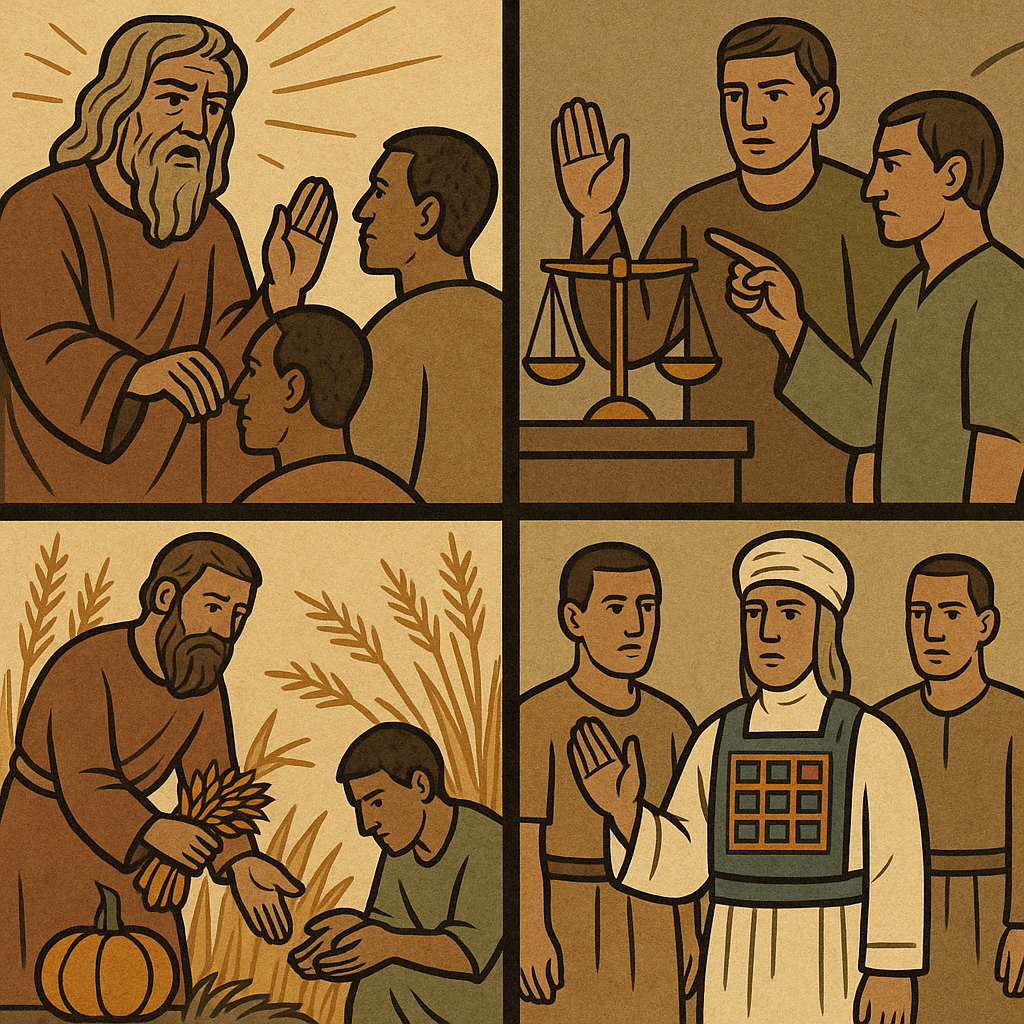
 Leviticus 19–21 develops one of the clearest concentrations of teaching on holiness in the Mosaic law. The recurring command is that Israel was to be holy because the LORD Himself is holy. That holiness affected worship, family life, treatment of neighbors, business dealings, sexual morality, separation from idolatry, and especially the conduct of the priests.
The historical setting is Israel under the Mosaic covenant. Leviticus later summarizes these laws as statutes and judgments given through Moses in connection with mount Sinai (Leviticus 26:46). The immediate text also looks forward to Israel dwelling in the land God was giving them (Leviticus 20:22–24).
For doctrinal clarity, these chapters were addressed directly to Israel, not to the New Testament church. Their moral teaching reveals the holiness and righteousness of God, but the Mosaic civil and ceremonial system is not the governmental code of the local church. Salvation was never earned by keeping these laws. Romans 3:20 says, “Therefore by the deeds of the law there shall no flesh be justified in his sight.”
Chapter Summaries
Leviticus 19 — Holiness in Everyday Life
The chapter opens with God speaking through Moses to “all the congregation of the children of Israel.”
Leviticus 19:2 states the controlling principle:
“Ye shall be holy: for I the LORD your God am holy.”
Holiness here is not restricted to sacrifices or ceremonies. The chapter explicitly applies God’s holiness to ordinary conduct.
Israel was commanded to reverence father and mother and keep the LORD’s sabbaths:
“Ye shall fear every man his mother, and his father, and keep my sabbaths: I am the LORD your God.”
— Leviticus 19:3
They were forbidden to turn to idols or make molten gods (19:4).
Verses 5–8 regulate the proper eating of a peace offering. The sacrifice had to be handled according to God’s command rather than according to human preference.
Provision for the Poor and the Stranger
Israel was not to harvest every last portion of the field or vineyard.
Leviticus 19:9–10 commands that portions be left:
“for the poor and stranger.”
This was an explicit provision in Israel’s law for those in need. The text does not describe this as indiscriminate redistribution of all property; rather, the owner was commanded to leave part of his harvest accessible to the poor and stranger.
Honesty and Justice
The chapter forbids stealing, false dealing, lying, and false swearing (19:11–12).
The employer was not to defraud a worker:
“the wages of him that is hired shall not abide with thee all night until the morning.”
— Leviticus 19:13
Israel was also commanded:
“Thou shalt not curse the deaf, nor put a stumblingblock before the blind, but shalt fear thy God.”
— Leviticus 19:14
Because the deaf might not hear the curse and the blind might not see the obstruction, these commands demonstrate that God’s standard is not limited to what a victim can detect. God sees the act.
Judges were commanded to show neither partiality toward the poor nor favoritism toward the powerful:
“in righteousness shalt thou judge thy neighbour.”
— Leviticus 19:15
Talebearing was forbidden, as was conduct that endangered one’s neighbor (19:16).
Love Without Hatred, Revenge, or Grudges
Leviticus 19:17 forbids inward hatred:
“Thou shalt not hate thy brother in thine heart.”
Yet biblical love did not require silence concerning wrongdoing. The same verse commands:
“thou shalt in any wise rebuke thy neighbour, and not suffer sin upon him.”
Then comes one of the great moral commands of Scripture:
“Thou shalt not avenge, nor bear any grudge against the children of thy people, but thou shalt love thy neighbour as thyself: I am the LORD.”
— Leviticus 19:18
Jesus later explicitly identified love for one’s neighbor as a great commandment (Matthew 22:39).
Separation and Distinction
Verse 19 contains commands against certain mixtures involving livestock, seed, and garments. The text explicitly commands these distinctions. Any additional explanation concerning the precise reason for every individual prohibition would go beyond what these verses directly state.
Verses 20–22 deal with an unlawful sexual act involving a bondmaid and prescribe judgment together with a trespass offering. The passage establishes that sexual conduct was subject to God’s law and that guilt required God’s appointed remedy.
Verses 23–25 regulate fruit trees after Israel entered the land. Their fruit was treated differently during the first several years, with the fourth year’s fruit being:
“holy to praise the LORD withal.”
Israel was also forbidden to eat anything with the blood, use enchantment, or observe times (19:26).
The chapter forbids particular pagan-associated practices involving the hair and beard and forbids cutting the flesh for the dead or printing marks upon oneself (19:27–28). The text gives these commands directly to Israel. Claims concerning every specific ancient custom behind them should not be stated as certain where Scripture itself does not explain the custom.
Verse 29 forbids prostituting one’s daughter.
Verse 30 joins reverence for God’s sabbaths with reverence for His sanctuary:
“Ye shall keep my sabbaths, and reverence my sanctuary: I am the LORD.”
Verse 31 explicitly forbids seeking after:
“familiar spirits”
and
“wizards.”
The Aged and the Stranger
God commanded respect for age:
“Thou shalt rise up before the hoary head, and honour the face of the old man, and fear thy God.”
— Leviticus 19:32
The stranger living among Israel was not to be mistreated:
“But the stranger that dwelleth with you shall be unto you as one born among you, and thou shalt love him as thyself.”
— Leviticus 19:34
God connected this command with Israel’s own history:
“for ye were strangers in the land of Egypt.”
Finally, dishonest measurements were forbidden. Israel was to use:
“Just balances, just weights, a just ephah, and a just hin.”
— Leviticus 19:36
The chapter closes by returning to obedience:
“Therefore shall ye observe all my statutes, and all my judgments, and do them: I am the LORD.”
— Leviticus 19:37
Leviticus 20 — Holiness Through Separation from Abomination
Leviticus 20 emphasizes the seriousness with which Israel was required to reject idolatry, occult practices, and sexual immorality.
The chapter contains several civil penalties belonging to Israel’s Mosaic legal system. Those penalties should not be transferred to the New Testament church as though the church were Israel’s civil government.
Molech Worship Condemned
The chapter begins with severe judgment against anyone in Israel who gave his seed unto Molech (20:1–5).
God says that such an offender had:
“defiled my sanctuary, and profaned my holy name.”
— Leviticus 20:3
The KJV explicitly connects the practice with Molech. Scripture does not require us to reconstruct every detail of the pagan ritual beyond what the text states.
God also warned against turning to familiar spirits and wizards:
“And the soul that turneth after such as have familiar spirits, and after wizards… I will even set my face against that soul.”
— Leviticus 20:6
Then comes another central command:
“Sanctify yourselves therefore, and be ye holy: for I am the LORD your God.”
— Leviticus 20:7
And immediately afterward:
“And ye shall keep my statutes, and do them: I am the LORD which sanctify you.”
— Leviticus 20:8
These verses place divine sanctification and human obedience side by side. God was the One who sanctified Israel, and Israel was responsible to obey His commandments.
Family Authority
Verse 9 assigns severe Mosaic judgment to one who cursed father or mother.
This reinforces the seriousness of parental authority already seen in Leviticus 19:3.
Sexual Holiness
A substantial portion of Leviticus 20 addresses unlawful sexual relationships and assigns penalties within Israel’s civil law.
The chapter explicitly condemns adultery and a number of other sexual unions prohibited by God.
It also explicitly states concerning homosexual acts between males:
“Thou shalt not lie with mankind, as with womankind: it is abomination.”
— Leviticus 18:22
Leviticus 20:13 again treats such conduct as sinful under Israel’s law.
The New Testament likewise teaches sexual purity for believers. First Corinthians 6:18 says:
“Flee fornication.”
The New Testament church, however, is not commanded to administer Israel’s Mosaic civil penalties. Church discipline and civil government are distinct matters in the present dispensation.
Separation from the Nations
The chapter reaches its doctrinal climax in verses 22–26.
God commanded Israel to keep His statutes so that the land would not reject them because of the abominations practiced by the nations before them.
God said:
“Ye shall therefore put difference between clean beasts and unclean, and between unclean fowls and clean.”
— Leviticus 20:25
Then He declared:
“And ye shall be holy unto me: for I the LORD am holy, and have severed you from other people, that ye should be mine.”
— Leviticus 20:26
The word “severed” is especially important. Israel’s separation was not presented as pride in themselves but as belonging uniquely to the LORD.
The chapter closes by again condemning those who had familiar spirits or practiced wizardry (20:27).
Leviticus 21 — The Holiness Required of the Priesthood
Leviticus 21 turns particularly to “the priests the sons of Aaron.”
The underlying principle remains holiness, but priests had additional restrictions because of their service before God.
Priests and Defilement for the Dead
Ordinary priests were forbidden to defile themselves for the dead among the people except for specifically named close relatives (21:1–3).
The text gives exceptions for:
- his mother,
- his father,
- his son,
- his daughter,
- his brother,
- and a near unmarried sister.
Priests were also forbidden particular mourning practices involving baldness, beard cutting, and cutting the flesh (21:5).
The reason is explicitly stated:
“They shall be holy unto their God, and not profane the name of their God.”
— Leviticus 21:6
Their conduct was connected with the holiness of their office because:
“the offerings of the LORD made by fire, and the bread of their God, they do offer.”
Priestly Marriage
Verse 7 places marriage restrictions upon the priests.
Verse 8 commands Israel concerning the priest:
“Thou shalt sanctify him therefore; for he offereth the bread of thy God: he shall be holy unto thee.”
God again gives His own character as the basis:
“for I the LORD, which sanctify you, am holy.”
The High Priest
Beginning in verse 10, stricter requirements are given for:
“he that is the high priest among his brethren.”
The high priest was not to uncover his head or rend his clothes in mourning (21:10). He was not to defile himself even for his father or mother (21:11).
He was also commanded:
“Neither shall he go out of the sanctuary, nor profane the sanctuary of his God; for the crown of the anointing oil of his God is upon him.”
— Leviticus 21:12
His marriage was likewise specially regulated. He was commanded to take:
“a virgin of his own people to wife.”
— Leviticus 21:14
These regulations emphasize the exceptional consecration attached to the high priestly office.
In the larger revelation of Scripture, the New Testament explicitly identifies Jesus Christ as the great High Priest. Hebrews 4:14 says:
“Seeing then that we have a great high priest, that is passed into the heavens, Jesus the Son of God.”
Hebrews 7:26 describes Him as:
“holy, harmless, undefiled, separate from sinners, and made higher than the heavens.”
We should not invent correspondences between every detail of Leviticus 21 and Christ, but the New Testament itself clearly reveals Christ as the perfect and final High Priest.
Priestly Physical Blemishes
Verses 16–23 deal with physical blemishes among Aaron’s descendants.
A priest with one of the listed blemishes could not approach to offer the bread of God or come near the altar.
It is important not to make the text say more than it says.
The passage does not state that such a man was morally inferior or spiritually rejected by God. In fact, it explicitly says:
“He shall eat the bread of his God, both of the most holy, and of the holy.”
— Leviticus 21:22
The restriction concerned his ceremonial priestly service:
“Only he shall not go in unto the vail, nor come nigh unto the altar, because he hath a blemish.”
— Leviticus 21:23
Therefore, using this passage to suggest that physical disability itself constitutes personal sin would go beyond the KJV text.
The chapter closes with Moses communicating these commandments to Aaron, Aaron’s sons, and the children of Israel.
Key People and Places
The LORD — The divine Lawgiver throughout these chapters. His own holiness is repeatedly presented as the reason His people must be holy: “I the LORD your God am holy” (19:2).
Moses — God’s appointed mediator who receives and communicates these commands to Israel (19:1; 20:1; 21:24).
The children of Israel — The covenant nation directly addressed by these statutes.
Aaron — Israel’s high priest and head of the priestly family. Leviticus 21 specifically addresses “the priests the sons of Aaron.”
The priests, the sons of Aaron — Men set apart for sanctuary service and therefore subject to additional requirements of ceremonial holiness.
The high priest — The specially anointed priest described in Leviticus 21:10–15.
The poor — Specifically protected in the gleaning laws of Leviticus 19:9–10.
The stranger — A non-Israelite dwelling among Israel who was not to be oppressed but was to be loved and treated justly (19:33–34).
The aged — Those represented by the “hoary head,” whom Israel was commanded to honor (19:32).
Molech — A false object of worship explicitly named in Leviticus 20:2–5. God strictly forbade Israel from giving their children unto Molech.
Egypt — Mentioned in Leviticus 19:34 as the land where Israel had formerly been strangers.
The land God was giving Israel — Leviticus 20:24 describes it as:
“a land that floweth with milk and honey.”
The land is not named as “Canaan” in these particular verses, though the broader Pentateuch identifies the land promised to Israel as Canaan.
The sanctuary — The holy place connected with Israel’s worship and priesthood (19:30; 20:3; 21:12).
The altar — The place of priestly approach and offering, particularly referenced in the priestly restrictions of Leviticus 21:23.
The vail — Mentioned in Leviticus 21:23 in connection with restrictions upon priestly approach.
Main Doctrinal and Spiritual Themes
1. God’s Holiness Is the Foundation of His People’s Holiness
The central statement is:
“Ye shall be holy: for I the LORD your God am holy.”
— Leviticus 19:2
And again:
“And ye shall be holy unto me: for I the LORD am holy.”
— Leviticus 20:26
Biblical holiness begins with God’s own nature. God’s commandments are not arbitrary. His moral standards arise from who He is.
2. Holiness Extends Into Ordinary Conduct
Leviticus 19 shows that holiness concerns far more than sanctuary ceremonies.
It includes:
- honoring parents,
- honest speech,
- honest wages,
- fair judgment,
- compassion toward the weak,
- rejection of hatred,
- refusal to avenge oneself,
- love for one’s neighbor,
- sexual purity,
- care for strangers,
- respect for the aged,
- honest business measurements,
- and rejection of occultism.
A man cannot biblically separate supposed devotion to God from his treatment of other people.
3. Separation Is a Biblical Principle
God told Israel:
“I… have severed you from other people, that ye should be mine.”
— Leviticus 20:26
Israel’s national separation must not be confused with the church. Scripture maintains a distinction between Israel and the church.
Nevertheless, the New Testament also commands believers to live separated from sin. Second Corinthians 6:17 says:
“Wherefore come out from among them, and be ye separate, saith the Lord.”
Biblical separation is fundamentally separation unto God, not mere isolation from other people.
4. Idolatry and Occultism Are Direct Rebellion Against God
Leviticus 19–20 repeatedly condemns:
- idols,
- molten gods,
- enchantments,
- familiar spirits,
- wizards,
- and Molech worship.
The believer should therefore reject every attempt to seek supernatural guidance or power apart from God and His Word.
Isaiah 8:20 supplies the proper standard:
“To the law and to the testimony.”
5. God’s Standard of Sexual Morality Is Objective
Leviticus 20 identifies sexual acts God forbade.
The standard was not determined by personal desire, surrounding culture, or the practice of neighboring nations.
The New Testament maintains sexual holiness for the church. First Thessalonians 4:3 says:
“For this is the will of God, even your sanctification, that ye should abstain from fornication.”
The Mosaic civil penalties belonged to Israel’s national government and are not transferred to the local church.
6. Justice Must Be Impartial
Leviticus 19:15 rejects both favoritism toward the poor and favoritism toward the powerful:
“Thou shalt do no unrighteousness in judgment.”
God’s justice is not based on social status.
The biblical standard is:
“in righteousness shalt thou judge thy neighbour.”
7. Love Does Not Mean Ignoring Sin
Leviticus 19:17–18 places several ideas together:
- do not hate,
- rebuke wrongdoing,
- do not avenge,
- do not bear a grudge,
- love your neighbor.
Therefore biblical love is neither bitterness nor moral indifference.
It seeks the neighbor’s good while refusing personal vengeance.
8. Spiritual Leadership Carries Greater Responsibility
Leviticus 21 places additional restrictions upon priests because they ministered in holy things.
The text does not establish New Testament pastors as Levitical priests. Those offices must not be confused.
However, Scripture separately teaches that spiritual teachers bear serious responsibility. James 3:1 warns:
“My brethren, be not many masters, knowing that we shall receive the greater condemnation.”
Those who handle holy things should treat their responsibility with gravity.
9. The Priesthood Anticipates the Need for a Perfect High Priest
Leviticus emphasizes priestly holiness and restricted approach to God.
The New Testament explicitly identifies Jesus Christ as the believer’s great High Priest.
Hebrews 7:25 declares:
“Wherefore he is able also to save them to the uttermost that come unto God by him.”
The believer does not approach God through an earthly Levitical priesthood today but through Jesus Christ.
10. Law-Keeping Is Not the Means of Justification
These chapters contain repeated commands to keep God’s statutes, but Scripture does not teach that sinners are justified by law-keeping.
Romans 3:20 states plainly:
“Therefore by the deeds of the law there shall no flesh be justified in his sight.”
Salvation is by grace through faith:
“For by grace are ye saved through faith; and that not of yourselves: it is the gift of God:
Not of works, lest any man should boast.”
— Ephesians 2:8–9
God’s moral law exposes sin and reveals His righteousness; it does not provide fallen man with a works-based means of earning eternal life.
Practical Applications and Lessons
Holiness Should Reach Every Area of Life
Leviticus 19 strongly rebukes the idea that a person can be religious in worship while dishonest, cruel, immoral, or unjust in ordinary life.
The believer’s conduct at home, at work, in business, and toward neighbors should agree with his profession of faith.
Honor Parents
God placed reverence for father and mother near the beginning of the chapter.
Children should not treat parental authority lightly. The New Testament continues the principle:
“Children, obey your parents in the Lord: for this is right.”
— Ephesians 6:1
Be Generous Toward Those in Need
The gleaning law showed that God’s people were not to consume every benefit solely upon themselves.
Although the church is not under Israel’s agricultural law, generosity remains a clear New Testament duty.
Galatians 6:10 says:
“As we have therefore opportunity, let us do good unto all men, especially unto them who are of the household of faith.”
Pay People Honestly and Promptly
Leviticus 19:13 forbids withholding the hired servant’s wages overnight.
A Christian employer should never use another person’s labor dishonestly.
Never Exploit Someone’s Weakness
The command concerning the deaf and blind teaches a powerful moral lesson directly consistent with the text: inability to detect mistreatment never makes mistreatment acceptable.
The controlling reason is:
“but shalt fear thy God.”
God sees what another person may never discover.
Refuse Favoritism
Do not alter truth or justice because a person is poor, wealthy, influential, admired, or disliked.
God commanded judgment “in righteousness.”
Reject Gossip and Talebearing
Leviticus 19:16 says:
“Thou shalt not go up and down as a talebearer among thy people.”
Speech capable of damaging another person’s reputation should be governed by truth, necessity, and charity.
Deal With Hatred Before It Becomes Revenge
God forbids:
- hatred in the heart,
- vengeance,
- and grudges.
Bitterness is not made righteous simply because another person truly did wrong.
Romans 12:19 likewise teaches:
“Vengeance is mine; I will repay, saith the Lord.”
Biblical Love Can Include Rebuke
Leviticus 19:17 does not treat love and correction as opposites.
Sometimes love requires speaking truth concerning sin.
Such correction must be biblical rather than vindictive.
Reject Occult Practices Completely
The believer has no biblical reason to seek mediums, psychics, spiritists, divination, or supposed supernatural guidance outside the Lord.
God’s people have His written Word.
Practice Sexual Purity
Leviticus 20 demonstrates that God has authority over the sexual life of man.
Modern culture does not have authority to redefine what God calls sin.
For the Christian:
“Flee fornication.”
— 1 Corinthians 6:18
Honor the Elderly
Leviticus 19:32 commands respect toward the “hoary head.”
A culture that mocks age and glorifies only youth is contrary to the spirit of this command.
Treat Strangers Justly
Israel was commanded not merely to tolerate the stranger but to avoid vexing him and to love him.
This does not erase lawful distinctions between Israel and the stranger elsewhere in the Mosaic law, but it plainly forbids personal oppression.
Believers should likewise treat foreigners and strangers with honesty, compassion, and dignity.
Keep Business Dealings Honest
God cared about balances, weights, measurements, and commercial integrity.
A Christian should not have one standard of honesty at church and another when money is involved.
Those Who Serve God Must Take Holiness Seriously
Leviticus 21 reminds us that sacred responsibility must never be treated casually.
New Testament pastors are not Levitical priests, but those who preach God’s Word should especially guard their doctrine, testimony, conduct, and homes.
Physical Disability Is Not Moral Defilement
Leviticus 21’s restrictions concerning priestly blemishes concerned ceremonial qualification for particular priestly duties.
The text expressly allowed the affected priest to eat the holy food.
Therefore the chapter gives no basis for treating a physically disabled person as morally inferior or spiritually unacceptable to God.
Overall Message of Leviticus 19–21
The three chapters can be summarized by God’s repeated declaration:
“I the LORD your God am holy.”
— Leviticus 19:2
Leviticus 19 shows holiness governing everyday life.
Leviticus 20 shows holiness requiring separation from idolatry, occultism, and sexual wickedness.
Leviticus 21 shows holiness especially required in those appointed to minister in God’s sanctuary.
Taken together, these chapters reveal that the holy God has the right to govern worship, morality, family life, justice, business, speech, relationships, and ministry.
For Israel, these commands operated within the Mosaic covenant.
For the New Testament believer, the Mosaic civil and ceremonial system is not the church’s covenantal law code, but God’s holiness remains unchanged. The Christian is saved by grace through faith rather than by works of the law, and having been saved, he is called to holy living.
First Peter 1:15–16 applies that principle directly to believers:
“But as he which hath called you is holy, so be ye holy in all manner of conversation;
Because it is written, Be ye holy; for I am holy.”
The proper response to these chapters is therefore neither an attempt to earn salvation through law nor a dismissal of God’s moral standards. It is reverent recognition that the God who saves sinners by grace is Himself holy and calls His redeemed people to live accordingly.
Comments are closed