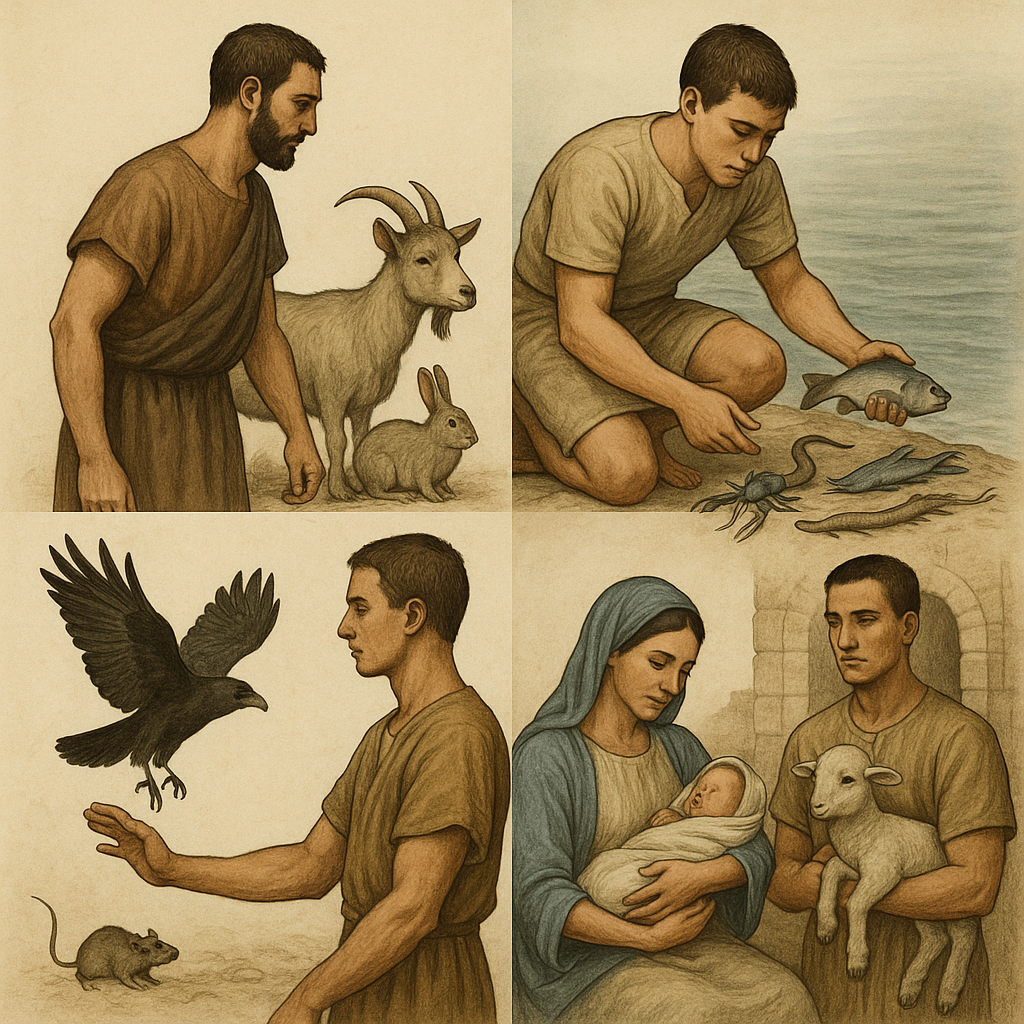
 Leviticus 11–12 continues the LORD’s instruction to Israel concerning holiness, ceremonial cleanness, and separation. Chapter 11 deals chiefly with clean and unclean creatures, while chapter 12 gives the law concerning a woman’s ceremonial purification after childbirth.
These commandments were specifically given to the children of Israel under the Mosaic law. They should therefore be interpreted first in that historical and covenant setting rather than imposed directly upon the New Testament church. Nevertheless, the holiness of God, the importance of obedience, the distinction between clean and unclean, and the need for cleansing and atonement remain important biblical truths.
Chapter Summaries
Leviticus 11 — Clean and Unclean Creatures
Leviticus 11 opens:
“And the LORD spake unto Moses and to Aaron, saying unto them, Speak unto the children of Israel…”
— Leviticus 11:1–2
That wording establishes the immediate recipients. These dietary and ceremonial regulations were commandments given to Israel.
1. Clean and unclean beasts — Leviticus 11:2–8
Among land animals, Israel could eat creatures meeting two stated qualifications:
“Whatsoever parteth the hoof, and is clovenfooted, and cheweth the cud, among the beasts, that shall ye eat.”
— Leviticus 11:3
Both characteristics were required.
The chapter specifically identifies the camel, coney, hare, and swine as unclean because each failed to meet the full requirement.
Concerning the swine:
“And the swine, though he divide the hoof, and be clovenfooted, yet he cheweth not the cud; he is unclean to you.”
— Leviticus 11:7
Israel was forbidden both to eat their flesh and to touch their dead carcasses.
The KJV does not state here that these animals were inherently morally evil. They were ceremonially unclean to Israel because God declared them so.
2. Creatures in the waters — Leviticus 11:9–12
Israel could eat creatures in the waters that possessed both fins and scales.
Those without fins and scales were called “an abomination unto you.”
The issue again is obedience to the distinction God Himself established.
3. Flying creatures — Leviticus 11:13–19
The LORD then gives a specific list of flying creatures that Israel was forbidden to eat.
Rather than supplying a general anatomical test, as with land and water creatures, the text names those creatures that were to be regarded as abominations.
Because identification of some ancient animal names can be debated outside the English text, it is safest to retain the KJV terminology rather than claim more precision than Scripture supplies.
4. Flying creeping things — Leviticus 11:20–23
The general rule was:
“All fowls that creep, going upon all four, shall be an abomination unto you.”
— Leviticus 11:20
An exception was then given for certain creatures having legs suited for leaping.
The text specifically names:
- the locust
- the bald locust
- the beetle
- the grasshopper
“after his kind.”
The precise identification of every ancient creature represented by these English names can involve historical questions. Such questions do not alter the plain command given to Israel.
5. Defilement through carcasses — Leviticus 11:24–40
The chapter moves from what could be eaten to what produced ceremonial uncleanness through contact.
Touching certain carcasses made a person unclean until the evening.
Carrying a carcass required washing the clothes, followed by uncleanness until evening.
The chapter also gives regulations concerning contamination of:
- vessels
- food
- water
- ovens
- ranges for pots
- seed
- dead animals
An earthen vessel into which an unclean carcass fell was to be broken.
This demonstrates how seriously God required Israel to treat the distinction between clean and unclean.
The passage itself concerns ceremonial defilement. It should not automatically be treated as a statement that every instance of uncleanness was equivalent to a deliberate act of moral wickedness.
6. Creeping things — Leviticus 11:41–43
Israel was forbidden to eat creeping things that moved upon the earth.
The LORD also warned:
“Ye shall not make yourselves abominable with any creeping thing that creepeth, neither shall ye make yourselves unclean with them…”
— Leviticus 11:43
The people were therefore responsible not merely to know God’s distinctions but to conduct themselves accordingly.
7. The doctrinal reason: God is holy — Leviticus 11:44–45
This is the theological center of the chapter:
“For I am the LORD your God: ye shall therefore sanctify yourselves, and ye shall be holy; for I am holy…”
— Leviticus 11:44
And:
“For I am the LORD that bringeth you up out of the land of Egypt, to be your God: ye shall therefore be holy, for I am holy.”
— Leviticus 11:45
God connects Israel’s separation with:
- His identity as the LORD
- His relationship to Israel as their God
- His deliverance of them from Egypt
- His own holiness
Israel did not determine what was clean and unclean by personal preference. God made the distinction.
The chapter concludes by stating its purpose:
“To make a difference between the unclean and the clean, and between the beast that may be eaten and the beast that may not be eaten.”
— Leviticus 11:47
That distinction is explicit in the text.
Leviticus 12 — Purification After Childbirth
Chapter 12 turns from animals and carcasses to ceremonial purification associated with childbirth.
1. The birth of a son — Leviticus 12:1–4
The LORD tells Moses:
“Speak unto the children of Israel, saying, If a woman have conceived seed, and born a man child: then she shall be unclean seven days…”
— Leviticus 12:2
For seven days following the birth of a male child, the mother was ceremonially unclean.
On the eighth day:
“And in the eighth day the flesh of his foreskin shall be circumcised.”
— Leviticus 12:3
This agrees with the covenant requirement of circumcision already given in Genesis 17:12.
Afterward, the mother continued:
“in the blood of her purifying three and thirty days”
During this period she was not to touch a hallowed thing or enter the sanctuary.
The stated periods total forty days following the birth of a son: seven days followed by thirty-three days.
2. The birth of a daughter — Leviticus 12:5
For the birth of a female child, the stated periods are different.
The mother was unclean for two weeks and then continued in the blood of her purifying for sixty-six days.
The stated periods total eighty days.
Scripture does not explicitly say why the period following the birth of a daughter was twice that following the birth of a son.
Therefore, explanations based upon supposed medical, social, biological, or cultural reasons should not be presented as though the Bible teaches them.
God gave the command; the KJV text does not give His reason for the difference.
3. The required offerings — Leviticus 12:6
At the completion of the purification period, the woman was to bring:
“a lamb of the first year for a burnt offering, and a young pigeon, or a turtledove, for a sin offering”
These were brought:
“unto the door of the tabernacle of the congregation, unto the priest”
The priest offered them before the LORD and made atonement for her.
The passage concludes:
“and she shall be cleansed from the issue of her blood.”
— Leviticus 12:7
The text therefore directly associates the ritual with purification from the issue of blood.
It would go beyond the text to say that giving birth itself was a moral sin. Scripture does not say that. The chapter concerns ceremonial uncleanness and the required purification under the law.
Neither does the passage explicitly explain every theological reason for calling one of the sacrifices a “sin offering.” We should therefore retain the terminology God gives without inventing an explanation the chapter does not provide.
4. Provision for the poor — Leviticus 12:8
God made provision when the mother could not afford a lamb:
“And if she be not able to bring a lamb, then she shall bring two turtles, or two young pigeons…”
One was used for the burnt offering and the other for the sin offering.
God did not exclude the poor from the prescribed means of ceremonial purification simply because they lacked financial resources.
This provision becomes particularly noteworthy in Luke 2:22–24. When Mary and Joseph fulfilled the law following the birth of Jesus, they offered:
“A pair of turtledoves, or two young pigeons.”
— Luke 2:24
The KJV explicitly records that offering. Luke does not explicitly state, in that verse, the financial condition of Joseph and Mary. Comparing it with Leviticus 12:8 may indicate that they used the provision available to those unable to bring a lamb, but we should not make Luke say more than it says.
Key People and Places
The LORD
The LORD is the Lawgiver throughout both chapters. His authority, holiness, and right to determine what is clean and unclean govern the entire passage.
The central declaration is:
“ye shall be holy; for I am holy”
— Leviticus 11:44
Moses
God gives His commandments through Moses. In chapter 11 the LORD speaks to both Moses and Aaron; in chapter 12 He speaks to Moses.
Moses is not presented as inventing these regulations. They originate with the LORD.
Aaron
Aaron is addressed alongside Moses in Leviticus 11:1. As priest, he belongs to the priestly system responsible for maintaining the distinctions God established.
The chapter does not assign every individual regulation directly to Aaron personally, so we should not claim more than the text states.
The Children of Israel
They are the expressly identified recipients:
“Speak unto the children of Israel…”
— Leviticus 11:2; 12:2
This is essential for proper doctrinal interpretation. These laws belong to God’s covenant dealings with Israel under Moses.
The Woman After Childbirth
Leviticus 12 concerns the ceremonial condition and purification of a mother after giving birth.
Nothing in the chapter presents motherhood or childbirth as morally sinful.
The Priest
At the conclusion of the mother’s purification period, the priest receives and offers the prescribed sacrifices.
Leviticus 12:7 says:
“the priest shall offer it before the LORD, and make an atonement for her”
The Tabernacle of the Congregation
The offerings of Leviticus 12 were brought:
“unto the door of the tabernacle of the congregation”
— Leviticus 12:6
The tabernacle was therefore the appointed place connected with the mother’s return to ceremonial cleanness.
Wilderness Setting
The larger setting of Leviticus is Israel at the tabernacle after the Exodus. Leviticus 1:1 states that the LORD called unto Moses:
“out of the tabernacle of the congregation”
The book itself does not name a new geographic location in chapters 11–12.
Main Doctrinal or Spiritual Themes
1. The Holiness of God
The primary doctrinal declaration of Leviticus 11 is not merely about food. It is about the character of the God who gave the commandments.
“I am holy.”
— Leviticus 11:44
God’s holiness is the standard.
Biblical holiness is therefore not created by culture, personal feeling, majority opinion, or convenience. God determines what He requires of His people.
2. God Has the Right to Make Distinctions
Leviticus 11:47 specifically says:
“To make a difference between the unclean and the clean”
God makes distinctions.
Modern man often dislikes boundaries, but Scripture repeatedly demonstrates that God distinguishes:
- holy from profane
- clean from unclean
- righteousness from wickedness
- truth from error
Under the Mosaic covenant, these distinctions included food and ceremonial contact.
The principle that God has authority to establish boundaries remains true, even though the particular Mosaic dietary regulations are not imposed upon the New Testament church.
3. Obedience Does Not Depend Upon God Explaining Every Reason
God does not explain in Leviticus 11 why every listed animal is clean or unclean.
Nor does Leviticus 12 explain why the purification periods following male and female births differ.
Israel was nevertheless responsible to obey.
There is an important devotional lesson here: God’s command is sufficient authority even when He does not reveal all of His reasons.
“For I am the LORD your God…”
— Leviticus 11:44
4. Ceremonial Uncleanness Must Be Distinguished From Moral Wickedness
This distinction prevents doctrinal confusion.
A woman became unclean following childbirth, but Scripture does not therefore declare childbirth wicked.
A person could become unclean by touching a carcass without the chapter describing that contact as deliberate moral rebellion.
The Mosaic system taught Israel that approaching a holy God required cleanness according to His appointed order.
We should use the biblical terminology precisely rather than treating “unclean” as though it always means “personally immoral.”
5. Cleansing and Atonement Are Necessary to Approach God
Leviticus 12 ends with sacrifice and priestly atonement.
The larger sacrificial system teaches that sinful man does not invent his own means of approaching God.
Hebrews later declares:
“without shedding of blood is no remission.”
— Hebrews 9:22
The sacrifices of the law could never provide the final and complete redemption accomplished by Jesus Christ. Hebrews 10:4 states:
“For it is not possible that the blood of bulls and of goats should take away sins.”
Christ’s sacrifice is sufficient and final.
“But this man, after he had offered one sacrifice for sins for ever, sat down on the right hand of God”
— Hebrews 10:12
Thus, Leviticus should be read within God’s unfolding revelation, with the sacrificial system ultimately giving way to the finished work of Christ.
6. Israel and the Church Must Remain Distinct
Leviticus 11 expressly addresses “the children of Israel.”
The church is not placed under Israel’s Mosaic dietary regulations.
The New Testament makes this clear. Paul writes:
“Let no man therefore judge you in meat, or in drink…”
— Colossians 2:16
And:
“For every creature of God is good, and nothing to be refused, if it be received with thanksgiving”
— 1 Timothy 4:4
Therefore, Christians should not attempt to gain righteousness, sanctification, or salvation by keeping Israel’s dietary laws.
Salvation is wholly by grace through faith:
“For by grace are ye saved through faith… Not of works, lest any man should boast.”
— Ephesians 2:8–9
The Mosaic dietary code belonged to Israel’s covenant administration, not to the church as a means of Christian justification or holiness.
7. Biblical Separation Remains a New Testament Principle
Although Christians are not commanded to separate from pork, shellfish, or other foods declared unclean to Israel, believers are commanded to separate from sin and spiritual uncleanness.
Paul writes:
“Wherefore come out from among them, and be ye separate, saith the Lord…”
— 2 Corinthians 6:17
Therefore, the form of Israel’s ceremonial separation must not be transferred indiscriminately to the church, but the broader biblical truth that God’s people should be holy and distinct from wickedness remains firmly taught in the New Testament.
Practical Applications or Lessons
Obey God’s Word even when every reason is not explained.
Israel was not invited to revise the list of clean and unclean creatures according to preference. God had spoken.
The believer likewise should approach Scripture with submission rather than placing human reasoning above divine revelation.
Learn to make biblical distinctions.
Leviticus 11 repeatedly distinguishes clean from unclean.
Christian discernment likewise requires distinguishing:
- truth from error
- righteousness from sin
- biblical doctrine from human tradition
- liberty from license
- Israel from the church
- ceremonial law from abiding moral truth
Confusion often begins when distinctions God makes are erased.
Holiness should affect ordinary life.
Leviticus 11 governs eating, touching, cooking vessels, food, water, and ordinary household matters.
For Israel, holiness was not confined to the tabernacle.
Likewise, Christian holiness should affect the believer’s conduct outside the church building as well as inside it.
“But as he which hath called you is holy, so be ye holy in all manner of conversation”
— 1 Peter 1:15
Do not confuse outward regulations with saving righteousness.
An Israelite’s dietary obedience did not provide the New Testament gospel of justification by faith, nor can Christian dietary choices save anyone today.
A sinner is justified by faith in Jesus Christ apart from works.
“Therefore we conclude that a man is justified by faith without the deeds of the law.”
— Romans 3:28
God cares about purity.
The repeated concern with contamination in Leviticus 11 teaches the seriousness with which God treated ceremonial purity under the law.
For the Christian, spiritual and moral purity should likewise be taken seriously.
“Abstain from all appearance of evil.”
— 1 Thessalonians 5:22
God’s provision did not overlook the poor.
Leviticus 12:8 specifically provided an alternative sacrifice for a woman who could not afford a lamb.
God’s law therefore recognized differing material circumstances while maintaining the requirement of approaching Him according to His appointed way.
Do not invent explanations where Scripture is silent.
The doubled purification period following the birth of a daughter is a good example.
The KJV states the difference but does not explain the reason.
Faithful Bible study says what Scripture says and stops where Scripture stops.
Conservative interpretation means greater submission to the written text, not greater confidence in unsupported tradition.
Cleansing ultimately directs our attention to Christ.
The Levitical priest could perform the ceremony God prescribed under the law, but complete redemption is found only in Jesus Christ.
“In whom we have redemption through his blood, the forgiveness of sins, according to the riches of his grace”
— Ephesians 1:7
The Old Testament system repeatedly reminds the reader that man needs cleansing, atonement, and an acceptable approach to a holy God. The New Testament reveals that the sinner’s perfect and sufficient Savior is Jesus Christ.
Overall Message of Leviticus 11–12
Leviticus 11–12 teaches that the LORD is holy, that He has the sovereign right to determine what is clean and unclean, and that His people were required to approach Him according to His revealed order.
Chapter 11 emphasizes distinction and separation: Israel was commanded to distinguish between clean and unclean creatures because they belonged to the holy LORD who had delivered them from Egypt.
Chapter 12 emphasizes uncleanness, purification, sacrifice, and restoration to ceremonial cleanness after childbirth. The chapter does not teach that childbirth itself is sinful, nor does it explain every reason behind the differing purification periods.
For the Christian, these Mosaic ceremonial regulations are not a means of righteousness and are not imposed upon the church. Yet the truths behind the passages remain instructive: God is holy, His Word determines our boundaries, His commands deserve obedience, man needs cleansing, and acceptable approach to God must be on God’s terms.
And under the New Testament, that approach is through Jesus Christ alone:
“For through him we both have access by one Spirit unto the Father.”
— Ephesians 2:18
Comments are closed