
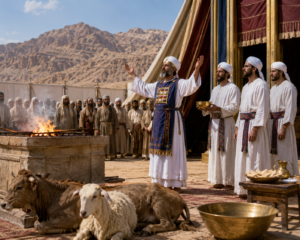
 Leviticus 7–10 moves from the detailed laws governing Israel’s sacrifices, to the consecration of Aaron and his sons, to the beginning of their priestly ministry, and finally to the solemn judgment of Nadab and Abihu. The sequence emphasizes that approach to God was not to be governed by human preference. The LORD prescribed the sacrifice, the priesthood, the manner of service, and the distinctions between holy and unholy.
Historically, these events belong to Israel under the Mosaic covenant. Leviticus 7:38 places these commands at “mount Sinai” and “in the wilderness of Sinai.” They should therefore not be imposed upon the New Testament church as ceremonial requirements. Nevertheless, they reveal abiding truths concerning God’s holiness, obedience, reverence, separation, and the seriousness of approaching Him according to His Word.
Chapter Summaries
Leviticus 7 — The Laws of the Offerings Completed
Leviticus 7 completes the instructions concerning the sacrifices begun in the preceding chapters.
The chapter opens with the trespass offering:
“Likewise this is the law of the trespass offering: it is most holy.” — Leviticus 7:1
The animal was killed in the appointed place, its blood was sprinkled upon the altar, and specified portions of fat were burned unto the LORD. The priest who made the offering received the portion appointed to him. The chapter also explains portions belonging to the priests from meat offerings.
Beginning in verse 11, the LORD gives further regulations concerning the peace offering. A peace offering could be associated with thanksgiving, a vow, or a voluntary offering.
The thanksgiving sacrifice had to be eaten on the day it was offered:
“And the flesh of the sacrifice of his peace offerings for thanksgiving shall be eaten the same day that it is offered; he shall not leave any of it until the morning.” — Leviticus 7:15
A vow or voluntary offering could also be eaten the following day, but anything remaining until the third day had to be burned. Eating it on the third day violated God’s command and rendered the sacrifice unacceptable.
Ceremonial cleanness was also required. An unclean person was forbidden to eat the flesh of the peace offering.
The LORD then expressly prohibited Israel from eating certain fat and from eating blood:
“Moreover ye shall eat no manner of blood, whether it be of fowl or of beast, in any of your dwellings.” — Leviticus 7:26
The breast and right shoulder of the peace offering were assigned to Aaron and his sons according to the LORD’s command.
The chapter concludes by summarizing the sacrificial legislation:
“This is the law of the burnt offering, of the meat offering, and of the sin offering, and of the trespass offering, and of the consecrations, and of the sacrifice of the peace offerings; Which the LORD commanded Moses in mount Sinai…” — Leviticus 7:37–38
The text therefore explicitly places these sacrificial laws within God’s dealings with Israel at Sinai.
Leviticus 8 — Aaron and His Sons Consecrated
Leviticus 8 records the carrying out of the priestly consecration that the LORD had commanded.
The LORD told Moses to bring Aaron, Aaron’s sons, the priestly garments, the anointing oil, the sacrificial animals, and the basket of unleavened bread. The congregation was assembled:
“And Moses did as the LORD commanded him; and the assembly was gathered together unto the door of the tabernacle of the congregation.” — Leviticus 8:4
A repeated emphasis throughout the chapter is that Moses acted “as the LORD commanded Moses.”
Moses washed Aaron and his sons with water. Aaron was clothed with the garments belonging to the high priest, including the coat, girdle, robe, ephod, breastplate, Urim and Thummim, mitre, and holy crown.
Moses then anointed the tabernacle and its furnishings.
“And he poured of the anointing oil upon Aaron’s head, and anointed him, to sanctify him.” — Leviticus 8:12
Aaron’s sons were also clothed for their priestly office.
A bullock was offered for a sin offering. A ram was then offered as a burnt offering. A second ram was used as “the ram of consecration.”
Blood from the ram of consecration was placed upon Aaron’s right ear, the thumb of his right hand, and the great toe of his right foot. The same was done to Aaron’s sons.
It is common to associate the ear, hand, and foot with hearing, service, and walking. Scripture does not explicitly state that this is the intended symbolism. The ceremony certainly demonstrates their consecration to priestly service, but further symbolism should be stated only as a possible inference rather than as an explicit interpretation of the text.
Blood and anointing oil were also sprinkled upon Aaron, his sons, and their garments:
“And sanctified Aaron, and his garments, and his sons, and his sons’ garments with him.” — Leviticus 8:30
Aaron and his sons were commanded to remain at the door of the tabernacle for seven days.
Moses warned them:
“Therefore shall ye abide at the door of the tabernacle of the congregation day and night seven days, and keep the charge of the LORD, that ye die not: for so I am commanded.” — Leviticus 8:35
The chapter closes significantly:
“So Aaron and his sons did all things which the LORD commanded by the hand of Moses.” — Leviticus 8:36
That statement prepares the reader for the contrast appearing in chapter 10.
Leviticus 9 — The Priesthood Begins Its Public Ministry
On the eighth day, Moses called Aaron, his sons, and the elders of Israel.
Aaron was instructed to offer a calf for his own sin offering and a ram for a burnt offering. Israel was also commanded to bring specified sacrifices.
Moses explained:
“For to day the LORD will appear unto you.” — Leviticus 9:4
Aaron first offered sacrifices relating to himself and then those pertaining to the people.
This order emphasizes that Aaron himself was a sinner who required sacrifice. The Aaronic priesthood therefore could never provide the final solution for sin.
Hebrews later explains the contrast with Christ:
“But Christ being come an high priest of good things to come…” — Hebrews 9:11
And unlike Aaronic priests, Christ entered:
“Neither by the blood of goats and calves, but by his own blood he entered in once into the holy place, having obtained eternal redemption for us.” — Hebrews 9:12
That does not erase the historical meaning of Leviticus. The sacrifices were literal ordinances given to Israel. Nevertheless, the New Testament explicitly identifies the sacrificial system as anticipatory:
“For the law having a shadow of good things to come…” — Hebrews 10:1
After Aaron completed the sacrifices, he blessed the people. Moses and Aaron entered the tabernacle of the congregation and afterward came out and blessed them.
Then the promise of verse 4 was fulfilled:
“And the glory of the LORD appeared unto all the people.” — Leviticus 9:23
Immediately afterward:
“And there came a fire out from before the LORD, and consumed upon the altar the burnt offering and the fat: which when all the people saw, they shouted, and fell on their faces.” — Leviticus 9:24
The fire came from the LORD. The people responded with both rejoicing and reverence.
This provides the immediate background for chapter 10. In chapter 9, fire from the LORD accepts the offering. In chapter 10, fire from the LORD judges unauthorized priestly conduct.
Leviticus 10 — Nadab and Abihu and the Holiness of God
The chapter begins abruptly:
“And Nadab and Abihu, the sons of Aaron, took either of them his censer, and put fire therein, and put incense thereon, and offered strange fire before the LORD, which he commanded them not.” — Leviticus 10:1
The central textual fact is clear: they offered “strange fire” which the LORD “commanded them not.”
Scripture does not provide every detail concerning precisely what made the fire “strange.” It is therefore safest not to construct an elaborate explanation beyond what God has revealed. Whatever specific element was unauthorized, their worship departed from the LORD’s command.
The judgment was immediate:
“And there went out fire from the LORD, and devoured them, and they died before the LORD.” — Leviticus 10:2
Moses then gave the divinely stated principle that explains the seriousness of the event:
“I will be sanctified in them that come nigh me, and before all the people I will be glorified.” — Leviticus 10:3
Aaron’s response is stated simply:
“And Aaron held his peace.”
Mishael and Elzaphan, relatives of Aaron, were instructed to carry Nadab and Abihu outside the camp.
Aaron, Eleazar, and Ithamar were commanded not to engage in the specified signs of mourning while carrying the responsibilities of their consecrated office:
“Uncover not your heads, neither rend your clothes; lest ye die…” — Leviticus 10:6
The rest of Israel was permitted to mourn the judgment.
The LORD then spoke directly to Aaron:
“Do not drink wine nor strong drink, thou, nor thy sons with thee, when ye go into the tabernacle of the congregation, lest ye die…” — Leviticus 10:9
The purpose included maintaining proper distinctions:
“And that ye may put difference between holy and unholy, and between unclean and clean; And that ye may teach the children of Israel all the statutes which the LORD hath spoken unto them by the hand of Moses.” — Leviticus 10:10–11
Because this prohibition concerning wine immediately follows the death of Nadab and Abihu, some have connected intoxication with their sin. Scripture does not explicitly say that Nadab and Abihu had been drinking. The placement of the command may suggest a relationship, but it does not prove one. Their explicitly stated offense remains that they “offered strange fire before the LORD, which he commanded them not.”
The chapter closes with another matter involving priestly responsibility.
Moses discovered that the goat of the sin offering had been burned rather than eaten as commanded in that circumstance. He was angry with Eleazar and Ithamar.
Aaron then answered Moses, explaining what had occurred and saying:
“And such things have befallen me: and if I had eaten the sin offering to day, should it have been accepted in the sight of the LORD?” — Leviticus 10:19
The chapter concludes:
“And when Moses heard that, he was content.” — Leviticus 10:20
The text does not elaborate beyond this. We should therefore be content with the explanation Scripture gives rather than inventing details concerning Aaron’s inward reasoning.
Key People and Places
Moses
The LORD’s appointed servant through whom these instructions were given and through whom Aaron and his sons were consecrated. Throughout chapter 8, Moses carefully performs what the LORD commanded.
Aaron
Brother of Moses and the high priest of Israel. He is consecrated in chapter 8, begins his priestly ministry in chapter 9, and loses two sons under divine judgment in chapter 10.
Nadab
A son of Aaron and consecrated priest. He and Abihu offered “strange fire before the LORD, which he commanded them not” and died before the LORD.
Abihu
Another son of Aaron who participated with Nadab in the unauthorized offering and received the same judgment.
Eleazar
A son of Aaron who continued in priestly service after the deaths of Nadab and Abihu.
Ithamar
A son of Aaron who likewise remained in the priestly ministry.
Mishael and Elzaphan
Sons of Uzziel, identified in Leviticus 10:4 as Aaron’s uncle’s sons. They were commanded to carry Nadab and Abihu “from before the sanctuary out of the camp.”
The Children of Israel
The covenant nation to whom the sacrificial and priestly system was given.
Mount Sinai
Leviticus 7:38 explicitly identifies Mount Sinai as the place where the LORD gave these sacrificial commands to Moses.
Wilderness of Sinai
Also explicitly named in Leviticus 7:38 as the setting in which Israel was commanded to offer its oblations.
Tabernacle of the Congregation
The center of Israel’s worship and priestly service. Aaron and his sons were consecrated at its door, and priestly access was governed by God’s commands.
The Altar
The appointed place upon which sacrifices were offered. In Leviticus 9:24, fire from before the LORD consumed the burnt offering and fat upon it.
Outside the Camp
The bullock used in Aaron’s consecration was burned outside the camp in Leviticus 8:17. Nadab and Abihu were also carried outside the camp after their deaths in Leviticus 10:4–5.
Main Doctrinal or Spiritual Themes
1. God Determines How He Is Approached
Perhaps the strongest unifying truth in these chapters is that man does not have the authority to invent his own manner of approaching God.
The sacrifices were prescribed. The priests were appointed. The garments were prescribed. The consecration was prescribed. The proper portions were prescribed. The distinctions between clean and unclean were prescribed.
Nadab and Abihu demonstrate the danger of substituting human initiative for divine command:
“Which he commanded them not.” — Leviticus 10:1
Sincerity cannot sanctify disobedience.
2. God Is Holy
God’s holiness is not merely an abstract doctrine. It governs man’s relationship to Him.
Leviticus 10:3 provides one of the clearest statements:
“I will be sanctified in them that come nigh me, and before all the people I will be glorified.”
Those who ministered nearest to the LORD carried a particularly solemn responsibility to honor His holiness.
3. Obedience Must Be Exact
Leviticus 8 repeatedly emphasizes that Moses acted “as the LORD commanded.”
Leviticus 8:36 closes:
“So Aaron and his sons did all things which the LORD commanded by the hand of Moses.”
Leviticus 10 then presents the opposite:
“Which he commanded them not.”
That contrast is deliberate in the text even without adding speculation. Obedience accepts God’s Word as sufficient authority.
4. Sin Requires Sacrifice
Even Aaron, Israel’s high priest, required a sin offering before ministering for the people.
That demonstrates the imperfection of the Aaronic priesthood. The priest himself needed atonement.
The New Testament gives the fulfillment in Christ, who did not need a sacrifice for His own sin:
“Who did no sin, neither was guile found in his mouth.” — 1 Peter 2:22
Christ’s sacrifice was once for all:
“But this man, after he had offered one sacrifice for sins for ever, sat down on the right hand of God.” — Hebrews 10:12
5. Blood Was Sacred
Israel was expressly prohibited from consuming blood:
“Ye shall eat no manner of blood.” — Leviticus 7:26
The larger explanation had already been given in Leviticus:
“For the life of the flesh is in the blood: and I have given it to you upon the altar to make an atonement for your souls…” — Leviticus 17:11
The sacrificial use of blood reinforced the seriousness of sin and the necessity of atonement.
6. There Must Be a Difference Between Holy and Unholy
The priesthood was responsible:
“That ye may put difference between holy and unholy, and between unclean and clean.” — Leviticus 10:10
Biblical holiness requires distinctions. God did not permit His priests to erase categories He Himself had established.
The specific ceremonial distinctions belonged to Israel’s Mosaic system, but the New Testament likewise commands believers:
“But as he which hath called you is holy, so be ye holy in all manner of conversation.” — 1 Peter 1:15
7. God’s Ministers Must Teach God’s Word
The priests were not merely sacrificers. They also had a teaching responsibility:
“And that ye may teach the children of Israel all the statutes which the LORD hath spoken unto them by the hand of Moses.” — Leviticus 10:11
The standard was not personal opinion but what “the LORD hath spoken.”
8. Worship and Ministry Require Sobriety
The LORD prohibited Aaron and his sons from drinking wine or strong drink when entering the tabernacle to perform their ministry.
The stated reasons included distinguishing holy from unholy and teaching God’s statutes accurately.
Again, Scripture does not explicitly identify drunkenness as Nadab and Abihu’s offense, so that conclusion should not be asserted as fact.
9. God’s Acceptance Comes on God’s Terms
In Leviticus 9, the sacrifices were offered according to God’s command, and:
“There came a fire out from before the LORD, and consumed upon the altar the burnt offering and the fat.” — Leviticus 9:24
In Leviticus 10, unauthorized fire was offered, and:
“There went out fire from the LORD, and devoured them.” — Leviticus 10:2
The same holy God is present in both chapters. His holiness brings acceptance where His Word is obeyed and judgment where His authority is defied.
Practical Applications or Lessons
Take God’s Word Seriously
The recurring standard is not what seems reasonable, impressive, traditional, emotional, or sincere. It is what God commanded.
A believer should therefore resist the attitude that obedience to Scripture can be replaced by good intentions.
Jesus said:
“If ye love me, keep my commandments.” — John 14:15
Do Not Invent Worship Contrary to Scripture
Nadab and Abihu warn against treating worship as an arena for human invention without regard for God’s revealed will.
Their exact unauthorized action should not be embellished beyond the KJV text. What Scripture makes unmistakable is that they offered something before the LORD “which he commanded them not.”
The principle remains important: God’s people should seek biblical warrant rather than merely asking whether a practice is popular or emotionally appealing.
Holiness Requires Separation
God commanded a distinction:
“Between holy and unholy, and between unclean and clean.”
Christians are not under Israel’s ceremonial cleanness regulations:
“For ye are not under the law, but under grace.” — Romans 6:14
Nevertheless, grace does not abolish holy living. The New Testament still commands believers to separate from sin and pursue holiness.
Spiritual Leadership Carries Serious Responsibility
Aaron and his sons ministered publicly before Israel. Their conduct affected not only themselves but the congregation.
James 3:1 warns:
“My brethren, be not many masters, knowing that we shall receive the greater condemnation.”
Those who teach or lead God’s people should therefore handle God’s Word with fear, care, and faithfulness.
God’s Work Must Be Done God’s Way
Leviticus 8 repeatedly emphasizes obedience to what the LORD commanded.
There is a valuable ministry principle here: God’s ends do not justify disobedient means. Churches should not abandon biblical standards simply because an alternative method appears more successful.
Reverence and Joy Are Not Opposites
When the glory of the LORD appeared in Leviticus 9:
“They shouted, and fell on their faces.”
Both responses occur together. There was rejoicing, but also reverence.
Biblical worship need not be lifeless, but neither should joy become irreverence.
Never Become Casual About the Holiness of God
Leviticus 10 stands as a permanent warning against treating sacred things lightly.
God’s statement is decisive:
“I will be sanctified in them that come nigh me.”
Familiarity with ministry should never become familiarity in the sense of carelessness toward God.
Ministers Need Clear Judgment
The prohibition of wine and strong drink in Leviticus 10:9 is followed immediately by the need to distinguish holy from unholy and to teach God’s statutes.
At minimum, the text explicitly connects priestly sobriety with clear discernment and faithful teaching.
Human Servants Fail; Christ Does Not
Aaron needed a sin offering. Two of his sons died under judgment. Even the priestly family was marked by human weakness.
That makes the perfection of the Lord Jesus Christ all the more glorious:
“For such an high priest became us, who is holy, harmless, undefiled, separate from sinners…” — Hebrews 7:26
The Levitical priesthood was real and divinely appointed for Israel, but it was not God’s final priesthood.
Salvation Is Not Obtained by Levitical Ritual
These sacrifices were God’s ordinances for Israel, but they could not provide the finished redemption accomplished by Christ.
“For it is not possible that the blood of bulls and of goats should take away sins.” — Hebrews 10:4
Salvation today is not obtained through sacrifice, priestly ceremony, sacraments, law-keeping, or human works. It is by grace through faith:
“For by grace are ye saved through faith; and that not of yourselves: it is the gift of God: Not of works, lest any man should boast.” — Ephesians 2:8–9
Overall Message of Leviticus 7–10
Leviticus 7–10 teaches that the holy God determines the terms upon which sinful man may approach Him.
Chapter 7 regulates the sacrifices.
Chapter 8 consecrates the priests.
Chapter 9 demonstrates worship conducted according to God’s command and answered by His manifested glory.
Chapter 10 demonstrates the deadly seriousness of departing from what God commanded.
The great contrast is especially striking:
Leviticus 8:36:
“So Aaron and his sons did all things which the LORD commanded by the hand of Moses.”
Leviticus 10:1:
“And offered strange fire before the LORD, which he commanded them not.”
The lesson is plain: God’s holiness is never to be treated casually, His Word must govern worship and ministry, and obedience is not optional for those who draw near to serve Him.
For the Christian, these chapters also magnify the superiority of Jesus Christ. The sacrifices, priesthood, blood, altar, and consecration belonged literally to Israel under the law, while the New Testament reveals that the sacrificial system pointed forward to the perfect and final work of Christ. We therefore do not return to Levitical ceremonies; we rest in the finished sacrifice of the Saviour and seek to serve Him in holiness and obedience.
Comments are closed