Chapter Summaries
Jeremiah 34
 This chapter records the word of the LORD to Jeremiah concerning Zedekiah king of Judah while Nebuchadnezzar king of Babylon and his army fought against Jerusalem and the remaining fortified cities, especially Lachish and Azekah. The setting is the final siege period before Jerusalem’s fall.
The LORD told Zedekiah plainly that Jerusalem would be given into the hand of the king of Babylon and burned with fire. Yet the message also contained a measure of mercy toward Zedekiah personally. He would not die by the sword, but would go to Babylon and die “in peace,” with lamentation made for him as for former kings. This shows that even in judgment, God may still temper His dealings with individual mercy. The nation would fall, but the king’s end would not be as violent as it could have been.
The chapter then turns to Judah’s sin regarding the Hebrew servants. Under covenant obligation, the people had agreed to proclaim liberty to their Hebrew bondservants, both men and women, releasing them according to God’s law. For a short time they obeyed. But afterward they turned back and brought the servants again into subjection. This was not merely social injustice. It was covenant-breaking before God. They had used the LORD’s name in making the covenant, then profaned that name by reversing their obedience when the immediate pressure seemed to ease.
God rebuked them sharply. Since they would not proclaim liberty to their brethren, He would proclaim “a liberty” for them—to the sword, to the pestilence, and to the famine. That is a solemn play on words: the liberty they denied others became the liberty of judgment released against them. God also reminded them of the covenant ceremony, referring to those who passed between the parts of the calf. They had pledged themselves before Him, and He would hold them to account.
The chapter closes with the certainty that the Babylonians would return, take the city, and burn it with fire. Temporary political relief did not cancel divine judgment. Judah’s outward reform, without a true heart of obedience, could not avert the LORD’s sentence.
Jeremiah 35
Jeremiah 35 presents the striking example of the Rechabites. The LORD told Jeremiah to bring this family into one of the chambers of the house of the LORD and set wine before them. Jeremiah obeyed, gathering Jaazaniah and others of the house of the Rechabites. When offered wine, they refused.
Their refusal was based on the command of Jonadab the son of Rechab, their ancestor, who had instructed them not to drink wine, not to build houses, not to sow seed, not to plant vineyards, and to dwell in tents. They had kept these commands faithfully for generations. They were not following a divine law in the same sense as the Mosaic covenant, but a family rule established by their forefather. Their loyalty and discipline were remarkable.
God then used the Rechabites as a living sermon against Judah. The point was sharp and undeniable: the sons of Jonadab obeyed the commandment of their earthly father, but Judah would not obey the words of the living God. The LORD had sent His prophets “rising early and speaking,” yet the nation would not incline their ear. So the obedience of the Rechabites stood as a rebuke to the rebellion of Judah.
This chapter strongly emphasizes obedience, submission, and consistency. The Rechabites were not praised because tent-dwelling or abstinence from wine were universal commands for all God’s people. They were praised because they faithfully kept the charge given to them. Meanwhile Judah had broken direct commandments from God Himself. That made their guilt far greater.
Because of Judah’s refusal to hear, judgment would come upon Jerusalem and Judah. But because the Rechabites obeyed the commandment of Jonadab their father, the LORD promised that Jonadab the son of Rechab should not want a man to stand before Him for ever. This is a beautiful testimony that God notices and honors faithful obedience, even when it is displayed in a small and disciplined remnant.
Jeremiah 36
Jeremiah 36 centers on the written word of God and the wicked rejection of it by Judah’s leadership. In the days of Jehoiakim the son of Josiah, the LORD commanded Jeremiah to take a roll of a book and write all the words He had spoken against Israel, Judah, and the nations from the days of Josiah onward. The purpose was gracious: perhaps the house of Judah would hear of the evil God intended to bring upon them, and perhaps they would return from their evil way so that their iniquity and sin might be forgiven.
Since Jeremiah was “shut up” and unable to go into the house of the LORD himself, he dictated the words to Baruch the son of Neriah, who wrote them on the roll. Baruch then read the words publicly in the temple on a day of fasting, where they came to the attention of the princes. He was later summoned to read the roll before them privately. As they heard the words, they became afraid and recognized the seriousness of the message. They asked where the words came from, and Baruch told them Jeremiah had dictated them.
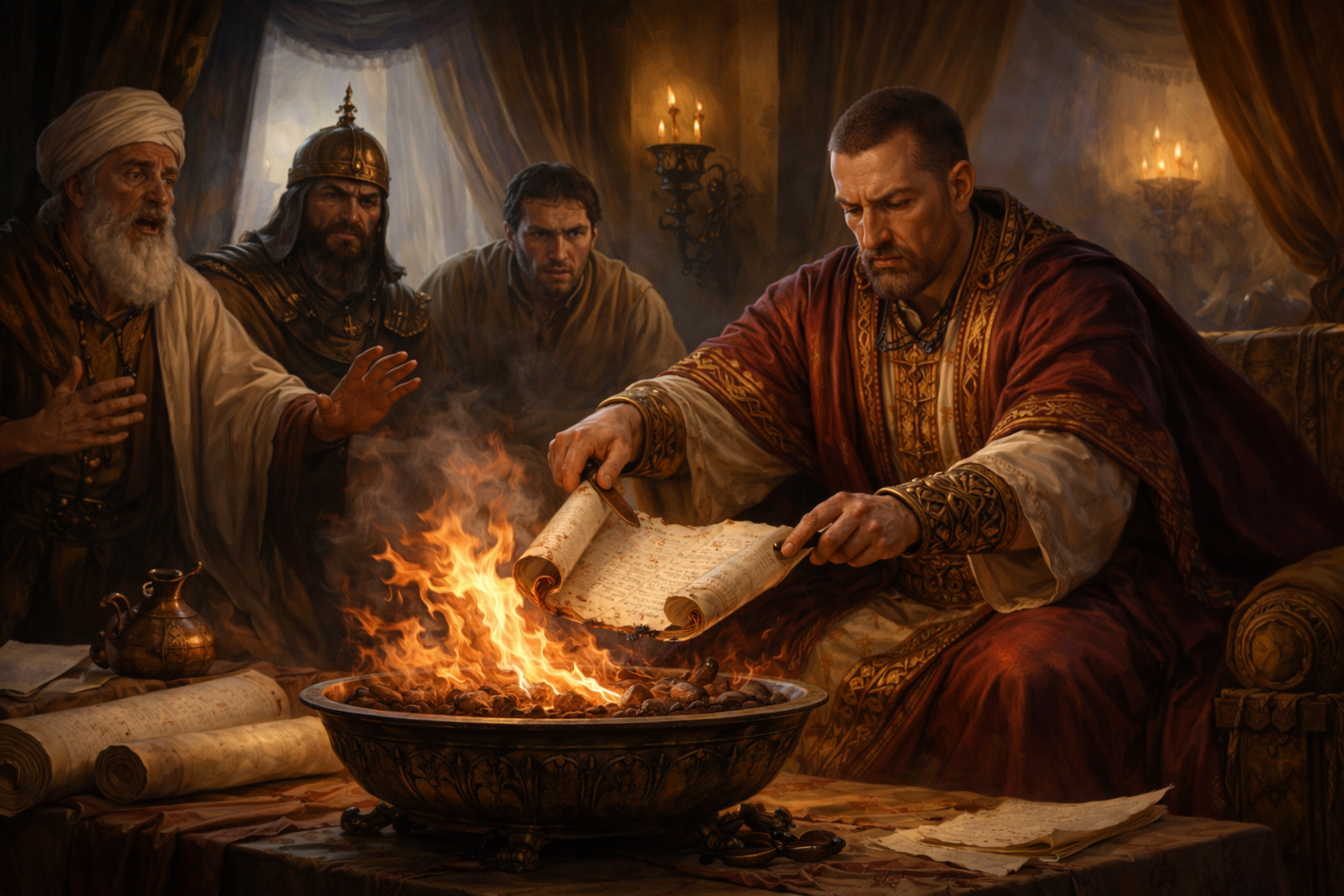
The princes advised Baruch and Jeremiah to hide, then brought the roll to King Jehoiakim. As the roll was read in the winter house, the king responded with shocking contempt. After every few leaves were read, he cut the roll with a penknife and cast it into the fire until the entire roll was burned. Though some urged him not to do it, he would not listen. This is one of the clearest pictures in Scripture of a ruler defiantly rejecting the word of God. He could burn the scroll, but he could not destroy the truth it contained or the God who spoke it.
The LORD then commanded Jeremiah to take another roll and write again all the former words, adding judgment specifically against Jehoiakim. God declared that Jehoiakim would have none to sit upon the throne of David in secure continuation, and his dead body would be shamefully exposed. More broadly, the LORD would bring upon him, his seed, and his servants the judgments He had pronounced because they would not hear.
This chapter teaches the preservation, authority, and invincibility of God’s word. Men may despise it, suppress it, or try to destroy it, but they cannot nullify it. The rewritten roll, with additional words besides, shows that God’s revelation stands firm despite human rebellion.
Key People and Places
Jeremiah
The prophet of the LORD, faithfully delivering God’s message of judgment and calling for repentance.
Zedekiah
The final king of Judah before Jerusalem’s fall. He receives a direct prophecy concerning his capture and fate.
Nebuchadnezzar
King of Babylon, God’s instrument of judgment against Judah.
Jehoiakim
An earlier king of Judah, marked in chapter 36 by arrogance and open contempt for the written word of God.
Baruch son of Neriah
Jeremiah’s scribe and faithful helper, who writes and reads the prophetic roll.
Jonadab son of Rechab
Ancestor of the Rechabites, remembered for giving commands his descendants faithfully kept.
Rechabites
A disciplined clan whose obedience to their forefather stands in contrast to Judah’s disobedience to God.
Princes of Judah
Officials who heard Baruch read the roll and recognized the seriousness of the message, though their response fell short of national repentance.
Jerusalem
The capital city under siege and destined for destruction because of persistent sin.
Lachish and Azekah
Fortified cities of Judah still resisting Babylon at the time of Jeremiah 34, showing how late in the national crisis these events occurred.
House of the LORD
The temple in Jerusalem, where the Rechabites were tested and where Baruch publicly read the scroll.
Babylon
The empire used by God to chasten Judah for covenant-breaking and rebellion.
Main Doctrinal or Spiritual Themes
1. God’s judgment is certain against persistent sin
These chapters repeatedly show that Judah’s rebellion had reached the point where judgment would not be avoided. God had warned long and patiently, but continued hardness brought certain punishment.
2. Outward reform without heart obedience is vain
In chapter 34, the people released their servants for a time, then took them back. Their reform was temporary and self-serving. God sees through shallow obedience.
3. God takes covenant obligations seriously
The broken covenant concerning Hebrew servants was not a minor social matter. It was a sin against God’s revealed will and against His holy name.
4. Obedience matters deeply to God
The Rechabites are set forth as an example of faithful submission. Their obedience condemns Judah’s stubborn refusal to hear the LORD.
5. The word of God is authoritative and indestructible
Jehoiakim burned the scroll, but God simply had it written again. Scripture cannot be overthrown by human rage or unbelief.
6. God speaks repeatedly before He judges
He sent His prophets again and again. Judgment came only after repeated warnings were despised. This reveals both His holiness and His longsuffering.
7. God honors faithfulness in the midst of widespread apostasy
The Rechabites show that even in dark days, the LORD sees and rewards those who walk in disciplined obedience.
8. Human rulers remain under divine authority
Kings like Zedekiah and Jehoiakim may sit on earthly thrones, but they cannot escape the rule of the King of heaven.
Practical Applications or Lessons
1. Do not make promises to God lightly
Judah entered covenant obligations and then broke them when it became inconvenient. Believers should be people of truth, integrity, and settled obedience.
2. Temporary conviction is not the same as repentance
The people in Jeremiah 34 changed course briefly under pressure, then returned to sin. A true turning to God is deeper than a momentary reaction.
3. Learn from godly examples of discipline and submission
The Rechabites show the power of generational faithfulness, order, and self-denial. Strong convictions, consistently practiced, can preserve a testimony across many years.
4. The greater the light, the greater the responsibility
Judah had God’s law and prophets. Their guilt was greater because they sinned against clearer truth. The same principle applies today where Scripture is known but ignored.
5. Never treat God’s word with contempt
Jehoiakim’s cutting and burning of the scroll is a warning. Men may mock, dismiss, or resist Scripture, but they only increase their guilt by doing so.
6. God’s word stands whether men receive it or reject it
The destruction of the scroll did not alter the message. Believers should rest in the permanence and certainty of divine revelation.
7. God sees faithful service that others overlook
Baruch quietly wrote and read the word. The Rechabites quietly kept their fathers commandment. God notices quiet faithfulness as surely as public ministry.
8. Judgment and mercy may appear together
Zedekiah still faced captivity, yet God showed him a measure of mercy in how he would die. The LORD is just, but He is not cruel. His dealings are always righteous.
Closing Overview
Jeremiah 34–36 presents a solemn portrait of Judah’s moral collapse, God’s righteous warnings, and the unbreakable authority of His word. Chapter 34 shows covenant-breaking and hollow reform. Chapter 35 shows the obedience of the Rechabites as a rebuke to national rebellion. Chapter 36 shows the written word of God rejected by a wicked king, yet preserved and reissued by the LORD.
Taken together, these chapters teach that God desires obedience from the heart, that He will judge persistent rebellion, and that His word cannot be silenced. Men may break covenants, reject prophets, oppress others, and even burn the scroll—but the LORD still speaks, still reigns, and still brings His word to pass.
Comments are closed