Chapter Summaries
Jeremiah 37
 This chapter opens in the reign of Zedekiah the son of Josiah, whom Nebuchadnezzar made king in the place of Coniah. Yet the sad summary is immediate: “neither he, nor his servants, nor the people of the land, did hearken unto the words of the LORD” spoken by Jeremiah. The chapter shows a king who wanted help from God in trouble, but not true submission to God’s word.
Zedekiah sent Jehucal and Zephaniah to Jeremiah, saying, “Pray now unto the LORD our God for us.” At that moment, the Chaldeans had temporarily withdrawn from Jerusalem because Pharaoh’s army was come forth out of Egypt. Outwardly, this may have appeared hopeful, but the Lord gave Jeremiah a message that cut through the false optimism. Egypt would not save Judah. The Babylonians would return, fight against the city, take it, and burn it with fire. The Lord was so definite that He said even if the whole Chaldean army were reduced to “wounded men,” they would still rise and take Jerusalem. This stresses the certainty of divine judgment once God has decreed it.
Jeremiah then went forth out of Jerusalem to go into the land of Benjamin, but he was seized at the gate by Irijah, who accused him of falling away to the Chaldeans. This was false, but Jeremiah’s denial was ignored. He was smitten, imprisoned, and confined in the house of Jonathan the scribe, which had been turned into a prison. Thus the faithful prophet suffered not for wrongdoing, but for speaking the truth in a nation that hated it.
After many days, King Zedekiah secretly sent for Jeremiah and asked, “Is there any word from the LORD?” Jeremiah did not soften the message. He answered plainly: “There is: for, said he, thou shalt be delivered into the hand of the king of Babylon.” He also respectfully pleaded his own cause, asking what offense he had committed to deserve such treatment, and reminding the king that the false prophets who had promised peace had been proven wrong. Zedekiah then ordered that Jeremiah be kept in the court of the prison and given a daily piece of bread so long as bread remained in the city. Even here, there is a glimpse of God’s preserving hand in the midst of judgment.
Jeremiah 38
The princes—Shephatiah, Gedaliah, Jucal, and Pashur—heard Jeremiah continue to warn the people: “He that remaineth in this city shall die by the sword, by the famine, and by the pestilence: but he that goeth forth to the Chaldeans shall live.” Humanly speaking, these words sounded unpatriotic and defeatist, but spiritually they were the word of the Lord. Submission to Babylon at this point was not cowardice; it was obedience to God’s chastening hand. Since Judah had refused repentance for so long, escape now lay not in resistance, but in yielding to the judgment God had appointed.
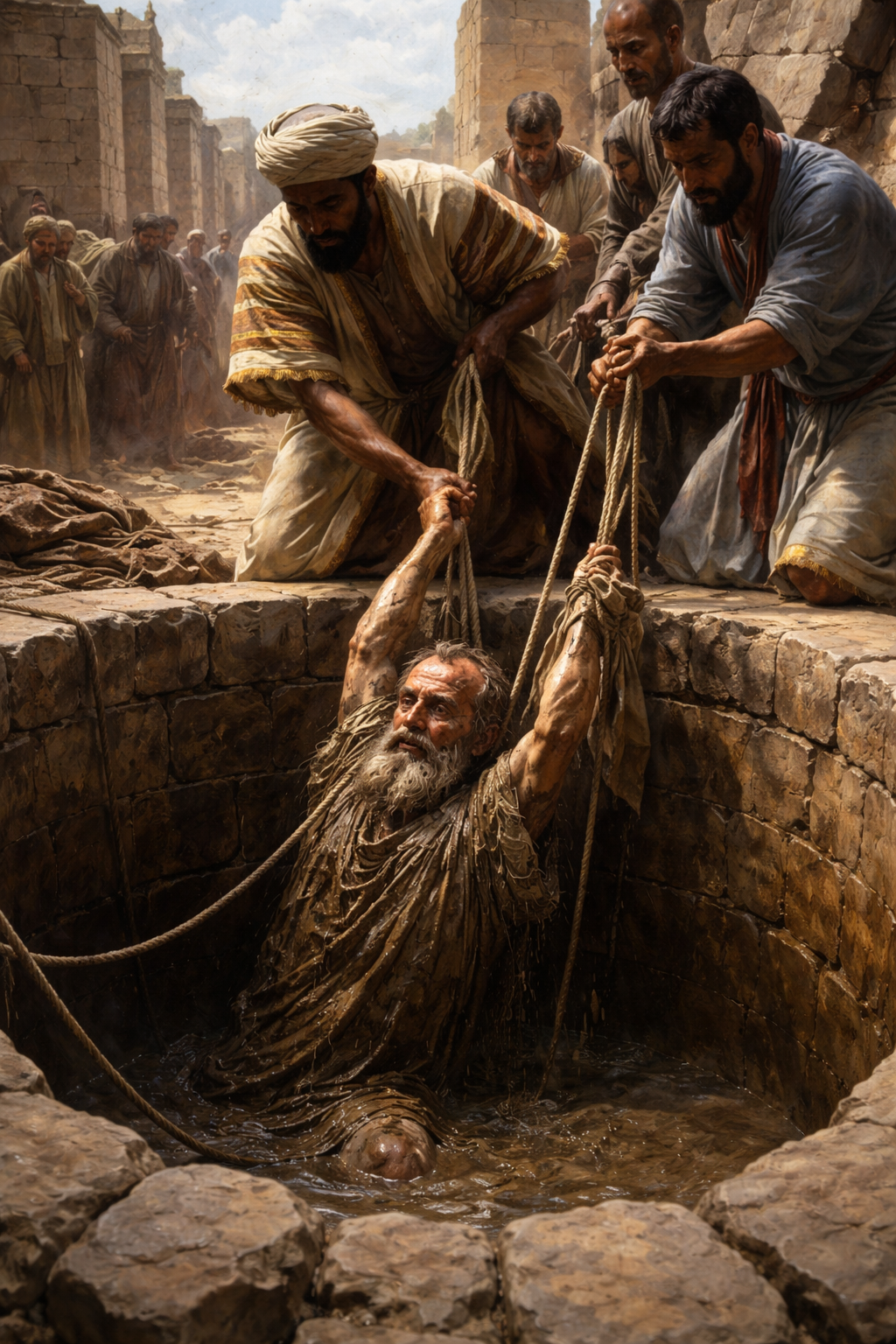
The princes told Zedekiah that Jeremiah weakened the hands of the men of war and sought not the welfare of the people, “but the hurt.” Zedekiah, weak and vacillating, answered, “Behold, he is in your hand: for the king is not he that can do any thing against you.” So they took Jeremiah and cast him into the dungeon of Malchiah, letting him down with cords. There was no water, “but mire: so Jeremiah sunk in the mire.” This is one of the most vivid pictures in the book: the prophet of God, rejected by his nation, sinking in mud while still bearing the truth.
The Lord then used an unlikely man, Ebed-melech the Ethiopian, a servant in the king’s house. Hearing what had been done, he courageously appealed to the king, saying the princes had done evil in all that they had done to Jeremiah, and that the prophet would die there for hunger. Zedekiah allowed him to rescue Jeremiah. Ebed-melech took old cast clouts and rotten rags, placed them under Jeremiah’s armholes beneath the cords, and drew him out carefully. Jeremiah remained in the court of the prison. The scene shows both human compassion and divine providence: God had not forgotten His servant.
Again Zedekiah secretly consulted Jeremiah. The king wanted the truth, yet feared the consequences of obeying it. Jeremiah first hesitated, knowing the king neither welcomed the message nor protected the messenger. But after the king swore not to kill him, Jeremiah gave the same basic counsel: if Zedekiah would surrender to the princes of Babylon, his life would be spared, the city would not be burned, and his house would live. But if he refused, the city would be given into the hand of the Chaldeans, burned with fire, and he would not escape.
Zedekiah confessed his fear of the Jews who had already defected to the Chaldeans, but Jeremiah assured him they would not deliver him over. Still, the king would not obey. He instead instructed Jeremiah to conceal the content of their conversation from the princes. The chapter ends with Jeremiah still confined. The spiritual tragedy is plain: Zedekiah preferred secrecy over submission, fear over faith, and political caution over obedience to God.
Jeremiah 39
This chapter records the fulfillment of Jeremiah’s warnings. In the ninth year of Zedekiah, Nebuchadnezzar came and besieged Jerusalem; in the eleventh year, the city was broken up. The Babylonian princes entered and sat in the middle gate, a sign that control had passed from Judah to Babylon exactly as God had said.
When Zedekiah and the men of war saw this, they fled by night through the king’s garden and by the gate between the two walls. But the Chaldean army pursued them and overtook Zedekiah in the plains of Jericho. He was brought to Nebuchadnezzar at Riblah. There the awful sentence fell: the king of Babylon slew the sons of Zedekiah before his eyes, also slew the nobles of Judah, then put out Zedekiah’s eyes and bound him in chains to carry him to Babylon. This was dreadful judgment, yet it also fulfilled the prophetic word. Zedekiah had been warned repeatedly, but he would not obey.
The Chaldeans burned the king’s house and the houses of the people and broke down the walls of Jerusalem. The remnant of the people and those who had fallen away to Babylon were carried captive by Nebuzar-adan, the captain of the guard. Yet the poorest of the people, which had nothing, were left in the land and given vineyards and fields. God’s judgment was severe, but even in judgment He ordered the aftermath according to His sovereign will.
A striking contrast appears in the treatment of Jeremiah. Nebuchadnezzar had specifically commanded Nebuzar-adan concerning him: “Take him, and look well to him, and do him no harm; but do unto him even as he shall say unto thee.” So Jeremiah was taken from the court of the prison and committed to Gedaliah to be carried home, and he dwelt among the people. The same city that rejected Jeremiah could not save itself; the pagan conqueror, under God’s providence, preserved the prophet whom Judah’s rulers had abused. This is a sobering lesson in itself.
The chapter closes with a personal word to Ebed-melech the Ethiopian, previously spoken while Jeremiah was still shut up in the court of the prison. The Lord promised judgment upon the city, but also promised deliverance to Ebed-melech: “thou shalt not be given into the hand of the men of whom thou art afraid.” Why? “Because thou hast put thy trust in me, saith the LORD.” He would not escape because he was strong or important, but because he trusted the Lord. In a chapter full of ruin and divine wrath, this promise shines like a lamp of grace.
Key People and Places
Key People
Jeremiah
The faithful prophet of the Lord. He continued to speak God’s truth despite imprisonment, rejection, accusation, and danger.
Zedekiah
The last king of Judah before Jerusalem fell. He was weak, fearful, double-minded, and unwilling to obey the clear word of God.
Nebuchadnezzar
King of Babylon, the human instrument God used to judge Judah and Jerusalem.
Jehucal / Jucal
A messenger of Zedekiah who appears in Jeremiah’s interactions with the king.
Zephaniah the priest
Sent by Zedekiah to request prayer from Jeremiah.
Irijah
Captain at the gate who falsely accused Jeremiah of defecting to the Chaldeans.
Jonathan the scribe
His house was made into a prison where Jeremiah was confined.
Shephatiah, Gedaliah, Pashur, and Jucal
Princes who opposed Jeremiah and sought his death because they hated his message.
Ebed-melech the Ethiopian
A servant in the king’s house who courageously rescued Jeremiah from the dungeon. He is a notable example of faith, compassion, and trust in the Lord.
Malchiah
Owner of the dungeon into which Jeremiah was cast.
Nebuzar-adan
Captain of the Babylonian guard, used in God’s providence to protect Jeremiah after Jerusalem fell.
Gedaliah the son of Ahikam
Entrusted with Jeremiah after the city’s fall; later an important figure in Judah’s remnant.
Key Places
Jerusalem
The capital city of Judah, under siege and eventually destroyed because of persistent sin and refusal to heed God’s word.
The land of Benjamin
Jeremiah attempted to go there when he was arrested.
The gate of Benjamin
The place where Jeremiah was falsely accused by Irijah.
The court of the prison
A place of confinement where Jeremiah was held, yet also relatively preserved.
The dungeon of Malchiah
The miry pit where Jeremiah was cast and nearly died.
Egypt
Represented false hope for Judah. Pharaoh’s army caused a temporary Babylonian withdrawal, but Egypt could not deliver Jerusalem.
Babylon / Chaldea
The instrument of God’s judgment against Judah.
Jericho
The area where Zedekiah was overtaken while fleeing.
Riblah
Where Nebuchadnezzar pronounced judgment on Zedekiah.
Main Doctrinal or Spiritual Themes
1. The certainty of God’s word
These chapters strongly emphasize that what God says will come to pass. Political appearances changed, armies moved, and kings hesitated, but the Lord’s word stood firm. Jerusalem fell exactly as Jeremiah had warned. God’s truth is not altered by human unbelief.
2. Judgment for persistent disobedience
Judah’s destruction did not come suddenly or unfairly. It came after long rebellion, repeated warnings, and continued hardening against God. These chapters show that divine judgment is not empty threat. God is longsuffering, but He is also holy and just.
3. The danger of fearing man instead of God
Zedekiah is a tragic example of this theme. He feared princes, public opinion, defectors, and political outcomes, but did not fear the Lord rightly. His fear of man became a snare and helped seal both his ruin and the city’s ruin.
4. The faithfulness of God to His servants
Though Jeremiah suffered greatly, the Lord preserved him through prison, false accusation, famine conditions, and national collapse. God did not spare him from hardship, but He did sustain him in it.
5. Submission to God’s chastening
Jeremiah’s message to surrender to Babylon was really a call to submit to God’s disciplinary hand. Sometimes obedience means not resisting the very chastening God has appointed. Pride wants to fight God’s judgment; humility bows beneath it.
6. Grace shown to those who trust the Lord
Ebed-melech stands out here. He was not a king, priest, or prince, but he trusted the Lord and acted righteously. God saw him and promised deliverance. The Lord notices individual faith even in times of widespread national apostasy.
7. False confidence versus true repentance
Judah wanted prayer, relief, and deliverance, but not repentance. The nation sought favorable outcomes without real submission. These chapters warn against wanting God’s help while refusing God’s rule.
Practical Applications or Lessons
1. It is not enough to want relief; we must also obey God
Zedekiah wanted Jeremiah to pray, and he wanted a word from the Lord, but he did not want to obey it. Many people still want God to fix trouble without surrendering to Him. The right response is not merely to seek help, but to submit.
2. God’s truth must be spoken even when it is unpopular
Jeremiah did not change his message to save himself. Believers today must not soften Bible truth because it is unwelcome. Faithfulness matters more than approval.
3. Fear of man leads to compromise and ruin
Zedekiah repeatedly listened to the wrong voices because he feared others. A believer who is ruled by human pressure will not stand firmly. The fear of the Lord gives courage; the fear of man produces instability.
4. God often sustains His servants through means
Jeremiah was helped by bread, by the court of the prison, by Ebed-melech, and later by Babylonian protection under God’s providence. The Lord may preserve His people through ordinary means, unexpected people, and surprising circumstances.
5. One godly act matters
Ebed-melech’s intervention may have seemed small in the scale of a collapsing kingdom, but God honored it. Kindness, courage, and faith are never wasted before the Lord.
6. Ignoring repeated warnings hardens the heart
Zedekiah heard the truth over and over. Each refusal made the final judgment more dreadful. It is dangerous to delay obedience when God’s word is already plain.
7. God remains sovereign when everything appears to collapse
Jerusalem burned, the king fell, and the nation was carried away. Yet none of it was outside the Lord’s control. He judged, preserved, directed, and remembered individuals in the midst of catastrophe. Believers can rest in God’s sovereignty even in dark times.
8. Outward religion without inward submission is empty
Calling for prayer while refusing God’s commands is hypocrisy. True spirituality is not merely asking religious leaders for help; it is humbling oneself before the Lord and obeying His word.
Comments are closed