Chapter Summaries
Jeremiah 32
 Jeremiah 32 takes place during a dark and desperate moment in Judah’s history. The city of Jerusalem is under siege by Nebuchadrezzar king of Babylon, and Jeremiah is shut up in the court of the prison because of his faithful preaching. He had declared that the city would be delivered into the hand of Babylon, that Zedekiah would not escape, and that resistance to God’s judgment would fail. The chapter opens, therefore, with the prophet outwardly confined but inwardly walking in obedience to God.
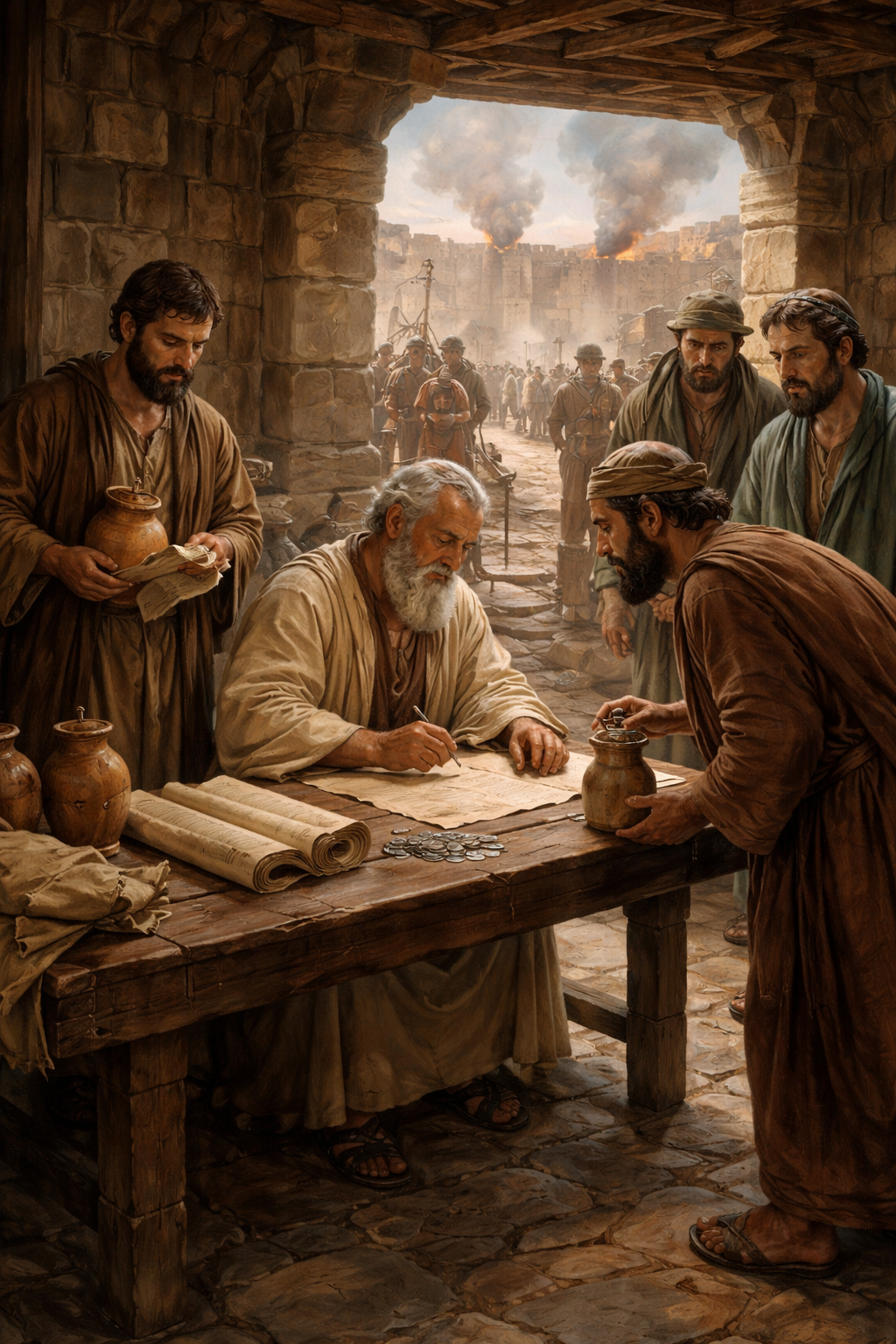
In that setting, the LORD tells Jeremiah that Hanameel, the son of Shallum his uncle, will come and ask him to buy a field in Anathoth, because the right of redemption belongs to him. When Hanameel comes exactly as the LORD had said, Jeremiah recognizes that “this was the word of the LORD.” He then purchases the field, weighs out the money, subscribes the evidence, seals it, takes witnesses, and carefully preserves the deeds in an earthen vessel “that they may continue many days.” This was not a foolish real-estate decision from a human standpoint. The land was in a war zone, the nation was collapsing, and captivity was certain. Yet the purchase was an act of faith in the promise of God that “houses and fields and vineyards shall be possessed again in this land.”
That transaction is one of the clearest acted prophecies in Jeremiah. God had indeed pronounced judgment, and the captivity would come exactly as foretold. But judgment was not the end of the covenant story. The purchase of the field testified that restoration would follow desolation. The land would not remain forever under wrath. The same God who uprooted would also plant again.
After the purchase, Jeremiah prays. His prayer is rich in doctrine. He magnifies the LORD as the Creator: “Ah Lord GOD! behold, thou hast made the heaven and the earth by thy great power and stretched out arm.” He praises God’s mercy and justice, His wisdom, His mighty acts in Israel’s history, and His faithfulness in giving the land. He also honestly acknowledges Judah’s guilt. The people had not obeyed God’s voice, neither walked in His law, and therefore all this evil had come upon them. Jeremiah’s struggle is not with whether God is right, but with how the promise of restoration fits with the immediate command to buy a field while the city is about to fall.
The LORD answers by first declaring His absolute sovereignty: “Behold, I am the LORD, the God of all flesh: is there any thing too hard for me?” He then reaffirms the certainty of judgment. Jerusalem will be given into the hand of the Chaldeans because of the people’s idolatry, apostasy, and provocation. Their houses had been polluted with false worship, they had turned unto God the back and not the face, and they had even caused their sons and daughters to pass through the fire unto Molech. The catastrophe was not arbitrary; it was deserved chastening.
Yet the answer does not end in wrath. God promises to gather His people out of all countries whither He had driven them, to bring them again into the place, and to cause them to dwell safely. He says, “they shall be my people, and I will be their God.” He promises to give them “one heart, and one way,” that they may fear Him forever. He speaks of “an everlasting covenant,” declaring that He will not turn away from doing them good, and that He will put His fear in their hearts so that they shall not depart from Him. The chapter closes with the assurance that fields shall again be bought in the land of Benjamin, in the places about Jerusalem, and in the cities of Judah. So Jeremiah 32 holds together both sides of God’s dealing: real judgment for real sin, and real restoration grounded in God’s covenant mercy.
Jeremiah 33
Jeremiah 33 continues while Jeremiah is still shut up in the court of the prison. The word of the LORD comes to him a second time and begins with a glorious summons: “Call unto me, and I will answer thee, and shew thee great and mighty things, which thou knowest not.” This is not a promise detached from context. It comes in the middle of national ruin, showing that when circumstances are bleakest, the believer is still invited to seek the LORD and hear His sure word.
The chapter first addresses the present devastation of Jerusalem. Houses are being broken down for defense against the siege mounts and the sword. The city is filled with the bodies of men whom God has slain in His anger because of Judah’s wickedness. Yet into that scene the LORD speaks healing: “Behold, I will bring it health and cure, and I will cure them.” He promises to reveal unto them “the abundance of peace and truth.” He will cause the captivity of Judah and Israel to return, cleanse them from all their iniquity, and pardon their sins whereby they had rebelled against Him.
The chapter then paints a future reversal. The very land that seemed desolate, without man and without beast, would again be filled with joy. The “voice of joy” and the “voice of gladness,” the voice of the bridegroom and the bride, and the voice of those saying, “Praise the LORD of hosts: for the LORD is good; for his mercy endureth for ever,” would once more be heard in the cities of Judah and the streets of Jerusalem. This language points beyond a mere political return; it emphasizes restored worship, restored thanksgiving, and restored covenant life centered on the goodness of God.
Jeremiah 33 also returns to the land theme seen in chapter 32. Places that are now desolate will again have shepherds causing their flocks to lie down. The ordinary blessings of settled life—pastures, villages, counted flocks, peaceful habitation—will return. This is a picture of divine reversal: devastation gives way to fruitfulness because the LORD intervenes.
Then the chapter rises to a major messianic promise. “In those days, and at that time, will I cause the Branch of righteousness to grow up unto David.” This Branch “shall execute judgment and righteousness in the land.” Judah shall be saved, and Jerusalem shall dwell safely. The name given is striking: “The LORD our righteousness.” This harmonizes with earlier prophecy in Jeremiah 23 and points to the coming Messiah from David’s line. From a conservative Baptist reading, this finds its ultimate fulfillment in the Lord Jesus Christ, the righteous King, who alone can provide true righteousness for His people and who will yet fulfill every promise made to David.
The LORD then confirms the certainty of His covenant with David and with the Levitical order in language as fixed as creation itself. If one could break God’s covenant of day and night, then might His covenant with David fail. But as long as the created order stands by God’s appointment, His covenant promises remain sure. He will multiply the seed of David and the Levites that minister unto Him. The chapter closes by answering unbelief. Men were saying that the LORD had cast off His people, but God declares the opposite. Just as His ordinances with heaven and earth stand fast, so He will not cast away the seed of Jacob and David His servant. He will cause their captivity to return and have mercy on them.
So Jeremiah 33 is a chapter of hope anchored in God’s character, prayer, covenant faithfulness, cleansing grace, restored worship, and the coming righteous Branch.
Key People and Places
People
Jeremiah
The weeping prophet, imprisoned for faithfully declaring God’s word during the Babylonian siege of Jerusalem. He serves as both preacher and living sign.
Zedekiah
The last king of Judah before Jerusalem’s fall. He rejected Jeremiah’s warnings and represents the failure of Judah’s leadership.
Nebuchadrezzar / Nebuchadnezzar
King of Babylon, God’s instrument of judgment upon Judah because of their sins.
Hanameel
Jeremiah’s cousin, son of Shallum. He comes to Jeremiah offering the field in Anathoth, fulfilling God’s word exactly.
Baruch the son of Neriah
Jeremiah’s faithful scribe and companion. He is entrusted with preserving the purchase deeds in an earthen vessel.
David
Mentioned in covenant promise. He represents the royal line through which the Messiah, the Branch of righteousness, would come.
The Levites / priests
Referenced in the covenant order of worship and ministry, showing God’s continuing concern for ordained worship and service.
Places
Jerusalem
The capital city under siege. It is the immediate setting of these prophecies and symbolizes both judgment and future restoration.
The court of the prison
Where Jeremiah is confined. Even there, God speaks, proving that His word is not bound.
Anathoth
Jeremiah’s hometown in the land of Benjamin. The field Jeremiah buys there becomes a sign of future restoration.
The land of Benjamin
Part of the area specifically mentioned as one day again having bought fields and restored habitation.
The cities of Judah
These are repeatedly mentioned as future sites of restoration, joy, worship, shepherding, and ordinary life.
All countries / lands of dispersion
The places where God would scatter Judah in judgment, yet from which He would gather them again in mercy.
Main Doctrinal or Spiritual Themes
1. God’s sovereignty in judgment
These chapters plainly teach that the fall of Jerusalem was not an accident of politics. It was the hand of God chastening a sinful nation. Babylon was powerful, but only because the LORD had determined to use it.
2. God’s faithfulness to His word
The arrival of Hanameel, the exact details of the purchase, the certainty of captivity, and the certainty of restoration all show that God’s word never fails. What He says in warning comes to pass; what He says in promise also comes to pass.
3. Obedient faith in dark times
Jeremiah’s purchase of the field is a model of faith acting on God’s promise when outward circumstances seem to deny it. Biblical faith does not ignore facts; it obeys God in spite of them.
4. The certainty of future restoration for Israel and Judah
These chapters strongly affirm a future regathering and restoration. God promises to bring them back, cleanse them, and cause them to dwell safely. A straightforward reading sees real national restoration in God’s plan, not merely a vague spiritual idea.
5. The everlasting covenant mercy of God
Jeremiah 32 especially emphasizes God’s gracious purpose to do His people good, to put His fear in their hearts, and not to turn away from them. This highlights divine grace, not human merit.
6. Inner spiritual renewal
God does not merely promise external return to the land. He promises “one heart, and one way,” cleansing from iniquity, pardon, and the fear of God within. True restoration includes inward change.
7. The Messiah as “the Branch of righteousness”
Jeremiah 33 points to the coming Son of David who will rule in righteousness. Conservative Baptist doctrine rightly sees the Lord Jesus Christ in this promise. He is the righteous King and the source of the believer’s righteousness.
8. The LORD as our righteousness
“The LORD our righteousness” is a rich truth. Sinners have no righteousness of their own sufficient before God. Salvation must come by righteousness provided from God Himself. This theme harmonizes beautifully with justification by faith in Christ.
9. Restored worship and joy
The return of praise, thanksgiving, marriage rejoicing, and shepherding shows that God delights not only to forgive but to restore the ordinary blessings of covenant life.
10. The unbreakable character of God’s covenant order
God compares His covenant faithfulness to the fixed ordinances of day and night. His purposes are not fragile. Men may doubt, but God does not forget His promises.
Practical Applications or Lessons
1. Obey God even when circumstances look hopeless
Jeremiah bought a field while the city was falling. Believers today must walk by faith, not by sight. When God’s word is clear, obedience is always right, even when the situation looks impossible.
2. God’s chastening is serious and deserved
Judah’s judgment reminds us that sin is not light. Idolatry, disobedience, and hardheartedness bring real consequences. God is merciful, but He is not indulgent toward rebellion.
3. Prayer should rest on God’s character
Jeremiah’s prayer begins with who God is—Creator, mighty, wise, just, and merciful. Strong prayer is rooted in sound doctrine.
4. Nothing is too hard for the Lord
Jerusalem’s ruin looked final, but God declared otherwise. Believers can trust Him with situations that appear beyond remedy. He is able to judge, restore, cleanse, and fulfill every promise.
5. God’s people need inward change, not merely outward relief
It is not enough to want improved circumstances. The deeper need is a new heart, the fear of God, cleansing from sin, and steadfastness in His ways.
6. Christ is the believer’s righteousness
Jeremiah 33 points us to the only sure standing before God. We are not saved by church attendance, morality, or effort. We need the righteousness of the righteous Branch, the Lord Jesus Christ.
7. The future belongs to God’s promises, not man’s despair
Men in Jeremiah’s day spoke as though God had cast off His people. God answered that unbelieving conclusion with covenant certainty. Believers should measure the future by Scripture, not by appearances.
8. The restoration of joy is a work of grace
God not only rescues from judgment; He restores song, praise, peace, and gladness. When God revives His people, worship becomes lively and thanksgiving becomes natural.
9. Preserve confidence in God’s word during national decline
These chapters were given during collapse. They are especially helpful when society, leadership, and institutions appear to be crumbling. God still reigns, and His word still stands.
10. Faithfulness in confinement is still faithfulness
Jeremiah was in prison, yet fruitful. A believer’s usefulness is not cancelled by limitation, hardship, or opposition. God can speak and work powerfully even in a confined place.
Comments are closed