Chapter Summaries
Isaiah 11 — The Righteous Branch and the Millennial Kingdom
 Isaiah 11 presents one of the clearest Old Testament prophecies of the Messiah’s reign. The chapter begins with the famous prophecy:
“And there shall come forth a rod out of the stem of Jesse, and a Branch shall grow out of his roots” (Isaiah 11:1).
The “stem of Jesse” refers to the royal line of David, which would appear cut down like a tree. Yet from that seemingly dead stump would arise the Messiah. Conservative interpreters consistently understand this “Branch” as the Lord Jesus Christ, the promised Son of David.
The Spirit of the LORD rests fully upon Him:
“The spirit of wisdom and understanding, the spirit of counsel and might, the spirit of knowledge and of the fear of the LORD” (11:2).
Unlike earthly kings who judge by outward appearances, Christ will judge perfectly:
“He shall not judge after the sight of his eyes, neither reprove after the hearing of his ears” (11:3).
His reign will be characterized by righteousness and justice. Wickedness will be destroyed:
“With the breath of his lips shall he slay the wicked” (11:4).
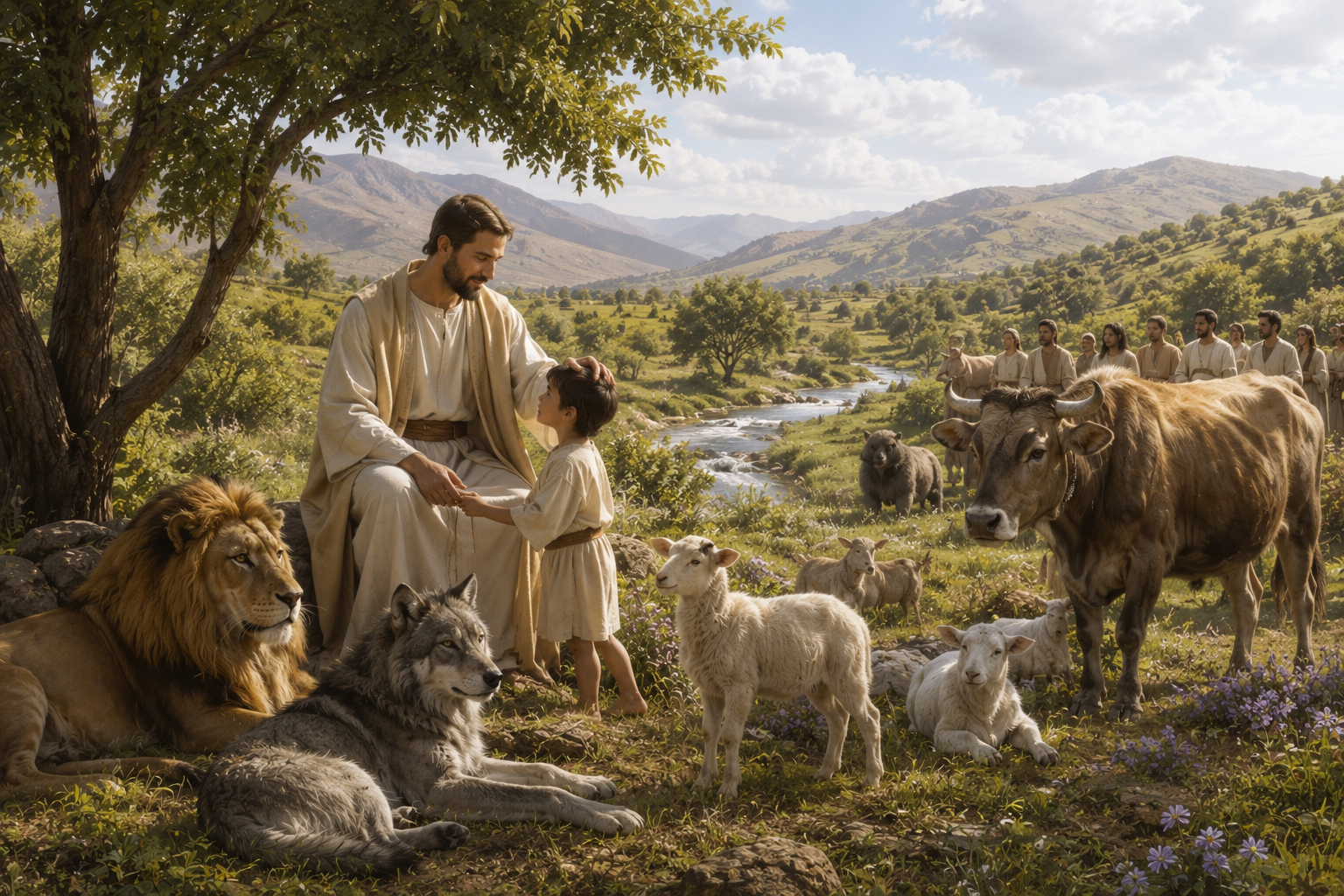
The passage then moves into a description widely understood by conservative Baptist interpreters as the Millennial Kingdom—the thousand-year reign of Christ described in Revelation 20.
Nature itself will be transformed:
“The wolf also shall dwell with the lamb… and a little child shall lead them” (11:6).
Predatory animals will become peaceful, and the curse on creation will be partially lifted. The knowledge of God will fill the earth:
“For the earth shall be full of the knowledge of the LORD, as the waters cover the sea” (11:9).
The Messiah will also gather Israel again:
“And he shall set up an ensign for the nations, and shall assemble the outcasts of Israel” (11:12).
This refers to the final regathering of Israel from all lands, a theme that appears repeatedly in prophetic Scripture.
Isaiah 12 — A Song of Redemption and Praise
Isaiah 12 is a brief but powerful hymn celebrating salvation. It anticipates the joy that will accompany God’s deliverance.
The redeemed say:
“O LORD, I will praise thee: though thou wast angry with me, thine anger is turned away, and thou comfortedst me” (12:1).
This reflects the biblical truth that God’s wrath against sin can be removed through His saving work.
The chapter contains a famous declaration:
“Behold, God is my salvation; I will trust, and not be afraid” (12:2).
The word “salvation” here connects strongly with the name Jesus (Yeshua), meaning “the LORD is salvation.”
Believers are pictured drawing joyfully from God’s provision:
“Therefore with joy shall ye draw water out of the wells of salvation” (12:3).
The chapter closes with a call for worldwide praise:
“Cry out and shout, thou inhabitant of Zion: for great is the Holy One of Israel in the midst of thee” (12:6).
The focus remains on God dwelling among His people.
Isaiah 13 — Judgment on Babylon
Beginning in chapter 13, Isaiah presents a series of prophecies against nations. The first is Babylon.
“The burden of Babylon, which Isaiah the son of Amoz did see” (13:1).
Though Babylon would not reach its greatest power until later, Isaiah prophetically announces its downfall.
God summons armies to execute judgment:
“I have commanded my sanctified ones, I have also called my mighty ones for mine anger” (13:3).
Historically, Babylon fell to the Medes and Persians in 539 BC. The prophecy mentions the Medes specifically:
“Behold, I will stir up the Medes against them” (13:17).
However, parts of the chapter also look beyond that historical fall to a broader prophetic theme known as “the day of the LORD.”
“Howl ye; for the day of the LORD is at hand; it shall come as a destruction from the Almighty” (13:6).
Descriptions of cosmic disturbances and worldwide judgment suggest a future fulfillment connected with the end-time judgment of wicked powers.
Babylon, the symbol of human pride and rebellion against God, will ultimately be destroyed:
“Babylon, the glory of kingdoms… shall be as when God overthrew Sodom and Gomorrah” (13:19).
The city will become desolate.
Isaiah 14 — The Fall of the King of Babylon and the Pride of Lucifer
Chapter 14 continues the theme of Babylon’s downfall but begins with a promise of Israel’s restoration:
“For the LORD will have mercy on Jacob, and will yet choose Israel” (14:1).
Israel will again dwell in the land, and their former oppressors will lose their power.
A taunt song is then directed at the king of Babylon:
“How hath the oppressor ceased! the golden city ceased!” (14:4).
The king who once terrified nations will lie powerless in death.
Midway through the chapter, the language moves beyond a mere human ruler and describes the spiritual power behind him. The famous passage reads:
“How art thou fallen from heaven, O Lucifer, son of the morning!” (14:12).
Lucifer’s pride is expressed through five arrogant declarations:
- “I will ascend into heaven”
- “I will exalt my throne above the stars of God”
- “I will sit also upon the mount of the congregation”
- “I will ascend above the heights of the clouds”
- “I will be like the most High” (14:13–14)
This passage describes the original rebellion of Satan. His pride led to his fall:
“Yet thou shalt be brought down to hell, to the sides of the pit” (14:15).
The chapter concludes with additional prophecies against Assyria and Philistia, demonstrating that all nations stand under God’s authority.
Key People and Places
Isaiah — The prophet delivering God’s messages to Judah.
Jesse — Father of King David; his lineage is the source of the Messianic “Branch.”
The Branch (Messiah) — The promised King, fulfilled in Jesus Christ.
Israel / Jacob — God’s covenant people, who will ultimately be restored.
Babylon — A powerful empire and symbolic center of human pride and rebellion.
Lucifer — The fallen angel whose rebellion against God led to his downfall.
Assyria — A dominant military power used by God as an instrument of judgment.
Philistia — A historic enemy of Israel.
Zion — Jerusalem, representing God’s dwelling among His people.
Main Doctrinal or Spiritual Themes
The Messiah’s Righteous Kingdom
Isaiah 11 reveals Christ as the perfect King who rules in righteousness, wisdom, and justice.
The Restoration of Israel
Prophecy repeatedly affirms God’s continuing purposes for Israel and their future regathering.
The Universal Knowledge of God
During Christ’s reign, the knowledge of the LORD will fill the earth.
The Day of the LORD
Isaiah 13 introduces the theme of divine judgment upon wicked nations and systems.
The Danger of Pride
Lucifer’s fall in Isaiah 14 demonstrates that pride is the root of rebellion against God.
God’s Sovereignty Over Nations
Empires such as Babylon and Assyria rise and fall according to God’s purposes.
Practical Applications or Lessons
God Keeps His Promises
The prophecy of the Branch confirms that God fulfills His covenant promises across centuries.
Christ Is the Only Perfect Ruler
Human governments fail, but Christ’s future reign will establish true justice.
Pride Leads to Destruction
Lucifer’s rebellion illustrates the danger of pride in both individuals and nations.
God Judges Sin
The fall of Babylon reminds believers that wickedness ultimately faces divine judgment.
Salvation Produces Joy and Praise
Isaiah 12 shows that those who experience God’s salvation naturally respond with worship.
Hope for the Future
Believers can look forward to Christ’s coming kingdom, when righteousness and peace will prevail.
Comments are closed