Chapter Summaries
1. The plot against Christ and Judas’ betrayal — Luke 22:1–6
Luke 22 opens near “the feast of unleavened bread”, called “the Passover” (Luke 22:1). This was the sacred Jewish memorial of Israel’s deliverance from Egypt, when the blood of the lamb marked the houses of the obedient Israelites. In God’s providence, Christ, “our passover” (1 Corinthians 5:7), was about to offer Himself as the true Lamb of God.
The chief priests and scribes “sought how they might kill him; for they feared the people” (Luke 22:2). Their problem was not lack of religion, but hatred of the truth. They were outwardly religious, yet inwardly opposed to God’s Son.
Then Satan entered Judas: “Then entered Satan into Judas surnamed Iscariot” (Luke 22:3). Judas was one of the twelve outwardly, but his heart was covetous and unbelieving. He went to the enemies of Christ and “communed with the chief priests and captains, how he might betray him unto them” (Luke 22:4). They covenanted to give him money, and Judas “sought opportunity to betray him unto them in the absence of the multitude” (Luke 22:6).
This passage shows both satanic influence and human responsibility. Judas was not a helpless victim; he willingly yielded himself to wickedness.
2. The preparation for the Passover — Luke 22:7–13
The day came “when the passover must be killed” (Luke 22:7). Jesus sent Peter and John, saying, “Go and prepare us the passover, that we may eat” (Luke 22:8).
The Lord gave exact instructions: they would meet a man bearing a pitcher of water and follow him into a house. There they would find “a large upper room furnished” (Luke 22:12). Everything was already under the Lord’s control. Even as His enemies plotted, Christ was calmly fulfilling the Father’s will.
This scene reminds believers that obedience often begins with simple instruction. Peter and John did not need to understand every detail; they needed to obey the Lord’s word.
3. The Passover and the institution of the Lord’s Supper — Luke 22:14–20
When the hour came, Jesus sat down with the twelve apostles. He said, “With desire I have desired to eat this passover with you before I suffer” (Luke 22:15). His suffering was not accidental. He knew exactly what lay before Him.
The Passover looked backward to Israel’s deliverance from Egypt, but Christ now pointed forward to His own sacrifice. He took bread, gave thanks, brake it, and said, “This is my body which is given for you: this do in remembrance of me” (Luke 22:19). Then He took the cup, saying, “This cup is the new testament in my blood, which is shed for you” (Luke 22:20).
From a conservative Baptist position, the Lord’s Supper is a memorial ordinance, not a saving sacrament. The bread and cup do not become the literal body and blood of Christ. Jesus was physically present when He spoke these words. The ordinance calls believers to remember His bodily sacrifice and shed blood. Salvation is not received by eating bread or drinking from a cup, but by grace through faith in the finished work of Christ.
The phrase “new testament in my blood” shows that redemption rests upon blood atonement. Christ did not come merely to teach, but to die as the sinner’s Substitute.
4. The betrayer revealed and the disciples corrected — Luke 22:21–30
Even at this holy table, betrayal was present. Jesus said, “But, behold, the hand of him that betrayeth me is with me on the table” (Luke 22:21). He then gave one of the clearest statements in Scripture on divine sovereignty and human responsibility: “And truly the Son of man goeth, as it was determined: but woe unto that man by whom he is betrayed!” (Luke 22:22).
Christ’s death was determined in God’s counsel, yet Judas remained guilty for his treachery.
The disciples then fell into strife over “which of them should be accounted the greatest” (Luke 22:24). Jesus corrected their pride by teaching servant leadership: “he that is greatest among you, let him be as the younger; and he that is chief, as he that doth serve” (Luke 22:26). The Lord Himself said, “I am among you as he that serveth” (Luke 22:27).
Christ also promised future kingdom honor to the faithful apostles: “That ye may eat and drink at my table in my kingdom, and sit on thrones judging the twelve tribes of Israel” (Luke 22:30). This preserves the plain distinction between Israel and the church. The twelve tribes are not erased or replaced; God still has future promises connected to Israel in the kingdom.
5. Peter warned, Satan’s sifting, and Christ’s intercession — Luke 22:31–38
Jesus warned Peter: “Simon, Simon, behold, Satan hath desired to have you, that he may sift you as wheat” (Luke 22:31). Satan’s desire was destructive, but he was not sovereign. Christ said, “But I have prayed for thee, that thy faith fail not” (Luke 22:32).
Peter was self-confident: “Lord, I am ready to go with thee, both into prison, and to death” (Luke 22:33). Yet Jesus answered, “the cock shall not crow this day, before that thou shalt thrice deny that thou knowest me” (Luke 22:34).
This passage is sobering and comforting. It warns against self-confidence, but also shows the intercession of Christ. Peter would fall, but he would not be finally abandoned. Jesus said, “when thou art converted, strengthen thy brethren” (Luke 22:32). Here “converted” has the sense of being turned back or restored, not Peter being saved again.
Jesus also told the disciples that conditions would change. Earlier they lacked nothing, but now opposition would intensify. His words about a sword were not a call to advance the gospel by violence, as the rest of the chapter proves. When Peter later used a sword, Jesus stopped the violence and healed the wounded man.
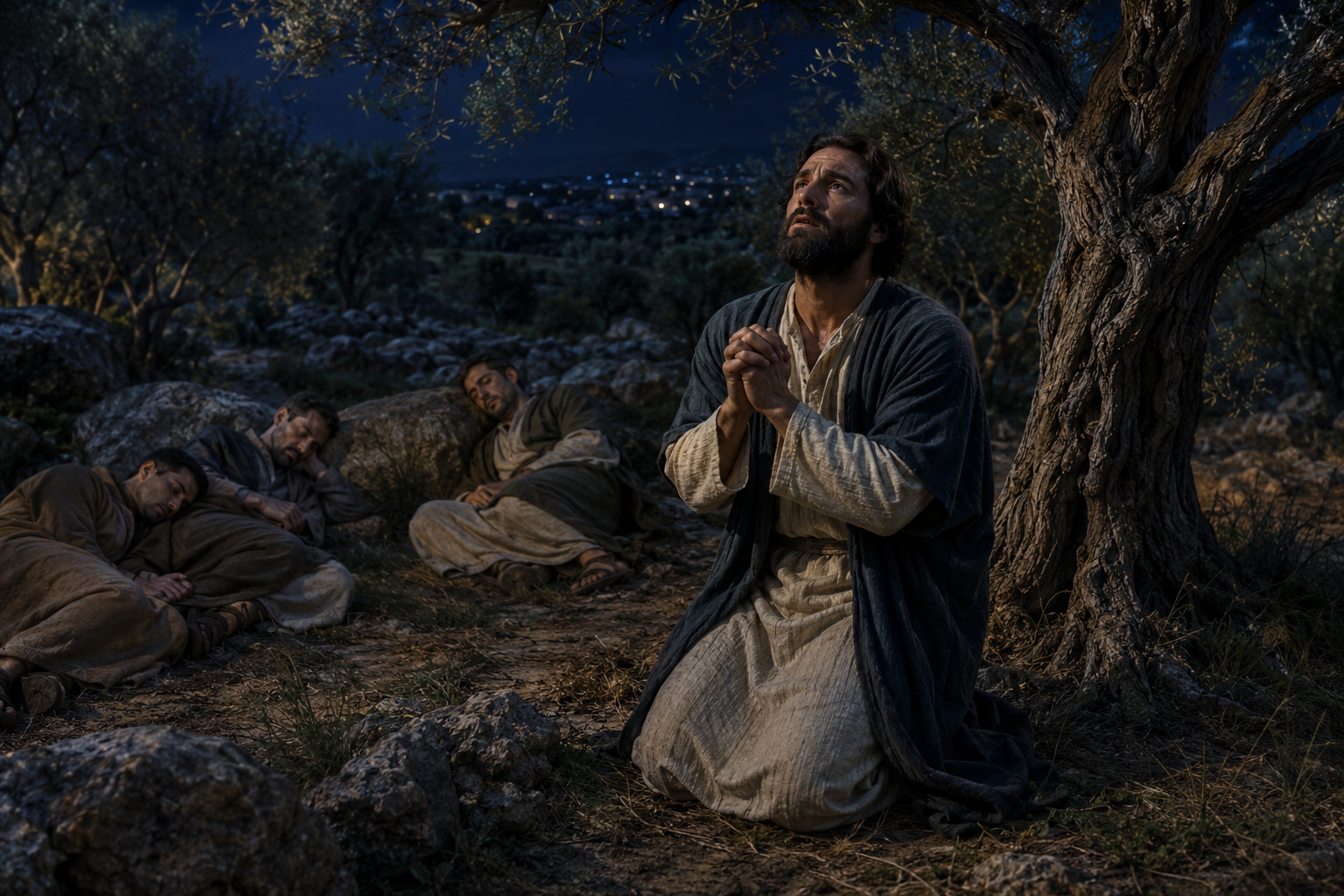
6. Christ’s agony and prayer on the Mount of Olives — Luke 22:39–46
Jesus went to the Mount of Olives, and His disciples followed. He told them, “Pray that ye enter not into temptation” (Luke 22:40). Then  , “Father, if thou be willing, remove this cup from me: nevertheless not my will, but thine, be done” (Luke 22:42).
This is one of the most sacred scenes in Scripture. Christ was not resisting the Father; He was submitting perfectly to Him. The “cup” speaks of the suffering, judgment, and wrath connected with bearing sin. In His holy humanity, the Lord felt the awful weight of what lay ahead.
Luke records, “And being in an agony he prayed more earnestly” (Luke 22:44). An angel strengthened Him, yet the disciples slept “for sorrow” (Luke 22:45). Jesus again commanded, “rise and pray, lest ye enter into temptation” (Luke 22:46).
The lesson is direct: temptation is not overcome by fleshly resolve, but by watchfulness, prayer, and submission to God.
7. The betrayal and arrest of Jesus — Luke 22:47–53
Judas came with a multitude and betrayed Christ with a kiss. Jesus asked, “Judas, betrayest thou the Son of man with a kiss?” (Luke 22:48). The sign of affection became the tool of treachery.
One of the disciples struck the servant of the high priest and cut off his right ear. Jesus answered, “Suffer ye thus far”, and “he touched his ear, and healed him” (Luke 22:51). Even while being arrested, the Lord showed mercy.
Jesus exposed the cowardice and wickedness of His enemies: “When I was daily with you in the temple, ye stretched forth no hands against me” (Luke 22:53). Then He said, “but this is your hour, and the power of darkness” (Luke 22:53).
Darkness was permitted to act, but only within God’s appointed purpose. Christ was not captured because He was powerless. He yielded Himself according to Scripture and the Father’s will.
8. Peter’s denial — Luke 22:54–62
Jesus was taken to the high priest’s house, and Peter followed “afar off” (Luke 22:54). That phrase is spiritually searching. Distance from the Lord often precedes failure.
Peter denied Christ three times. After the third denial, “immediately, while he yet spake, the cock crew” (Luke 22:60). Then comes the piercing statement: “And the Lord turned, and looked upon Peter” (Luke 22:61). Peter remembered the word of the Lord, went out, and “wept bitterly” (Luke 22:62).
Peter’s tears were not the cause of salvation, but they showed godly sorrow and repentance. A true believer may fall grievously, but the Lord’s word, look, and intercession can bring him back.
9. Christ mocked, beaten, and examined before the council — Luke 22:63–71
The men holding Jesus mocked Him, smote Him, blindfolded Him, and demanded, “Prophesy, who is it that smote thee?” (Luke 22:64). Their cruelty revealed the depravity of the human heart.
When day came, He was brought before the elders, chief priests, and scribes. They asked, “Art thou the Christ? tell us” (Luke 22:67). Jesus exposed their unbelief: “If I tell you, ye will not believe” (Luke 22:67).
Then He declared, “Hereafter shall the Son of man sit on the right hand of the power of God” (Luke 22:69). They asked, “Art thou then the Son of God?” He answered, “Ye say that I am” (Luke 22:70). They understood His claim and condemned Him from their own unbelief.
Luke 22 ends with Christ rejected by religious rulers, but heaven’s verdict is unchanged: the suffering Son of man is the Son of God who will sit in power and glory.
Key People and Places
Jesus Christ — The Son of God, the true Passover Lamb, the suffering Saviour, and the coming King.
Judas Iscariot — One of the twelve outwardly, but a betrayer inwardly. Satan entered him, yet Judas acted willingly and wickedly.
Peter — Bold in profession, weak in the flesh, warned by Christ, sifted by Satan, and restored through the Lord’s intercession.
John — Sent with Peter to prepare the Passover.
The twelve apostles — Present at the supper; they struggled with pride and weakness, yet were instructed for future service.
Chief priests and scribes — Religious leaders who plotted Christ’s death while fearing the people.
Captains — Temple officers involved in the arrest plot.
Servant of the high priest — The man whose ear was cut off and healed by Christ.
The people / multitude — A factor in the rulers’ fear; the enemies wanted to arrest Jesus away from public attention.
Jerusalem — The city where the Passover was observed and where Christ would suffer.
The upper room — The prepared place where Jesus ate the Passover and instituted the Lord’s Supper.
Mount of Olives — The place of Christ’s prayer and agony before His arrest.
The high priest’s house — The place where Jesus was taken and where Peter denied Him.
The council — The assembled elders, chief priests, and scribes who questioned and rejected Christ.
Main Doctrinal or Spiritual Themes
1. Christ is the true Passover Lamb.
The chapter is set at Passover, and Christ is moving toward the cross. The Old Testament lamb pointed forward to Him. His blood alone provides redemption.
2. The Lord’s Supper is a memorial ordinance.
Jesus said, “this do in remembrance of me” (Luke 22:19). It is not a sacrifice repeated, nor a sacrament that saves. It is a solemn remembrance for believers of Christ’s body given and His blood shed.
3. Salvation rests upon the blood of Christ.
Jesus said, “This cup is the new testament in my blood, which is shed for you” (Luke 22:20). Biblical salvation is by grace through faith in the finished work of Christ, not by works, rituals, sacraments, or church membership.
4. God’s sovereign plan does not remove man’s responsibility.
Christ said, “the Son of man goeth, as it was determined: but woe unto that man by whom he is betrayed!” (Luke 22:22). God’s purpose stood sure, but Judas was still guilty.
5. Satan is real, active, and malicious.
Satan entered Judas and desired to sift Peter. The chapter gives no room for a merely symbolic devil. Spiritual warfare is real.
6. Christ intercedes for His own.
Jesus said to Peter, “I have prayed for thee, that thy faith fail not” (Luke 22:32). The believer’s security rests not in self-strength, but in the faithful Saviour.
7. The flesh is weak even when intentions are strong.
Peter meant what he said, but he did not know his own weakness. Confidence in self is dangerous.
8. Prayer is necessary in temptation.
Twice Jesus said, “Pray that ye enter not into temptation” (Luke 22:40, 46). Prayer is not optional decoration in the Christian life; it is spiritual necessity.
9. True greatness is service.
Jesus rebuked pride among the apostles and said, “I am among you as he that serveth” (Luke 22:27). Biblical leadership is not self-exaltation, but humble service under God.
10. Christ submitted perfectly to the Father’s will.
His prayer, “nevertheless not my will, but thine, be done” (Luke 22:42), is the perfect model of obedience.
11. Christ’s kingdom promises remain literal.
Jesus spoke of the apostles judging “the twelve tribes of Israel” (Luke 22:30). This supports the plain distinction between Israel and the church and looks forward to Christ’s coming kingdom.
12. Religious opposition can be more dangerous than open paganism.
The chief priests and scribes were religious men, yet they hated Christ. Religion without truth becomes a tool of darkness.
Practical Applications or Lessons
1. Do not mistake religious activity for a right heart with God.
The chief priests were busy with Passover religion while plotting murder. A man may be near religious things and still far from God.
2. Guard the heart against covetousness and secret sin.
Judas did not fall suddenly. His betrayal revealed a heart long given to unbelief and greed.
3. Obey the Lord in the details.
Peter and John prepared the Passover by following Christ’s specific instructions. Faithfulness often begins with simple obedience.
4. Remember Christ’s sacrifice regularly and reverently.
The Lord’s Supper should never become empty routine. It points the believer back to the body given and the blood shed.
5. Reject pride and seek the servant’s place.
The disciples argued over greatness while Christ was going to the cross. Pride is ugly anywhere, but especially among God’s people.
6. Do not trust your own strength.
Peter was sincere, but sincerity without watchfulness failed. The believer must walk humbly.
7. Pray before temptation, not merely after failure.
Jesus told the disciples to pray before the crisis fully came. Many defeats happen because prayer was neglected beforehand.
8. Submit to the will of God even when obedience is costly.
Christ’s submission in the garden is the pattern for all believers: “not my will, but thine, be done.”
9. Do not fight spiritual battles with carnal weapons.
The sword could not accomplish the work of God. Christ’s kingdom advances by truth, prayer, preaching, holiness, and the power of God.
10. Failure should lead to repentance, not despair.
Peter denied the Lord, but he wept bitterly and was later restored. A fallen believer should not excuse sin, but neither should he run from the Saviour.
11. Christ remains holy under mistreatment.
When mocked, beaten, and falsely judged, He did not sin. Believers are called to suffer wrong without becoming wicked themselves.
12. The cross was not a defeat.
Everything in Luke 22 moves toward Calvary by divine appointment. Christ was betrayed, arrested, mocked, and condemned, yet He was fulfilling redemption.
Comments are closed