Chapter Summaries
Luke 14 — Humility, Compassion, and the Cost of Discipleship
 Luke 14 opens with the Lord Jesus entering “into the house of one of the chief Pharisees to eat bread on the sabbath day” (Luke 14:1). The setting is important: He is being watched carefully by religious leaders who are more concerned with accusing Him than learning from Him. A man with “the dropsy” is before Him, and Jesus asks, “Is it lawful to heal on the sabbath day?” The Pharisees hold their peace. Jesus heals the man and then exposes their inconsistency by reminding them that they would rescue an ox or an ass fallen into a pit on the sabbath day. The Lord shows that mercy is not a violation of God’s law.
Jesus then gives instruction about humility. Observing how the guests chose the chief rooms, He teaches that a man should not exalt himself but take the lower room. “For whosoever exalteth himself shall be abased; and he that humbleth himself shall be exalted” (Luke 14:11). This principle runs throughout Scripture: pride brings shame, but humility is honored by God.
The Lord also addresses the host, teaching that hospitality should not be driven by social advantage. Instead of inviting only friends, brethren, kinsmen, or rich neighbours, he should invite “the poor, the maimed, the lame, the blind” (Luke 14:13). Such kindness may not bring earthly repayment, but it will be remembered “at the resurrection of the just.”
A man at the table says, “Blessed is he that shall eat bread in the kingdom of God” (Luke 14:15). Jesus responds with the parable of the great supper. A certain man makes a great supper and invites many, but those first invited make excuses. One has bought land, another has bought oxen, another has married a wife. Their excuses reveal misplaced priorities. The servant is then sent into the streets and lanes to bring in “the poor, and the maimed, and the halt, and the blind.” Still there is room, so the servant is sent into the highways and hedges to “compel them to come in” (Luke 14:23). This does not teach forced conversion, but urgent, earnest Gospel invitation. The rejected invitation warns Israel’s unbelieving religious leaders, while the open invitation shows God’s grace reaching the needy and outcast.
The chapter closes with a sober call to discipleship. Great multitudes follow Jesus, but He warns them that true discipleship requires supreme loyalty to Him. When He says a disciple must “hate” father, mother, wife, children, brethren, sisters, and his own life also, the meaning is not sinful hatred, but that love for Christ must be so supreme that every earthly attachment is secondary. A disciple must bear his cross and come after Christ. Jesus gives the illustrations of a man building a tower and a king going to war, both of whom must count the cost. He ends with the warning that salt which has lost its savour is useless. A disciple without real devotion is like tasteless salt.
Luke 15 — The Lost Sheep, Lost Coin, and Lost Son
Luke 15 begins with publicans and sinners drawing near to hear Jesus. The Pharisees and scribes murmur, saying, “This man receiveth sinners, and eateth with them” (Luke 15:2). What they meant as an accusation is actually a glorious truth. Christ came to seek and to save sinners.
Jesus gives three related parables. First, He speaks of a shepherd who has one hundred sheep and loses one. He leaves the ninety and nine in the wilderness and goes after that which is lost “until he find it” (Luke 15:4). When he finds it, he lays it on his shoulders rejoicing. The lesson is clear: “joy shall be in heaven over one sinner that repenteth” (Luke 15:7). This reveals the seeking heart of the Saviour and the joy of Heaven when a sinner repents.
Second, Jesus speaks of a woman who has ten pieces of silver and loses one. She lights a candle, sweeps the house, and seeks diligently till she finds it. When she finds it, she calls her friends and neighbours to rejoice with her. Again Jesus says, “there is joy in the presence of the angels of God over one sinner that repenteth” (Luke 15:10). The lost coin emphasizes the value of the lost and the diligence of the search.
Third, Jesus gives the account of the lost son, often called the prodigal son. A younger son asks his father for his portion of goods, leaves home, wastes his substance with riotous living, and ends up feeding swine in a far country. For a Jewish hearer, feeding swine would picture deep uncleanness and disgrace. In his misery he comes to himself and says, “I will arise and go to my father” (Luke 15:18). His repentance includes recognition of sin: “Father, I have sinned against heaven, and before thee.”
The father sees him while he is yet a great way off, has compassion, runs, falls on his neck, and kisses him. The son confesses his sin, but the father restores him with the best robe, a ring, shoes, and a feast. “For this my son was dead, and is alive again; he was lost, and is found” (Luke 15:24).
The elder son, however, is angry and refuses to go in. He represents the self-righteous spirit of the Pharisees, who resented grace being shown to sinners. The father pleads with him, reminding him that it was right to rejoice because the lost son had been restored. The chapter strongly magnifies repentance, grace, restoration, and Heaven’s joy over sinners coming home.
Luke 16 — Stewardship, Mammon, and Eternity
Luke 16 begins with the parable of the unjust steward. A rich man hears that his steward has wasted his goods. The steward knows he will lose his position, so he acts quickly and reduces the debts of his lord’s debtors, hoping they will receive him when he is put out of the stewardship. The lord commends the unjust steward, not for dishonesty, but for foresight and prudence. Jesus says, “the children of this world are in their generation wiser than the children of light” (Luke 16:8).
The lesson is not that believers should be dishonest, but that they should use present opportunities with eternity in view. Earthly resources are temporary. God’s people should use what they have for eternal purposes. Jesus teaches, “He that is faithful in that which is least is faithful also in much” (Luke 16:10). Faithfulness in material things reveals spiritual character. The Lord then gives the clear warning: “Ye cannot serve God and mammon” (Luke 16:13). Money is a useful servant but a cruel master.
The Pharisees, “who were covetous,” hear these things and deride Him. Jesus exposes their heart: “Ye are they which justify yourselves before men; but God knoweth your hearts” (Luke 16:15). This is a serious warning against outward religion that hides inward corruption. What is highly esteemed among men may be abomination in the sight of God.
Jesus then speaks of the law and the prophets being until John, and since that time the kingdom of God is preached. He affirms the enduring authority of God’s Word: “it is easier for heaven and earth to pass, than one tittle of the law to fail” (Luke 16:17). He also addresses divorce and remarriage, showing that God’s moral standard remains holy and serious.
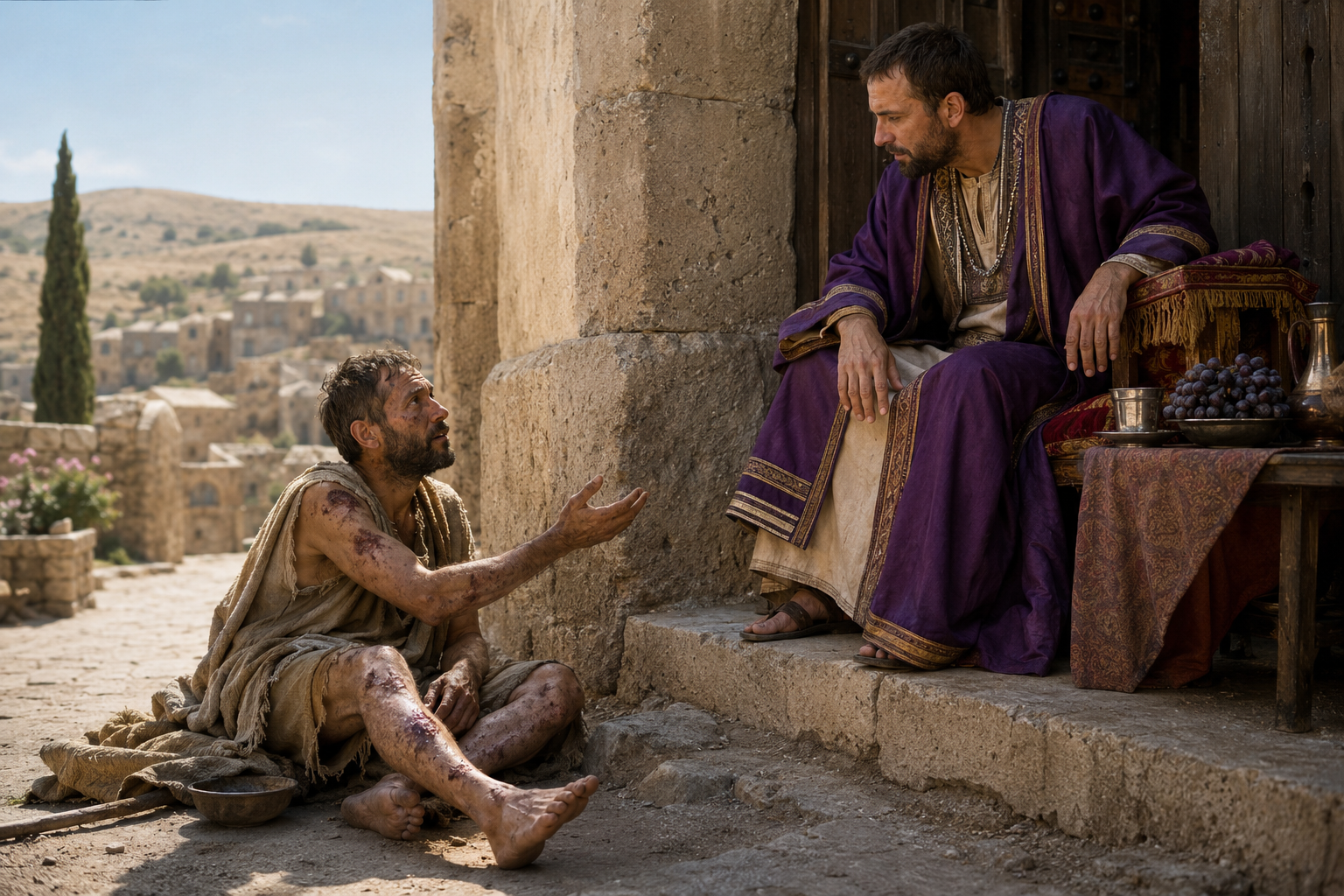
The chapter closes with the account of the rich man and Lazarus. A certain rich man is clothed in purple and fine linen and fares sumptuously every day. A beggar named Lazarus lies at his gate, full of sores, desiring crumbs from the rich man’s table. Both men die. Lazarus is carried by the angels into Abraham’s bosom, while the rich man lifts up his eyes in hell, being in torments.
This passage is best understood as a solemn account, not merely a symbolic parable. Jesus gives the poor man a name, describes conscious existence after death, and teaches the fixed state of the lost. The rich man asks for mercy, but there is a great gulf fixed. He then asks that Lazarus be sent to warn his five brethren, but Abraham answers, “They have Moses and the prophets; let them hear them” (Luke 16:29). When the rich man argues that one rising from the dead would persuade them, Abraham says, “If they hear not Moses and the prophets, neither will they be persuaded, though one rose from the dead” (Luke 16:31).
Luke 16 gives one of Scripture’s clearest warnings about eternity. Riches cannot save. Poverty does not save either. The difference is not money, but one’s relationship to God. The Word of God is sufficient testimony, and rejection of Scripture leaves men without excuse.
Key People and Places
Key People
Jesus Christ — The central Person in all three chapters. He heals, teaches, warns, receives sinners, exposes hypocrisy, and reveals eternal truth.
The chief Pharisee — The host in Luke 14 whose house becomes the setting for Christ’s teaching on mercy, humility, and true hospitality.
The man with dropsy — A sick man healed by Jesus on the sabbath day, demonstrating Christ’s compassion and authority over disease.
The Pharisees and scribes — Religious leaders who watch Jesus, criticize His mercy toward sinners, deride His teaching on money, and represent outward religion without inward humility.
The publicans and sinners — Those despised by the religious elite, yet willing to draw near and hear Jesus. They illustrate the kind of needy sinners Christ came to save.
The shepherd — In the parable of the lost sheep, he pictures the seeking love and care of the Lord for the lost.
The woman with the lost silver — She illustrates diligent searching and the joy of recovering what was lost.
The younger son — The prodigal, who pictures a sinner brought low by sin, awakened to repentance, and restored by grace.
The father — A picture of gracious reception, compassion, forgiveness, and restoration.
The elder son — A picture of self-righteous resentment, especially like the Pharisees who objected to grace being shown to sinners.
The unjust steward — A dishonest but shrewd servant used by Jesus to teach prudence, stewardship, and the wise use of present opportunity.
The rich man — A man who lived in luxury but died lost, entering conscious torment. He is a warning against neglecting God while enjoying earthly comfort.
Lazarus — A poor beggar who suffered in life but was comforted after death. His name means “God is my help,” fitting the spiritual emphasis of the account.
Abraham — Seen in Luke 16 as speaking from the place of comfort, representing covenant promise and the testimony of the Old Testament Scriptures.
Key Places
House of the chief Pharisee — The setting of Luke 14, where Jesus heals on the sabbath and teaches about humility, hospitality, and the great supper.
The streets and lanes of the city — In the parable of the great supper, these represent the needy and outcast who are invited when the first invited guests refuse.
The highways and hedges — Places beyond the city, showing the widening invitation of grace to those outside expected religious circles.
The far country — In Luke 15, the place where the younger son wastes his substance. It represents distance from the father, sinful independence, and spiritual ruin.
The father’s house — The place of repentance, restoration, forgiveness, and joy.
The rich man’s gate — The place where Lazarus lay in suffering, showing the rich man’s daily opportunity to show mercy.
Abraham’s bosom — The place of comfort for the righteous dead before Christ’s finished resurrection victory, emphasizing blessing, rest, and fellowship.
Hell — The place of conscious torment for the lost. Luke 16 presents it as real, terrible, and irreversible.
Main Doctrinal or Spiritual Themes
1. Mercy is consistent with true holiness
Jesus healing on the sabbath shows that God’s law was never opposed to mercy. The Pharisees had added man-made traditions and missed the heart of God. True holiness is not cold, harsh, or indifferent to suffering.
2. Pride is condemned; humility is honored
Luke 14:11 gives the principle: “whosoever exalteth himself shall be abased; and he that humbleth himself shall be exalted.” God resists pride and honors humility. This applies to salvation, service, church life, and daily conduct.
3. God’s grace reaches the undeserving
The great supper shows the gracious invitation of God. Those who seemed likely to come refused, while the needy were brought in. Salvation is not earned by status, background, wealth, or religious reputation. It is received by responding to the invitation of grace.
4. Excuses reveal the heart
The invited guests in Luke 14 all had excuses. Land, oxen, and marriage are not sinful in themselves, but when they become reasons for rejecting God’s call, they expose misplaced priorities. Many respectable things can become spiritual hindrances when they stand before obedience to God.
5. True discipleship has a cost
Christ does not hide the demands of following Him. A disciple must love Christ above all, bear his cross, and forsake all that competes with Him. Salvation is by grace through faith, not by works, but discipleship is serious and costly.
6. Christ receives sinners
Luke 15 is one of the clearest passages showing the saving heart of the Lord Jesus. The Pharisees murmured, but Heaven rejoices when sinners repent. Christ does not receive sinners so they may remain in sin; He receives repentant sinners and restores them.
7. Repentance is real and necessary
The lost son “came to himself,” confessed his sin, and returned to the father. Biblical repentance is not merely regret over consequences. It is a change of mind and heart that turns from sin toward God.
8. Restoration brings joy
The shepherd rejoices, the woman rejoices, and the father rejoices. Heaven rejoices over repentance. God’s people should rejoice when sinners are saved and when backsliders return.
9. Self-righteousness is spiritually dangerous
The elder brother was near the house but far from the father’s heart. The Pharisees were religious, but they resented grace. A person can be moral, active, and religious while still proud, bitter, and lost.
10. Stewardship matters
Luke 16 teaches that believers must be faithful with what God entrusts to them. Money, possessions, influence, time, and opportunity are stewardship matters. Faithfulness in small things matters to God.
11. No man can serve two masters
“Ye cannot serve God and mammon” is a direct warning. The issue is not whether a person possesses money, but whether money possesses him. Covetousness is idolatry of the heart.
12. God knows the heart
The Pharisees justified themselves before men, but God knew their hearts. Outward respectability cannot hide inward sin from God. The Lord judges truly.
13. Scripture is sufficient warning
The rich man wanted Lazarus sent back from the dead, but Abraham pointed to “Moses and the prophets.” The Word of God is sufficient. Those who reject Scripture will not be persuaded by signs alone.
14. Death fixes eternal destiny
Luke 16 gives a solemn warning: after death there is no second chance. The great gulf is fixed. This supports the urgency of preaching the Gospel now.
15. Hell is real and conscious
The rich man is in torment, aware, speaking, remembering, and concerned for his brethren. This passage strongly supports the biblical doctrine of conscious punishment after death for the lost.
Practical Applications or Lessons
1. Do not let religious routine make you hard toward people
The Pharisees watched Jesus more than they cared for the sick man. A believer must guard against becoming technically religious but practically cold. Compassion matters.
2. Choose the lower room
A Christian should not live for recognition, titles, seats of honor, or public praise. Let God do the exalting. Humility is safer than self-promotion.
3. Serve those who cannot repay you
Jesus specifically mentions the poor, maimed, lame, and blind. Christian kindness should not be limited to those who can return the favor.
4. Beware of respectable excuses
The excuses in Luke 14 were ordinary life matters. Work, possessions, family, and responsibilities can become spiritually dangerous when they keep a person from obeying God.
5. Count the cost of following Christ
True Christian living is not casual attachment to Jesus. He must have first place. A believer should be willing to obey Christ even when it costs comfort, approval, or earthly advantage.
6. Keep a burden for the lost
Luke 15 shows the value of one lost soul. The shepherd seeks one sheep. The woman seeks one coin. Heaven rejoices over one sinner that repenteth. Churches should never become indifferent to evangelism.
7. Come home when you have sinned
The prodigal did not improve himself in the far country. He arose and returned to his father. A backslider should not stay away in shame and pride. Confession and return are the right path.
8. Rejoice when sinners repent
The elder brother’s spirit still appears when people resent grace shown to others. God’s people should rejoice when anyone is saved, restored, forgiven, or helped.
9. Use money for eternal purposes
Money cannot be taken beyond the grave, but it can be used now in ways that bear eternal fruit: supporting missions, helping the needy, strengthening Gospel work, and serving others.
10. Be faithful in little things
Small duties reveal character. Faithfulness in finances, time, speech, private conduct, and church responsibilities matters before God.
11. Do not serve mammon
A believer must not let money become master. Contentment, generosity, honesty, and eternal priorities protect the heart from covetousness.
12. Remember that God sees beneath appearances
Men may praise outward success, but God weighs the heart. A person may look impressive to society and still be spiritually bankrupt.
13. Take Hell seriously
Luke 16 is not a passage to soften or explain away. It should stir compassion, urgency, and evangelistic concern. The lost need the Gospel now.
14. Trust the authority of Scripture
The rich man’s brothers had “Moses and the prophets.” Today we have the completed Word of God. Scripture is the sufficient message God has given for warning, conviction, and salvation.
15. Prepare for eternity
The rich man had luxury but was not ready to meet God. Lazarus suffered but was received into comfort. Earthly condition is temporary; eternity is forever.
Conservative Baptist Emphasis
Luke 14–16 strongly presents man’s responsibility before God, the grace of Christ toward sinners, the necessity of repentance, and the reality of eternal judgment. These chapters should not be reduced to social lessons only. They contain searching doctrine: the danger of pride, the emptiness of self-righteous religion, the urgency of Gospel invitation, the cost of discipleship, the joy of repentance, the stewardship of earthly possessions, and the fixed reality of Heaven and Hell.
The Lord Jesus is seen as compassionate toward the helpless, gracious toward sinners, firm toward hypocrites, and faithful in warning men about eternity. These chapters call the believer to humility, separation from covetousness, earnest evangelism, and serious discipleship.
Comments are closed