Chapter Summaries
Luke 20 — Christ’s Authority Challenged and Vindicated
 Luke 20 takes place in Jerusalem during the final public days of the Lord Jesus before His crucifixion. The setting is the temple, where He is teaching the people and preaching the gospel. The chief priests, scribes, and elders confront Him, asking, “Tell us, by what authority doest thou these things? or who is he that gave thee this authority?” (Luke 20:2). Their question is not honest inquiry but hostile resistance. They had rejected John the Baptist, and now they reject Christ.
Jesus answers by asking whether John’s baptism was “from heaven, or of men” (Luke 20:4). Their refusal to answer exposes their unbelief and political fear. This teaches that unbelief is often not caused by lack of evidence, but by refusal to submit to truth already given.
The Lord then gives the parable of the wicked husbandmen. A man plants a vineyard and lets it out to husbandmen. When he sends servants to receive fruit, they are beaten and mistreated. At last he sends his beloved son, saying, “It may be they will reverence him when they see him” (Luke 20:13). But they kill the son. This plainly pictures Israel’s religious rulers rejecting the prophets and finally rejecting the Son of God. Jesus applies Psalm 118: “The stone which the builders rejected, the same is become the head of the corner” (Luke 20:17). Christ is rejected by men but chosen and exalted by God.
This does not mean the Church replaces Israel. Rather, unbelieving Israel’s leaders are judged, while God’s covenant purposes for Israel remain and will be fulfilled according to prophecy.
The rulers then send spies to trap Him with a political question about tribute to Caesar. Jesus asks for a penny and says, “Render therefore unto Caesar the things which be Caesar’s, and unto God the things which be God’s” (Luke 20:25). This teaches lawful civil responsibility, but also the higher claim of God upon man.
The Sadducees, who deny the resurrection, then try to ridicule the doctrine by asking about a woman who had seven husbands. Jesus corrects their false reasoning and teaches that in the resurrection men “neither marry, nor are given in marriage” (Luke 20:35). He proves resurrection from Moses, saying God is “not a God of the dead, but of the living: for all live unto him” (Luke 20:38). Resurrection is not a vague spiritual idea, but a certain biblical truth.
Jesus then asks how Christ can be both David’s Son and David’s Lord. He cites David’s words: “The LORD said unto my Lord, Sit thou on my right hand” (Luke 20:42). This proves the Messiah is truly man, David’s Son, and truly God, David’s Lord.
The chapter closes with a warning against the scribes, who loved religious display, honor, and long prayers, while they “devour widows’ houses” (Luke 20:47). Christ condemns hypocritical religion that uses godliness for gain.
Luke 21 — The Widow’s Mites, Jerusalem’s Judgment, and Christ’s Return
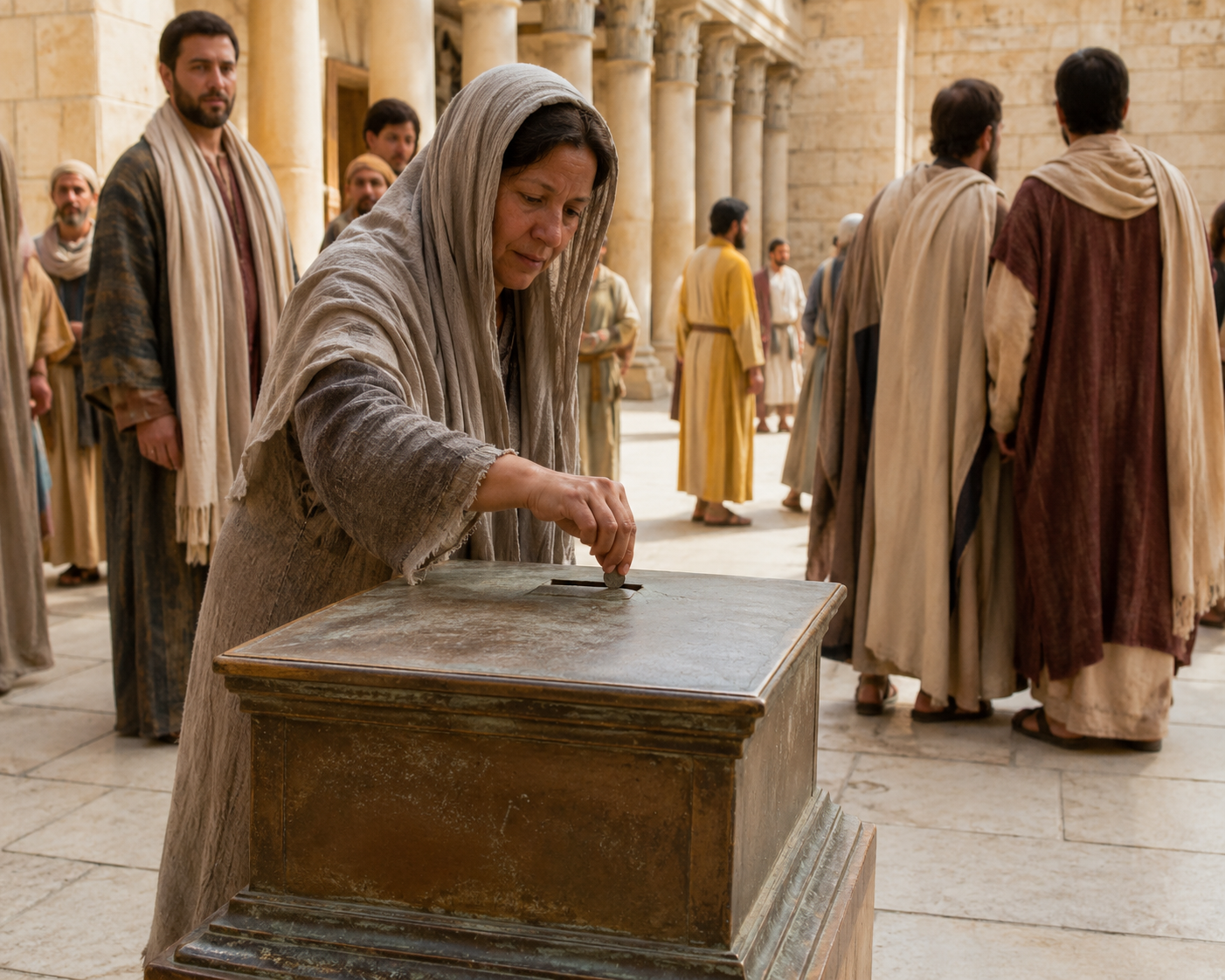
Luke 21 begins with Jesus observing the giving in the temple. Rich men cast in gifts, but a poor widow gives two mites. Jesus says, “Of a truth I say unto you, that this poor widow hath cast in more than they all” (Luke 21:3). God measures giving not merely by amount, but by sacrifice, faith, and heart. She gave “all the living that she had” (Luke 21:4).
Some then speak of the beauty of the temple. Jesus answers with a sobering prophecy: “the days will come, in the which there shall not be left one stone upon another, that shall not be thrown down” (Luke 21:6). This was fulfilled in the destruction of Jerusalem by Rome in A.D. 70, but the chapter also stretches forward to end-time events connected with Israel, Jerusalem, and the coming of the Son of man.
The disciples ask, “Master, but when shall these things be? and what sign will there be when these things shall come to pass?” (Luke 21:7). Jesus warns first against deception: “Take heed that ye be not deceived” (Luke 21:8). False Christs, wars, commotions, earthquakes, famines, pestilences, and fearful sights will come, but believers are not to be shaken by every crisis as though the end has immediately arrived.
Christ also warns of persecution. His followers will be delivered to synagogues, prisons, kings, and rulers for His name’s sake. Yet He says, “It shall turn to you for a testimony” (Luke 21:13). Persecution becomes a platform for witness. The promise, “In your patience possess ye your souls” (Luke 21:19), speaks of faithful endurance, not works-based salvation.
Jesus then gives a specific warning concerning Jerusalem: “And when ye shall see Jerusalem compassed with armies, then know that the desolation thereof is nigh” (Luke 21:20). Those in Judaea are told to flee. This had a near fulfillment in the Roman destruction of Jerusalem, yet the language also looks forward to continuing Gentile domination: “Jerusalem shall be trodden down of the Gentiles, until the times of the Gentiles be fulfilled” (Luke 21:24). From a dispensational Baptist perspective, this keeps Israel central in prophecy and does not merge Israel into the Church.
The Lord then describes signs in the heavens and distress among nations. The climax is not human progress, but the visible return of Christ: “And then shall they see the Son of man coming in a cloud with power and great glory” (Luke 21:27). This is the Second Coming in glory, not the Church’s catching away before the tribulation. The Church is looking for Christ, while Israel and the nations will see these public signs connected with His return to earth.
Jesus gives the parable of the fig tree and all the trees. When they shoot forth, men know summer is near. Likewise, when these prophetic signs come to pass, the kingdom is near. His words are certain: “Heaven and earth shall pass away: but my words shall not pass away” (Luke 21:33). This is a strong testimony to the preservation and authority of the words of God.
The chapter ends with a warning: “And take heed to yourselves” (Luke 21:34). Drunkenness, cares of this life, and spiritual carelessness can dull the soul. The Lord commands watchfulness and prayer: “Watch ye therefore, and pray always” (Luke 21:36). The believer is to live soberly, expectantly, and faithfully.
Key People and Places
Jesus Christ — The central figure of both chapters; the Son of God, David’s Lord, rejected Stone, coming King, and final Judge.
Chief priests, scribes, and elders — The Jewish religious authorities who oppose Christ, question His authority, and seek to destroy Him.
John the Baptist — Referenced by Christ as a test of the rulers’ honesty. Their rejection of John exposed their rejection of God’s authority.
The wicked husbandmen — A picture of Israel’s rebellious leaders who mistreated God’s messengers and rejected His Son.
The beloved son — In the parable, a clear picture of Christ, sent by the Father and rejected by the rulers.
Caesar — Represents civil government. Christ teaches lawful duty to government without surrendering God’s supreme claim.
The Sadducees — A religious sect denying the resurrection. Jesus rebukes their error and proves resurrection from Scripture.
David — Israel’s king and inspired psalmist. Jesus uses David’s words to show that Messiah is both David’s Son and David’s Lord.
The poor widow — A humble woman whose sacrificial giving is honored by Christ above the larger gifts of the rich.
Jerusalem — The city central to Israel’s worship, rejection of Christ, coming judgment, and future prophetic fulfillment.
The temple — The place of public teaching and religious conflict. Its coming destruction shows God’s judgment on empty religion and rejected light.
Judaea — The region warned to flee when Jerusalem is surrounded by armies.
The Gentiles — Connected with the phrase “the times of the Gentiles”; Gentile dominion over Jerusalem continues until God’s appointed time is fulfilled.
Main Doctrinal or Spiritual Themes
1. The Authority of Christ
Christ does not receive authority from men. His authority is from heaven. The religious rulers wanted to examine Him, but in truth, He examined them. Every soul must answer whether Christ is Lord or merely a religious figure. The Bible presents Him as Lord.
2. The Rejection and Exaltation of the Messiah
The parable of the wicked husbandmen shows man’s rebellion against God’s messengers and God’s Son. Yet the rejected Stone becomes “the head of the corner.” Calvary was not defeat; it was God’s ordained means of redemption.
3. Israel’s Responsibility and Future
Luke 20–21 deals heavily with Israel, Jerusalem, the temple, and Jewish leadership. A sound dispensational reading keeps Israel and the Church distinct. Israel’s unbelief brought judgment, but God has not cancelled His prophetic promises to Israel.
4. The Resurrection
Jesus plainly defends resurrection against the Sadducees. Death does not end existence. God is “not a God of the dead, but of the living.” The believer’s hope is not merely influence, memory, or morality, but bodily resurrection and life with God.
5. Separation from Religious Hypocrisy
The scribes had outward religion but inward corruption. They loved robes, greetings, chief seats, and long prayers, but oppressed widows. God hates religious pretense. True godliness is humble, honest, and obedient.
6. Sacrificial Giving
The widow’s mites teach that God sees the heart. Giving is not measured only by public amount, but by private sacrifice. Her gift was small in man’s eyes but great in Christ’s eyes.
7. Prophecy and the Certainty of Christ’s Return
Luke 21 teaches that history is moving according to God’s prophetic plan. Jerusalem’s destruction, Gentile dominion, world trouble, deception, and persecution all point to the need for watchfulness. Christ will come “with power and great glory.”
8. The Preservation of Christ’s Words
Jesus said, “Heaven and earth shall pass away: but my words shall not pass away.” The words of Christ are more enduring than creation itself. This supports full confidence in the preserved Word of God.
9. Watchfulness and Prayer
The Lord’s people must not be overcome with drunkenness, worldliness, fear, or the cares of this life. The proper posture is watching, praying, witnessing, and remaining faithful.
Practical Applications or Lessons
First, do not question God’s authority when He has already spoken. The rulers asked Christ about authority, but their real problem was rebellion. A believer should come to Scripture with submission, not suspicion.
Second, beware of religious pride. Long prayers, outward appearance, titles, and public honor do not prove spirituality. Christ sees whether a man is humble, honest, and obedient.
Third, give God what belongs to God. Jesus said to render unto Caesar what is Caesar’s, but the deeper issue is rendering unto God what is God’s. Man bears God’s image and owes Him worship, obedience, faith, and surrender.
Fourth, hold firmly to the resurrection. The Sadducees erred because they denied supernatural truth. Christianity stands upon the living God, the risen Christ, and the future resurrection of the dead.
Fifth, measure giving by faithfulness, not comparison. The widow did not give much in the eyes of men, but she gave greatly in the eyes of Christ. God honors sacrifice.
Sixth, do not be deceived by false teachers or prophetic sensationalism. Jesus said, “Take heed that ye be not deceived.” The believer must test teaching by Scripture, not emotion, trends, or fear.
Seventh, use persecution as testimony. Christ said trials would “turn to you for a testimony.” Opposition is not a reason to quit; it is an opportunity to witness.
Eighth, remember that earthly structures pass away. The temple was magnificent, but it was destroyed. Buildings, nations, and institutions can fall, but Christ’s words shall not pass away.
Ninth, live ready for the Lord. Luke 21 ends with watchfulness and prayer. The Christian life is not careless ease, but sober expectation, holy living, and faithful service.
Website Tags
Luke 20, Luke 21, King James Bible, KJV, Jesus Christ, Jerusalem, Temple, Chief Priests, Scribes, Elders, John the Baptist, Wicked Husbandmen, Vineyard Parable, Rejected Stone, Caesar, Tribute Money, Sadducees, Resurrection, David, Messiah, David’s Lord, Poor Widow, Widow’s Mites, Mount of Olives, Judaea, Times of the Gentiles, Son of Man, Second Coming, Bible Prophecy, Israel, Dispensational Theology, Conservative Baptist, Independent Baptist, Gospel of Luke, KJV Bible Study, End Times, Watch and Pray, Biblical Giving, Religious Hypocrisy, Authority of Christ, Preservation of Scripture, Heaven and Earth Shall Pass Away, My Words Shall Not Pass Away
Comments are closed