Luke 8-9: Christ’s Authority and the Cost of Following Him
 Luke 8-9 presents the authority of Jesus Christ over nature, devils, disease, and death. Alongside these mighty works, Jesus teaches the importance of receiving God’s Word, exercising faith, and following Him with humility and steadfast devotion. Peter identifies Him as “The Christ of God,” and the Father declares, “This is my beloved Son: hear him” (Luke 9:20, 35).
These chapters also bring Christ’s approaching suffering into clear focus. The One who feeds the multitude and reveals His glory declares that He must be rejected, slain, and raised the third day. His followers must hear both His promises and His call to daily self-denial.
Chapter Summaries
Luke 8: Hearing God’s Word and Witnessing Christ’s Power
Women minister to Jesus – Luke 8:1-3
Jesus travels through cities and villages, “preaching and shewing the glad tidings of the kingdom of God.” The twelve accompany Him, together with women who had been healed of evil spirits and infirmities.
Luke names Mary Magdalene, out of whom seven devils had departed; Joanna, the wife of Chuza, Herod’s steward; and Susanna. These women and others minister to Jesus “of their substance.”
Their service demonstrates the practical importance of supporting the Lord’s work with material resources. Scripture does not identify Mary Magdalene as a prostitute or connect her explicitly with the unnamed woman in Luke 7. Her stated background here is deliverance from seven devils.
The sower and the responsibility of hearing – Luke 8:4-18
Jesus describes seed falling by the wayside, upon a rock, among thorns, and on good ground. He supplies the controlling interpretation: “The seed is the word of God” (Luke 8:11).
The four conditions describe different responses to that Word:
- The wayside: The devil takes away the Word from their hearts, “lest they should believe and be saved” (Luke 8:12).
- The rock: These hearers receive the Word with joy but have no root. They “for a while believe, and in time of temptation fall away” (Luke 8:13).
- The thorns: These hearers are choked by “cares and riches and pleasures of this life” and bring no fruit to perfection (Luke 8:14).
- The good ground: These hearers receive the Word in an honest and good heart, keep it, and “bring forth fruit with patience” (Luke 8:15).
The passage distinguishes hearing, temporary response, competing interests, and enduring fruitfulness. It does not explicitly call the rocky-ground hearers born-again people who subsequently lose eternal life. That claim should not be added to the text. Christ’s promise concerning the security of His sheep must also be considered when discussing salvation (John 10:27-29).
Jesus then describes a lighted candle placed where its light can be seen and warns that hidden things will be made manifest. His command, “Take heed therefore how ye hear,” makes personal responsibility central to the passage (Luke 8:18).
Christ’s mother and brethren – Luke 8:19-21
When Jesus is told that His mother and brethren desire to see Him, He answers, “My mother and my brethren are these which hear the word of God, and do it.”
Jesus identifies His spiritual family by its response to God’s Word. Family connections cannot substitute for personal faith and obedience. The passage does not say that Jesus ceased to care for His earthly family.
Jesus stills the storm – Luke 8:22-25
While Jesus and His disciples cross the lake, He falls asleep. A storm fills their vessel with water, and Luke states that they are “in jeopardy.”
The disciples awaken Him, crying, “Master, master, we perish.” Jesus rebukes the wind and raging water, and there is a calm. He then asks, “Where is your faith?”
The danger was real, and Christ’s authority was sufficient. His sleep shows a genuine feature of His humanity; His command over the storm displays extraordinary authority over creation. The disciples respond with fear and wonder as they consider who He is.
Deliverance in the country of the Gadarenes – Luke 8:26-39
Across from Galilee, Jesus encounters a man possessed by many devils. The name “Legion” is explained by the text: “because many devils were entered into him” (Luke 8:30). Luke does not give their exact number.
The devils recognize Jesus as the “Son of God most high.” Their recognition should not be confused with saving faith; James 2:19 likewise distinguishes the devils’ belief from obedient faith.
With Christ’s permission, the devils enter a herd of swine, which rush into the lake and perish. The people afterward find the man “sitting at the feet of Jesus, clothed, and in his right mind” (Luke 8:35).
The surrounding multitude asks Jesus to depart because they are overcome with fear. Scripture explicitly gives fear as the reason; it does not explicitly say that financial resentment motivated their request.
The delivered man desires to remain with Jesus, but the Lord sends him home to declare what God has done. He obeys by publishing throughout the city what Jesus has done for him. His testimony begins among people in his own community.
A suffering woman healed and Jairus’ daughter raised – Luke 8:40-56
Jairus, a ruler of the synagogue, falls at Jesus’ feet and pleads for his only daughter, about twelve years old, who is dying.
During the journey, a woman who has suffered an issue of blood for twelve years touches the border of Jesus’ garment and is immediately healed. Before the people, she declares why she touched Him and how she was healed. Jesus tells her, “Daughter, be of good comfort: thy faith hath made thee whole; go in peace” (Luke 8:48).
News then arrives that Jairus’ daughter has died. Jesus tells him, “Fear not: believe only, and she shall be made whole” (Luke 8:50).
At the house, Jesus says that she sleeps. This does not mean that she was merely unconscious: Luke states that the people knew she was dead and that, at Christ’s command, “her spirit came again, and she arose straightway” (Luke 8:55). Jesus then commands that she be given food.
The account displays both His power over death and His attention to an ordinary physical need. His promise to Jairus concerns this particular event; it is not a blanket promise that every believer’s illness or bereavement will be reversed immediately. biblehub.com
Luke 9: The Identity of Christ and the Demands of Discipleship
The twelve are sent out – Luke 9:1-6
Jesus gives the twelve power and authority over devils and diseases and sends them to preach the kingdom of God and heal the sick. Their authority comes from Him.
His instructions concerning provisions and lodging govern this particular mission. They should not be turned into a universal prohibition against preparing for ministry travel, especially since Jesus gives different instructions concerning provisions in Luke 22:35-36.
Those who refuse the messengers are given a solemn testimony against them through the shaking off of dust. The disciples depart, “preaching the gospel, and healing every where.”
Herod’s perplexity – Luke 9:7-9
Herod hears reports about Jesus and is troubled by conflicting explanations. Some say John has risen; others suggest Elias or another ancient prophet.
Herod acknowledges that he beheaded John and desires to see Jesus. The passage records curiosity and perplexity, but it does not state that Herod repents or believes.
Jesus feeds about five thousand men – Luke 9:10-17
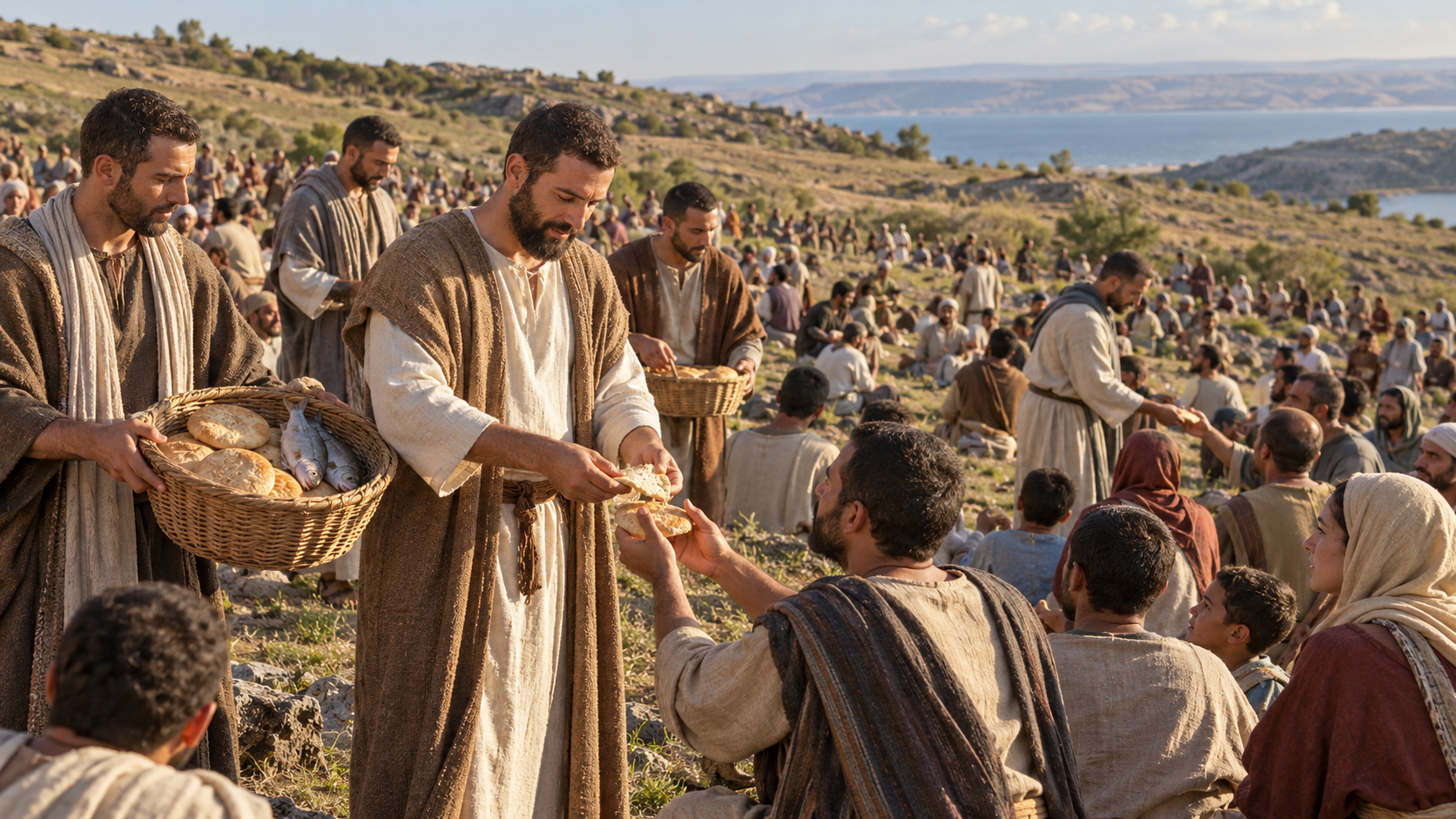
After the apostles return, Jesus withdraws with them to a desert place belonging to Bethsaida. When the people follow, He receives them, teaches them about God’s kingdom, and heals those needing healing.
As the day declines, the disciples propose sending the multitude away for food and lodging. Jesus answers, “Give ye them to eat” (Luke 9:13).
With five loaves and two fishes, He feeds about five thousand men. The disciples arrange the people in companies of fifty and distribute the food Jesus provides. All eat and are filled, and twelve baskets of fragments remain.
The provision comes from Christ; the disciples serve by carrying out His instructions. The text records a miraculous provision, not merely an example of people sharing food they had concealed.
Peter’s confession and Christ’s coming suffering – Luke 9:18-22
Jesus asks His disciples who the people say He is, then makes the question personal: “But whom say ye that I am?”
Peter answers, “The Christ of God” (Luke 9:20).
Jesus commands them not to announce this and declares that the Son of man must suffer, be rejected by the elders, chief priests, and scribes, be slain, and be raised the third day.
His suffering does not contradict His identity as the Christ. Jesus Himself declares both His identity and the necessity of His death and resurrection.
Daily self-denial and eternal priorities – Luke 9:23-27
Jesus says:
“If any man will come after me, let him deny himself, and take up his cross daily, and follow me” (Luke 9:23).
Following Christ involves surrendering self-rule and remaining faithful to Him even when obedience is costly. The word “daily” makes this an ongoing responsibility.
Jesus also asks what advantage a person gains by obtaining the whole world while losing himself or being cast away. Material success cannot compensate for spiritual ruin.
His warning against being ashamed of Him and His words includes a declaration of His future coming in glory. Christian discipleship therefore looks beyond present approval to Christ’s judgment and glory.
The transfiguration – Luke 9:28-36
About eight days after these sayings, Jesus takes Peter, John, and James up a mountain to pray. As He prays, His appearance changes, and His clothing becomes “white and glistering.”
Moses and Elias appear in glory and speak with Him about “his decease which he should accomplish at Jerusalem” (Luke 9:31). Even in this manifestation of glory, His approaching death remains central.
Peter proposes three tabernacles, but Luke adds that he did not know what he was saying. A cloud overshadows them, and a voice declares:
“This is my beloved Son: hear him” (Luke 9:35).
The Father’s command directs attention to Jesus. Luke does not name the mountain, so a particular identification should not be presented as a biblical fact.
A child delivered and another announcement of suffering – Luke 9:37-45
The following day, a father pleads for his only child, whom an unclean spirit afflicts. The disciples have been unable to cast it out.
Jesus rebukes the unclean spirit, heals the child, and delivers him to his father. The people marvel at God’s mighty power.
While they are amazed, Jesus again speaks of being delivered into men’s hands. The disciples do not understand; Luke says the saying is hidden from them, and they are afraid to ask.
Their failure to understand is explicitly stated. Their precise thoughts and reasons beyond what Luke records should not be supplied.
Humility and the correction of pride – Luke 9:46-50
The disciples reason about which of them should be greatest. Jesus perceives the thought of their heart and sets a child beside Him. He teaches that receiving such a child in His name is receiving Him and the One who sent Him.
He concludes, “he that is least among you all, the same shall be great” (Luke 9:48).
John then reports that they prohibited a man from casting out devils in Jesus’ name because he did not follow with their company. Jesus answers, “Forbid him not: for he that is not against us is for us” (Luke 9:50).
The correction concerns the exclusion John describes. It should not be expanded into permission to disregard false doctrine, which Scripture elsewhere commands believers to reject (Romans 16:17).
Jerusalem, Samaritan rejection, and costly commitment – Luke 9:51-62
Jesus “stedfastly set his face to go to Jerusalem” as the time approaches for Him to be received up (Luke 9:51).
A Samaritan village refuses to receive Him because His face is toward Jerusalem. James and John ask whether they should command fire from heaven. Jesus rebukes them, declaring, “For the Son of man is not come to destroy men’s lives, but to save them” (Luke 9:56). They proceed to another village.
The chapter closes with three encounters concerning following Jesus. He addresses the absence of guaranteed earthly comfort, the priority of proclaiming God’s kingdom, and the danger of looking back after beginning.
One man requests permission to bury his father. Scripture does not explicitly say whether the father had already died or whether the man was requesting an indefinite delay. The certain point is Christ’s command: “go thou and preach the kingdom of God” (Luke 9:60).
Luke does not record the final response of these three individuals. Their subsequent obedience or refusal should not be invented. biblehub.com
Key People and Places
| Person or place | Context |
|---|---|
| Jesus Christ | Preaches God’s kingdom, performs miracles, reveals His glory, and foretells His death and resurrection. |
| The twelve | Accompany Jesus and receive authority for a preaching and healing mission. |
| Mary Magdalene | A woman from whom seven devils had departed; named among those accompanying Jesus. |
| Joanna and Chuza | Joanna ministers from her resources; Chuza, her husband, is Herod’s steward. |
| Susanna | Named among the women supporting Jesus’ ministry. |
| Jesus’ mother and brethren | Seek to see Him while He is surrounded by a crowd. |
| The delivered man | Freed from many devils and sent home to testify about God’s work. |
| Jairus and his daughter | A synagogue ruler and his only daughter, whom Jesus raises from death. |
| The woman with an issue of blood | Healed after twelve years of suffering. |
| Peter, John, and James | Present at the raising of Jairus’ daughter and at the transfiguration. |
| Herod the tetrarch | Acknowledges John’s execution and seeks to see Jesus. |
| Moses and Elias | Appear in glory and speak with Jesus about His death at Jerusalem. |
| Galilee and the lake | Geographic setting associated with the crossing and the country opposite Galilee. |
| The country of the Gadarenes | Location of the deliverance of the man possessed by devils. |
| Bethsaida | City associated with the desert place where Jesus feeds the multitude. |
| The unnamed mountain | Location of the transfiguration. |
| The Samaritan village | Refuses to receive Jesus as He travels toward Jerusalem. |
| Jerusalem | Named in connection with Christ’s approaching death and His determined journey. |
Main Doctrinal or Spiritual Themes
1. The identity and authority of Jesus Christ
Peter confesses Jesus as “The Christ of God,” and the Father identifies Him as His beloved Son. His commands govern the wind, water, devils, disease, and death (Luke 8:24-25, 29-35, 43-55; 9:20, 35).
These events agree with the wider KJV testimony that Jesus Christ is God manifest in the flesh and the Creator of all things (John 1:1-3, 14).
2. The Word of God and saving faith
Jesus directly connects believing with being saved in Luke 8:12. The parable emphasizes the importance of receiving and keeping God’s Word.
Salvation is by grace through faith, not earned by works (Ephesians 2:8-9). Good works belong to the life God intends for the saved (Ephesians 2:10). Fruitfulness must therefore be taught as the outworking of spiritual life, not the purchase price of salvation.
3. Christ’s death and resurrection
Jesus explicitly announces His death and resurrection, while Moses and Elias speak with Him about His approaching death at Jerusalem (Luke 9:22, 31, 44).
The saving significance of that death is stated elsewhere: Christ “died for our sins according to the scriptures” and rose again the third day (1 Corinthians 15:3-4). His miracles should never displace His redemptive work from the center of gospel preaching.
4. The reality of spiritual opposition
The devil opposes the reception of God’s Word, and unclean spirits afflict people (Luke 8:12, 27-33; 9:38-42). These are presented as real spiritual beings.
However, these accounts do not authorize believers to label every illness as demonic. Luke distinguishes diseases from devils when describing the authority given to the twelve (Luke 9:1).
5. Humility, obedience, and daily discipleship
Hearing must lead to doing, and following Christ requires self-denial rather than competition for prominence (Luke 8:21; 9:23, 46-48).
The call to take up the cross must not be reduced to a promise of comfort or prosperity. Christ requires allegiance even when faithfulness brings loss.
6. Mercy without doctrinal compromise
Jesus rebukes the disciples’ desire to destroy the Samaritan villagers and corrects their attempt to forbid another man’s work merely because he is outside their company (Luke 9:49-56).
Believers must reject vindictiveness and personal rivalry while continuing to obey Scripture’s commands concerning truth and separation from false teaching (Romans 16:17; 2 John 9-11).
Practical Applications or Lessons
- Examine how you hear Scripture. Ask whether you are keeping God’s Word or allowing temptation, anxiety, wealth, and pleasure to choke its influence (Luke 8:11-18).
- Support gospel ministry practically. The women who ministered from their substance provide a direct example of using material resources in the Lord’s service (Luke 8:1-3).
- Trust Christ in genuine danger. The storm account encourages confidence in His authority. It does not promise believers a life without storms or guarantee immediate deliverance from every difficulty (Luke 8:22-25).
- Tell others what the Lord has done. The delivered man’s commission shows the value of testimony within one’s own home and community (Luke 8:38-39).
- Bring your needs to the Lord. Jairus, the suffering woman, and the father of the afflicted child sought Jesus’ help. Their accounts encourage dependent prayer without turning particular miracles into universal guarantees (Luke 8:41-50; 9:38-42).
- Serve with what Christ supplies. In feeding the multitude, the disciples distributed what Jesus provided. Christian service should proceed in obedience and dependence upon Him (Luke 9:13-17).
- Choose faithfulness over worldly advantage. No gain is worth being ashamed of Christ or disregarding His words (Luke 9:23-26).
- Reject the desire for prominence. Receive and serve those who cannot advance your reputation. Christ’s measure of greatness confronts personal ambition (Luke 9:46-48).
- Respond to rejection without revenge. Jesus rebuked destructive zeal and continued to another village. Gospel work must not become an excuse for personal retaliation (Luke 9:51-56).
- Give Christ first place. His closing commands challenge divided loyalties and backward-looking service. Apply what He plainly commands without inventing motives or outcomes for the unnamed men (Luke 9:57-62).
Supporting Study References
The KJV passages govern this study. John MacArthur’s Receptivity to the Gospel, Part 1 provides supplementary discussion of the differing responses to God’s Word in Luke 8:4-15. Adrian Rogers’ sermon index lists Taking Up Your Cross, based on Luke 9:23. These are secondary study resources, not authorities for adding details to the biblical account. gty.org
Comments are closed