Chapter Summaries
Jeremiah 40
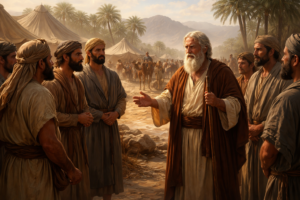 After Jerusalem fell, Nebuzaradan the captain of the guard released Jeremiah from among the captives at Ramah. He openly acknowledged that the LORD had brought this judgment on Judah because the people had sinned against Him: “the LORD thy God pronounced this evil upon this place” and “because ye have sinned against the LORD, and have not obeyed his voice” (Jer. 40:2-3, KJV). Even a pagan officer could see what Judah had refused to admit.
Jeremiah was given liberty either to go to Babylon with honor and provision or to remain in the land. He chose to stay with Gedaliah the son of Ahikam, whom the king of Babylon had made governor over the poor remnant left in Judah. This choice fits Jeremiah’s whole ministry: he remained with the afflicted remnant rather than seeking comfort for himself.
Gedaliah established his administration at Mizpah and urged the scattered Jews and military leaders not to fear serving the Chaldeans: “dwell in the land, and serve the king of Babylon, and it shall be well with you” (40:9). Under him, a brief season of order and gathering followed. Jews returned out of Moab, Ammon, Edom, and other places, and the remnant gathered “wine and summer fruits very much” (40:12).
Yet trouble was already brewing. Johanan the son of Kareah warned Gedaliah that Baalis king of the Ammonites had sent Ishmael the son of Nethaniah to slay him. Gedaliah refused to believe the report, even calling it false. His kindness and openness seem commendable, but he failed in discernment. The chapter closes with danger unheeded.
Jeremiah 41
This chapter records the murder of Gedaliah and the further collapse of the remnant. Ishmael came to Mizpah with ten men, and while eating bread together with Gedaliah, he rose up and slew him, along with the Jews and Chaldean soldiers who were with him. It was treachery joined to violence. The murder of Gedaliah was not only political rebellion; it was also contempt for the mercy God had left to the remnant through Babylon’s appointed governor.
Ishmael then murdered eighty men who came from Shechem, Shiloh, and Samaria, men who had signs of mourning and were bringing offerings and incense to the house of the LORD. Their coming shows that even after the temple’s destruction there remained a broken-hearted religious concern among some in Israel. Ishmael lured them deceitfully, then slew most of them and cast their bodies into a pit. Only ten survived by bargaining with hidden stores of wheat, barley, oil, and honey.
He carried away captive the residue of the people at Mizpah, including “the king’s daughters,” intending to flee to the Ammonites. But Johanan and the other captains pursued him and rescued the captives at the great waters that are in Gibeon. Ishmael escaped with eight men to Ammon.
The rescued remnant then dwelt in the habitation of Chimham, which is by Bethlehem, preparing to go into Egypt because they feared Babylonian retaliation for Gedaliah’s murder. Instead of resting in God’s overruling hand, they began to move by fear.
Jeremiah 42
Here the remnant came to Jeremiah with a seemingly humble request. Johanan, the captains, and “all the people from the least even unto the greatest” asked Jeremiah to pray that the LORD would show them “the way wherein we may walk, and the thing that we may do” (42:3). Their words sounded admirable. They even pledged, “whether it be good, or whether it be evil, we will obey the voice of the LORD our God” (42:6).
Jeremiah faithfully agreed and, after ten days, received the word of the LORD. God’s answer was plain. If they would remain in Judah, He said, “I will build you, and not pull you down, and I will plant you, and not pluck you up” (42:10). They were not to fear the king of Babylon, for the LORD declared, “for I am with you to save you, and to deliver you from his hand” (42:11). God promised mercy, preservation, and settled dwelling in the land if they would obey.
But if they said, “No; but we will go into the land of Egypt,” seeking escape from war, hunger, and uncertainty, then the very things they feared would overtake them there. “The sword, which ye feared, shall overtake you there in the land of Egypt, and the famine… and there ye shall die” (42:16). God plainly exposed their hypocrisy: they had sent Jeremiah to seek the will of God, but in their hearts they had already decided to go to Egypt. Jeremiah warned them that disobedience would end in sword, famine, pestilence, and reproach.
This chapter strongly highlights the difference between asking for God’s will and being willing to do it.
Jeremiah 43
The rebellion became open. As soon as Jeremiah finished speaking all the words of the LORD, Azariah the son of Hoshaiah, Johanan, and “all the proud men” accused Jeremiah of lying. They claimed Baruch had stirred him up to deliver them into the hand of the Chaldeans. Pride does not merely ignore God’s word; it often attacks God’s messenger.
So Johanan and the captains took the entire remnant—including men, women, children, the king’s daughters, Jeremiah, and Baruch—and went into Egypt, coming to Tahpanhes. This was direct disobedience to the explicit word they had just received.
At Tahpanhes, the LORD gave Jeremiah another sign. He was commanded to take great stones and hide them in the clay in the brickkiln at Pharaoh’s house, in the sight of the men of Judah. Then he prophesied that Nebuchadrezzar king of Babylon, called by the LORD “my servant,” would come and set his throne upon those stones and smite the land of Egypt. The people fled to Egypt for safety, but judgment would follow them there. Egypt, throughout Scripture, often stands as a picture of the world, human refuge, and unbelieving dependence on earthly security. This remnant rejected God’s word and chose visible refuge over covenant faith.
Key People and Places
Key People
Jeremiah
The prophet of the LORD, vindicated by events, yet still rejected by many of his own people. He remains faithful in speaking God’s truth even when it is unwelcome.
Nebuzaradan
Captain of the Babylonian guard. Though a heathen officer, he recognized that Judah’s fall came because of sin against the LORD.
Gedaliah son of Ahikam
Babylon’s appointed governor over the remnant in Judah. He encouraged peaceful submission and stable living in the land. He appears gracious and well-meaning, though lacking caution.
Johanan son of Kareah
A military leader among the remnant. He correctly warned Gedaliah about Ishmael and later rescued captives, yet he ultimately led the people in disobedience by taking them into Egypt.
Ishmael son of Nethaniah
Of royal lineage and a violent conspirator. He murdered Gedaliah and others, bringing fresh misery on the remnant.
Baalis king of the Ammonites
The foreign ruler behind Ishmael’s plot against Gedaliah.
Azariah son of Hoshaiah
One of the leaders who openly rejected Jeremiah’s message and accused him falsely.
Baruch son of Neriah
Jeremiah’s faithful companion and scribe. He was falsely blamed as the instigator of Jeremiah’s prophecy.
Nebuchadrezzar / Nebuchadnezzar king of Babylon
The instrument God used in judgment. In Jeremiah 43:10 he is called “my servant,” meaning God sovereignly used him to accomplish divine chastening, though Babylon itself was not righteous.
Key Places
Ramah
The place where Jeremiah was released from among the captives.
Mizpah
Gedaliah’s headquarters and the center of the remnant’s administration after Jerusalem’s fall.
Judah / the land
The place where God told the remnant to remain and trust His protection under Babylonian rule.
Shechem, Shiloh, and Samaria
Northern locations from which mourning men came, showing continuing sorrow and religious concern after Jerusalem’s destruction.
Gibeon
Where Johanan recovered the captives from Ishmael.
The habitation of Chimham by Bethlehem
A staging place where the remnant gathered while planning to flee into Egypt.
Egypt
The place of forbidden refuge, chosen in unbelief rather than by faith.
Tahpanhes
The Egyptian city where the remnant settled and where Jeremiah enacted the sign of coming Babylonian conquest.
Ammon
The place to which Ishmael escaped, and whose king had helped sponsor the plot.
Main Doctrinal or Spiritual Themes
1. God’s judgment is righteous and explained by sin
Jerusalem did not fall by chance, politics alone, or Babylon’s strength alone. The explanation given even by Nebuzaradan is that Judah sinned against the LORD and did not obey His voice. This is consistent with the covenant warnings of the Old Testament. God is holy, and persistent rebellion brings chastening.
2. God still shows mercy in judgment
Even after Jerusalem’s destruction, God preserved a remnant. Gedaliah’s governorship, the gathering of the poor in the land, and the divine promise in chapter 42 all show that the LORD had not ceased to be merciful. Judgment was severe, but it was not the end of His dealings.
3. True submission to God includes submission to His chastening
Gedaliah’s counsel and Jeremiah’s prophecy both pointed the people to a humble acceptance of Babylonian rule. In this situation, serving Babylon was not compromise with paganism but submission to God’s chastening hand. There are times when resisting circumstances is really resisting God.
4. Hypocrisy in seeking God’s will
Chapter 42 is a major lesson in false spirituality. The people asked for God’s guidance and promised obedience, but they had already set their hearts on Egypt. Many profess to want God’s will so long as it agrees with their preferences. Partial willingness is not obedience.
5. Fear versus faith
The remnant feared Babylon more than they feared disobeying God. Their move to Egypt was driven by visible dangers, not by trust in divine promise. Unbelief often dresses itself as prudence, but when it rejects God’s plain word, it is sin.
6. Pride rejects reproof
Jeremiah 43 says “all the proud men” rejected Jeremiah’s message. Pride is a root sin here. Proud men do not want God to contradict their plans. When the heart is lifted up, it becomes easy to accuse the preacher, question motives, and refuse truth.
7. God’s sovereignty over kings and nations
Nebuchadnezzar is called God’s “servant” in the sense that the LORD used him as an instrument of judgment. Scripture does not thereby approve his character or cruelty. It means God rules over history and can use even ungodly rulers to accomplish His purposes.
8. Egypt as a false refuge
Throughout the Old Testament, Egypt repeatedly appears as a place of carnal dependence. Instead of trusting the LORD, people look to worldly strength, political shelter, or visible security. Jeremiah 40-43 shows that there is no safe place outside the will of God.
Practical Applications or Lessons
1. It is possible to ask for God’s guidance while secretly planning disobedience
Believers should examine their own hearts. Do we truly want the Lord’s will, or only His approval of what we have already chosen? Honest praying must be joined with surrendered hearts.
2. Fear can drive people into bad decisions
The remnant feared what Babylon might do, but the LORD had already spoken peace to them if they stayed in the land. When fear rules, people run ahead of God. Faith rests on what God has said, not merely on what circumstances suggest.
3. The safest place is in obedience to God
Judah looked safer than Egypt only by faith. Egypt looked safer than Judah only by sight. The lesson remains: there is no security in disobedience. Apparent safety outside God’s will is a snare.
4. God’s messengers are often blamed for the message they carry
Jeremiah was accused of lying and of being manipulated by Baruch. Faithful preaching often provokes resentment when it crosses human plans. Believers should not measure truth by how pleasant it sounds.
5. Pride makes repentance difficult
The text plainly links rebellion with pride. A teachable spirit is essential if we are going to obey Scripture. Proud men defend themselves; humble men submit to the Lord.
6. Discernment matters in leadership
Gedaliah’s refusal to believe the warning about Ishmael had tragic consequences. Christian leaders should be gracious, but not gullible. Love must be joined to wisdom.
7. God remains faithful even when people fail
Though the remnant repeatedly failed, the LORD continued to speak, warn, and reveal His truth through Jeremiah. God’s faithfulness shines even against the dark background of human inconsistency.
8. Worldly refuge cannot shield from divine judgment
The people thought Egypt would protect them from sword and famine, yet God said those very judgments would find them there. No job, plan, move, alliance, or earthly system can protect a person who knowingly persists in disobedience.
Jeremiah 40-43 shows a sorrowful progression: judgment fell, mercy remained, fear rose, counsel was sought, truth was given, and obedience was refused. The chapters warn against hypocrisy, pride, and worldly dependence, while also showing the steadfast truthfulness of God’s word. The remnant could have been planted and preserved in the land had they trusted the LORD. Instead, they chose Egypt, and with it chose the sorrow that follows unbelief.
Comments are closed