Chapter Summaries
Psalm 108 — Praise and Confidence in Battle
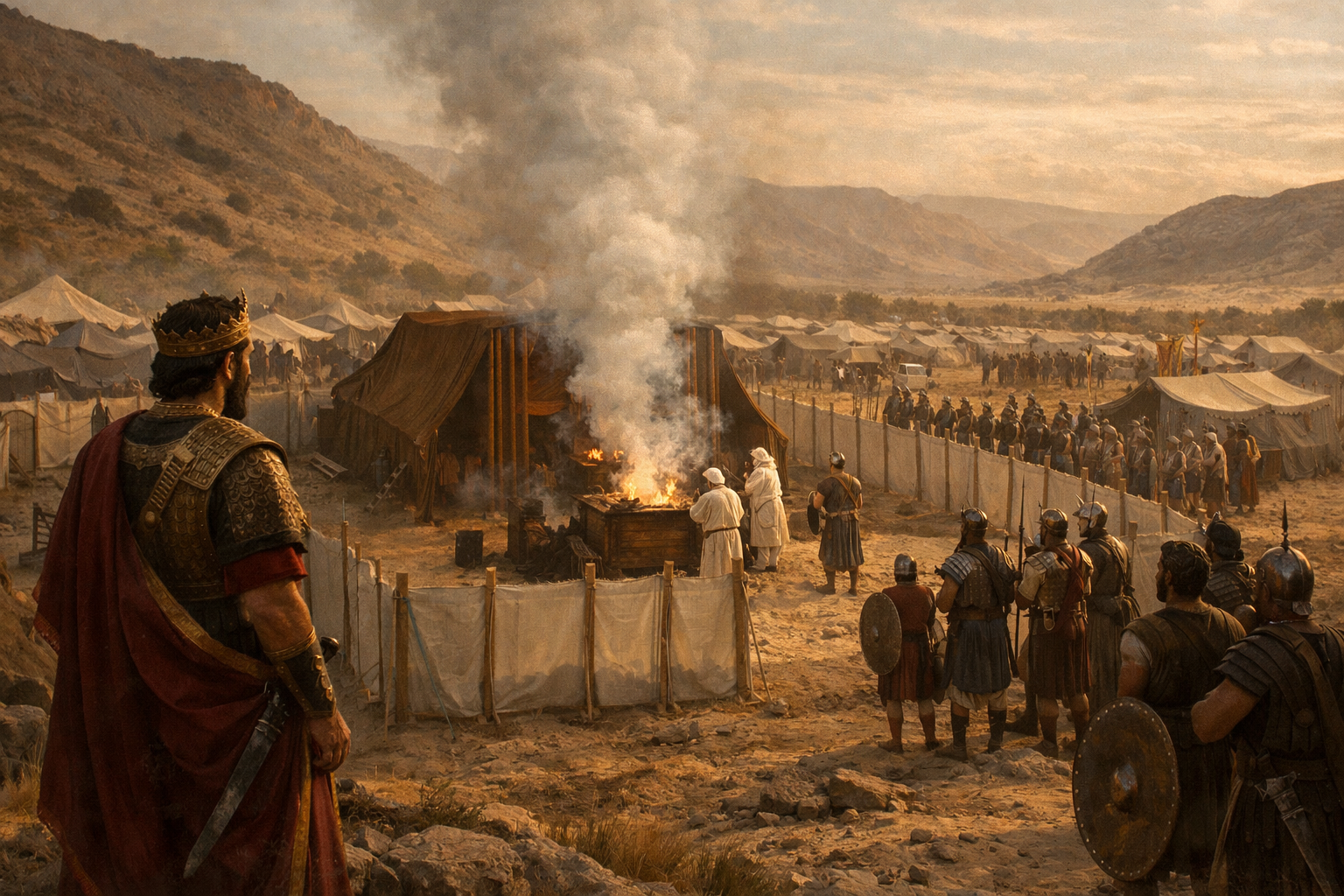
 This psalm combines portions of Psalm 57 and Psalm 60. David begins with fixed resolve: “O God, my heart is fixed; I will sing and give praise, even with my glory” (108:1). Praise precedes victory. He desires God’s glory to be exalted “above the heavens” (v. 5).
The latter half shifts to national confidence. God had spoken concerning His covenant possession of Israel: “Gilead is mine; Manasseh is mine” (v. 8). The surrounding nations—Moab, Edom, Philistia—are placed under divine sovereignty.
The psalm ends with dependence: “Through God we shall do valiantly: for he it is that shall tread down our enemies” (v. 13). Victory is not human strength but divine intervention.
Psalm 109 — Imprecation Against the Wicked
A deeply personal psalm of David against false accusers. He laments betrayal: “For my love they are my adversaries” (109:4). The language is strong, calling for judgment upon a wicked enemy.
Verse 8, “Let his days be few; and let another take his office,” is applied in Acts 1:20 to Judas Iscariot, showing prophetic fulfillment.
Though the psalm contains imprecatory elements, it closes with faith: “For he shall stand at the right hand of the poor, to save him from those that condemn his soul” (v. 31). Justice belongs to God.
Psalm 110 — The Messianic King-Priest
A foundational Messianic psalm. “The LORD said unto my Lord, Sit thou at my right hand” (110:1). Jesus Himself used this verse (Matthew 22:44) to demonstrate His deity.
Verse 4 declares: “Thou art a priest for ever after the order of Melchizedek.” This is expounded in Hebrews 5–7, showing Christ as eternal High Priest.
The psalm presents Christ as reigning King and conquering Judge. He rules “in the midst of thine enemies” (v. 2). This anticipates both present spiritual reign and future visible triumph.
Psalm 111 — Praise for the Works of the LORD
An acrostic psalm celebrating God’s works. His works are “great… honourable and glorious” (vv. 2–3). The psalm emphasizes covenant faithfulness: “He hath remembered his covenant for ever” (v. 5).
It concludes: “The fear of the LORD is the beginning of wisdom” (v. 10). True wisdom begins in reverent submission.
Psalm 112 — The Blessed Man
A companion to Psalm 111. Where Psalm 111 describes God’s character, Psalm 112 describes the godly man reflecting that character.
“Blessed is the man that feareth the LORD” (v. 1). The righteous are stable, generous, and unafraid of evil tidings (v. 7). Their righteousness endureth for ever.
This psalm describes practical godliness flowing from covenant fear.
Psalm 113 — The Exalted and Condescending LORD
Begins the “Egyptian Hallel” (Psalms 113–118), sung at Passover.
“From the rising of the sun unto the going down of the same the LORD’S name is to be praised” (v. 3). God is exalted above all nations (v. 4).
Yet He humbles Himself to lift the poor from the dust (v. 7) and make the barren woman fruitful (v. 9). Sovereign majesty joined with tender mercy.
Psalm 114 — The Exodus Power of God
Recalls Israel’s deliverance: “When Israel went out of Egypt” (v. 1). The sea saw it and fled; Jordan was driven back (v. 3).
Creation responds to the presence of the LORD. The Rock became standing water (v. 8). God’s redemptive power alters nature itself.
Psalm 115 — Glory to God Alone
“Not unto us, O LORD, not unto us, but unto thy name give glory” (v. 1). A contrast between the living God and lifeless idols.
Idols have mouths but speak not (v. 5). Those who make them are like them (v. 8). Israel is called to trust in the LORD (vv. 9–11).
The psalm affirms that heaven is the LORD’s (v. 16), but He has given earth to men under His authority.
Psalm 116 — Personal Deliverance and Thanksgiving
A testimony psalm. “I love the LORD, because he hath heard my voice” (v. 1). The psalmist was near death, but God delivered him.
“Precious in the sight of the LORD is the death of his saints” (v. 15). God values His redeemed.
The psalm concludes with vows of public praise in the courts of the LORD’s house (v. 19).
Psalm 117 — Universal Call to Praise
The shortest psalm. “O praise the LORD, all ye nations” (v. 1). Gentiles are called to worship.
Paul cites this in Romans 15:11, showing the missionary heart of God. His merciful kindness is great toward us (v. 2).
Key People and Places
David — Author of Psalms 108, 109, 110; king of Israel; type of Christ.
Melchizedek — King-priest of Salem (Genesis 14), typifies Christ’s eternal priesthood.
Judas Iscariot — Fulfillment of Psalm 109:8 (Acts 1:20).
Israel — Covenant nation central to Psalms 108 and 114.
Egypt — Place of bondage; referenced in Psalm 114.
Jordan River — Miraculously parted (Psalm 114).
Moab, Edom, Philistia — Surrounding hostile nations (Psalm 108).
Main Doctrinal or Spiritual Themes
- The Sovereignty of God Over Nations (108, 113, 115)
- The Messianic Kingship and Priesthood of Christ (110)
- The Justice of God Against the Wicked (109)
- The Fear of the LORD as the Foundation of Wisdom (111–112)
- God’s Redemptive Power in History (114)
- Separation from Idolatry (115)
- Personal Testimony and Public Thanksgiving (116)
- Global Evangelistic Vision (117)
Practical Applications or Lessons
- Fix your heart in praise before seeking deliverance (108:1).
- Leave vengeance in God’s hands when falsely accused (109).
- Recognize Christ as both reigning King and eternal High Priest (110).
- Cultivate reverential fear of the LORD for stability in troubled times (111–112).
- Give God glory alone; avoid subtle forms of modern idolatry (115).
- Testify publicly when God answers prayer (116).
- Maintain a missionary spirit—God’s mercy extends to all nations (117).
Comments are closed