 Leviticus 1–4 opens the LORD’s instructions concerning Israel’s sacrificial worship at the tabernacle. Exodus closes with the tabernacle erected and “the glory of the LORD” filling it (Exodus 40:34–38). Leviticus begins:
“And the LORD called unto Moses, and spake unto him out of the tabernacle of the congregation, saying,”
— Leviticus 1:1
The movement of these four chapters is orderly: the burnt offering in chapter 1, the meat offering in chapter 2, the peace offering in chapter 3, and the sin offering in chapter 4. The repeated details concerning the altar, blood, fire, fat, priesthood, and offerings emphasize that Israel was not free to devise its own manner of approaching and worshiping God. The LORD Himself prescribed the way.
In the wider teaching of the KJV, these sacrifices must not be understood as independently giving eternal salvation. Hebrews 10:4 states plainly, “For it is not possible that the blood of bulls and of goats should take away sins.” The law’s sacrifices were divinely appointed, while the New Testament identifies the final and sufficient sacrifice in Jesus Christ. Hebrews 10:10 says believers are sanctified “through the offering of the body of Jesus Christ once for all.”
Chapter Summaries
Leviticus 1 — The Burnt Offering
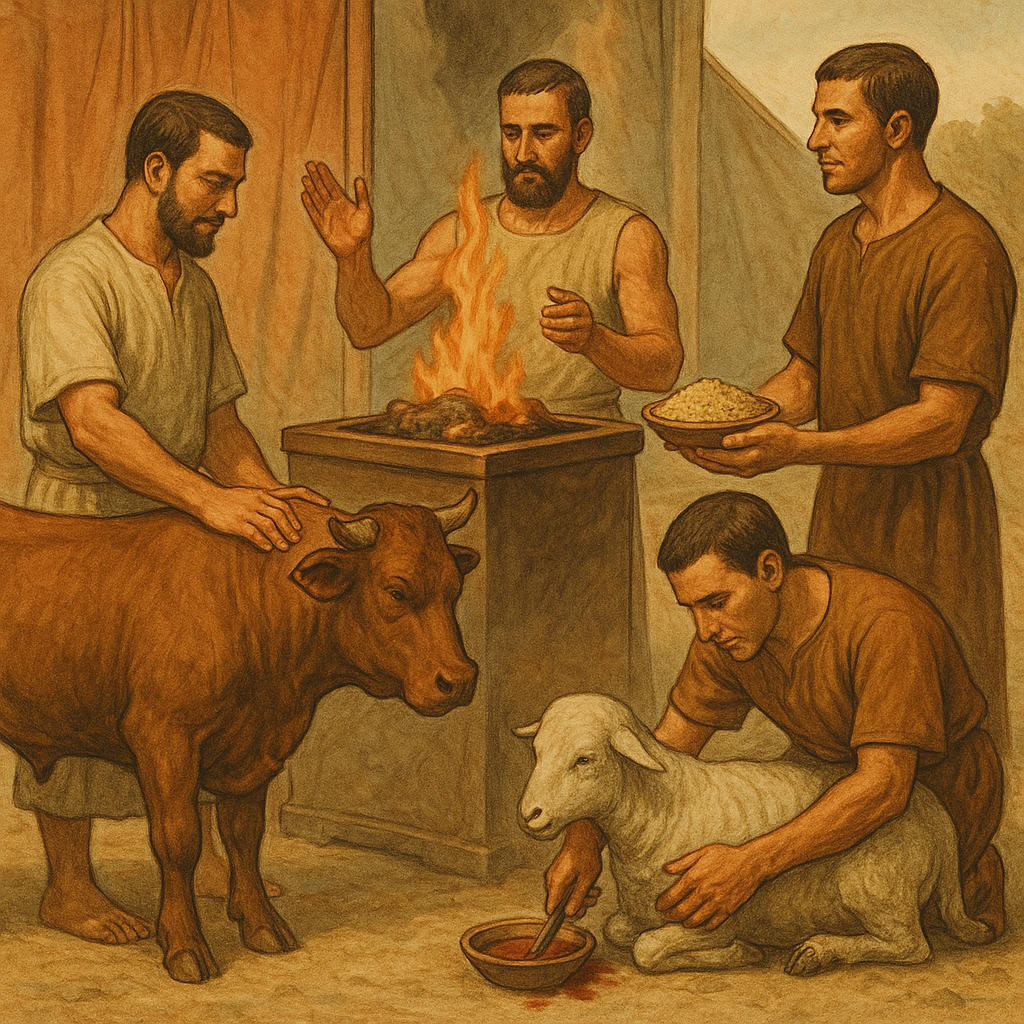
The LORD first instructs Moses concerning a burnt sacrifice. The offering could come from “the herd” or “the flock” (1:2), and provision is also given for an offering “of fowls” (1:14).
For an offering from the herd, the sacrifice was to be:
“a male without blemish” — Leviticus 1:3
The offerer was to present it “at the door of the tabernacle of the congregation before the LORD” and:
“he shall put his hand upon the head of the burnt offering; and it shall be accepted for him to make atonement for him.”
— Leviticus 1:4
The animal was killed “before the LORD” (1:5). Aaron’s sons, the priests, handled the blood and sprinkled it “round about upon the altar” (1:5). The sacrifice was flayed and divided, its inward parts and legs washed, and the whole offering was burned upon the altar.
The chapter repeatedly describes it as:
“an offering made by fire, of a sweet savour unto the LORD.”
— Leviticus 1:9
The same basic pattern is given for sheep or goats, and then for turtledoves or young pigeons.
Doctrinal significance
The chapter explicitly joins atonement, blood, death, and an acceptable sacrifice. The offerer lays his hand upon the sacrifice, and the animal is “accepted for him to make atonement for him” (1:4). The text does not use the word substitute, but these statements provide a clear biblical foundation for understanding sacrificial substitution.
The requirement that the animal be “without blemish” also prepares the reader for later New Testament language concerning Christ. First Peter 1:18–19 speaks explicitly of redemption:
“with the precious blood of Christ, as of a lamb without blemish and without spot.”
We should distinguish the certainty levels carefully. Leviticus 1 explicitly concerns Israel’s burnt offering. The identification of Jesus Christ as the perfect sacrificial fulfillment comes from later inspired New Testament revelation rather than from speculation imposed upon Leviticus.
Leviticus 2 — The Meat Offering
Chapter 2 concerns what the KJV calls the “meat offering.” The chapter itself shows that this offering commonly consisted of fine flour, oil, and frankincense, rather than the animal sacrifices described in chapters 1 and 3.
The opening instruction is:
“And when any will offer a meat offering unto the LORD, his offering shall be of fine flour; and he shall pour oil upon it, and put frankincense thereon:”
— Leviticus 2:1
The priest took a handful of the flour and oil with the frankincense and burned this “memorial” upon the altar. The remainder belonged to Aaron and his sons and was described as:
“a thing most holy of the offerings of the LORD made by fire.”
— Leviticus 2:3
The chapter then gives instructions for offerings baked in an oven, prepared in a pan, or made in a frying pan.
Two substances were specifically prohibited from being burned in this offering:
“For ye shall burn no leaven, nor any honey, in any offering of the LORD made by fire.”
— Leviticus 2:11
Salt, however, was required:
“And every oblation of thy meat offering shalt thou season with salt; neither shalt thou suffer the salt of the covenant of thy God to be lacking from thy meat offering: with all thine offerings thou shalt offer salt.”
— Leviticus 2:13
The chapter concludes with instructions concerning an offering of firstfruits involving “green ears of corn dried by the fire” and “corn beaten out of full ears” (2:14).
Doctrinal significance
Chapter 2 demonstrates that worship involved more than the shedding of animal blood. Material from the ordinary provision of life—flour, oil, grain, frankincense, and salt—was placed under God’s specific commands.
It therefore emphasizes dedication to God, holiness in worship, and obedience to God’s stated requirements.
It would go beyond the wording of Leviticus 2 to assign a separate hidden spiritual meaning to every ingredient unless another Scripture establishes that meaning. The safest interpretation is to emphasize what the LORD explicitly commands.
Leviticus 3 — The Peace Offering
Chapter 3 gives the law concerning the “sacrifice of peace offering.”
An offering from the herd could be:
“whether it be a male or female, he shall offer it without blemish before the LORD.”
— Leviticus 3:1
Again the worshiper placed his hand upon the head of the sacrifice and killed it “at the door of the tabernacle of the congregation” (3:2). Aaron’s sons sprinkled its blood upon the altar.
Certain portions, particularly the fat associated with the inward parts, were burned upon the altar.
The procedure is then described for a lamb and for a goat.
One of the chapter’s strongest declarations is:
“all the fat is the LORD’S.”
— Leviticus 3:16
The chapter closes with a continuing prohibition for Israel:
“It shall be a perpetual statute for your generations throughout all your dwellings, that ye eat neither fat nor blood.”
— Leviticus 3:17
Doctrinal significance
The name “peace offering” is explicit in the text. The offering was made before the LORD according to His commands and repeatedly called “an offering made by fire of a sweet savour unto the LORD” (3:5, 16).
The chapter emphasizes that fellowship with God cannot properly be separated from obedience to God. Israel could not decide which portions were sacred and which commands could be ignored.
The prominence of blood is also important in the broader biblical doctrine of atonement. Later, Leviticus 17:11 will explicitly say:
“For the life of the flesh is in the blood: and I have given it to you upon the altar to make an atonement for your souls.”
That later verse supplies an inspired explanation for the importance placed upon blood within these sacrificial laws.
Leviticus 4 — The Sin Offering
Chapter 4 introduces a different situation:
“If a soul shall sin through ignorance against any of the commandments of the LORD concerning things which ought not to be done, and shall do against any of them:”
— Leviticus 4:2
The chapter does not teach that ignorance makes sin harmless. Instead, it provides God’s prescribed sacrifice when such sin becomes known.
Four situations receive particular treatment.
1. The anointed priest — Leviticus 4:3–12
If “the priest that is anointed” sinned according to the sin of the people, he was to offer:
“a young bullock without blemish unto the LORD for a sin offering.”
— Leviticus 4:3
The priest brought some of its blood into the tabernacle, sprinkled it seven times before the LORD before the veil, placed blood upon the horns of the altar of sweet incense, and poured the remaining blood at the bottom of the altar of burnt offering.
The remainder of the bullock was carried “without the camp unto a clean place” and burned there (4:12).
2. The whole congregation — Leviticus 4:13–21
If:
“the whole congregation of Israel sin through ignorance” — Leviticus 4:13
and the matter was hidden from them but afterward became known, the congregation was to offer a young bullock.
The elders of the congregation laid their hands upon its head, and the prescribed blood ritual followed.
The result is expressly stated:
“and the priest shall make an atonement for them, and it shall be forgiven them.”
— Leviticus 4:20
3. A ruler — Leviticus 4:22–26
The text then addresses:
“When a ruler hath sinned, and done somewhat through ignorance against any of the commandments of the LORD his God concerning things which should not be done, and is guilty;”
— Leviticus 4:22
When his sin came to his knowledge, he was to bring “a kid of the goats, a male without blemish” (4:23).
After the prescribed sacrifice:
“the priest shall make an atonement for him as concerning his sin, and it shall be forgiven him.”
— Leviticus 4:26
4. One of the common people — Leviticus 4:27–35
If “any one of the common people” sinned through ignorance, he was likewise declared guilty when he had violated the LORD’s commandment.
He could bring a female kid of the goats without blemish or, in the instructions that follow, a female lamb without blemish.
Again the chapter concludes:
“the priest shall make an atonement for his sin that he hath committed, and it shall be forgiven him.”
— Leviticus 4:35
Doctrinal significance
Leviticus 4 establishes several things explicitly:
Sin is measured against “the commandments of the LORD,” not merely against human opinion. A person may violate God’s command “through ignorance” and nevertheless be described as “guilty.” Priests, the congregation, rulers, and common people are all accountable before God.
Yet God also provides a prescribed means of atonement within the Mosaic system, repeatedly declaring, “it shall be forgiven him.”
The New Testament prevents us from misunderstanding these sacrifices as the ultimate payment for sin. Hebrews 10:4 says:
“For it is not possible that the blood of bulls and of goats should take away sins.”
Christ’s offering is categorically superior and final:
“But this man, after he had offered one sacrifice for sins for ever, sat down on the right hand of God;”
— Hebrews 10:12
Thus conservative Baptist doctrine does not teach salvation by keeping ceremonial law or by performing sacrifices. Salvation is by God’s grace through faith, and the final basis of forgiveness is the finished sacrifice of Jesus Christ.
Key People and Places
The LORD
The LORD is the central Person throughout these chapters. He calls Moses, establishes the offerings, determines acceptable worship, defines sin, provides atonement, and appoints the responsibilities of the priests.
The repeated expression “unto the LORD” keeps the focus upon God rather than upon religious ceremony for its own sake.
Moses
Moses receives the LORD’s commandments:
“And the LORD called unto Moses, and spake unto him out of the tabernacle of the congregation.” — Leviticus 1:1
Moses is acting as the recipient and communicator of God’s revealed instructions to Israel.
Aaron and His Sons
Leviticus 1 repeatedly identifies:
“the priests, Aaron’s sons” — Leviticus 1:5
They minister at the altar, handle the blood, arrange the sacrifices, and burn the prescribed portions.
Chapter 4 also discusses “the priest that is anointed” (4:3). Scripture establishes a distinct priestly ministry within Israel’s covenant worship.
The Children of Israel
The instructions are given to the covenant nation:
“Speak unto the children of Israel” — Leviticus 1:2
These chapters therefore belong directly to Israel under the Mosaic law. They should not be transferred indiscriminately to the New Testament church.
The Whole Congregation of Israel
Leviticus 4:13 specifically deals with corporate guilt when “the whole congregation of Israel sin through ignorance.”
The Elders of the Congregation
In the congregation’s sin offering:
“the elders of the congregation shall lay their hands upon the head of the bullock before the LORD.” — Leviticus 4:15
The Ruler
Leviticus 4:22–26 shows that a ruler remains accountable to “the commandments of the LORD his God.” Position does not remove moral responsibility.
The Common People
Leviticus 4:27–35 specifically provides instructions for “any one of the common people.” God’s law reaches every level of society.
The Tabernacle of the Congregation
This is the central physical setting of the chapters. The LORD speaks from it in 1:1, sacrifices are presented at its door, and in chapter 4 sacrificial blood is carried inside in particular cases.
The Altar of Burnt Offering
The sacrifices of chapters 1–4 repeatedly involve this altar. Blood is sprinkled around it, sacrifices are burned upon it, and blood from certain sin offerings is poured at its base.
The Altar of Sweet Incense
In particular sin offerings, blood was placed:
“upon the horns of the altar of sweet incense before the LORD” — Leviticus 4:7
Before the Veil
For the sin of the anointed priest and of the congregation, blood was sprinkled “seven times before the LORD, before the vail of the sanctuary” (4:6; compare 4:17).
Without the Camp
The remains of certain sin offerings were taken:
“without the camp unto a clean place, where the ashes are poured out” — Leviticus 4:12
The immediate text states the location and procedure. Any further symbolic significance should be established from other Scripture rather than assumed.
Main Doctrinal or Spiritual Themes
1. God Determines How He Is Approached
These chapters do not present man designing worship according to preference. The LORD specifies the animal, its condition, the place, the priestly actions, the use of blood, the portions burned, and the treatment of the remains.
Biblical worship therefore begins with revelation and obedience, not human invention.
2. God’s Holiness Requires Serious Treatment of Sin
Leviticus does not portray sin casually. Even the phrase “sin through ignorance” is followed by language of guilt and atonement.
God’s standard remains His commandments.
3. Atonement Requires a God-Appointed Sacrifice
Leviticus 1:4 expressly connects the sacrifice with atonement:
“it shall be accepted for him to make atonement for him.”
Leviticus 4 repeatedly connects atonement with forgiveness.
This is God’s arrangement, not man’s religious invention.
4. Blood Has a Central Place in Sacrifice
Blood is repeatedly handled at the altar in chapters 1, 3, and 4. Scripture later explains:
“without shedding of blood is no remission.”
— Hebrews 9:22
The ultimate fulfillment is not endless animal sacrifice but the blood of Christ.
5. Christ’s Sacrifice Is Final and Sufficient
Hebrews supplies the inspired New Testament interpretation of the sacrificial system:
“For the law having a shadow of good things to come…” — Hebrews 10:1
And:
“For by one offering he hath perfected for ever them that are sanctified.” — Hebrews 10:14
Thus the Christian does not return to Levitical sacrifices. Christ has offered the sufficient sacrifice “once for all” (Hebrews 10:10).
6. Salvation Is Not Earned Through Sacrificial Works
Neither the blood of animals nor human religious works can provide eternal redemption.
Hebrews 10:4 rules out the saving sufficiency of animal blood. In the New Testament, justification is consistently grounded in faith rather than works:
“Therefore being justified by faith, we have peace with God through our Lord Jesus Christ:”
— Romans 5:1
The Levitical sacrificial system should therefore never be turned into sacramental or works-based salvation.
7. God Requires What Is Without Blemish
“Without blemish” repeatedly appears in these chapters.
The immediate requirement concerns the sacrificial animal. The New Testament explicitly applies similar language to Christ, who is described as:
“a lamb without blemish and without spot.”
— 1 Peter 1:19
8. Religious Leaders Are Accountable to God
The anointed priest receives no exemption from dealing with sin in Leviticus 4.
The chapter therefore plainly establishes that religious office does not place a man above God’s commandments.
9. Ignorance Does Not Redefine God’s Standard
Leviticus 4 repeatedly speaks of sin “through ignorance.” When that sin becomes known, God’s prescribed response is required.
A man does not make something righteous merely because he did not recognize its wrongness when he committed it.
10. Israel and the Church Must Be Distinguished
These commandments were spoken to “the children of Israel” and administered through the Aaronic priesthood and tabernacle.
The church is not commanded to perform these sacrifices. Hebrews explicitly presents Christ’s sacrifice as final. Applying the spiritual truths of these chapters must therefore preserve the biblical distinction between Israel under the Mosaic law and the New Testament church.
Practical Applications or Lessons
- Approach God on His terms.
Israel was required to follow God’s revealed pattern precisely. Believers today likewise have no authority to replace God’s Word with religious preference or tradition. - Give God what He requires, not merely what is convenient.
“Without blemish” repeatedly emphasizes that the LORD’s commands were to be taken seriously. - Treat sin seriously even when it was committed unknowingly.
Leviticus 4 shows that ignorance does not make God’s commandment cease to be God’s commandment. - When sin becomes known, deal with it rather than excuse it.
The repeated language “if his sin…come to his knowledge” is followed by action. For the Christian, 1 John 1:9 gives the corresponding principle of confession: “If we confess our sins, he is faithful and just to forgive us our sins.” - Leadership increases neither innocence nor exemption.
Priest, congregation, ruler, and common person are all addressed. God’s commandments apply regardless of position. - Remember the seriousness of atonement.
Forgiveness is never presented as God pretending sin did not matter. Sacrifice, blood, and death dominate these chapters. - Rest in Christ rather than religious works.
The Levitical sacrifices were repeatedly offered, but Christ’s sacrifice is complete. Hebrews 10:12 declares that He “offered one sacrifice for sins for ever.” - Worship should be reverent and obedient.
Leviticus 1–4 contains careful instructions because worship belongs to God. Reverence is not empty ceremony; it is submission to what God has spoken. - Do not build doctrine upon invented symbolism.
Flour, oil, frankincense, salt, blood, fat, fire, and various animals all occur in these chapters. Where Scripture gives an explanation, that explanation should govern us. Where Scripture does not explicitly assign a symbolic meaning, conservative interpretation should resist speculation. - Let the sacrificial system magnify Christ.
The sacrifices themselves could never finally take away sin, but the New Testament reveals the sufficient Savior to whom the entire sacrificial order points. The believer’s confidence is therefore not in ceremony, priestly mediation, or personal merit, but in the finished offering of Jesus Christ.
Overall Message of Leviticus 1–4
Leviticus 1–4 presents a holy God establishing the conditions of Israel’s sacrificial approach to Him. The burnt offering emphasizes an offering accepted for atonement; the meat offering presents consecrated material worship according to God’s exact directions; the peace offering is offered before the LORD under His prescribed order; and the sin offering deals specifically with guilt arising from violations of God’s commandments committed through ignorance.
Together, the chapters establish that God is holy, sin is real, guilt must be dealt with, blood and sacrifice belong to God’s appointed system of atonement, worship requires obedience, and no person is above God’s commandments.
In the fuller revelation of the KJV, the animal sacrifices are not the final answer to man’s sin. Jesus Christ is. The law has “a shadow of good things to come” (Hebrews 10:1), while Christ “offered one sacrifice for sins for ever” (Hebrews 10:12).
That keeps the interpretation where Scripture itself places it: honoring the literal Levitical ordinances given to Israel while recognizing the final, sufficient sacrifice of Christ revealed in the New Testament.
Comments are closed