 Exodus 38–40 brings the book of Exodus to its appointed conclusion. The LORD had already given Moses detailed instructions for the tabernacle, its furniture, the priestly garments, and the consecration of the priesthood. These closing chapters record the completion of that work, Moses’ inspection of it, the erection of the tabernacle, and finally the visible manifestation of the glory of the LORD.
A dominant expression is that the work was done “as the LORD commanded Moses” (Exodus 39:1, 5, 7, 21, 26, 29, 31, 42; 40:16, 19, 21, 23, 25, 27, 29, 32). The emphasis is not upon human religious creativity but upon careful obedience to the revealed Word of God.
Exodus began with Israel suffering under Pharaoh in Egypt. It ends with the redeemed people of Israel having the tabernacle of the LORD in their midst and the cloud of His presence directing their journeys.
Chapter Summaries
Exodus 38 — The Altar, Laver, Court, and Accounting of the Materials
Chapter 38 records the construction of several major portions of the tabernacle complex and then gives an accounting of the materials used.
1. The brasen altar — Exodus 38:1–7
Bezaleel made the altar of burnt offering of shittim wood, overlaid with brass.
It included:
- horns upon its four corners,
- pans,
- shovels,
- basons,
- fleshhooks,
- firepans,
- a grate of brass,
- rings,
- and staves for carrying it.
The altar had already been commanded in Exodus 27:1–8. Here the command is carried out.
The prominence of the altar reminds the reader that sinful men did not simply enter God’s presence according to their own ideas. Sacrifice was an essential part of Israel’s God-appointed worship.
Later revelation explains the inadequacy of animal sacrifices to take away sin permanently and points to the perfect sacrifice of Christ. Hebrews 10:4 says:
“For it is not possible that the blood of bulls and of goats should take away sins.”
Christ’s sacrifice, by contrast, was offered “once for all” (Hebrews 10:10).
This does not mean that every feature of the altar should be assigned an invented spiritual symbolism. Scripture should determine the extent of any typological application.
2. The brasen laver — Exodus 38:8
The KJV specifically says:
“And he made the laver of brass, and the foot of it of brass, of the lookingglasses of the women assembling, which assembled at the door of the tabernacle of the congregation.”
The text explicitly identifies the source of this brass as the women’s lookingglasses.
The laver was for priestly washing, according to the instructions of Exodus 30:18–21. The priests were required to wash when they approached their appointed service.
The immediate doctrine concerns ceremonial cleansing under the Mosaic system. It should not be turned into an arbitrary allegory. Nevertheless, the principle that God requires holiness in those who serve Him is consistent throughout Scripture.
3. The court of the tabernacle — Exodus 38:9–20
The court was completed with:
- fine twined linen hangings,
- pillars,
- brass sockets,
- silver hooks and fillets,
- and the hanging for the court gate.
Nothing in the passage suggests a casual approach to worship. Measurements, materials, placement, and construction were governed by God’s command.
4. The accounting of the tabernacle materials — Exodus 38:21–31
The text identifies the work as:
“the sum of the tabernacle, even of the tabernacle of testimony”
and states that the accounting was made under Moses’ command “for the service of the Levites, by the hand of Ithamar, son to Aaron the priest” (v. 21).
Bezaleel is again named as the principal craftsman, with Aholiab assisting him.
The recorded totals include:
- Gold: twenty-nine talents and seven hundred thirty shekels — v. 24.
- Silver: one hundred talents and one thousand seven hundred seventy-five shekels — v. 25.
- Brass: seventy talents and two thousand four hundred shekels — v. 29.
The silver was connected with those who were numbered:
“six hundred thousand and three thousand and five hundred and fifty men”
from twenty years old and upward (vv. 26–28).
This corresponds with the half-shekel requirement given in Exodus 30:11–16.
The detailed accounting demonstrates that God’s work was not treated carelessly. The materials dedicated to the tabernacle were counted and their use recorded.
Exodus 39 — The Holy Garments and Completion of the Work
Chapter 39 centers chiefly upon the garments for Aaron and the priesthood and concludes with the completion and inspection of the entire tabernacle project.
1. The ephod — Exodus 39:1–7
The craftsmen made the holy garments using:
“blue, and purple, and scarlet”
and the ephod from gold, blue, purple, scarlet, and fine twined linen.
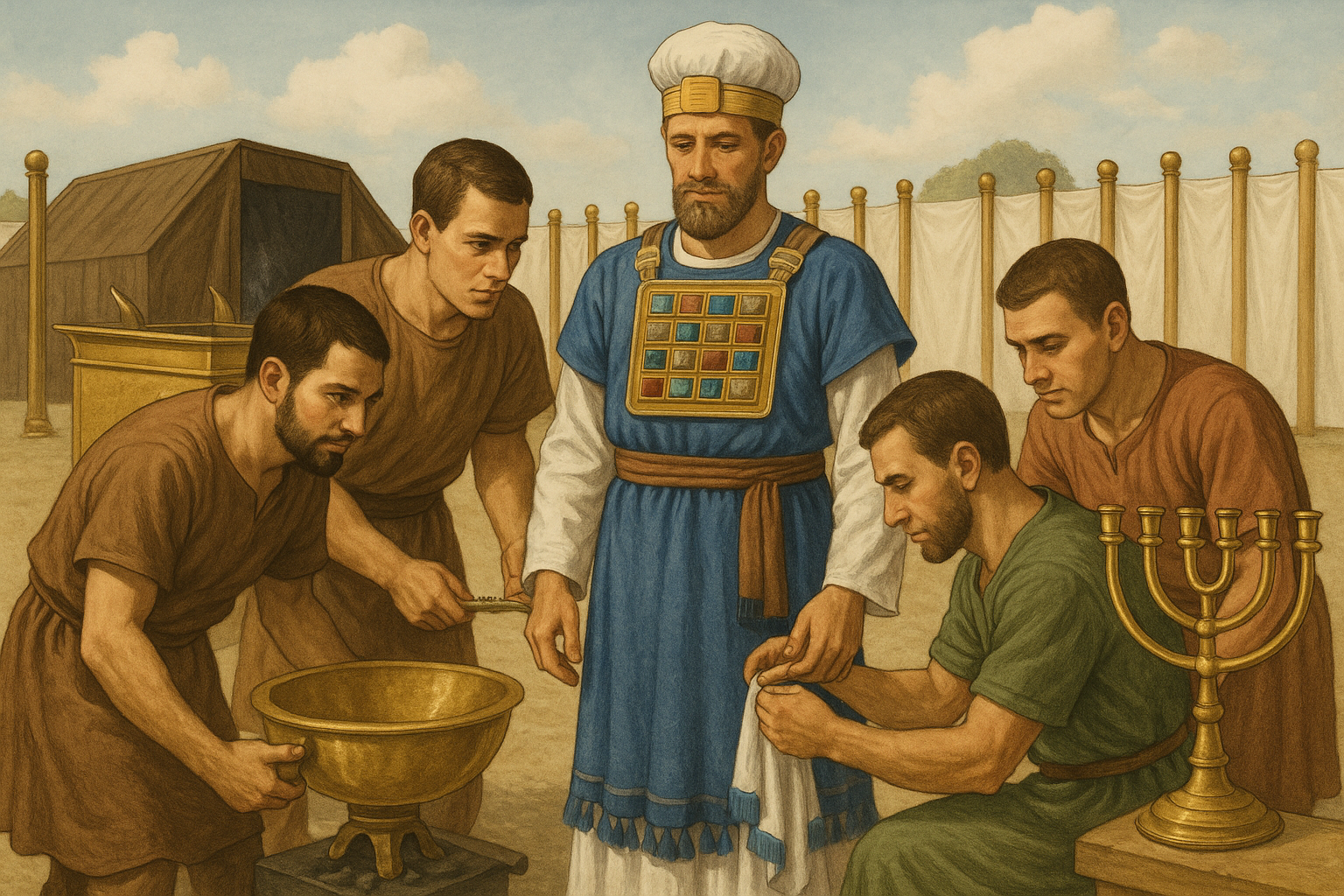
Two onyx stones were engraved with the names of the children of Israel and attached to the shoulders of the ephod.
Verse 7 says they were:
“stones for a memorial to the children of Israel; as the LORD commanded Moses.”
Aaron’s priesthood was therefore directly connected with his appointed representation of Israel before the LORD.
2. The breastplate — Exodus 39:8–21
The breastplate was made with the same skilled workmanship as the ephod.
Twelve precious stones were set into it:
“according to the names of the children of Israel”
with each stone engraved according to one of the twelve tribes.
The breastplate was carefully attached to the ephod according to God’s command.
This was not a priesthood invented by Aaron. Neither its office nor its garments rested upon personal preference. The entire arrangement was established by the LORD.
3. The robe and other priestly garments — Exodus 39:22–29
The robe of the ephod was made of blue.
Around its hem were pomegranates and bells:
“A bell and a pomegranate, a bell and a pomegranate, round about the hem of the robe to minister in”
(v. 26).
The coats, mitre, bonnets, linen breeches, and girdle were also made as God had prescribed.
4. The golden plate — Exodus 39:30–31
One of the strongest statements in the chapter appears upon the plate of the holy crown:
“HOLINESS TO THE LORD.”
That inscription accurately summarizes a major truth running through the entire tabernacle system.
The LORD is holy.
His priesthood was holy.
His sanctuary was holy.
His worship was regulated by His Word.
Israel was not free to remake divine worship according to surrounding cultures or personal taste.
5. The work is finished — Exodus 39:32–43
Verse 32 declares:
“Thus was all the work of the tabernacle of the tent of the congregation finished.”
More importantly:
“and the children of Israel did according to all that the LORD commanded Moses, so did they.”
The completed items were brought to Moses.
After examining them, Moses found that:
“as the LORD had commanded, even so had they done it”
(v. 43).
Then:
“Moses blessed them.”
This is one of the clearest lessons in the entire section: God’s approval was associated with obedience to what He had actually commanded.
Exodus 40 — The Tabernacle Erected and Filled With God’s Glory
Exodus 40 is the climax not merely of the tabernacle construction but of the book of Exodus itself.
1. The LORD commands the tabernacle to be erected — Exodus 40:1–15
God told Moses:
“On the first day of the first month shalt thou set up the tabernacle of the tent of the congregation.”
This was during the second year according to Exodus 40:17.
The furniture was to be placed in its appointed positions:
- the ark,
- the vail,
- the table,
- the candlestick,
- the golden altar,
- the hanging at the door,
- the altar of burnt offering,
- and the laver.
The court was also to be established.
Moses was commanded to anoint the tabernacle and its vessels.
Aaron and his sons were then to be:
- washed,
- clothed,
- anointed,
- and consecrated for priestly service.
The KJV explicitly describes their priesthood as:
“an everlasting priesthood throughout their generations”
(Exodus 40:15).
This refers to the Aaronic priesthood as ordained for Israel’s generations under that economy. It should not be confused with the New Testament church.
2. Moses obeys exactly — Exodus 40:16–33
Verse 16 gives the controlling principle:
“Thus did Moses: according to all that the LORD commanded him, so did he.”
The tabernacle was erected.
The ark was placed within.
The mercy seat was placed upon it.
The vail was hung.
The table was positioned and the bread arranged.
The candlestick was placed and its lamps lighted.
The golden altar was established and incense burned.
The altar of burnt offering was positioned.
The laver was placed between the tent and altar, and water was put within it.
The court was erected.
Verse 33 concludes:
“So Moses finished the work.”
This recalls Exodus 39:32, but now the tabernacle is not merely constructed—it is assembled and ready for the service God ordained.
3. The glory of the LORD fills the tabernacle — Exodus 40:34–35
Then comes the great climax:
“Then a cloud covered the tent of the congregation, and the glory of the LORD filled the tabernacle.”
The manifestation was so overwhelming that:
“Moses was not able to enter into the tent of the congregation, because the cloud abode thereon, and the glory of the LORD filled the tabernacle.”
Scripture explicitly attributes this to the glory of the LORD. No psychological or merely natural explanation should be substituted for what the text says.
4. The LORD guides Israel — Exodus 40:36–38
The cloud also directed Israel’s movements.
“And when the cloud was taken up from over the tabernacle, the children of Israel went onward in all their journeys:”
But:
“if the cloud were not taken up, then they journeyed not till the day that it was taken up.”
The final verse of Exodus says:
“For the cloud of the LORD was upon the tabernacle by day, and fire was on it by night, in the sight of all the house of Israel, throughout all their journeys.”
Thus Exodus closes with Jehovah visibly dwelling in the midst of Israel and directing their journey.
Key People and Places
- The LORD — The One who gave the instructions for the tabernacle, priesthood, worship, erection of the sanctuary, and Israel’s movements. His glory fills the completed tabernacle.
- Moses — God’s appointed servant who received the commands, supervised the work, inspected its completion, erected the tabernacle, and carried out what God commanded.
- Bezaleel — Explicitly identified as the craftsman who made what the LORD commanded Moses (Exodus 38:22). His appointment and divine enabling had previously been stated in Exodus 31:1–5.
- Aholiab — Assisted in the work and is described in Exodus 38:23 as an engraver, cunning workman, and embroiderer.
- Aaron — Consecrated to serve as Israel’s high priest according to God’s command.
- Aaron’s sons — Consecrated with Aaron for priestly ministry.
- Ithamar — Aaron’s son who had responsibility connected with the accounting of the tabernacle materials for the service of the Levites (Exodus 38:21).
- The children of Israel — The covenant nation for whom the tabernacle was constructed and among whom the LORD manifested His presence.
- The women assembling at the door of the tabernacle of the congregation — Their brass lookingglasses were used in making the laver (Exodus 38:8).
- The tabernacle / tent of the congregation — The divinely appointed sanctuary around which these chapters center.
- The court — The enclosed area surrounding the tabernacle and containing the altar and laver.
- The wilderness of Sinai — Exodus 38–40 does not repeatedly name the geographical location. However, comparison with Numbers 10:11–12 explicitly shows that Israel remained in the wilderness of Sinai until the twentieth day of the second month of the second year. Since Exodus 40:17 places the erection of the tabernacle on the first day of the first month of the second year, the biblical chronology places this event before Israel’s departure from Sinai.
Main Doctrinal or Spiritual Themes
1. God’s holiness
The words:
“HOLINESS TO THE LORD”
stand prominently upon Aaron’s holy crown.
The tabernacle system continually emphasized that God is holy and that sinful man cannot determine for himself the terms upon which he approaches God.
Biblical worship begins with who God is—not with what man prefers.
2. Obedience to the revealed Word of God
Perhaps the strongest practical theme of chapters 39–40 is the repeated declaration:
“as the LORD commanded Moses.”
They did not improve God’s design.
They did not modernize God’s commands.
They did not substitute their preferences.
They did what God said.
That principle remains essential. Deuteronomy 4:2 says:
“Ye shall not add unto the word which I command you, neither shall ye diminish ought from it.”
God’s Word, not religious innovation, must govern faith and practice.
3. God determines how He is to be worshipped
Every major portion of the tabernacle was established by divine revelation:
- dimensions,
- materials,
- furniture,
- priesthood,
- garments,
- sacrifices,
- cleansing,
- placement,
- and service.
This strongly contradicts the idea that sincerity alone makes worship acceptable.
Good intentions are not a substitute for obedience.
4. Sacrifice and approach to God
The altar stood prominently within the court.
Under the Mosaic system, Israel’s approach involved God-appointed sacrifices.
The New Testament makes clear that these sacrifices could not perfect the conscience permanently. Hebrews 10:11–12 contrasts them with Christ:
“And every priest standeth daily ministering and offering oftentimes the same sacrifices, which can never take away sins:
But this man, after he had offered one sacrifice for sins for ever, sat down on the right hand of God;”
The Christian therefore does not return to the Mosaic sacrificial system. Christ’s sacrifice is sufficient.
5. Cleansing in service
The priests washed at the laver before performing their appointed ministry.
The immediate reference concerns ceremonial washing required of Aaron and his sons.
A legitimate spiritual principle is that holiness matters in service to God. However, Scripture does not authorize assigning an invented spiritual meaning to every physical feature of the laver.
6. The priesthood was God’s appointment
Aaron did not appoint himself.
His sons did not establish their own religious office.
God chose them and prescribed their consecration.
Hebrews later reveals that Christ possesses a superior and distinct priesthood. Christians therefore should neither rebuild the Aaronic system nor confuse Israel’s priesthood with New Testament church offices.
7. Faithful stewardship and accountability
Exodus 38 gives a detailed record of the precious metals used in the work.
That explicit accounting shows that the resources dedicated to God’s service were treated seriously.
A sound application is that churches and ministries should likewise handle money and property with integrity, care, and accountability.
8. God’s presence cannot be manufactured
The craftsmen could construct the tabernacle.
Moses could erect it.
Aaron could be clothed for the priesthood.
But none of them could manufacture the glory of God.
Only after the work had been completed according to God’s command does Scripture say:
“the glory of the LORD filled the tabernacle.”
God’s genuine presence is not produced through human excitement, emotional manipulation, music, ceremony, or religious technique.
9. God guided Israel
Israel moved when the cloud was taken up and remained when it was not.
The text describes God’s direct supernatural guidance of Israel during their wilderness journeys.
It would go beyond the text to claim that believers today should expect a visible cloud or fire to direct personal decisions.
New Testament believers possess the written Word of God and are commanded to walk according to God’s revealed truth.
10. Israel and the Church must remain distinct
Exodus 38–40 concerns Israel, the Aaronic priesthood, the Mosaic tabernacle, and Israel’s wilderness journey.
The church did not replace Israel in these chapters.
Nor should the church be placed under Israel’s ceremonial ordinances.
There are genuine spiritual principles for believers, and Hebrews gives inspired interpretation of the tabernacle system, but that does not erase the biblical distinction between Israel and the Church.
11. The tabernacle has divinely revealed typological significance
We should avoid speculative symbolism, but we should not ignore symbolism that Scripture itself establishes.
Hebrews 9:9 calls the first tabernacle:
“a figure for the time then present”
and Hebrews 9:23 speaks of:
“the patterns of things in the heavens.”
Therefore, it is biblical to recognize that the tabernacle and its services had a divinely appointed representative significance fulfilled in connection with Christ’s superior priesthood and sacrifice.
However, conservative interpretation should stop where Scripture stops. We should not invent meanings for every color, socket, hook, board, measurement, or piece of furniture unless Scripture itself supplies the connection.
Practical Applications or Lessons
Obey God precisely
The repeated words “as the LORD commanded Moses” are perhaps the greatest practical lesson of these chapters.
God is pleased when His people take His Word seriously enough to obey it.
James 1:22 says:
“But be ye doers of the word, and not hearers only, deceiving your own selves.”
Finish the work God gives you
Exodus 39:32 says the work was “finished.”
Exodus 40:33 says:
“So Moses finished the work.”
There is a difference between beginning something for God and faithfully carrying it through.
The believer should seek to finish his course faithfully.
Holiness still matters
The inscription “HOLINESS TO THE LORD” belongs directly to Israel’s priesthood, but God’s moral holiness has not changed.
First Peter 1:15–16 says:
“But as he which hath called you is holy, so be ye holy in all manner of conversation;
Because it is written, Be ye holy; for I am holy.”
Grace is never permission for careless living.
God’s work should be handled responsibly
The accounting of gold, silver, and brass provides a sound pattern of seriousness regarding resources devoted to God’s work.
Church finances should not be secretive, careless, or treated as personal property.
Ability should be used for God’s glory
Bezaleel and Aholiab used their craftsmanship in the service God appointed.
The passage demonstrates that service to God was not limited to Moses and Aaron. Skilled labor also had an important place.
That may encourage believers to recognize that practical abilities can be used faithfully in the Lord’s service.
Religious sincerity must remain subordinate to Scripture
The builders could not say, “We meant well,” while disregarding God’s design.
Obedience was measured by what God had commanded.
The same principle guards the church against traditions, innovations, experiences, or preferences that contradict Scripture.
God’s presence is more important than religious machinery
A perfectly constructed tabernacle without the LORD would merely have been a structure.
The great climax is not that the craftsmen finished the building.
It is:
“the glory of the LORD filled the tabernacle.”
Churches likewise need more than buildings, programs, organization, or activity. They must remain submitted to God and His Word.
Follow God’s revealed direction
Israel moved according to God’s direction.
For the believer today, the proper lesson is not to seek a wilderness cloud but to submit decisions and conduct to the revealed Word of God.
Psalm 119:105 says:
“Thy word is a lamp unto my feet, and a light unto my path.”
Overall Message of Exodus 38–40
The closing chapters of Exodus present completed obedience followed by the manifested glory of God.
God gave the pattern.
God called the workers.
The people supplied the materials.
The craftsmen completed the work.
Moses inspected it.
Moses erected the tabernacle.
Aaron and his sons were set apart for their appointed ministry.
Everything was done according to God’s command.
Then:
“the glory of the LORD filled the tabernacle.” — Exodus 40:34
Exodus therefore ends very differently from how it began. The book opens with Israel under the oppression of Pharaoh. It closes with Israel gathered around the sanctuary of Jehovah, with His cloud over them, His fire visible by night, and His presence guiding them “throughout all their journeys.”
The central lesson is plain: the holy God who redeemed Israel also prescribed how redeemed Israel was to worship, serve, and walk before Him. Redemption did not make obedience unnecessary; it placed Israel in a position where they were responsible to obey the God who had delivered them.
For the New Testament believer, salvation is wholly by grace through faith in Jesus Christ, apart from works (Ephesians 2:8–9). Yet the believer who has been saved by grace is then created “unto good works” (Ephesians 2:10). Obedience does not purchase salvation; it should flow from salvation.
Comments are closed