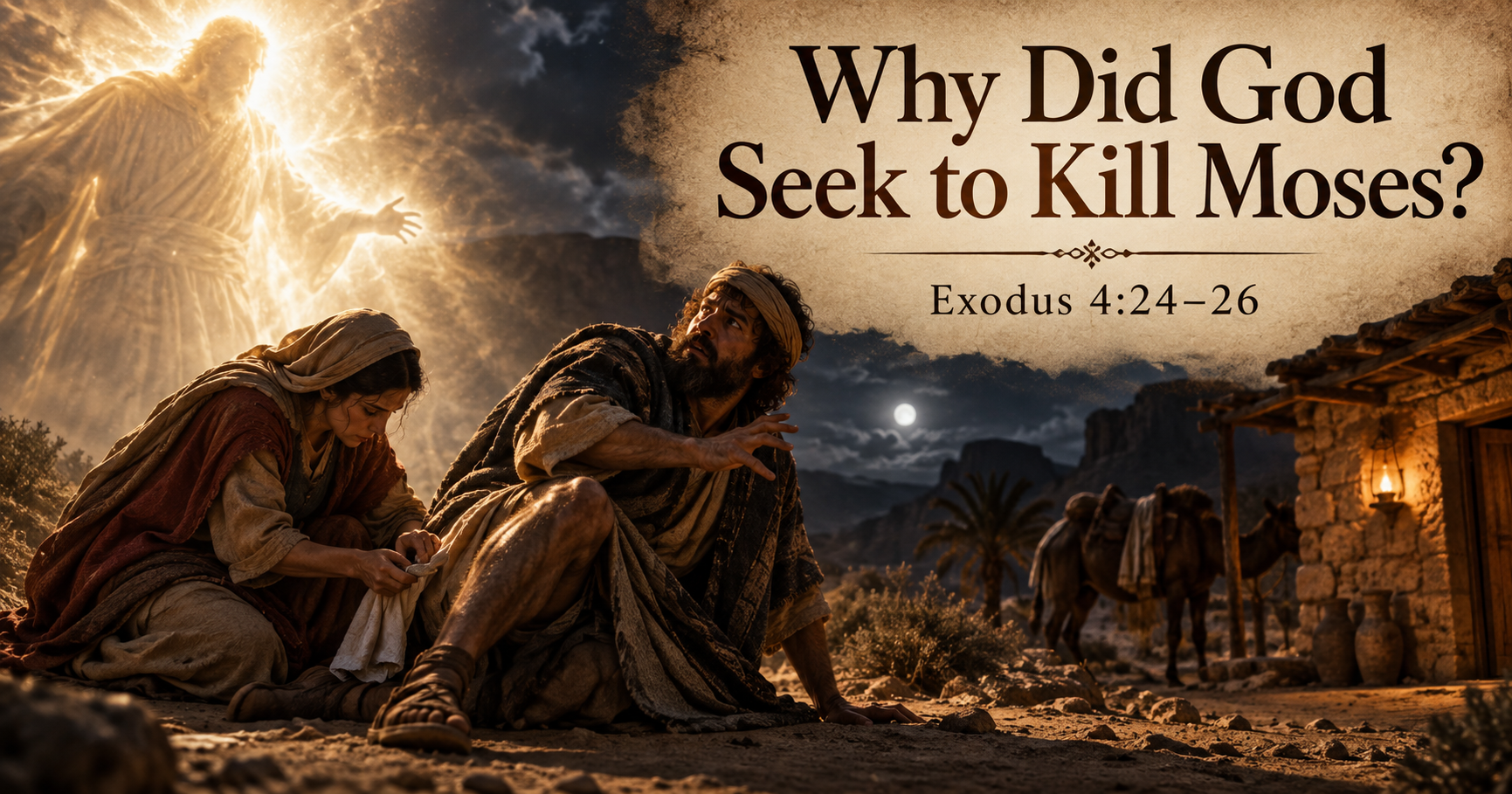
Why Did God Seek to Kill Moses in Exodus 4?
One of the most startling passages in the life of Moses occurs immediately after God commissions him to return to Egypt:
 Exodus 4:24-26
“And it came to pass by the way in the inn, that the LORD met him, and sought to kill him.
Then Zipporah took a sharp stone, and cut off the foreskin of her son, and cast it at his feet, and said, Surely a bloody husband art thou to me.
So he let him go: then she said, A bloody husband thou art, because of the circumcision.”
Why would the LORD call Moses to deliver Israel and then, only a few verses later, seek to kill him?
The answer is found in obedience to God’s covenant command concerning circumcision.
Moses Had Neglected a Clear Command of God
Circumcision had been commanded by God when He established His covenant with Abraham.
Genesis 17:10-11
“This is my covenant, which ye shall keep, between me and you and thy seed after thee; Every man child among you shall be circumcised.
And ye shall circumcise the flesh of your foreskin; and it shall be a token of the covenant betwixt me and you.”
God went even further:
Genesis 17:14
“And the uncircumcised man child whose flesh of his foreskin is not circumcised, that soul shall be cut off from his people; he hath broken my covenant.”
Moses was a descendant of Abraham and was about to return to Egypt as God’s appointed leader of Israel. Yet at least one of his sons had apparently not been circumcised.
That was not a small ceremonial oversight. Moses was neglecting a plainly revealed command connected with the Abrahamic covenant.
Moses Could Not Represent God While Defying God’s Command
Moses was about to stand before Pharaoh and command obedience in the name of the LORD.
He would soon say:
Exodus 5:1
“Thus saith the LORD God of Israel, Let my people go, that they may hold a feast unto me in the wilderness.”
But before Moses could demand obedience from Pharaoh, God required obedience from Moses.
The man who would represent God’s authority could not knowingly disregard God’s authority in his own household.
This is an important biblical principle: God’s servants are not exempt from obeying the Word they proclaim to others.
Moses’ calling did not excuse his disobedience. His usefulness did not make him indispensable. God takes His own holiness seriously.
Zipporah’s Action Reveals the Offense
The passage itself tells us what resolved the crisis.
Zipporah:
“took a sharp stone, and cut off the foreskin of her son”
Immediately afterward:
“So he let him go”
That sequence is decisive.
Whatever questions remain concerning the details of the encounter, Scripture directly connects the removal of God’s threatened judgment with the circumcision of Moses’ son.
Therefore the most natural interpretation is that Moses had failed to circumcise his son, and God confronted him because of that disobedience.
Why Did Zipporah Perform the Circumcision?
Scripture does not explicitly tell us why Moses had failed to circumcise the child or why Zipporah performed the act herself.
Her statement—
“Surely a bloody husband art thou to me”
—certainly shows that she found the matter deeply unpleasant.
Some have suggested that Zipporah had previously opposed circumcision and that Moses compromised in order to please her. That is possible, but the Bible does not directly state it. We should not turn a reasonable possibility into revealed fact.
What Scripture does reveal is sufficient: the son was uncircumcised, Zipporah circumcised him, and the LORD’s judgment ceased.
God Was Not Uncertain or Unsuccessful
The wording says:
“the LORD met him, and sought to kill him.”
This should not be understood as though God attempted to kill Moses but somehow failed.
Nothing can frustrate God’s power.
The statement describes a genuine threat of divine judgment. Moses stood under sentence of death unless the covenant violation was corrected. Once the circumcision took place, the LORD:
“let him go.”
God’s purpose was accomplished.
There Is Also a Serious Connection With What Comes Next
Immediately before this incident, God told Moses what he was to say to Pharaoh:
Exodus 4:22-23
“And thou shalt say unto Pharaoh, Thus saith the LORD, Israel is my son, even my firstborn:
And I say unto thee, Let my son go, that he may serve me: and if thou refuse to let him go, behold, I will slay thy son, even thy firstborn.”
Then Moses himself is confronted concerning his own son.
That placement is significant.
Moses was going to announce God’s judgment upon Pharaoh’s household while there was unresolved disobedience concerning God’s covenant in Moses’ own household.
God dealt with His messenger before sending His messenger to confront another man.
The Lesson for God’s Servants
This passage teaches several serious truths.
First, God means what He says. Circumcision was not man’s tradition. God had commanded it.
Second, leadership increases responsibility rather than reducing it. Moses’ great calling did not give him permission to disregard a command of God.
Third, God deals with His servants before using them to deal with others.
Fourth, family pressure never overrules Scripture. Whatever circumstances produced Moses’ failure, God’s command remained God’s command.
Finally, this passage reminds us that God’s grace must never be confused with indifference toward disobedience. Moses belonged to God and had been called by God, but the LORD still dealt severely with his rebellion.
Conclusion
Why did God seek to kill Moses in Exodus 4?
Because Moses had apparently failed to circumcise his son in obedience to God’s covenant command.
The proof is found within the passage itself: Zipporah circumcised the boy, and immediately afterward the LORD “let him go.”
Moses was about to become God’s public representative before Pharaoh. Before God would use him to demand obedience from Egypt, Moses first had to submit to God’s Word in his own household.
The lesson is plain: no calling, position, family consideration, or ministry usefulness gives a servant of God permission to disregard what God has plainly commanded.
Comments are closed