These psalms continue the majestic “theocratic praise” section, exalting the LORD as Creator, King, Judge, Redeemer, and Covenant God. They emphasize His sovereignty over Israel and the nations, His faithfulness to Abraham, and His righteous rule over all creation.
Chapter Summaries
Psalm 98 – A New Song for the LORD’s Salvation
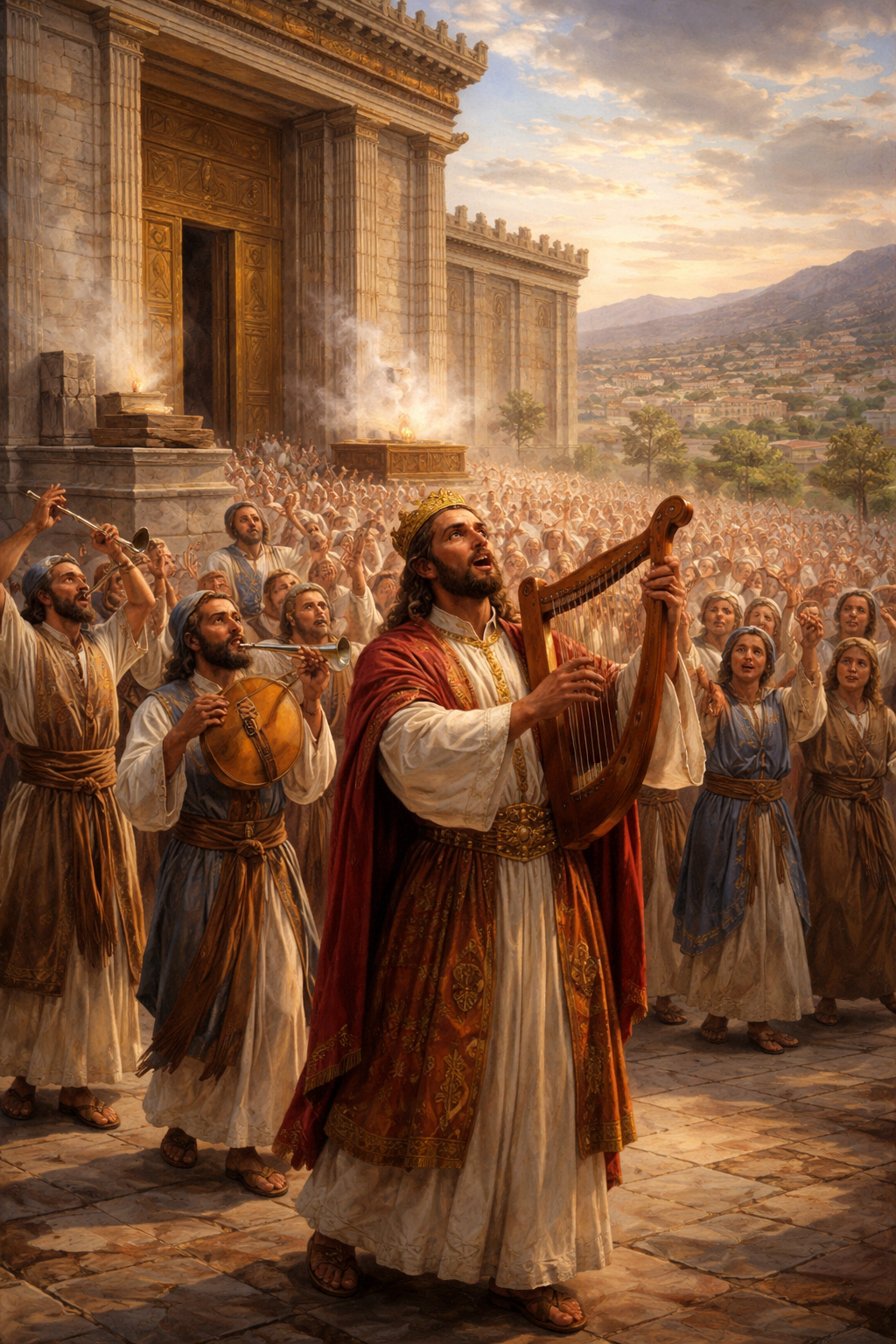
 This psalm calls for a “new song” because “he hath done marvellous things: his right hand, and his holy arm, hath gotten him the victory” (v.1). The salvation described is both historical (deliverance of Israel) and prophetic (Messianic reign).
- “The LORD hath made known his salvation” (v.2).
- “All the ends of the earth have seen the salvation of our God” (v.3).
- Nature joins the praise: “Let the sea roar… the floods clap their hands” (vv.7–8).
- He comes “to judge the earth… with righteousness” (v.9).
Doctrinal Background:
This psalm anticipates the universal reign of Christ. Conservative Baptist commentators have long seen a millennial tone here: the righteous King judging in equity. It is not allegory but literal expectation of Messiah’s rule.
Psalm 99 – The Holy King
“The LORD reigneth; let the people tremble” (v.1). His throne is “between the cherubims,” referencing the mercy seat in the tabernacle.
- “Holy is he” (v.3).
- “The king’s strength also loveth judgment” (v.4).
- Moses, Aaron, and Samuel are cited as examples of intercessors (v.6).
- Repeated refrain: “He is holy” (vv.5, 9).
Historical Context:
The mention of the cherubim ties this psalm to the Ark of the Covenant in Jerusalem. It affirms covenant faithfulness and divine holiness.
Psalm 100 – A Call to Worship
A universal invitation: “Make a joyful noise unto the LORD, all ye lands” (v.1).
- “Know ye that the LORD he is God” (v.3).
- “It is he that hath made us, and not we ourselves.”
- “Enter into his gates with thanksgiving” (v.4).
- “His mercy is everlasting; and his truth endureth to all generations” (v.5).
Doctrinal Emphasis:
God as Creator, Shepherd, and Covenant Lord. Salvation produces joyful worship, not cold ritual.
Psalm 101 – The King’s Righteous Rule
A psalm of David expressing commitment to holy leadership.
- “I will behave myself wisely in a perfect way” (v.2).
- “I will set no wicked thing before mine eyes” (v.3).
- “He that worketh deceit shall not dwell within my house” (v.7).
Application:
Leadership must reflect holiness. This anticipates Christ’s perfect administration and sets a pattern for civil and spiritual leaders.
Psalm 102 – The Afflicted One and the Eternal LORD
This is a “prayer of the afflicted.” It describes deep suffering:
- “My days are consumed like smoke” (v.3).
- “I am like a pelican of the wilderness” (v.6).
Yet the psalm turns to hope:
- “Thou, O LORD, shalt endure for ever” (v.12).
- “When the LORD shall build up Zion” (v.16).
Verses 25–27 speak of God as Creator whose years “shall have no end.” Hebrews 1 applies this directly to Christ, affirming His deity.
Doctrinal Note:
This is both personal lament and Messianic prophecy. It affirms Christ’s eternal nature.
Psalm 103 – Bless the LORD, O My Soul
A psalm of personal praise focused on redemption.
- “Who forgiveth all thine iniquities” (v.3).
- “Who redeemeth thy life from destruction” (v.4).
- “The LORD is merciful and gracious, slow to anger” (v.8).
- “As far as the east is from the west, so far hath he removed our transgressions” (v.12).
Man is frail: “As for man, his days are as grass” (v.15). But God’s mercy is “from everlasting to everlasting” (v.17).
Doctrinal Emphasis:
Substitutionary forgiveness, covenant mercy, paternal compassion. This psalm strongly supports security in God’s covenant faithfulness.
Psalm 104 – The Majesty of the Creator
This psalm magnifies God’s creative power.
- “Who coverest thyself with light as with a garment” (v.2).
- He “laid the foundations of the earth” (v.5).
- He set boundaries for the waters (vv.6–9).
- He provides for beasts and man alike.
- “The glory of the LORD shall endure for ever” (v.31).
Creation reveals God’s wisdom and sovereignty. It is not evolutionary speculation but deliberate, ordered creation consistent with Genesis.
Key People and Places
- The LORD (Jehovah) – Covenant God of Israel; eternal, holy, righteous King.
- Moses, Aaron, Samuel (Psalm 99:6) – Historical intercessors who called upon the LORD.
- David (Psalm 101) – King committed to righteous rule.
- Zion/Jerusalem – Center of covenant worship.
- The Cherubim – Associated with the Ark and mercy seat.
- All the earth / Nations – Emphasis on universal recognition of God’s reign.
- Creation (sea, floods, mountains, beasts) – Witnesses to God’s sovereignty.
Main Doctrinal or Spiritual Themes
- The Sovereign Reign of God
“The LORD reigneth” (99:1). His kingship is literal, righteous, and future in its fullest expression. - Holiness of God
Repeated declaration: “He is holy.” - Covenant Mercy and Forgiveness
Psalm 103 clearly affirms forgiveness grounded in God’s mercy. - The Eternal Nature of Christ
Psalm 102 affirms deity and immutability. - Creation by Divine Design
Psalm 104 affirms intelligent creation and providence. - Worship as Response to Salvation
Joyful praise flows from redemption. - Righteous Leadership and Separation from Evil
Psalm 101 emphasizes moral purity.
Practical Applications or Lessons
- Worship Should Be Joyful and Reverent
True praise recognizes both mercy and holiness. - Leaders Must Guard Their Eyes and Homes
“I will set no wicked thing before mine eyes” applies directly today. - God’s Forgiveness Is Complete
Believers may rest in the removal of sin “as far as the east is from the west.” - Suffering Does Not Cancel God’s Covenant
Psalm 102 teaches hope in affliction. - Creation Reveals God’s Glory
The natural world should lead believers to reverent praise, not speculation. - Holiness Is Not Optional
The repeated emphasis on divine holiness demands personal sanctification. - Christ Will Reign in Righteousness
These psalms encourage anticipation of the Lord’s righteous judgment and kingdom rule.
Comments are closed