Chapter Summaries
Psalm 90 — The Prayer of Moses the Man of God
Major Flow of the Text
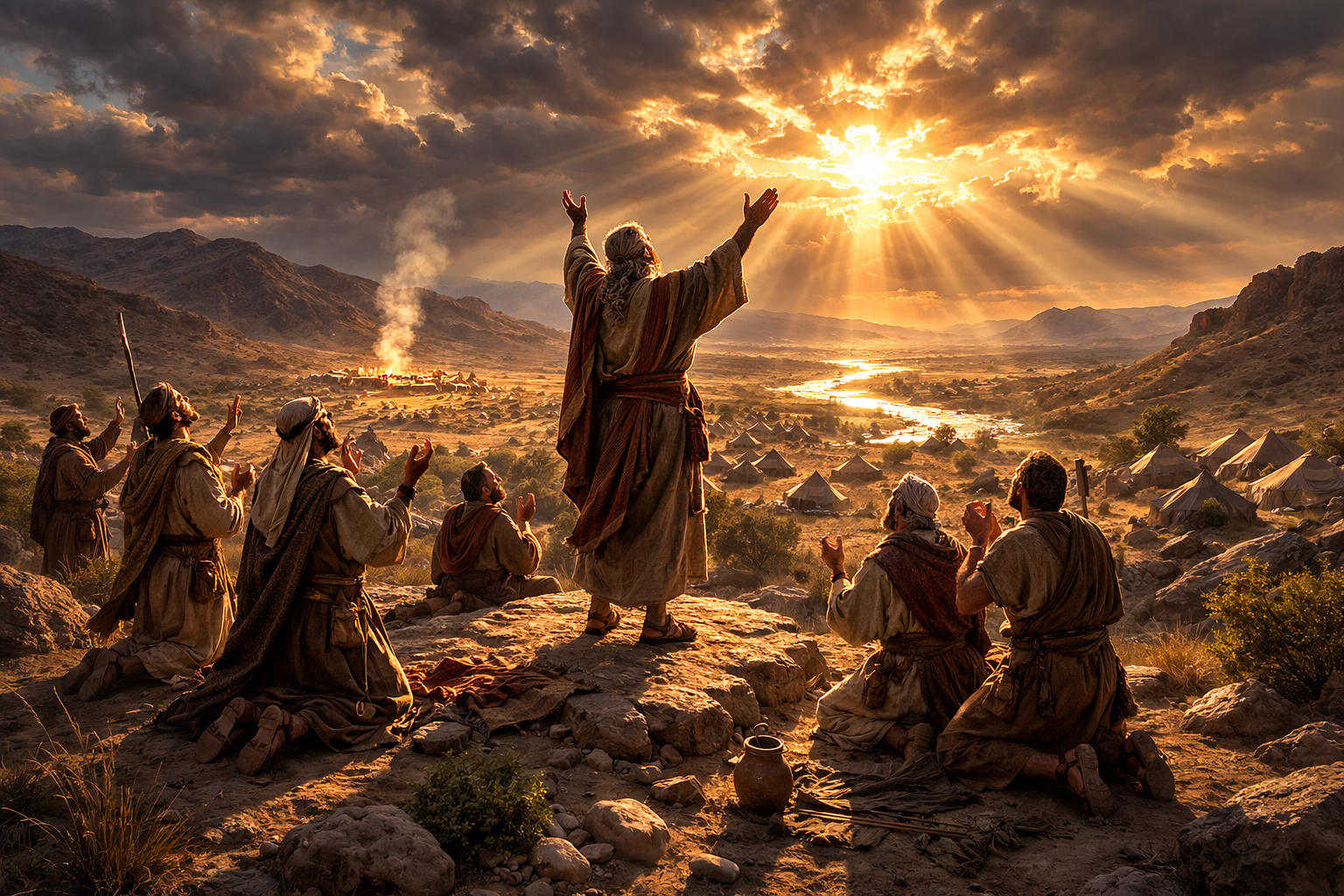
 This psalm is uniquely attributed to Moses, likely reflecting the wilderness period. It contrasts the eternal nature of God with the frailty and brevity of man.
- God is declared the everlasting refuge: “Lord, thou hast been our dwelling place in all generations” (90:1).
- His eternal nature is emphasized: “from everlasting to everlasting, thou art God” (90:2).
- Man’s mortality is described vividly: “Thou turnest man to destruction… For a thousand years in thy sight are but as yesterday” (90:3–4).
- Human life is brief: “The days of our years are threescore years and ten” (90:10).
- The central petition: “So teach us to number our days, that we may apply our hearts unto wisdom” (90:12).
- It closes with prayer for mercy, joy, and the establishing of the work of their hands (90:14–17).
Historical & Doctrinal Background
Likely written during the wilderness wanderings when a generation was dying under divine judgment (Numbers 14). It reflects Mosaic theology: God is holy, sin brings wrath, and man must depend wholly upon divine mercy.
Psalm 91 — The Security of the Godly
Major Flow of the Text
This psalm proclaims divine protection for the one who dwells “in the secret place of the most High” (91:1).
- God is called “my refuge and my fortress” (91:2).
- Deliverance from “the snare of the fowler” and “the noisome pestilence” (91:3).
- Protection under His wings (91:4).
- Freedom from fear “for the terror by night” (91:5).
- Angelic protection: “He shall give his angels charge over thee” (91:11).
- God Himself speaks in the final verses, promising deliverance, honor, and long life to those who love Him (91:14–16).
Doctrinal Note
Satan misused verses 11–12 when tempting Christ (Matthew 4), but the promise is not reckless presumption—it is covenantal security for those walking in obedience.
Psalm 92 — A Psalm for the Sabbath Day
Major Flow
A song of thanksgiving emphasizing God’s faithfulness.
- “It is a good thing to give thanks unto the LORD” (92:1).
- The wicked flourish temporarily (92:7).
- God’s eternal throne: “But thou, LORD, art most high for evermore” (92:8).
- The righteous flourish “like the palm tree” and “like a cedar in Lebanon” (92:12).
- Even in old age they remain fruitful (92:14).
Background
Likely used in Sabbath worship. Emphasizes divine justice and reward.
Psalm 93 — The Majesty of the LORD
Major Flow
A brief but powerful declaration:
- “The LORD reigneth, he is clothed with majesty” (93:1).
- Though floods lift up their voice, “The LORD on high is mightier” (93:4).
- His testimonies are “very sure,” and “holiness becometh thine house” (93:5).
A declaration of God’s sovereign kingship over chaos.
Psalm 94 — God the Righteous Judge
Major Flow
A cry for justice:
- “O LORD God, to whom vengeance belongeth” (94:1).
- Wicked rulers oppress the helpless (94:6).
- The folly of thinking God does not see (94:7–9).
- Comfort to the chastened believer (94:12–13).
- Assurance that “the LORD will not cast off his people” (94:14).
- Final declaration that God will bring judgment upon evil (94:23).
Psalm 95 — A Call to Worship and Obedience
Major Flow
Two sections:
- Worship: “O come, let us sing unto the LORD” (95:1).
- Warning: “To day if ye will hear his voice, harden not your heart” (95:7–8).
Refers to Israel’s rebellion at Meribah and Massah (Exodus 17; Numbers 14). This warning is cited in Hebrews 3–4 concerning unbelief.
Psalm 96 — The LORD’s Global Glory
Major Flow
A missionary psalm:
- “Sing unto the LORD a new song” (96:1).
- Declare His glory “among the heathen” (96:3).
- Idols are nothing: “all the gods of the nations are idols: but the LORD made the heavens” (96:5).
- He comes to judge the earth (96:13).
Likely connected to David bringing the ark to Jerusalem (1 Chronicles 16).
Psalm 97 — The Universal Reign of God
Major Flow
- “The LORD reigneth; let the earth rejoice” (97:1).
- “Clouds and darkness are round about him: righteousness and judgment are the habitation of his throne” (97:2).
- Idolatry is shamed (97:7).
- Zion rejoices because of God’s judgments (97:8).
- “Ye that love the LORD, hate evil” (97:10).
- “Light is sown for the righteous” (97:11).
Emphasizes God’s visible, righteous, global rule.
Key People and Places
- Moses — Author of Psalm 90; wilderness leadership context.
- Israel (Wilderness Generation) — Background of Psalm 90 & 95.
- Meribah / Massah — Sites of Israel’s testing and unbelief (Psalm 95).
- Lebanon — Cedars symbolizing strength and longevity (Psalm 92).
- Zion — Represents Jerusalem and God’s covenant people (Psalm 97).
- The Heathen/Nations — Emphasized in Psalms 96–97, anticipating global worship.
Main Doctrinal or Spiritual Themes
- God’s Eternity vs. Man’s Frailty (Psalm 90)
- Divine Protection for the Obedient (Psalm 91)
- Sabbath Praise and Spiritual Fruitfulness (Psalm 92)
- The Sovereign Kingship of the LORD (Psalms 93, 97)
- Divine Justice and Chastening (Psalm 94)
- The Danger of Hardened Hearts (Psalm 95)
- Global Evangelistic Vision (Psalm 96)
- Separation from Evil (Psalm 97:10)
These psalms strongly emphasize God’s holiness, sovereignty, righteous judgment, covenant faithfulness, and the moral obligation of believers to obedience and worship.
Practical Applications or Lessons
- Number Your Days — Live with eternity in view (90:12).
- Abide in the Secret Place — Security flows from communion, not presumption (91:1).
- Be Faithful in Old Age — Fruitfulness is not limited by years (92:14).
- Trust God Amid Turmoil — He is mightier than the floods (93:4).
- Rest in God’s Justice — He sees and will repay (94).
- Respond Promptly to God’s Voice — Do not delay obedience (95:7–8).
- Declare His Glory Among the Nations — Missions is not optional (96:3).
- Love the LORD, Hate Evil — Biblical love requires moral separation (97:10).
Comments are closed