
Zechariah prophesied after the Babylonian captivity, during the days when the Jews had returned to Jerusalem and the temple work needed encouragement. His ministry stands alongside Haggai’s, calling the people back to obedience while also revealing God’s future purposes for Jerusalem, Israel, and the coming Messiah. The book is prophetic, but it is not mystical guesswork. It is grounded in God’s covenant dealings with Israel and His revealed plan to restore Jerusalem.
Chapter Summaries
Zechariah 1 — Return Unto Me
 Zechariah begins with a clear call to repentance: “Turn ye unto me, saith the LORD of hosts, and I will turn unto you, saith the LORD of hosts” (Zechariah 1:3). The prophet reminds the returned remnant not to be like their fathers, who ignored the former prophets and suffered judgment. God’s Word overtook them, proving that His warnings were not empty.
The first night vision concerns “a man riding upon a red horse” standing “among the myrtle trees that were in the bottom” (1:8). Behind him were red, speckled, and white horses. These riders report that “all the earth sitteth still, and is at rest” (1:11), while Jerusalem remains afflicted. The angel of the LORD intercedes: “O LORD of hosts, how long wilt thou not have mercy on Jerusalem and on the cities of Judah?” (1:12).
God answers with comfort: “I am returned to Jerusalem with mercies: my house shall be built in it” (1:16). This is both immediate encouragement for temple rebuilding and prophetic assurance that Jerusalem is still central in God’s plan.
The chapter closes with the vision of four horns and four carpenters. The horns represent powers that scattered Judah, Israel, and Jerusalem. The carpenters are raised up to fray and cast down those Gentile powers. Doctrinally, this confirms that God judges the nations that afflict Israel.
Zechariah 2 — Jerusalem Measured and Protected
Zechariah sees “a man with a measuring line in his hand” (2:1). He is going to measure Jerusalem, showing God’s ownership, order, and future restoration of the city. Jerusalem will one day overflow with inhabitants, and the LORD Himself says, “I will be unto her a wall of fire round about, and will be the glory in the midst of her” (2:5).
The Jews still scattered in Babylon are commanded to flee: “Deliver thyself, O Zion, that dwellest with the daughter of Babylon” (2:7). Separation from Babylon is both historical and spiritual. God’s people are not to settle down in the world’s system when God has called them to His place and purpose.
A key phrase appears in verse 8: “he that toucheth you toucheth the apple of his eye.” This refers to God’s care for Israel. Though the Church is precious to the Lord, this passage is not to be stolen from Israel. Conservative Baptist, dispensational interpretation maintains the distinction between Israel and the Church.
The chapter looks ahead to the Lord dwelling in the midst of Zion: “Sing and rejoice, O daughter of Zion: for, lo, I come, and I will dwell in the midst of thee” (2:10). This has ultimate Messianic and kingdom significance.
Zechariah 3 — Joshua the High Priest Cleansed
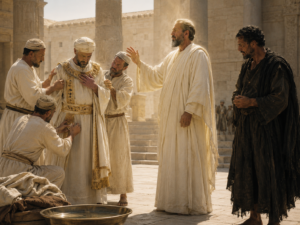
Zechariah sees Joshua the high priest standing before the angel of the LORD, and Satan standing at his right hand to resist him. This is a vivid scene of accusation and divine mercy. The LORD rebukes Satan: “The LORD rebuke thee, O Satan” (3:2).
Joshua is clothed with “filthy garments” (3:3), representing defilement and iniquity. Yet the Lord commands that the filthy garments be taken away, saying, “Behold, I have caused thine iniquity to pass from thee, and I will clothe thee with change of raiment” (3:4). This is a strong picture of cleansing by grace, not by human merit.
Joshua is then given a fair mitre and clean garments. The priesthood is restored, not because Joshua is worthy in himself, but because God graciously removes iniquity.
The chapter also introduces a Messianic title: “my servant the BRANCH” (3:8). This points to the coming Messiah, the Lord Jesus Christ, who is both King and Priest. The promise, “I will remove the iniquity of that land in one day” (3:9), looks beyond Zechariah’s immediate day to the future cleansing and restoration of Israel.
Zechariah 4 — Not by Might, Nor by Power
Zechariah sees a golden candlestick, a bowl, seven lamps, seven pipes, and two olive trees. The angel explains the central message: “Not by might, nor by power, but by my spirit, saith the LORD of hosts” (4:6).
This word is directed especially to Zerubbabel, the civil leader overseeing temple reconstruction. The work of God would not be completed by military strength, political influence, or human ability, but by God’s Spirit. The mountain of opposition would become a plain.
The Lord promises that Zerubbabel’s hands, which laid the foundation of the house, would also finish it. God warns against despising “the day of small things” (4:10). The temple project may have looked weak compared to Solomon’s temple, but God was in the work.
The two olive trees are connected with “the two anointed ones, that stand by the Lord of the whole earth” (4:14). In the immediate context, this points to Joshua and Zerubbabel as priestly and civil instruments. Prophetically, it also anticipates God’s future witness and kingdom purposes.
Zechariah 5 — Sin Judged in the Land
Zechariah then sees “a flying roll” (5:1). Its length and breadth are given, and it represents the curse that goes forth over the face of the whole earth, especially against the thief and the false swearer. God’s law exposes sin, and God’s judgment enters the house of the wicked.
This chapter shows that restoration is not merely national rebuilding; God also requires moral cleansing. A rebuilt temple without holiness would not please the LORD.
The second vision concerns an ephah, a woman sitting in the midst of it, and the declaration: “This is wickedness” (5:8). The woman is cast into the ephah, the weight of lead is placed upon its mouth, and two women carry it away to the land of Shinar. Shinar connects with Babylon, the old seat of organized rebellion against God.
The doctrinal point is clear: God will remove wickedness from the land. Israel’s restoration requires the judgment and removal of sin, false worship, theft, lying, and corruption.
Key People and Places
Zechariah — The prophet used of God to encourage the returned remnant and reveal God’s future dealings with Jerusalem and Israel.
The LORD of hosts — A repeated title emphasizing God’s sovereign command over heaven’s armies and earthly events.
The angel of the LORD — A divine messenger appearing prominently in the visions, interceding for Jerusalem and speaking with authority.
Joshua the high priest — The priestly representative of the restored remnant, shown defiled but graciously cleansed.
Satan — The adversary and accuser, resisting Joshua. His work is accusation, but he is rebuked by the LORD.
Zerubbabel — The civil leader of Judah, encouraged that the temple work would be completed by God’s Spirit.
Jerusalem — The city chosen by God, afflicted but not forsaken. These chapters reaffirm Jerusalem’s future importance in God’s prophetic program.
Judah — The returned remnant from captivity, called to repentance, rebuilding, and holiness.
Babylon / Shinar — The place of captivity and the symbolic center of organized rebellion and wickedness.
The BRANCH — A Messianic title pointing to the Lord Jesus Christ, the righteous King and Priest.
Main Doctrinal or Spiritual Themes
1. God Calls His People to Repentance
The opening burden is plain: “Turn ye unto me.” Before visions, symbols, and prophetic promises, God confronts the heart. The returned Jews were not merely to rebuild outward structures; they were to return to the LORD inwardly.
2. God Has Not Cast Away Israel
Zechariah 1–2 is full of God’s continuing concern for Jerusalem and Judah. A conservative Baptist dispensational reading does not replace Israel with the Church. God’s promises to Jerusalem and Zion remain meaningful and will be fulfilled according to His Word.
3. Satan Accuses, but God Justifies
Joshua’s filthy garments show real defilement, but the LORD provides cleansing. Satan’s accusations cannot overthrow God’s grace. This pictures the truth that salvation and cleansing are of the LORD, not of man’s works.
4. God’s Work Requires God’s Spirit
“Not by might, nor by power, but by my spirit” is not a slogan for emotionalism or charismatic excess. In context, it teaches dependence on God for the completion of His work. The temple would not be finished by fleshly strength, but by divine enablement.
5. God Judges Sin Among His People
Zechariah 5 teaches that God’s restoration includes purification. Theft, false swearing, wickedness, and Babylonish corruption cannot be tolerated. God’s mercy does not cancel His holiness.
6. Christ Is Central in God’s Plan
The mention of “my servant the BRANCH” points forward to Christ. He is the One who ultimately brings cleansing, restoration, and kingdom blessing. Zechariah’s prophecy is not merely political encouragement; it is Messianic in direction.
Practical Applications or Lessons
1. Do Not Repeat the Sins of Former Generations
Zechariah warns the remnant not to follow their fathers in rebellion. Believers today should learn from the failures of others and obey God’s Word without delay.
2. God’s Word Always Proves True
The fathers died, but God’s words overtook them. Men pass away; the Word of God stands. The believer should trust the preserved Word of God and submit to it.
3. God Sees the Affliction of His People
Jerusalem looked weak, but heaven had not forgotten her. The Lord knew her condition and spoke “good words and comfortable words” (1:13). God’s people may be small or despised, but they are never unseen by Him.
4. Cleansing Is by Grace
Joshua could not cleanse his own garments. God removed his iniquity. This is a strong reminder that salvation is by grace through faith, apart from works. Good works follow cleansing; they do not purchase it.
5. Small Beginnings Should Not Be Despised
The returned remnant’s work seemed small, but God was in it. Churches, ministries, families, and individual believers should not measure faithfulness by outward impressiveness.
6. Separation from Babylon Is Still Necessary
The call to flee Babylon teaches separation from the world’s corrupt religious and moral systems. A believer cannot walk with God while making peace with wickedness.
7. God’s Work Must Be Done God’s Way
Human strength, politics, personality, and cleverness cannot replace the Spirit of God. The work of God requires obedience, holiness, faith, and dependence upon Him.
Comments are closed