Overview of Numbers 9–11 — KJV
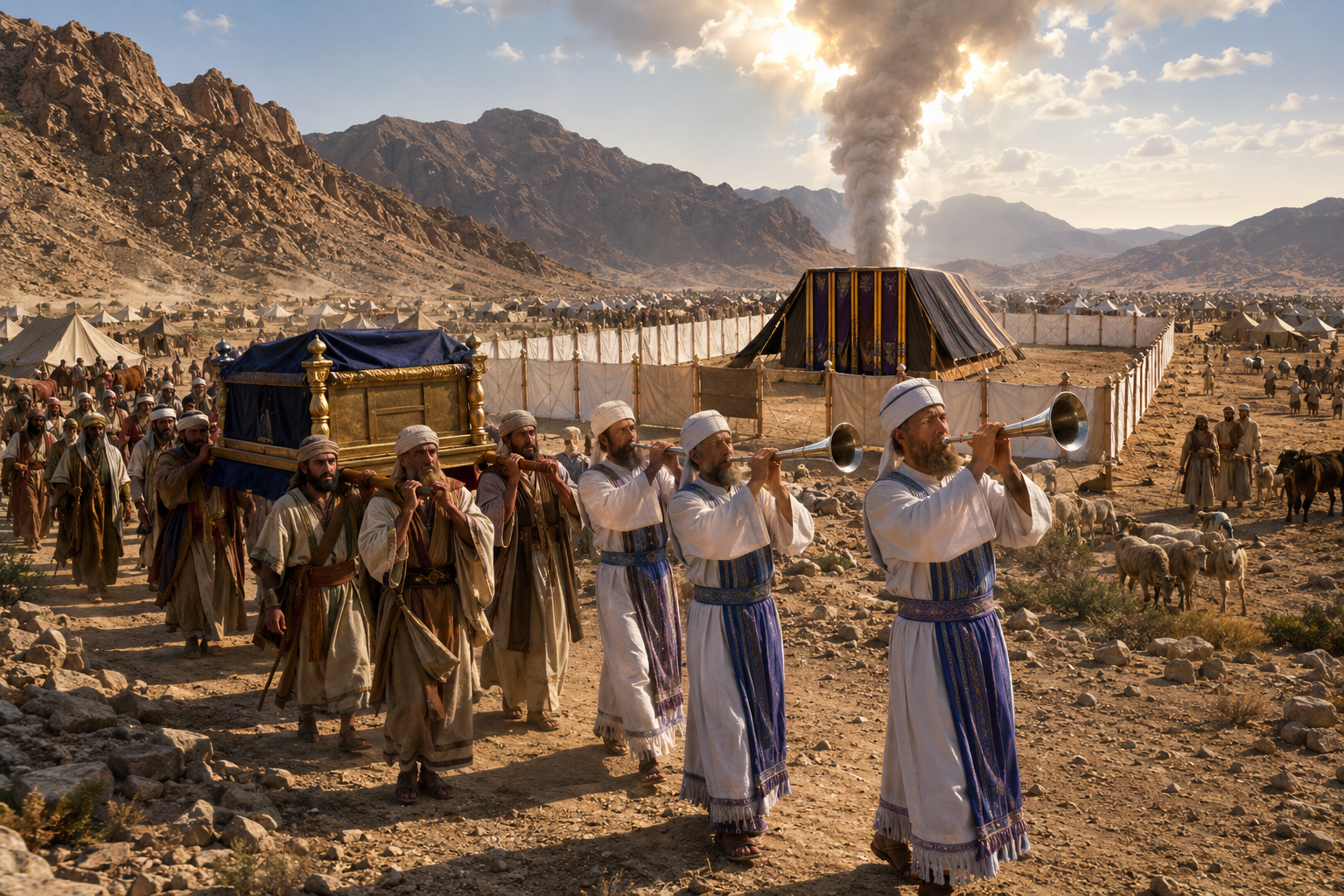
 Numbers 9–11 records a major transition in Israel’s wilderness history. Numbers 9 concerns the Passover and the LORD’s visible direction of Israel by the cloud. Numbers 10 gives the ordinances concerning the silver trumpets and records Israel’s departure from the wilderness of Sinai. Numbers 11 then shows how quickly murmuring, dissatisfaction, and lust appeared after the journey began.
The chapters therefore move from worship and divine guidance, to ordered movement under God’s direction, and then to human discontent and divine chastening.
These events concern Israel as a nation under the Mosaic covenant. They should not be confused with ordinances given to the New Testament church. Nevertheless, the New Testament expressly tells believers to learn from Israel’s wilderness failures:
1 Corinthians 10:6: “Now these things were our examples, to the intent we should not lust after evil things, as they also lusted.”
Thus the historical distinction between Israel and the Church should be maintained while recognizing the spiritual warnings God Himself draws from Israel’s conduct.
Chapter Summaries
Numbers 9 — The Passover and the LORD’s Guidance
1. Israel keeps the Passover in the wilderness — Numbers 9:1–5
The chapter opens in the wilderness of Sinai:
Numbers 9:1: “And the LORD spake unto Moses in the wilderness of Sinai, in the first month of the second year after they were come out of the land of Egypt…”
The LORD commanded Israel to keep the Passover:
Numbers 9:2: “Let the children of Israel also keep the passover at his appointed season.”
They were to observe it on the fourteenth day of the first month “at even,” according to all the rites and ceremonies commanded by God.
This Passover looks back historically to Israel’s deliverance from Egypt in Exodus 12. Israel was not to forget that the LORD had redeemed them from Egyptian bondage.
The Passover belonged specifically to Israel under the law. In the New Testament, however, Paul explicitly identifies Christ with the fulfillment represented by Passover:
1 Corinthians 5:7: “…For even Christ our passover is sacrificed for us.”
That does not make Israel and the Church the same body. Rather, it shows that the deliverance associated with the Passover finds its ultimate redemptive significance in Christ.
2. Provision for those ceremonially unclean — Numbers 9:6–14
Certain men were:
“defiled by the dead body of a man”
and therefore could not keep the Passover at the appointed time.
They asked Moses and Aaron why they should be kept from presenting the LORD’s offering. Moses did not invent an answer or change the command on his own authority. He said:
Numbers 9:8: “Stand still, and I will hear what the LORD will command concerning you.”
That is an important principle. Moses waited for the word of God.
The LORD provided that a person who was unclean because of a dead body, or who was “in a journey afar off,” could keep the Passover on the fourteenth day of the second month.
This was not human accommodation or a relaxation of God’s standard. It was a provision specifically commanded by the LORD.
Conversely, a man who was clean, was not on a journey, and nevertheless refused to keep the Passover was to be cut off from among his people:
Numbers 9:13: “…because he brought not the offering of the LORD in his appointed season, that man shall bear his sin.”
A stranger who desired to keep the Passover was required to observe it according to the same ordinance:
Numbers 9:14: “…ye shall have one ordinance, both for the stranger, and for him that was born in the land.”
The immediate context concerns the Passover ordinance. The verse should not be expanded beyond what the text actually addresses.
3. The cloud over the tabernacle — Numbers 9:15–23
When the tabernacle was erected, the cloud covered it:
Numbers 9:15: “…the cloud covered the tabernacle, namely, the tent of the testimony: and at even there was upon the tabernacle as it were the appearance of fire, until the morning.”
The text repeatedly emphasizes that Israel moved or remained according to the LORD’s command.
When the cloud was taken up, Israel journeyed. When the cloud remained, Israel stayed.
Sometimes the cloud remained only briefly; at other times it remained many days. Israel was not to move merely because the people became impatient.
The chapter closes:
Numbers 9:23: “At the commandment of the LORD they rested in the tents, and at the commandment of the LORD they journeyed…”
The plain emphasis is obedience to divine direction.
Numbers 10 — The Trumpets and Israel’s Departure from Sinai
1. Two silver trumpets — Numbers 10:1–10
The LORD commanded Moses:
Numbers 10:2: “Make thee two trumpets of silver; of a whole piece shalt thou make them…”
The trumpets served several specifically stated purposes.
They were used to call the congregation, summon the princes, signal the movement of the camps, sound an alarm in war, and accompany offerings during appointed occasions.
The sons of Aaron, the priests, were appointed to blow them.
When Israel went to war against an enemy oppressing them, they were instructed:
Numbers 10:9: “…ye shall be remembered before the LORD your God, and ye shall be saved from your enemies.”
The trumpets were therefore part of the ordered religious and national life of Israel.
They were also sounded:
“in the day of your gladness, and in your solemn days, and in the beginnings of your months”
over burnt offerings and peace offerings.
Nothing in the chapter presents these silver trumpets as a New Testament church ordinance. They belong to Israel’s worship and national order under Moses.
2. Israel departs from Sinai — Numbers 10:11–28
A major transition occurs:
Numbers 10:11: “And it came to pass on the twentieth day of the second month, in the second year, that the cloud was taken up from off the tabernacle of the testimony.”
The children of Israel departed from the wilderness of Sinai, and:
“the cloud rested in the wilderness of Paran.”
The tribal camps moved in the order God had established.
Judah’s camp went first. The Gershonites and Merarites followed carrying the tabernacle. Reuben’s camp followed. The Kohathites carried the sanctuary. Then came Ephraim’s camp, followed by Dan’s camp as the “rereward of all the camps.”
This was not an unorganized migration. The text presents an ordered people moving according to God’s arrangement.
3. Moses speaks with Hobab — Numbers 10:29–32
The KJV states:
Numbers 10:29: “And Moses said unto Hobab, the son of Raguel the Midianite, Moses’ father in law…”
Moses invited Hobab to travel with Israel:
“Come thou with us, and we will do thee good: for the LORD hath spoken good concerning Israel.”
Hobab initially replied:
“I will not go; but I will depart to mine own land, and to my kindred.”
Moses appealed to him again, mentioning Hobab’s knowledge of where Israel should encamp in the wilderness.
Scripture does not explicitly state in Numbers 10 whether Hobab accepted Moses’ second appeal. Therefore, it is best not to assert from this chapter that he either did or did not accompany them afterward.
4. The ark goes before them — Numbers 10:33–36
Israel departed from the mount of the LORD on a three-day journey:
Numbers 10:33: “…and the ark of the covenant of the LORD went before them in the three days’ journey, to search out a resting place for them.”
The cloud of the LORD was over them by day.
When the ark moved, Moses said:
Numbers 10:35: “Rise up, LORD, and let thine enemies be scattered; and let them that hate thee flee before thee.”
When it rested:
Numbers 10:36: “Return, O LORD, unto the many thousands of Israel.”
Israel’s journey was therefore presented as dependent upon the LORD’s presence, direction, and protection.
Numbers 11 — Murmuring, Lust, the Seventy Elders, and the Quails
Numbers 11 provides a striking contrast to Numbers 9–10. Israel had the LORD’s direction, His provision, His presence, and His promises, yet dissatisfaction quickly arose.
1. The people complain — Numbers 11:1–3
The chapter begins:
Numbers 11:1: “And when the people complained, it displeased the LORD: and the LORD heard it; and his anger was kindled…”
The fire of the LORD burned among them and consumed those in “the uttermost parts of the camp.”
The people cried unto Moses. Moses prayed unto the LORD, and the fire was quenched.
The place was called Taberah:
“because the fire of the LORD burnt among them.”
The text does not give the exact words of the initial complaint. Therefore, it would go beyond Scripture to invent the particular subject of their complaining in verses 1–3.
2. The mixed multitude and Israel lust for Egypt’s food — Numbers 11:4–9
The next incident is more specific:
Numbers 11:4: “And the mixt multitude that was among them fell a lusting…”
The children of Israel joined in and said:
“Who shall give us flesh to eat?”
They remembered the fish, cucumbers, melons, leeks, onions, and garlic of Egypt.
They complained:
Numbers 11:6: “But now our soul is dried away: there is nothing at all, beside this manna, before our eyes.”
This was a serious distortion of their circumstances. The manna was the LORD’s miraculous provision, yet they spoke of it with dissatisfaction while remembering Egypt chiefly for its food.
The passage then describes manna. It was like coriander seed, its color was like bdellium, and the people gathered it, ground it, beat it, baked it, and made cakes. Its taste was:
“as the taste of fresh oil.”
It came with the dew by night.
3. Moses feels the burden of the people — Numbers 11:10–15
Moses heard the people weeping throughout their families.
The LORD’s anger:
“was kindled greatly”
and Moses also was displeased.
Moses then expressed the crushing weight he felt in bearing responsibility for the congregation.
He asked:
Numbers 11:14: “I am not able to bear all this people alone, because it is too heavy for me.”
His words became so intense that he asked God to kill him rather than leave him under the continuing burden.
The text records Moses’ distress plainly. We should not diagnose motives or psychological conditions that the Bible itself does not state.
4. God appoints seventy elders — Numbers 11:16–17, 24–30
The LORD commanded Moses to gather seventy men of the elders of Israel, men whom Moses knew to be elders and officers.
God said:
Numbers 11:17: “…I will take of the spirit which is upon thee, and will put it upon them; and they shall bear the burden of the people with thee…”
The LORD came down in a cloud, spoke to Moses, and placed the spirit upon the seventy elders.
The KJV states:
Numbers 11:25: “…and it came to pass, that, when the spirit rested upon them, they prophesied, and did not cease.”
Two men, Eldad and Medad, remained in the camp, yet:
“the spirit rested upon them”
and they prophesied there.
A young man reported this to Moses. Joshua said:
“My lord Moses, forbid them.”
Moses answered:
Numbers 11:29: “Enviest thou for my sake? would God that all the LORD’S people were prophets, and that the LORD would put his spirit upon them!”
This episode records a specific work of God among appointed men in Israel during Moses’ leadership. It should not be turned into a justification for modern charismatic teaching or treated as a standing New Testament church ordinance.
The straightforward lesson from the text is that God supplied help for the burden He had permitted Moses to bear.
5. God promises flesh — Numbers 11:18–23
God told Moses to sanctify the people because they would eat flesh.
But their request had not arisen merely from physical necessity. The LORD identified the deeper problem:
Numbers 11:20: “…because that ye have despised the LORD which is among you, and have wept before him, saying, Why came we forth out of Egypt?”
Their craving had become a rejection of God’s provision and dissatisfaction with His deliverance.
Moses mentioned the immense size of the congregation:
Numbers 11:21: “The people, among whom I am, are six hundred thousand footmen…”
He questioned how such a multitude could receive enough flesh.
The LORD answered with one of the great statements of the chapter:
Numbers 11:23: “And the LORD said unto Moses, Is the LORD’S hand waxed short? thou shalt see now whether my word shall come to pass unto thee or not.”
God’s ability was not limited by the size of the need.
6. The quails and judgment at Kibrothhattaavah — Numbers 11:31–35
A wind went forth from the LORD and brought quails from the sea.
The quails were around the camp:
“as it were a day’s journey on this side, and as it were a day’s journey on the other side”
and about two cubits high upon the face of the earth.
The people gathered quails throughout that day, night, and the following day. The one who gathered least gathered ten homers.
Then judgment fell:
Numbers 11:33: “And while the flesh was yet between their teeth, ere it was chewed, the wrath of the LORD was kindled against the people, and the LORD smote the people with a very great plague.”
The place was named Kibrothhattaavah:
“because there they buried the people that lusted.”
Israel then journeyed from Kibrothhattaavah to Hazeroth and remained there.
The chapter therefore ends with a solemn warning: receiving the thing one has demanded in unbelieving lust is not necessarily blessing.
Key People and Places
Moses
God’s appointed leader of Israel. In these chapters Moses receives the LORD’s instructions concerning the Passover, the silver trumpets, the order of journeying, the seventy elders, and God’s response to Israel’s demand for flesh.
Numbers 11 also records Moses openly expressing the unbearable weight he felt in carrying the nation’s burden alone.
Aaron
The high priest. Numbers 9 records the unclean men approaching both Moses and Aaron concerning their inability to keep the Passover at the appointed time.
Aaron’s priestly sons were commanded to blow the silver trumpets in Numbers 10:8.
Joshua
Described in Numbers 11:28 as:
“the son of Nun, the servant of Moses, one of his young men”
He asked Moses to forbid Eldad and Medad from prophesying. Moses rejected any jealous response on his behalf.
Eldad and Medad
Two of the men upon whom the spirit rested. Although they were in the camp rather than gathered around the tabernacle with the others, the KJV explicitly says:
“they prophesied in the camp.”
The Seventy Elders
Men whom God appointed to help Moses:
“they shall bear the burden of the people with thee”
Their appointment demonstrates that God provided human assistance for the responsibility Moses had been attempting to carry alone.
Hobab
Numbers 10:29 describes:
“Hobab, the son of Raguel the Midianite, Moses’ father in law…”
Moses invited him to accompany Israel and appealed to his knowledge of wilderness encampments. Scripture does not explicitly state within Numbers 10 how Hobab responded to Moses’ final appeal.
The Mixed Multitude
Numbers 11:4 explicitly says:
“the mixt multitude that was among them fell a lusting”
The children of Israel then joined in the complaint for flesh.
The passage plainly identifies their lusting as influential in the episode. Scripture does not provide enough information here to assign every later act of rebellion to this group.
Wilderness of Sinai
The location in Numbers 9 where the LORD gave instructions concerning the Passover. Israel had remained in this region while the tabernacle and national order were established.
Wilderness of Paran
Numbers 10:12 states that after Israel departed from Sinai:
“the cloud rested in the wilderness of Paran.”
Taberah
The place named after the LORD’s fire burned among the complaining people.
The name is directly associated in the text with that judgment.
Kibrothhattaavah
The place where the people who lusted were buried following the plague.
Numbers 11:34 explicitly explains the name in connection with:
“the people that lusted.”
Hazeroth
The location to which Israel traveled after Kibrothhattaavah.
Numbers 11 closes with Israel abiding there.
Egypt
Israel had physically departed Egypt, but in Numbers 11 they remembered its foods and questioned why they had come out.
The text presents this memory negatively because it accompanied dissatisfaction with the LORD’s present provision and deliverance.
Main Doctrinal or Spiritual Themes
1. God must be worshiped according to His Word
Numbers 9 repeatedly stresses God’s appointed season, ordinance, rites, and commands regarding the Passover.
Even when an unusual circumstance arose, Moses did not manufacture a solution:
“Stand still, and I will hear what the LORD will command concerning you.”
Biblical obedience does not consist of improving upon what God has spoken.
2. God determines both movement and waiting
Numbers 9 emphasizes:
“At the commandment of the LORD they rested in the tents, and at the commandment of the LORD they journeyed.”
Sometimes obedience means moving. Sometimes obedience means remaining where God has placed a person.
The important issue is not activity for activity’s sake but submission to what God has said.
3. God is a God of order
The Passover had an appointed time.
The trumpets had assigned purposes.
The tribes marched in an appointed order.
The tabernacle had assigned bearers.
The priests had specific duties.
The wilderness congregation was not intended to operate according to personal preference.
A New Testament believer should likewise remember:
1 Corinthians 14:40: “Let all things be done decently and in order.”
4. God’s presence does not make rebellion harmless
Israel had the cloud over them.
They had the tabernacle.
They had manna.
They had Moses.
They had witnessed divine deliverance.
Yet Numbers 11 begins almost immediately with complaining.
Outward proximity to the things of God does not make murmuring, unbelief, or lust acceptable.
5. Murmuring displeases God
Numbers 11:1 could hardly be clearer:
“And when the people complained, it displeased the LORD…”
The New Testament gives the corresponding warning:
1 Corinthians 10:10: “Neither murmur ye, as some of them also murmured, and were destroyed of the destroyer.”
This application is not based merely upon analogy; the New Testament expressly uses Israel’s wilderness conduct as a warning.
6. Lust distorts a person’s view of God’s provision
Israel said:
“there is nothing at all, beside this manna, before our eyes.”
Yet the manna itself was a miraculous provision from God.
Their craving caused them to treat a divine provision as though it were an intolerable deprivation.
Lust frequently says, in effect, “What God has provided is not enough.”
7. Nostalgia can forget bondage
Israel remembered Egypt’s fish, cucumbers, melons, leeks, onions, and garlic.
What their complaint did not emphasize was the bondage from which God had delivered them.
The text does not say they had forgotten every detail of their slavery mentally. It does show that in this complaint they emphasized Egypt’s food while despising their present circumstances under the LORD’s direction.
That is a warning against remembering the pleasures associated with a former life while minimizing the bondage from which God delivered.
8. God supplies strength for God-given responsibility
Moses said:
“I am not able to bear all this people alone…”
God answered by appointing seventy elders to:
“bear the burden of the people with thee.”
The passage does not teach that every difficulty will be removed. It does demonstrate that God was fully capable of supplying what was necessary for the work He required.
9. Spiritual leadership should not be ruled by personal jealousy
When Joshua wanted Eldad and Medad forbidden, Moses replied:
“Enviest thou for my sake?”
Moses was not concerned that the work of God among others would diminish his own position.
A servant of God should desire God’s work to prosper rather than seek personal prominence.
10. God’s power is unlimited
The central question is:
“Is the LORD’S hand waxed short?”
The expected answer is no.
Six hundred thousand footmen did not exhaust God’s resources.
No circumstance can make God less than almighty.
11. God can give men what they demand and still judge their lust
The people wanted flesh.
God gave flesh in overwhelming abundance.
Yet the giving of the quails was accompanied by judgment because their demand had arisen from lust and from despising the LORD’s provision.
Therefore, obtaining a desired thing is not by itself proof of divine approval.
12. Sin has consequences
Taberah and Kibrothhattaavah became geographical reminders of rebellion.
At Kibrothhattaavah:
“there they buried the people that lusted.”
Numbers 11 refuses to portray persistent unbelief as a harmless weakness. God is merciful, but He is also holy.
Practical Applications or Lessons
Obey what God has actually said
Moses’ response in Numbers 9 is exemplary:
“Stand still, and I will hear what the LORD will command concerning you.”
When Scripture speaks plainly, believers need no substitute revelation, human tradition, or cultural revision.
Do not confuse impatience with divine leading
Israel traveled when the cloud moved and remained when the cloud stayed.
The direct historical command concerned Israel and the cloud. For believers today, the application is not to seek a visible wilderness cloud, but to submit patiently to the written Word of God rather than forcing circumstances according to personal desire.
Remember past deliverance accurately
Israel remembered Egypt’s menu while complaining about God’s manna.
A believer should be careful not to romanticize former sin, former bondage, or worldly living by remembering only what appealed to the flesh.
Guard against the influence of discontent
The mixed multitude “fell a lusting,” and Israel joined the cry for flesh.
Sinful dissatisfaction spreads easily through a congregation, family, or group.
This does not mean every complaint originates with outsiders; Numbers 11 only states what occurred in this particular incident.
Gratitude protects the heart from contempt for God’s provision
Manna was miraculous, but familiarity contributed to Israel speaking contemptuously of it.
A blessing received regularly is still a blessing.
Daily provision should produce thankfulness rather than entitlement.
Do not measure God’s ability by visible resources
Moses looked at six hundred thousand footmen and the enormous quantity of food that would be required.
God answered:
“Is the LORD’S hand waxed short?”
The believer should never redefine God’s ability according to the size of a visible problem.
Leadership burdens should drive the servant of God toward God
Moses did bring his burden directly to the LORD.
Although his language was deeply distressed, he brought the problem to the One who could actually answer it.
Pastors and other servants of God should remember that no human leader was designed to be self-sufficient.
Welcome faithful help rather than protecting personal territory
Moses did not treat Eldad and Medad as rivals.
Ministry is not about enlarging a preacher’s personal reputation. The work belongs to the LORD.
Do not mistake fulfilled lust for blessing
Israel received exactly the flesh it demanded, but the outcome was judgment.
Getting what one desperately wants can be spiritually disastrous when the desire itself is contrary to a heart of submission to God.
Murmuring is serious
Modern culture often treats complaining as a minor personality habit.
Numbers 11 does not.
God heard the complaints and was displeased.
Believers should take seriously the command:
Philippians 2:14: “Do all things without murmurings and disputings:”
Contentment is spiritual strength
The wilderness generation continually faced the temptation to compare present hardship with a selectively remembered Egypt.
The New Testament answer is:
1 Timothy 6:6: “But godliness with contentment is great gain.”
Contentment does not mean pretending hardship is pleasant. It means refusing to accuse God of failing because He has not supplied everything the flesh desires.
Overall Message of Numbers 9–11
Numbers 9–11 presents Israel at a decisive moment.
In Numbers 9, Israel worships according to God’s command and waits upon His direction.
In Numbers 10, Israel moves in divinely appointed order from Sinai toward the next stage of the journey.
In Numbers 11, the people begin murmuring and lusting, showing that outward direction from God does not automatically produce inward submission to God.
The LORD remains faithful throughout the passage.
He provides the Passover ordinance.
He provides guidance by the cloud.
He provides order through the trumpets.
He provides direction for the journey.
He provides help for Moses through the seventy elders.
He demonstrates that His hand is not shortened.
But He also judges complaining, unbelief, and lust.
The great contrast is between trusting what the LORD provides and despising what the LORD provides.
Israel’s safest position was expressed in Numbers 9:
“At the commandment of the LORD they rested in the tents, and at the commandment of the LORD they journeyed…”
Their danger began when their desires became more authoritative to them than the goodness and wisdom of the God who was leading them.
For the believer, the wilderness history gives a sober warning without confusing Israel and the Church:
1 Corinthians 10:11: “Now all these things happened unto them for ensamples: and they are written for our admonition…”
God’s people should therefore cultivate obedience, gratitude, contentment, confidence in God’s power, respect for His order, and a holy fear of murmuring against His provision.
Comments are closed