
 Numbers 12–14 records a solemn progression from rebellion against God-appointed leadership, to unbelief concerning God’s promise, to open refusal to enter the land, and finally to presumptuous action without the LORD’s presence. Against that dark background stand Moses’ meekness and intercession and the faith of Caleb and Joshua.
These chapters concern Israel under the Mosaic covenant and must first be understood in that historical setting. Israel and the New Testament Church are not the same body. Nevertheless, the New Testament expressly uses Israel’s wilderness failures as warnings to believers: “Now all these things happened unto them for ensamples: and they are written for our admonition” (1 Corinthians 10:11). Hebrews likewise points directly to this generation and concludes, “So we see that they could not enter in because of unbelief” (Hebrews 3:19).
Chapter Summaries
Numbers 12 — Miriam and Aaron Speak Against Moses
Numbers 12 begins with opposition arising within Moses’ own family:
“And Miriam and Aaron spake against Moses because of the Ethiopian woman whom he had married: for he had married an Ethiopian woman” (Numbers 12:1).
The KJV explicitly calls the woman “the Ethiopian woman.” Scripture does not explicitly identify her by name in this chapter. Although various explanations have been proposed concerning her identity, the passage itself does not establish whether she was Zipporah or another woman. Therefore, that question should not be made part of the doctrinal meaning of the chapter.
Their complaint immediately turns from Moses’ marriage to his prophetic authority:
“Hath the LORD indeed spoken only by Moses? hath he not spoken also by us? And the LORD heard it” (Numbers 12:2).
Whatever else lay behind their words, the text explicitly shows that they challenged Moses’ unique position as the LORD’s servant.
Verse 3 gives God’s own testimony concerning Moses:
“Now the man Moses was very meek, above all the men which were upon the face of the earth.”
Biblical meekness is not weakness. Moses could exercise authority firmly, yet he did not answer this personal attack by seeking revenge. The LORD Himself took up the matter.
God called Moses, Aaron, and Miriam to “the tabernacle of the congregation” and came down “in the pillar of the cloud” (Numbers 12:4-5). He then made an important distinction between Moses and ordinary prophetic revelation.
Concerning a prophet, God said:
“I the LORD will make myself known unto him in a vision, and will speak unto him in a dream” (Numbers 12:6).
But concerning Moses:
“My servant Moses is not so, who is faithful in all mine house. With him will I speak mouth to mouth, even apparently, and not in dark speeches” (Numbers 12:7-8).
Moses therefore occupied a uniquely privileged place in Israel’s revelation and government. Hebrews later repeats God’s testimony that “Moses verily was faithful in all his house, as a servant” (Hebrews 3:5), while showing the superiority of Christ as the Son over His own house.
The LORD then asked Miriam and Aaron:
“Wherefore then were ye not afraid to speak against my servant Moses?” (Numbers 12:8).
God’s anger was kindled, the cloud departed, and Miriam became “leprous, white as snow” (Numbers 12:10).
Only Miriam is explicitly said to have been struck with leprosy. Scripture does not explicitly state why Aaron did not receive the same physical judgment, so no definite explanation should be asserted.
Aaron immediately acknowledged their sin:
“Alas, my lord, I beseech thee, lay not the sin upon us, wherein we have done foolishly, and wherein we have sinned” (Numbers 12:11).
Moses then prayed one of the shortest and most earnest prayers in Scripture:
“Heal her now, O God, I beseech thee” (Numbers 12:13).
There is no bitterness in the recorded prayer. The man who had been attacked interceded for the one who had spoken against him.
The LORD required Miriam to remain outside the camp seven days. Israel did not journey until she was brought in again. Afterward they departed from Hazeroth and “pitched in the wilderness of Paran” (Numbers 12:16).
The chapter therefore demonstrates both the seriousness of rebellion against God’s appointed order and the value of meek, forgiving intercession.
Numbers 13 — The Twelve Spies Search Canaan
From the wilderness of Paran, the LORD commanded Moses:
“Send thou men, that they may search the land of Canaan, which I give unto the children of Israel” (Numbers 13:2).
Notice the certainty of God’s wording: “the land of Canaan, which I give.” The land was not merely a possible possession. God had declared His intention to give it to Israel.
Deuteronomy 1:22-23 adds that the people had approached Moses proposing that men be sent before them to search the land, and that the proposal pleased Moses. Numbers 13 explicitly records the LORD directing Moses to send the men. Neither passage gives Israel authority to turn the reconnaissance mission into a vote on whether God’s promise should be obeyed.
One ruler from each tribe was chosen.
Among them were:
- Caleb the son of Jephunneh, representing Judah.
- Oshea the son of Nun, representing Ephraim.
Moses called Oshea:
“Jehoshua” (Numbers 13:16),
the man subsequently known throughout the narrative as Joshua.
Moses commanded the spies to examine the land, its people, its cities, its fertility, and its produce. They searched the land “from the wilderness of Zin unto Rehob, as men come to Hamath” (Numbers 13:21).
At Hebron they saw Ahiman, Sheshai, and Talmai, “the children of Anak” (Numbers 13:22). The text also notes:
“Now Hebron was built seven years before Zoan in Egypt.”
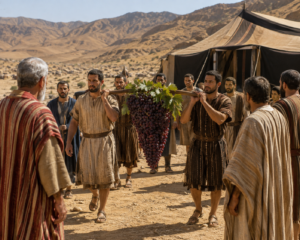
At “the brook of Eshcol” they cut down a branch containing a cluster of grapes so large that:
“they bare it between two upon a staff” (Numbers 13:23).
They also brought pomegranates and figs.
After forty days, the spies returned to Moses, Aaron, and the congregation at Kadesh in the wilderness of Paran.
Their initial report confirmed the goodness of the land:
“We came unto the land whither thou sentest us, and surely it floweth with milk and honey; and this is the fruit of it” (Numbers 13:27).
But ten of the spies centered their attention upon the obstacles. They described strong inhabitants, walled cities, the children of Anak, Amalekites, Hittites, Jebusites, Amorites, and Canaanites.
Caleb responded decisively:
“Let us go up at once, and possess it; for we are well able to overcome it” (Numbers 13:30).
Caleb’s confidence must not be interpreted as human self-confidence separated from God. Chapter 14 explains his reasoning: “the LORD is with us” (Numbers 14:9). His confidence rested upon God’s promise and presence.
The other spies contradicted him:
“We be not able to go up against the people; for they are stronger than we” (Numbers 13:31).
The KJV then explicitly describes what they spread as:
“an evil report of the land” (Numbers 13:32).
They said:
“The land, through which we have gone to search it, is a land that eateth up the inhabitants thereof.”
They also emphasized the great stature of the inhabitants and said:
“And there we saw the giants, the sons of Anak, which come of the giants: and we were in our own sight as grasshoppers, and so we were in their sight” (Numbers 13:33).
The statement that they were “as grasshoppers” is the spies’ own description. The KJV records them saying it; the passage does not independently establish every fearful conclusion they drew from what they saw.
That distinction is important. Some of the obstacles they described were real, but their conclusion—“We be not able”—contradicted the LORD who had already said, “I give” them the land.
The central issue was therefore not whether Canaan contained formidable enemies. It did. The issue was whether Israel would believe the LORD in the presence of those enemies.
Numbers 14 — Israel Refuses the Land
The evil report produced a national crisis:
“And all the congregation lifted up their voice, and cried; and the people wept that night” (Numbers 14:1).
The children of Israel murmured against Moses and Aaron and said:
“Would God that we had died in the land of Egypt! or would God we had died in this wilderness!” (Numbers 14:2).
They accused the LORD of bringing them into the land to die by the sword and feared that their wives and children would become prey.
Then their rebellion became explicit:
“Let us make a captain, and let us return into Egypt” (Numbers 14:4).
This was more than ordinary discouragement. They were proposing to reverse the deliverance God had accomplished and return to the land from which He had brought them.
Moses and Aaron fell upon their faces before the congregation.
Joshua and Caleb tore their clothes and pleaded with Israel:
“The land, which we passed through to search it, is an exceeding good land” (Numbers 14:7).
They continued:
“If the LORD delight in us, then he will bring us into this land, and give it us” (Numbers 14:8).
Their appeal centered on two commands:
“Only rebel not ye against the LORD, neither fear ye the people of the land” (Numbers 14:9).
And their confidence rested on this truth:
“The LORD is with us: fear them not.”
The congregation responded by speaking of stoning them. At that moment:
“the glory of the LORD appeared in the tabernacle of the congregation before all the children of Israel” (Numbers 14:10).
God identified the heart of Israel’s rebellion:
“How long will this people provoke me? and how long will it be ere they believe me, for all the signs which I have shewed among them?” (Numbers 14:11).
The fundamental issue was unbelief.
God announced that He could smite the nation with pestilence and make of Moses “a greater nation and mightier than they” (Numbers 14:12).
Moses then interceded.
His prayer is significant because it was centered primarily upon the LORD’s name and character, not upon Israel’s worthiness. Moses argued that Egypt and the nations had heard of God’s presence with Israel. If Israel were destroyed, those nations would speak wrongly concerning God’s ability to fulfill His purpose.
Moses also appealed directly to what God had revealed concerning Himself:
“The LORD is longsuffering, and of great mercy, forgiving iniquity and transgression” (Numbers 14:18).
Yet Moses did not omit God’s justice:
“and by no means clearing the guilty.”
He then prayed:
“Pardon, I beseech thee, the iniquity of this people according unto the greatness of thy mercy” (Numbers 14:19).
God answered:
“I have pardoned according to thy word” (Numbers 14:20).
That declaration is immediately followed by severe temporal judgment. This is an important biblical truth: pardon does not necessarily remove every earthly consequence of sin.
Numbers 14, however, is dealing directly with God’s governmental judgment upon Israel in the wilderness. The passage should not be made to say more than it says concerning the eternal spiritual condition of every individual in that generation.
God declared that those who had seen His glory and signs, yet had refused to hearken to His voice, would not see the promised land.
Of Caleb He said:
“But my servant Caleb, because he had another spirit with him, and hath followed me fully, him will I bring into the land” (Numbers 14:24).
The phrase “another spirit with him” distinguishes Caleb from the unbelieving congregation. The verse itself does not define the expression as a technical statement concerning New Testament indwelling. What it explicitly emphasizes is Caleb’s different response toward God: “he hath followed me fully.”
God further declared concerning the numbered generation:
“Your carcases shall fall in this wilderness” (Numbers 14:29).
The judgment applied to those:
“from twenty years old and upward, which have murmured against me.”
Caleb and Joshua were specifically excepted:
“Doubtless ye shall not come into the land, concerning which I sware to make you dwell therein, save Caleb the son of Jephunneh, and Joshua the son of Nun” (Numbers 14:30).
Israel had complained that their children would become prey. God answered:
“But your little ones, which ye said should be a prey, them will I bring in, and they shall know the land which ye have despised” (Numbers 14:31).
Their wilderness judgment was connected directly to the forty days of spying:
“After the number of the days in which ye searched the land, even forty days, each day for a year, shall ye bear your iniquities, even forty years” (Numbers 14:34).
The ten spies responsible for the evil report then:
“died by the plague before the LORD” (Numbers 14:37),
while:
“Joshua the son of Nun, and Caleb the son of Jephunneh, which were of the men that went to search the land, lived still” (Numbers 14:38).
When Moses reported God’s judgment, the people mourned greatly. The following morning they tried to go into the land after all.
Their words sounded different:
“Lo, we be here, and will go up unto the place which the LORD hath promised: for we have sinned” (Numbers 14:40).
But God had not commanded this attempt.
Moses warned:
“Wherefore now do ye transgress the commandment of the LORD? but it shall not prosper” (Numbers 14:41).
He further said:
“Go not up, for the LORD is not among you” (Numbers 14:42).
Nevertheless:
“they presumed to go up unto the hill top” (Numbers 14:44).
Neither Moses nor the ark of the covenant went with them.
The result was defeat:
“Then the Amalekites came down, and the Canaanites which dwelt in that hill, and smote them, and discomfited them, even unto Hormah” (Numbers 14:45).
The chapter therefore ends with a striking contrast.
When God said go, Israel refused.
When God afterward said go not up, Israel went.
Neither action was faith because both actions rejected the present word of God.
Key People and Places
People
- Moses — The LORD’s servant and Israel’s leader. Numbers 12 explicitly calls him “very meek” and records God describing him as “faithful in all mine house.” In Numbers 14 he intercedes for Israel after their rebellion.
- Miriam — Moses’ sister, who joined Aaron in speaking against Moses. She was struck with leprosy and shut outside the camp for seven days.
- Aaron — Moses’ brother and Israel’s high priest. He joined Miriam in speaking against Moses, confessed, “we have done foolishly, and…we have sinned,” and appealed to Moses concerning Miriam.
- Caleb the son of Jephunneh — Judah’s representative among the twelve spies. He urged immediate obedience and later pleaded, “the LORD is with us.” God said Caleb had “followed me fully.”
- Joshua the son of Nun — Ephraim’s representative. Numbers 13 says Moses called Oshea “Jehoshua.” Joshua joined Caleb in opposing the evil report and was one of the two adult spies explicitly permitted to enter the land.
- The ten unbelieving spies — Scripture does not ordinarily refer to them by that collective title in the narrative, but Numbers 13 names the twelve, while Numbers 14 distinguishes Joshua and Caleb from “those men that did bring up the evil report.” Those responsible for that report died by plague before the LORD.
- The congregation of Israel — The nation that received the spies’ report, murmured against Moses and Aaron, proposed returning to Egypt, rejected Joshua and Caleb’s appeal, and came under the forty-year wilderness judgment.
- The children of Anak — Men encountered by the spies, particularly in connection with Hebron. Ahiman, Sheshai, and Talmai are specifically named.
Places
- Hazeroth — The location connected with the events immediately preceding Israel’s move into the wilderness of Paran. Numbers 12 concludes with Israel departing from Hazeroth.
- Wilderness of Paran — The region from which the spies were sent and where Israel was encamped during these events.
- Wilderness of Zin — The southern extent named in the spies’ search.
- Rehob and Hamath — Used in Numbers 13:21 to describe the northern extent of their search.
- Hebron — A significant city in the land where the children of Anak were seen.
- Brook of Eshcol — The place where the spies cut the remarkable cluster of grapes. The name became associated with that cluster.
- Kadesh — The location in the wilderness of Paran to which the spies returned and where the congregation received their report.
- Egypt — The land from which God had delivered Israel. In rebellion the people proposed returning there.
- Canaan — The land God explicitly said He was giving to the children of Israel.
- Hormah — The point to which the Amalekites and Canaanites pursued and defeated the Israelites who presumptuously attempted to enter the land.
Main Doctrinal and Spiritual Themes
1. God Takes Rebellion Against His Appointed Order Seriously
Miriam and Aaron were not merely expressing a personal disagreement. Their words challenged the special position God had given Moses:
“Hath the LORD indeed spoken only by Moses?”
God Himself answered the challenge.
Numbers 12 therefore warns against treating divine order casually. This does not teach that human leaders are infallible or beyond biblical examination. Moses himself was a man under God’s authority. The point of the passage is that Miriam and Aaron challenged a position that God Himself had explicitly established.
2. Meekness Is Compatible With Strong Leadership
Moses was:
“very meek.”
Yet he was also the leader who stood before Pharaoh, governed Israel, delivered God’s commandments, rebuked sin, and interceded before God.
Biblical meekness is therefore not cowardice or surrender of responsibility. It is strength that does not need to defend personal pride.
When Miriam was judged, Moses did not ask that the punishment be increased. He cried:
“Heal her now, O God, I beseech thee.”
3. God’s Word Must Be Believed Above Visible Circumstances
The ten spies saw fortified cities and powerful enemies.
Caleb saw the same land.
The difference was not principally what they saw but what they believed concerning the LORD.
God had already said:
“the land of Canaan, which I give unto the children of Israel.”
The unbelieving spies said:
“We be not able.”
Caleb said:
“We are well able.”
Chapter 14 explains why Caleb could speak this way:
“The LORD is with us.”
Biblical faith is therefore not pretending obstacles do not exist. Faith sees the obstacle but believes what God has said.
4. Unbelief Is Rebellion Against God
God Himself connected their refusal with unbelief:
“How long will it be ere they believe me?”
Joshua and Caleb called their proposed refusal:
“rebel[ling]…against the LORD.”
Hebrews 3:19 gives the inspired New Testament explanation:
“So we see that they could not enter in because of unbelief.”
Unbelief is not presented here as intellectually cautious neutrality. After all the LORD had shown Israel, refusing His promise was rebellion.
5. Fear Magnifies Man and Minimizes God
The ten spies described themselves as grasshoppers.
Joshua and Caleb said:
“Neither fear ye the people of the land.”
They did not deny the enemy’s strength. They simply refused to measure the outcome by human strength alone.
Their decisive statement was:
“The LORD is with us.”
Fear asks, “How strong are they compared with us?”
Faith asks, “What has the LORD said?”
6. Majority Opinion Does Not Determine Truth
Ten spies opposed two.
The congregation sided with the ten.
Yet the minority was right because Caleb and Joshua stood with the word of God.
Scriptural truth is never established by counting votes. A multitude can be sincerely frightened, emotionally united, and completely wrong.
The believer’s authority remains what God has said.
7. Intercession Should Be Concerned With God’s Glory
Moses’ prayer in Numbers 14 is not centered upon Israel’s deserving another opportunity.
His great concern is the reputation of the LORD among the nations and the character God has revealed concerning Himself.
This gives an important pattern for prayer. The highest purpose of prayer is not merely relief from difficulty but the glory of God and the fulfillment of His will.
8. God Is Both Merciful and Just
Moses confessed that the LORD is:
“longsuffering, and of great mercy, forgiving iniquity and transgression.”
He also confessed:
“and by no means clearing the guilty.”
Neither truth cancels the other.
God said:
“I have pardoned according to thy word,”
yet that generation still experienced serious temporal consequences.
A sound doctrine of God refuses to emphasize His mercy in a way that denies His holiness and justice, or His judgment in a way that denies His mercy.
9. Forgiveness Does Not Necessarily Remove Temporal Consequences
Israel’s case makes this particularly plain.
God declared pardon, but He also declared:
“Your carcases shall fall in this wilderness.”
Sin can be forgiven while consequences remain.
That principle should be applied carefully. Numbers 14 is first describing God’s governmental dealing with Israel. It is not a detailed exposition of New Testament justification, nor does it explicitly state the eternal destiny of every member of that generation.
10. God Honors Wholehearted Faithfulness
The LORD said concerning Caleb:
“he hath followed me fully.”
That is one of the great testimonies God gives concerning a man in the Old Testament.
Caleb was surrounded by unbelief but did not permit the unbelief of others to determine his obedience.
Joshua likewise remained with Caleb against the evil report and was preserved to enter the land.
11. Presumption Is Not Faith
This is one of the most important lessons at the end of Numbers 14.
Israel first refused to advance when God commanded them to enter.
Then they advanced when God commanded them not to go.
The KJV explicitly says:
“they presumed to go up.”
Religious enthusiasm is not automatically faith.
Courage is not automatically faith.
Determination is not automatically faith.
Faith obeys what God has actually said.
Trying to accomplish yesterday’s command while disobeying today’s command is still disobedience.
12. God’s Presence Is More Important Than Human Confidence
Moses warned:
“Go not up, for the LORD is not among you.”
The ark remained in the camp. Moses remained in the camp. The people went forward anyway and were defeated.
Their earlier problem had been fear despite God’s presence.
Their later problem was confidence without God’s presence.
Both were wrong.
The believer needs neither fearful unbelief nor fleshly presumption, but obedient dependence upon the Lord.
13. Israel and the Church Must Remain Distinct
Numbers 12–14 concerns literal Israel, a literal wilderness journey, literal tribes, and God’s literal promise concerning Canaan.
The Church does not replace Israel in the promises of this passage.
Nevertheless, God has expressly preserved Israel’s history for the believer’s instruction. First Corinthians 10:6 says:
“Now these things were our examples, to the intent we should not lust after evil things, as they also lusted.”
And verse 11 says:
“they are written for our admonition.”
Therefore, the historical interpretation remains Israelite, while the spiritual and moral warnings legitimately apply to believers because the New Testament itself makes that application.
Practical Applications and Lessons
Guard the Tongue Against Proud and Rebellious Speech
Numbers 12 begins with words spoken against Moses, and:
“the LORD heard it.”
That brief statement should govern Christian speech. Words spoken in private are not hidden from God.
Believers should exercise particular caution before attacking legitimate spiritual authority merely because of personal dissatisfaction, jealousy, or wounded pride. At the same time, all Christian authority remains subordinate to Scripture.
Do Not Defend Yourself When God Can Defend You
Moses’ recorded response to the personal attack is striking because Scripture records no angry self-defense from him. God addressed the matter.
There are occasions when truth must be defended, but personal pride need not control the response.
“The man Moses was very meek.”
Pray for Those Who Have Wronged You
When Miriam was judged, Moses prayed:
“Heal her now, O God, I beseech thee.”
That is a demanding example of grace. It is easier to pray for a friend who is suffering than for someone whose own sin against you helped bring the difficulty.
Moses prayed anyway.
Never Let the Size of an Obstacle Become Greater Than the Promise of God
The inhabitants were strong. The cities were walled. The children of Anak were real.
But none of those facts overturned:
“the land of Canaan, which I give.”
Faith does not require pretending difficulties are small. It requires believing that God remains greater than the difficulty.
Beware of an Evil Report
The ten spies did not invent every fact in their report. The great danger was the unbelieving conclusion they attached to the facts.
A report can contain accurate observations and still lead people into an ungodly conclusion.
Believers must therefore judge conclusions by Scripture rather than accepting them merely because the circumstances described are real.
Refuse Grasshopper Thinking
The spies said:
“we were in our own sight as grasshoppers.”
Their attention had become fixed upon themselves and their enemies.
Caleb and Joshua fixed attention upon the LORD:
“the LORD is with us.”
Christian usefulness will always be crippled when the believer measures every duty only by personal ability.
Do Not Follow the Crowd Into Unbelief
The ten had the majority among the spies.
The congregation joined them.
Caleb and Joshua stood almost alone.
Truth remained with the two because the two stood with God’s promise.
A Baptist conviction worthy of the name must finally rest upon the Bible, not popularity, denominational pressure, scholarship, tradition, or the mood of the crowd.
Do Not Romanticize Egypt
Israel said:
“Let us make a captain, and let us return into Egypt.”
Egypt had been the place of their bondage, yet unbelief made slavery appear preferable to trusting God in difficulty.
Christians likewise must not allow present hardship to make the old life of sin appear desirable.
The world never becomes a better master because obedience becomes difficult.
Understand the Seriousness of Unbelief
The LORD did not describe Israel’s response merely as anxiety.
He asked:
“how long will it be ere they believe me?”
The issue was faith in His word.
When God has spoken plainly, continued refusal is not caution. It is unbelief.
Intercede With God’s Character in View
Moses based his prayer upon who God is:
“The LORD is longsuffering, and of great mercy.”
Prayer becomes stronger and more biblical when it rests upon revealed truth concerning God rather than emotion alone.
Never Confuse Repentant-Sounding Words With Obedience
After judgment was pronounced, Israel said:
“for we have sinned.”
Those words were true.
Yet they immediately disobeyed again by going up when God had told them not to go.
A verbal confession that does not submit to God’s present command is not enough.
Do Not Call Presumption Faith
Israel’s final attempt looked courageous.
They climbed the hill.
They faced the enemy.
They were determined to enter the land.
Yet Scripture says:
“they presumed to go up.”
Bold action can still be disobedience.
The question is not merely, “Am I sincere?” or “Am I courageous?”
The decisive question is, “Am I obeying what God has said?”
Follow the LORD Fully
God’s testimony concerning Caleb should challenge every believer:
“he hath followed me fully.”
Not partially.
Not when the majority agreed.
Not only when circumstances seemed favorable.
Caleb’s distinguishing characteristic in the passage is steady confidence in the LORD resulting in obedience.
Overall Message of Numbers 12–14
Numbers 12–14 shows the danger of rebellion developing through successive stages.
In chapter 12, Miriam and Aaron challenge the servant God appointed.
In chapter 13, ten spies challenge the promise God gave.
In chapter 14, the congregation challenges the direction God commanded.
Finally, when God forbids them to advance, they challenge that command also.
The repeated problem is a refusal to accept the word of the LORD as final.
Standing against that unbelief are three remarkable examples:
Moses demonstrates meekness and intercession.
Joshua demonstrates courageous agreement with God’s promise.
Caleb demonstrates wholehearted faithfulness:
“he hath followed me fully.”
The great dividing line in these chapters is therefore not between people who encounter difficulties and people who do not. Everyone saw the same wilderness, the same fortified cities, and the same formidable inhabitants.
The difference was whether they believed God.
Israel said:
“We be not able.”
Caleb said:
“We are well able.”
Joshua and Caleb gave the reason:
“The LORD is with us.”
That remains the central spiritual lesson of Numbers 12–14: God’s people must receive His Word as true, obey what He has actually commanded, refuse both unbelieving fear and fleshly presumption, and follow the Lord fully.
Comments are closed