
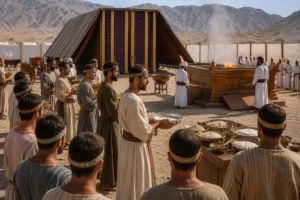
 Numbers 7–8 records the dedication offerings connected with the newly erected tabernacle and the formal cleansing and setting apart of the Levites for their appointed service. These chapters emphasize that worship, giving, holiness, and ministry were to be carried out according to God’s order rather than man’s preference.
The setting is Israel’s encampment in the wilderness at the tabernacle. Numbers 7 reaches back to the occasion when Moses had finished setting up and anointing the tabernacle, while Numbers 8 continues with instructions concerning the candlestick and the consecration of the Levites.
These commands belong specifically to Israel under the Mosaic covenant. They should not be imposed upon the New Testament church as ceremonial requirements. Nevertheless, enduring truths concerning holiness, obedience, stewardship, order, and consecrated service remain instructive for believers.
Chapter Summaries
Numbers 7 — The Princes’ Offerings at the Dedication of the Altar
Numbers 7 opens:
Numbers 7:1 — “And it came to pass on the day that Moses had fully set up the tabernacle, and had anointed it, and sanctified it, and all the instruments thereof, both the altar and all the vessels thereof, and had anointed them, and sanctified them;”
The chapter concerns the dedication connected with the tabernacle and altar after Moses had set them up and sanctified them according to God’s command.
1. The princes bring wagons and oxen — Numbers 7:1–9
The princes of Israel were the tribal leaders who had previously assisted in the numbering of the people.
They brought before the LORD:
- Six covered wagons.
- Twelve oxen.
- One wagon for every two princes.
- One ox from each prince.
The LORD instructed Moses to accept these gifts for the work of the tabernacle.
The wagons and oxen were distributed according to the work assigned to the Levitical families.
The sons of Gershon received two wagons and four oxen according to their service.
The sons of Merari received four wagons and eight oxen because their responsibilities involved the heavier structural materials of the tabernacle.
But Scripture specifically says concerning the Kohathites:
Numbers 7:9 — “But unto the sons of Kohath he gave none: because the service of the sanctuary belonging unto them was that they should bear upon their shoulders.”
This was not merely a practical transportation decision. It was God’s prescribed order for handling the holy things assigned to Kohath.
The text therefore establishes an important principle: God’s work must be performed in God’s appointed manner.
2. The princes dedicate the altar — Numbers 7:10–83
The princes then brought offerings for the dedication of the altar.
The LORD told Moses:
Numbers 7:11 — “They shall offer their offering, each prince on his day, for the dedicating of the altar.”
One tribal prince presented his offering each day for twelve days.
The order was:
- Nahshon, prince of Judah.
- Nethaneel, prince of Issachar.
- Eliab, prince of Zebulun.
- Elizur, prince of Reuben.
- Shelumiel, prince of Simeon.
- Eliasaph, prince of Gad.
- Elishama, prince of Ephraim.
- Gamaliel, prince of Manasseh.
- Abidan, prince of Benjamin.
- Ahiezer, prince of Dan.
- Pagiel, prince of Asher.
- Ahira, prince of Naphtali.
Each prince brought the same prescribed amount and kinds of offerings.
Each day’s presentation included silver and gold vessels, fine flour mingled with oil, incense, animals for a burnt offering, an animal for a sin offering, and animals for peace offerings.
A striking feature of Numbers 7 is the deliberate repetition of each prince’s offering. Although the gifts were identical, the Holy Ghost records each tribal leader and his offering separately.
The KJV does not explicitly state why God chose to record the offerings with such repetition. It may indicate the individual recognition of each tribe’s participation, but Scripture does not explicitly assign that explanation. What the text certainly demonstrates is that God considered each presentation worthy of being recorded.
3. The totals of the dedication offerings — Numbers 7:84–88
After recording the twelve offerings separately, Scripture gives their combined totals.
The dedication included twelve silver chargers, twelve silver bowls, twelve golden spoons, together with the various animals used for burnt offerings, sin offerings, and peace offerings.
The chapter therefore moves from individual responsibility to united participation: twelve distinct tribal representatives participated in one dedication of the altar.
4. God speaks with Moses — Numbers 7:89
The chapter closes with a remarkable statement:
Numbers 7:89 — “And when Moses was gone into the tabernacle of the congregation to speak with him, then he heard the voice of one speaking unto him from off the mercy seat that was upon the ark of testimony, from between the two cherubims: and he spake unto him.”
The text explicitly states that Moses heard the voice speaking from above the mercy seat, between the cherubims.
This emphasizes that the tabernacle was not merely a national monument or religious structure. God had established it as the appointed center of Israel’s worship and as the place associated with His revealed presence among them.
Numbers 8 — The Candlestick and the Consecration of the Levites
Numbers 8 shifts from the tribal princes to the priesthood and Levites.
1. Aaron arranges the lamps — Numbers 8:1–4
The LORD instructed Moses concerning the seven lamps of the candlestick.
Numbers 8:2 — “Speak unto Aaron, and say unto him, When thou lightest the lamps, the seven lamps shall give light over against the candlestick.”
Aaron obeyed:
Numbers 8:3 — “And Aaron did so; he lighted the lamps thereof over against the candlestick, as the LORD commanded Moses.”
The candlestick itself had been made according to the pattern shown by the LORD.
The central emphasis of the passage is obedience. Aaron did precisely what the LORD commanded.
Any further symbolic interpretation must be kept subordinate to what the text actually states. Numbers 8 itself does not explicitly explain a symbolic meaning for the seven lamps in this passage.
2. The Levites are cleansed — Numbers 8:5–7
God commanded:
Numbers 8:6 — “Take the Levites from among the children of Israel, and cleanse them.”
Their cleansing included:
Numbers 8:7 — “Sprinkle water of purifying upon them, and let them shave all their flesh, and let them wash their clothes, and so make themselves clean.”
These were ceremonial requirements God gave specifically for the Levites before entering their appointed ministry.
They teach plainly that men appointed to holy service under the Mosaic order were not permitted to treat that service casually.
3. Sacrifices accompany their consecration — Numbers 8:8
Two young bullocks were brought.
One was connected with a burnt offering and the other with a sin offering.
The Levites were therefore not presented for service on the basis of supposed personal perfection. Sacrifice was included in their consecration according to God’s command.
4. Israel lays hands upon the Levites — Numbers 8:9–10
The Levites were brought before the tabernacle, and the whole assembly of Israel was gathered.
Numbers 8:10 — “And thou shalt bring the Levites before the LORD: and the children of Israel shall put their hands upon the Levites:”
The passage explicitly records the laying on of hands but does not state that this was identical in meaning or function to every laying on of hands found elsewhere in Scripture.
Within this immediate context, the Levites were being formally presented before the LORD as those whom God had taken from among Israel for tabernacle service.
5. Aaron offers the Levites before the LORD — Numbers 8:11–15
Aaron was commanded:
Numbers 8:11 — “And Aaron shall offer the Levites before the LORD for an offering of the children of Israel, that they may execute the service of the LORD.”
The Levites were themselves presented to God for His service.
After the prescribed sacrifices and cleansing were completed, they were permitted to enter into their work concerning the tabernacle.
There was preparation before service.
6. God takes the Levites instead of Israel’s firstborn — Numbers 8:16–18
God states:
Numbers 8:16 — “For they are wholly given unto me from among the children of Israel; instead of such as open every womb, even instead of the firstborn of all the children of Israel, have I taken them unto me.”
God then connects this claim with the firstborn in Egypt:
Numbers 8:17 — “For all the firstborn of the children of Israel are mine, both man and beast: on the day that I smote every firstborn in the land of Egypt I sanctified them for myself.”
This provides the explicit biblical reason for the Levites’ special position.
The Levites were taken in place of the firstborn of Israel.
Their consecration therefore rested upon God’s declared ownership and appointment, not upon human ambition.
7. The Levites are given to Aaron and his sons — Numbers 8:19
God says:
Numbers 8:19 — “And I have given the Levites as a gift to Aaron and to his sons from among the children of Israel, to do the service of the children of Israel in the tabernacle of the congregation…”
The Levites belonged to God, yet God assigned them to assist Aaron and his sons in the service of the tabernacle.
Their ministry was therefore both sacred and subordinate.
They were not free to invent their own office or redefine their responsibilities.
8. Moses, Aaron, and Israel obey — Numbers 8:20–22
The chapter repeatedly stresses obedience.
Numbers 8:20 — “And Moses, and Aaron, and all the congregation of the children of Israel, did to the Levites according unto all that the LORD commanded Moses concerning the Levites, so did the children of Israel unto them.”
Verse 22 again emphasizes:
“according as the LORD had commanded Moses concerning the Levites, so did they unto them.”
The repeated phrase is significant. Biblical ministry is governed by divine command.
9. The ages of Levitical service — Numbers 8:23–26
The LORD commanded that Levites beginning at twenty-five years old should enter into their appointed service:
Numbers 8:24 — “This is it that belongeth unto the Levites: from twenty and five years old and upward they shall go in to wait upon the service of the tabernacle of the congregation:”
At fifty:
Numbers 8:25 — “And from the age of fifty years they shall cease waiting upon the service thereof, and shall serve no more:”
Verse 26 carefully qualifies this:
“But shall minister with their brethren in the tabernacle of the congregation, to keep the charge, and shall do no service.”
Therefore, Scripture does not say that a Levite became useless or was completely removed from all involvement at age fifty. He ceased from the particular service described while still being permitted to minister with his brethren and keep the charge.
That distinction should be preserved because the text itself makes it.
Key People and Places
Moses
God’s appointed leader of Israel and the recipient of the instructions recorded in these chapters.
In Numbers 7:89, Moses enters the tabernacle and hears the voice speaking from above the mercy seat.
Aaron
Israel’s high priest.
In Numbers 8 he lights the lamps according to God’s command and presents the Levites before the LORD.
The Levites
The tribe specially taken by God for tabernacle service in place of the firstborn of Israel.
Numbers 8 emphasizes their cleansing, presentation, sacrifice, service, and appointed responsibilities.
The sons of Gershon
A Levitical family receiving two wagons and four oxen for their assigned tabernacle work.
The sons of Merari
A Levitical family receiving four wagons and eight oxen because of the work assigned to them.
The sons of Kohath
A Levitical family receiving no wagons.
Scripture explicitly explains why:
“because the service of the sanctuary belonging unto them was that they should bear upon their shoulders.” — Numbers 7:9
The twelve princes of Israel
The tribal leaders who presented offerings for the dedication of the altar, one prince each day.
Their names were Nahshon, Nethaneel, Eliab, Elizur, Shelumiel, Eliasaph, Elishama, Gamaliel, Abidan, Ahiezer, Pagiel, and Ahira.
The children of Israel
The covenant nation gathered around the tabernacle. They participated in the presentation of the Levites and were represented by their tribal princes.
The Tabernacle of the Congregation
The divinely appointed sanctuary around which these events occur.
It had been erected, anointed, and sanctified according to God’s command.
The Altar
The altar was formally dedicated through the offerings described throughout Numbers 7.
The Ark of the Testimony
Located within the tabernacle and associated with the mercy seat.
The Mercy Seat
Numbers 7:89 states that Moses heard the voice speaking:
“from off the mercy seat that was upon the ark of testimony, from between the two cherubims.”
Egypt
Mentioned in Numbers 8:17 when God explains His claim upon Israel’s firstborn:
“on the day that I smote every firstborn in the land of Egypt I sanctified them for myself.”
The Wilderness Setting
These events belong to Israel’s wilderness period after the Exodus. Numbers 1:1 explicitly places this stage of Israel’s history “in the wilderness of Sinai.” Numbers 7–8 themselves center attention upon the tabernacle rather than describing the surrounding geography in detail.
Main Doctrinal or Spiritual Themes
1. God’s Work Must Be Done God’s Way
Numbers 7:9 is particularly important.
The Kohathites were not given wagons because their assigned holy objects were to be carried upon their shoulders.
Convenience could not replace command.
This principle appears repeatedly throughout Scripture: obedience to God’s revealed will is more important than devising supposedly improved methods.
For believers today, our authority is the written Word of God.
2 Timothy 3:16–17 — “All scripture is given by inspiration of God, and is profitable for doctrine, for reproof, for correction, for instruction in righteousness: That the man of God may be perfect, throughly furnished unto all good works.”
2. God Is a God of Order
The offerings were presented:
- By appointed representatives.
- On appointed days.
- In an appointed manner.
- For an appointed purpose.
The Levites likewise had defined duties.
Their service was not disorderly or self-appointed.
The New Testament church is not governed by the Levitical system, but the principle of orderly ministry remains consistent with:
1 Corinthians 14:40 — “Let all things be done decently and in order.”
3. Holiness Precedes Sacred Service
Before the Levites served, they were cleansed and presented according to God’s command.
The ceremonial details belong to Israel under the law and should not be imposed upon Christians as church ordinances.
Nevertheless, the broader truth that God’s servants should pursue holiness is clearly taught in the New Testament:
2 Timothy 2:21 — “If a man therefore purge himself from these, he shall be a vessel unto honour, sanctified, and meet for the master’s use, and prepared unto every good work.”
Christian holiness does not purchase salvation. Salvation is entirely by grace through faith apart from works. Rather, holiness should characterize those who already belong to the Lord.
4. Service Begins With God’s Claim Upon the Servant
The Levites were not primarily presented as volunteers seeking a religious career.
God said:
Numbers 8:14 — “Thus shalt thou separate the Levites from among the children of Israel: and the Levites shall be mine.”
And:
Numbers 8:16 — “For they are wholly given unto me…”
Their service began with divine ownership.
For the Christian, the New Testament expresses a corresponding—not identical—principle:
1 Corinthians 6:19–20 — “…ye are not your own? For ye are bought with a price: therefore glorify God in your body, and in your spirit, which are God’s.”
The Levitical arrangement belonged to Israel; the Christian’s relationship to Christ is established under the New Testament. The two should not be confused.
5. Redemption and Service Are Closely Connected
God’s choice of the Levites was directly tied to His judgment upon Egypt and His claim upon Israel’s firstborn.
Numbers 8:17 explicitly connects their consecration to the Exodus.
God had delivered Israel, and He possessed the right to determine how Israel would serve Him.
Likewise, a saved believer should understand that salvation produces a proper desire to live for the One who redeemed him. Such service does not obtain salvation; it follows salvation.
Ephesians 2:8–10 teaches both truths in their proper order: salvation is “by grace…through faith,” “not of works,” while those who are saved are afterward “created in Christ Jesus unto good works.”
6. Faithful Giving Is Part of Worship
Numbers 7 devotes eighty-nine verses largely to gifts brought for God’s service.
The chapter treats those offerings seriously.
Giving to God’s work was not presented as meaningless bookkeeping. It was part of Israel’s response during the dedication.
For the church, New Testament giving is not governed by Numbers 7’s ceremonial requirements, but believers are commanded to give willingly and purposefully.
2 Corinthians 9:7 — “Every man according as he purposeth in his heart, so let him give; not grudgingly, or of necessity: for God loveth a cheerful giver.”
7. Every Tribe Was Represented
All twelve tribal princes participated.
No tribe’s offering is omitted from the record.
The offerings were equal in content, but every giver is individually named.
Scripture does not explicitly explain why God chose to repeat each identical offering in such detail. It may suggest that individual faithfulness mattered even when each man performed essentially the same duty, but that conclusion should remain an application rather than be presented as an explicit interpretation.
8. God’s Presence Was Central to Israel’s Worship
The climax of Numbers 7 is not the accumulated wealth of the offerings.
It is verse 89.
Moses enters the tabernacle and hears the voice speaking from above the mercy seat.
The greatest feature of the tabernacle was not its materials but the God who had appointed it and revealed Himself to His servant there.
Biblical worship must therefore remain God-centered rather than man-centered.
9. Separation Unto God
The LORD commanded:
Numbers 8:14 — “Thus shalt thou separate the Levites from among the children of Israel: and the Levites shall be mine.”
This separation had a specific historical and ceremonial meaning for the Levites.
Christians are not Levites, and the church is not Israel. Nevertheless, New Testament believers are also called to separation from sin unto God.
2 Corinthians 6:17 — “Wherefore come out from among them, and be ye separate, saith the Lord…”
Biblical separation is not isolation for its own sake. It is separation from evil unto obedience and fellowship with God.
Practical Applications or Lessons
Obey God’s Exact Instructions
The Kohathites were required to carry their assigned holy things upon their shoulders.
The method mattered because God had spoken.
A believer should therefore resist the attitude that the end justifies the means. In doctrine, worship, ministry, family life, morality, and church practice, Scripture must govern both what we do and how we do it.
Never Substitute Convenience for Obedience
Wagons were useful.
They were appropriate for Gershon and Merari.
They were not God’s appointed provision for Kohath’s assigned work.
Something can therefore be useful in one circumstance without being authorized in another.
Christian discernment must ask more than, “Does it work?”
The more important question is, “Is it biblical?”
Take God’s Work Seriously
Numbers 7 records the offerings with remarkable detail.
Numbers 8 records detailed instructions for cleansing and service.
There is nothing casual about approaching God’s appointed work.
Church ministry should never be treated merely as entertainment, social activity, personal advancement, or a platform for human recognition.
Colossians 3:23 — “And whatsoever ye do, do it heartily, as to the Lord, and not unto men;”
Preparation Matters
The Levites did not simply walk into tabernacle service unprepared.
God prescribed their cleansing and presentation.
Although Christians are not under this Levitical ceremony, there remains an important practical lesson: spiritual responsibilities should not be approached carelessly.
Prayer, holiness, biblical knowledge, humility, faithfulness, and dependence upon God matter in Christian service.
God’s Servant Belongs to God
“The Levites shall be mine.”
That statement should humble anyone who serves the Lord.
Ministry is not ultimately about building a man’s reputation.
The preacher belongs to God.
The missionary belongs to God.
The Christian worker belongs to God.
And every believer has been purchased by Christ.
Faithfulness Is More Important Than Uniqueness
Each prince’s offering was essentially the same, yet every presentation was recorded.
A servant of God does not need to invent something new in order for his service to matter.
Faithfulness to what God has commanded is more valuable than novelty.
1 Corinthians 4:2 — “Moreover it is required in stewards, that a man be found faithful.”
No One Should Despise an Assigned Place of Service
Gershon had one assignment.
Merari had another.
Kohath had another.
Aaron and his sons had responsibilities that differed from those of the Levites.
The princes had their own role.
The text does not present these distinctions as defects. God assigned responsibilities according to His own order.
Believers likewise should value faithfulness more highly than prominence.
Older Servants Still Have Value
Numbers 8:25–26 must be read carefully.
At fifty, a Levite ceased from the particular service described, but verse 26 still allowed him to “minister with his brethren” and “keep the charge.”
Therefore the passage does not support the idea that age automatically makes a faithful servant useless.
The exact Levitical age requirement does not govern New Testament church ministry, but the passage certainly does not teach contempt for older servants.
Experience, counsel, prayer, encouragement, and faithful example remain valuable forms of service.
God’s Word, Not Tradition, Determines Doctrine
Numbers 7–8 repeatedly use expressions such as:
“as the LORD commanded Moses”
That is the controlling principle.
Neither ancient custom, denominational habit, personal preference, popular opinion, nor religious tradition has authority equal to Scripture.
A conservative Baptist position must remain conservative first in this sense: it refuses to go beyond what God actually said.
Worship Must Center on God Rather Than the Gift
Numbers 7 contains an enormous amount of material about offerings, yet the final verse directs attention to the voice of God.
The gifts served God’s appointed worship; they were not the object of worship.
The same principle protects churches today from making buildings, money, personalities, programs, or ministry success more important than the Lord Himself.
Overall Message of Numbers 7–8
Numbers 7–8 presents an orderly people approaching the service of a holy God according to His revealed instructions.
Numbers 7 emphasizes dedication, giving, assigned responsibility, and God’s prescribed order.
Numbers 8 emphasizes light in the sanctuary, cleansing, separation, sacrifice, consecration, and appointed service.
Together the chapters teach that God determines:
- How His work is to be performed.
- Who serves in particular responsibilities.
- How His servants are to be prepared.
- What belongs to Him.
- What holiness His service requires.
The central practical lesson is not that the church must reproduce Israel’s tabernacle ceremonies. It must not. Israel and the New Testament church are distinct in God’s dispensational program.
The enduring lesson is that the God who redeemed His people has the right to order their service.
The fitting response is reverent obedience:
Numbers 8:20 — “…according unto all that the LORD commanded Moses concerning the Levites, so did the children of Israel unto them.”
Faithful service begins when God’s people stop asking how they would prefer to serve and begin asking what God has actually commanded in His Word.
Comments are closed