Christ’s Word is right
Mark 6–8 presents a concentrated revelation of the authority, compassion, and identity of Jesus Christ while repeatedly exposing unbelief, man-made religion, spiritual dullness, and mistaken ideas about the Messiah. Christ teaches, sends forth the twelve, feeds multitudes, walks upon the sea, heals the afflicted, rebukes religious tradition, delivers the oppressed, warns against corrupting influences, and plainly announces His coming suffering, death, and resurrection.
The three chapters also show an important progression in the disciples’ understanding. They witness unmistakable works of Christ yet sometimes fail to understand what those works demonstrate. Mark 8 reaches a central confession when Peter declares concerning Jesus, “Thou art the Christ” (Mark 8:29). Immediately afterward, however, Christ begins teaching that the Son of man must suffer, be rejected, be killed, and rise again. The disciples therefore had true revelation concerning His identity while still needing correction concerning the manner in which His messianic work would unfold.
Throughout these chapters, the plain KJV text presents Jesus Christ as the authoritative Son of God whose word must be believed above human tradition, human reasoning, religious reputation, fear of men, or temporal circumstances.
Chapter Summaries
Mark 6 — Rejection, Ministry, John the Baptist, and the Mighty Works of Christ
 Mark 6 begins with Jesus returning to “his own country” (Mark 6:1). The chapter itself does not name that location. It is commonly understood to be Nazareth from the broader Gospel record, but Mark 6:1 itself simply calls it “his own country.”
When the sabbath day came, Jesus taught in the synagogue. Those hearing Him were astonished at His wisdom and mighty works, yet they also questioned His familiar earthly associations:
“Is not this the carpenter, the son of Mary, the brother of James, and Joses, and of Juda, and Simon?” (Mark 6:3)
The text then says, “And they were offended at him.” Jesus answered:
“A prophet is not without honour, but in his own country, and among his own kin, and in his own house.” (Mark 6:4)
Mark records that He “could there do no mighty work, save that he laid his hands upon a few sick folk, and healed them” and that “he marvelled because of their unbelief” (Mark 6:5–6). The text should not be stretched into teaching that Christ lacked divine power. It records the unbelief of the people and the limited mighty works done there without explaining this as any deficiency in Christ’s omnipotence.
Jesus then sends forth the twelve “by two and two” and gives them “power over unclean spirits” (Mark 6:7). They are commanded to travel simply, remain where they are received, and shake off the dust under their feet as a testimony against those who will not receive them. Their message is stated plainly:
“And they went out, and preached that men should repent.” (Mark 6:12)
They also cast out devils and “anointed with oil many that were sick, and healed them” (Mark 6:13). The passage gives the twelve specific authority from Christ. It does not say that the oil bestowed saving grace, nor does it establish salvation through a sacrament. Neither should these apostolic signs automatically be turned into a promise that every believer in every age will exercise identical miraculous powers.
The account then turns to Herod and John the Baptist. Herod hears reports concerning Jesus, while others speculate that He is Elias or a prophet. Herod believes that John the Baptist, whom he had beheaded, is risen from the dead.
Mark then explains John’s imprisonment. John had told Herod concerning Herodias:
“It is not lawful for thee to have thy brother’s wife.” (Mark 6:18)
John’s message demonstrates that civil rulers are not exempt from God’s moral law. Herodias therefore “had a quarrel against him, and would have killed him” (Mark 6:19).
Herod’s attitude was more complicated. Scripture explicitly says that he “feared John, knowing that he was a just man and an holy, and observed him”, and that when he heard John, “he did many things, and heard him gladly” (Mark 6:20). The text does not say that these responses amounted to repentance or saving faith.
At Herod’s birthday celebration, the daughter of Herodias dances before Herod and his guests. The KJV does not give her personal name. Herod makes a rash oath, and because of his oath and those sitting with him, he grants the request for John’s head. John is consequently executed.
This episode gives a solemn picture of what happens when fear of man, sinful relationships, pride, and foolish promises take precedence over righteousness. Herod’s oath did not make murder righteous. A sinful promise does not create a righteous obligation.
After the apostles return and report what they have done and taught, Jesus says:
“Come ye yourselves apart into a desert place, and rest a while.” (Mark 6:31)
The multitude follows, and Jesus is moved with compassion:
“because they were as sheep not having a shepherd: and he began to teach them many things.” (Mark 6:34)
Christ’s compassion produces both spiritual and physical ministry. He first teaches them and then feeds them.
Five loaves and two fishes are brought. Jesus blesses, breaks, and distributes the food through His disciples. Everyone eats and is filled, and twelve baskets of fragments remain. Mark specifies that “they that did eat of the loaves were about five thousand men” (Mark 6:44).
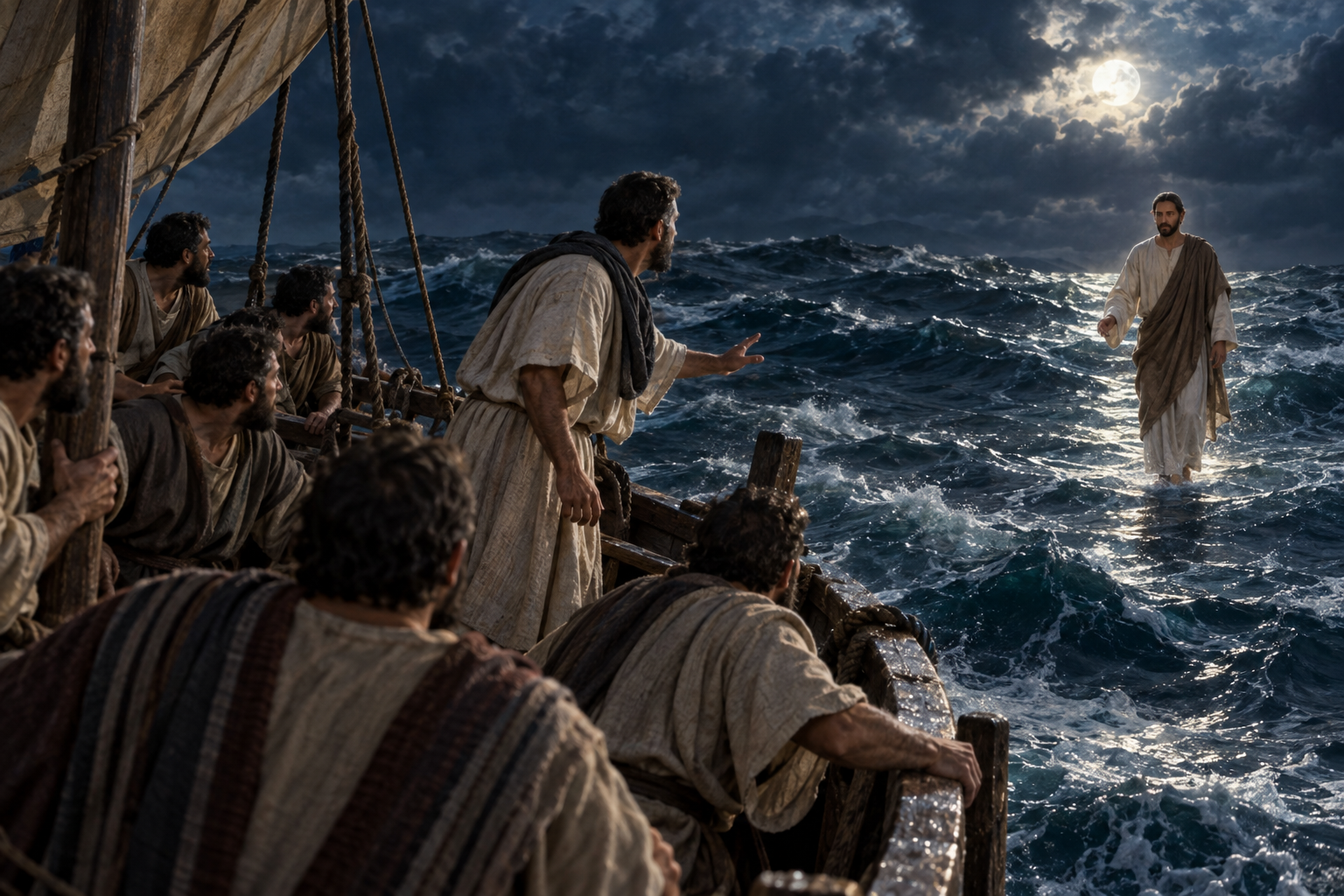
Jesus then constrains His disciples to enter a ship while He sends away the people and goes into a mountain to pray. During the night the disciples struggle against the wind. Jesus comes to them, “walking upon the sea” (Mark 6:48).
They are troubled when they see Him, but He says:
“Be of good cheer: it is I; be not afraid.” (Mark 6:50)
When He enters the ship, the wind ceases. Mark adds an important spiritual explanation:
“For they considered not the miracle of the loaves: for their heart was hardened.” (Mark 6:52)
The KJV therefore explicitly connects their amazement with failure to consider the earlier miracle and hardness of heart.
The chapter closes at the land of Gennesaret. People recognize Jesus, bring the sick to Him, and seek permission simply to touch “the border of his garment.” Mark states:
“and as many as touched him were made whole.” (Mark 6:56)
Mark 7 — God’s Word Above Tradition and the Defilement of the Heart
Mark 7 opens with Pharisees and scribes coming from Jerusalem. They criticize Christ’s disciples because some eat bread with “defiled, that is to say, with unwashen, hands” (Mark 7:2).
Mark explains that the controversy involves traditions concerning ceremonial washing. Jesus does not submit God’s Word to their traditions. Instead, He applies Isaiah’s words to them:
“This people honoureth me with their lips, but their heart is far from me.” (Mark 7:6)
He continues:
“Howbeit in vain do they worship me, teaching for doctrines the commandments of men.” (Mark 7:7)
The central issue is not simply washing hands. It is the elevation of religious tradition to a position where it displaces divine commandment.
Jesus tells them:
“Full well ye reject the commandment of God, that ye may keep your own tradition.” (Mark 7:9)
He uses their practice involving “Corban”, which Mark itself explains as “a gift” (Mark 7:11). Their tradition could be used to avoid responsibilities toward father or mother.
The result is stated with exceptional force:
“Making the word of God of none effect through your tradition, which ye have delivered.” (Mark 7:13)
This establishes an enduring principle: no church tradition, denominational custom, scholarly theory, personal experience, or religious authority has the right to nullify the written Word of God.
Jesus then teaches concerning defilement. He says:
“There is nothing from without a man, that entering into him can defile him: but the things which come out of him, those are they that defile the man.” (Mark 7:15)
He later explains that evil proceeds “from within, out of the heart of men” and lists evil thoughts, adulteries, fornications, murders, thefts, covetousness, wickedness, deceit, lasciviousness, an evil eye, blasphemy, pride, and foolishness (Mark 7:21–22).
The doctrinal emphasis is unmistakable: man’s fundamental moral problem is internal. Religious ceremony cannot cleanse a sinful heart.
Mark 7:19 contains the KJV expression “purging all meats.” Care should be taken not to rewrite that wording into a broader statement the KJV does not actually make. The immediate teaching emphasizes the distinction between what enters the belly and the moral evil that proceeds from the heart.
Jesus then goes toward the borders of Tyre and Sidon. A woman whose daughter has an unclean spirit comes to Him. Scripture explicitly describes her as “a Greek, a Syrophenician by nation” (Mark 7:26).
Jesus tells her:
“Let the children first be filled: for it is not meet to take the children’s bread, and to cast it unto the dogs.” (Mark 7:27)
She answers humbly:
“Yes, Lord: yet the dogs under the table eat of the children’s crumbs.” (Mark 7:28)
Jesus responds:
“For this saying go thy way; the devil is gone out of thy daughter.” (Mark 7:29)
The word “first” indicates an order or priority in the Lord’s statement. The verse itself does not justify erasing God’s distinction between Israel and the Gentiles, nor does it teach that the Church has replaced Israel. The broader dispensational distinction between Israel and the Church should remain intact.
Jesus next travels through the region associated with Decapolis. A man is brought to Him who is deaf and has an impediment in his speech. Jesus takes him aside, touches him, looks to heaven, sighs, and says:
“Ephphatha, that is, Be opened.” (Mark 7:34)
Immediately his ears are opened and his tongue is loosed.
Jesus commands that they tell no man, but Mark explicitly says:
“the more he charged them, so much the more a great deal they published it.” (Mark 7:36)
Their spreading of the report was therefore contrary to the specific command Christ had given them, regardless of any favorable human evaluation of their enthusiasm.
The people declare:
“He hath done all things well: he maketh both the deaf to hear, and the dumb to speak.” (Mark 7:37)
Mark 8 — Provision, Spiritual Blindness, Peter’s Confession, and the Cost of Discipleship
Mark 8 begins with another large multitude having nothing to eat. Jesus says:
“I have compassion on the multitude, because they have now been with me three days, and have nothing to eat.” (Mark 8:2)
Seven loaves and a few small fishes are available. Jesus gives thanks, the disciples distribute the food, and the people eat and are filled. Seven baskets of fragments remain. Mark says that “they that had eaten were about four thousand” (Mark 8:9).
The details distinguish this event from the feeding in Mark 6. Mark 6 records five loaves, two fishes, approximately five thousand men, and twelve baskets remaining. Mark 8 records seven loaves, a few small fishes, approximately four thousand people, and seven baskets remaining. Jesus Himself later refers separately to both miracles in Mark 8:19–20. The KJV therefore presents them as distinct events.
The Pharisees then come and seek “a sign from heaven, tempting him” (Mark 8:11). Jesus “sighed deeply in his spirit” and refuses their demand.
After entering the ship, Jesus warns:
“Take heed, beware of the leaven of the Pharisees, and of the leaven of Herod.” (Mark 8:15)
The disciples reason that He speaks this way because they have no bread. Jesus reproves their lack of understanding and specifically reminds them of the two feeding miracles.
The context makes it clear that His warning concerns something beyond literal bread. Mark 8 itself, however, does not give a detailed definition of every aspect represented by “the leaven of Herod.” It is therefore better to retain Christ’s warning than to construct an elaborate meaning the passage does not expressly supply. The picture of leaven may suggest a corrupting influence, but that further description should be recognized as an inference rather than the exact wording of the verse.
At Bethsaida, a blind man is brought to Christ. Jesus leads him out of the town and heals him in stages. After the first action, the man says:
“I see men as trees, walking.” (Mark 8:24)
Jesus puts His hands upon his eyes again, after which “he was restored, and saw every man clearly” (Mark 8:25).
This staged healing is explicitly recorded. Scripture does not tell us that Christ lacked power to heal him at once. Nor should the two stages automatically be turned into an allegory of salvation or a universal pattern of spiritual development. The safe interpretation is first to accept the miracle exactly as Mark records it.
Jesus and His disciples then go into the towns of Caesarea Philippi. He asks what men are saying concerning His identity. Various answers are given: John the Baptist, Elias, or one of the prophets.
Then He asks the decisive question:
“But whom say ye that I am?”
Peter answers:
“Thou art the Christ.” (Mark 8:29)
This is a central confession in the Gospel. Jesus is not merely another prophet. He is the Christ.
Immediately Christ begins teaching His disciples:
“that the Son of man must suffer many things, and be rejected of the elders, and of the chief priests, and scribes, and be killed, and after three days rise again.” (Mark 8:31)
His suffering, death, and resurrection are therefore not presented as accidents or defeats. Christ says these things “must” occur.
Peter takes Him and begins to rebuke Him. Jesus then rebukes Peter:
“Get thee behind me, Satan: for thou savourest not the things that be of God, but the things that be of men.” (Mark 8:33)
The passage does not say Peter was demon-possessed. Christ rebukes Peter’s opposition to the divine necessity of the cross and identifies the character of that opposition.
Jesus then calls the people together with His disciples and says:
“Whosoever will come after me, let him deny himself, and take up his cross, and follow me.” (Mark 8:34)
The verses that follow address the serious cost of identifying with and following Christ in a hostile world. They must not be interpreted as teaching justification by human merit. The clear biblical doctrine of salvation remains:
“For by grace are ye saved through faith; and that not of yourselves: it is the gift of God: Not of works, lest any man should boast.” (Ephesians 2:8–9)
Likewise:
“But to him that worketh not, but believeth on him that justifieth the ungodly, his faith is counted for righteousness.” (Romans 4:5)
Mark 8:34 therefore concerns the demands of discipleship and following Christ, not a works-based method of obtaining justification.
Christ closes this section by warning against being ashamed of Him and His words in “this adulterous and sinful generation” (Mark 8:38). Faithfulness to Christ includes faithfulness to His words.
Key People and Places
Jesus Christ — The central Person throughout all three chapters. He teaches with authority, sends the twelve, performs miracles, rebukes religious hypocrisy, delivers from unclean spirits, heals disease and disability, receives Peter’s confession as the Christ, and foretells His own death and resurrection.
The Twelve / the disciples — Sent two by two in Mark 6 and given authority by Christ. They preach repentance, participate in distributing food to the multitudes, witness Christ walking upon the sea, and repeatedly require correction concerning spiritual understanding.
John the Baptist — A just and holy preacher who directly confronts Herod’s unlawful relationship. He is imprisoned and killed because of his faithful stand and the events surrounding Herod’s oath.
Herod — The ruler appearing in Mark 6 and again in Christ’s warning concerning “the leaven of Herod” in Mark 8. Mark 6 describes his fear of John, his willingness to hear John, his oath before his guests, and his order resulting in John’s death.
Herodias — Herod’s brother Philip’s wife, according to Mark 6:17. John declares Herod’s possession of his brother’s wife unlawful.
Herodias’s daughter — Dances before Herod and those with him and requests John’s head at her mother’s instruction. The KJV text in Mark does not give her a personal name.
The Syrophenician woman — Explicitly described as “a Greek, a Syrophenician by nation.” She petitions Christ concerning her daughter and answers His statement concerning the children and the dogs with humility and persistence.
Peter — Confesses Jesus as “the Christ” at Caesarea Philippi but is sharply rebuked when he opposes Christ’s announcement of His coming suffering and death.
“His own country” — The location of the rejection recorded at the beginning of Mark 6. It may be identified with Nazareth from the broader Gospel setting, but Mark 6:1 itself does not name the town.
Gennesaret — The region reached after Jesus walks upon the sea. The sick are brought to Him throughout the surrounding area.
Tyre and Sidon — The border region associated with the encounter between Christ and the Syrophenician woman.
Decapolis — The geographical region mentioned as Jesus travels before healing the deaf man with the speech impediment.
Dalmanutha — The region reached after the feeding of the four thousand (Mark 8:10).
Bethsaida — The town associated with the blind man whose sight Christ restores.
Caesarea Philippi — The region in which Jesus asks His disciples, “Whom say ye that I am?” and Peter confesses, “Thou art the Christ.”
Main Doctrinal or Spiritual Themes
The absolute authority of Jesus Christ. Christ has authority over unclean spirits, sickness, physical creation, human disability, and the forces of nature. He feeds multitudes from meager supplies and walks upon the sea. These are presented as actual works, not allegories.
The danger of unbelief. Those in Christ’s own country are offended at Him, while the disciples themselves can witness miracles without properly considering their significance. Mark 6 explicitly states, “their heart was hardened.”
Repentance is part of faithful preaching. When Christ sends the twelve, “they went out, and preached that men should repent” (Mark 6:12). Biblical preaching does not flatter sinners concerning sin.
God’s Word stands above religious tradition. Mark 7 gives one of Scripture’s clearest condemnations of religious tradition when it contradicts divine revelation. Christ condemns those who make “the word of God of none effect” through tradition.
True moral defilement proceeds from the heart. Man’s deepest problem is not external ceremony but inward sin. Christ names the evils proceeding from the human heart.
Christ’s compassion does not eliminate truth. He is moved with compassion upon hungry multitudes and suffering individuals, yet He also rebukes unbelief, hypocrisy, hardness of heart, false reasoning, and opposition to God’s purposes.
Christ is the Messiah. Peter’s statement, “Thou art the Christ,” directly identifies Jesus as the promised Christ.
The cross belongs to God’s revealed plan. Christ declares that He “must suffer many things”, be rejected, killed, and after three days rise again. Attempts to separate Christ’s messianic identity from His suffering are directly rebuked.
The resurrection is explicitly foretold. Christ says He will rise “after three days.” His death is therefore not the end of the revelation given in Mark 8.
Salvation and discipleship must not be confused. Eternal justification is by grace through faith apart from works. Mark 8 nevertheless teaches that following Christ involves self-denial, identification with Him, and willingness to bear reproach or loss for His sake.
Israel and the Gentiles are not made interchangeable. Christ’s language to the Syrophenician woman includes the significant word “first.” Nothing in Mark 7 teaches that God’s promises to Israel have been transferred to another people or that Israel has ceased to have its distinct place in God’s program.
Miracles authenticate Christ’s authority but do not justify speculation. The passage records real miracles. Where Scripture does not explain why Christ performed a particular miracle in a particular manner—such as the two-stage healing at Bethsaida—the interpreter should stop where Scripture stops.
Practical Applications or Lessons
Receive God’s truth even when it comes from someone familiar. Those in Christ’s own country allowed familiarity to become an occasion for offense. Truth does not become less true because the hearer thinks he already knows the messenger.
Preach repentance plainly. The twelve did not merely offer encouragement. They “preached that men should repent.” Gospel ministry must deal honestly with sin while pointing sinners to Christ.
Do not allow reputation or fear of people to override righteousness. Herod knew John was “a just man and an holy,” yet his concern over his oath and those sitting with him contributed to a wicked decision. Proverbs 29:25 remains true: “The fear of man bringeth a snare.”
A promise cannot make sin righteous. Herod’s oath did not turn an evil request into a lawful act. A believer should never suppose that keeping one’s word requires disobeying God’s Word.
Christ’s compassion should shape Christian ministry. Jesus saw the multitude as sheep without a shepherd. His response included teaching them. Biblical compassion seeks more than temporal relief; it gives people truth.
Remember what God has already done. The disciples’ failure to consider the miracle of the loaves contributed to their amazement and confusion. Forgetfulness of God’s past faithfulness can strengthen present fear.
Do not place tradition above Scripture. Every belief and religious practice must remain subject to the written Word of God. Long usage, respected personalities, institutional authority, or scholarly acceptance cannot make a human command equal to Scripture.
Guard the heart. Christ identifies the heart as the source from which many sins proceed. External conformity without inward righteousness is insufficient.
Approach Christ humbly. The Syrophenician woman’s response displays humility rather than entitlement. She accepts Christ’s words and appeals to His sufficiency.
Obedience is better than religious enthusiasm. Those healed in Mark 7 were commanded not to publish the matter, yet they did so increasingly. A favorable motive does not grant permission to disregard an explicit command of Christ.
Beware corrupting influences. Jesus says, “Take heed, beware of the leaven of the Pharisees, and of the leaven of Herod.” Even where every detail of the figure is not defined, the command to beware is plain.
Do not force symbolic meanings into miracles. The gradual restoration of the blind man’s sight happened exactly as Mark describes it. Applications may be drawn cautiously, but doctrine should not be built upon an allegory that Scripture itself does not give.
Answer Christ’s question personally and biblically. The central question remains: “Whom say ye that I am?” Peter’s answer is direct: “Thou art the Christ.”
Never separate Christ from His cross. Peter was willing to confess Christ while objecting to Christ’s announced suffering. Jesus rejected that thinking. The biblical Christ is the Christ who came to suffer, die, and rise again.
Do not confuse discipleship with meritorious salvation. Salvation is God’s gift received by faith, not earned through self-denial. Yet the believer who follows Christ should expect self-denial, loyalty to His words, and willingness to endure reproach.
Do not be ashamed of Christ or His words. Mark 8 ends with a direct warning concerning shame before an adulterous and sinful generation. Cultural opposition is never sufficient reason to alter, conceal, or apologize for what Christ has said.
Overall Message of Mark 6–8
Mark 6–8 confronts the reader with both the greatness of Christ and the weakness of human understanding. Hometown familiarity does not diminish His authority. Political power cannot silence God’s truth without accountability. Human insufficiency cannot exhaust Christ’s provision. Storms cannot prevent His coming. Religious tradition cannot overrule His Word. Gentile background cannot place a needy soul beyond His power. Physical blindness cannot resist His touch. Human expectations cannot redefine His messianic mission.
The great turning point comes when Peter says, “Thou art the Christ.” Yet knowing Christ’s title is not enough if men reject what Christ Himself says about His cross. He “must suffer many things,” be killed, and rise again.
The believer’s proper response is therefore faith in Christ, submission to His Word, separation from false religious authority, remembrance of His works, rejection of the fear of man, humility of heart, and faithful discipleship.
The controlling principle throughout these chapters is simple: Christ’s Word is right, whether men understand it immediately or not.
Comments are closed