The glory of Jesus Christ
 Mark 9–10 continues the Lord Jesus Christ’s preparation of His disciples for His suffering, death, resurrection, and the demands of true discipleship. These chapters move from the glory of Christ revealed on the mount to the humility of service, from a desperate father’s faith to solemn warnings about hell, from God’s design for marriage to the danger of trusting riches, and finally to Christ’s declaration that He came “to give his life a ransom for many” (Mark 10:45).
Throughout these chapters, the disciples repeatedly struggle to understand Christ’s coming suffering and the nature of greatness in His kingdom. The Lord repeatedly turns their attention away from position, pride, earthly advantage, and human ability toward faith, prayer, humility, service, dependence upon God, and the cross.
Chapter Summaries
Mark 9 — Christ’s Glory, Faith, Humility, and Seriousness About Sin
Mark 9 opens with Christ’s statement:
“Verily I say unto you, That there be some of them that stand here, which shall not taste of death, till they have seen the kingdom of God come with power.” — Mark 9:1
Six days later Jesus takes Peter, James, and John “up into an high mountain apart by themselves” (Mark 9:2). Mark does not name the mountain. Any attempt to identify it geographically goes beyond what this passage explicitly states.
There Jesus is transfigured before them. His raiment becomes “shining, exceeding white as snow; so as no fuller on earth can white them” (Mark 9:3). Elias and Moses appear and talk with Jesus.
Peter proposes making three tabernacles, one each for Christ, Moses, and Elias. Mark explains that Peter “wist not what to say; for they were sore afraid” (Mark 9:6).
A cloud overshadows them, and the Father declares:
“This is my beloved Son: hear him.” — Mark 9:7
The command is unmistakably Christ-centered. Moses and Elias disappear from sight, and the disciples suddenly see “no man any more, save Jesus only with themselves” (Mark 9:8).
The proximity of Mark 9:1 to the Transfiguration may indicate that the event provided the three disciples with a preview of Christ’s kingdom glory. Mark, however, does not explicitly state, “This event fulfilled verse 1,” so that connection should be presented as an interpretation rather than as an express statement of the verse.
As they descend, Jesus commands the three disciples not to tell what they had seen until “the Son of man were risen from the dead” (Mark 9:9). They question among themselves what the rising from the dead should mean.
They then ask concerning Elias. Jesus declares that Elias comes first and restores all things, while also emphasizing that Scripture says the Son of man “must suffer many things, and be set at nought” (Mark 9:12). Jesus then says Elias “is indeed come” (Mark 9:13). Mark 9 itself does not identify by name whom Christ means in that statement, so it is best not to insert an identification into Mark’s wording.
When Jesus returns to the other disciples, He finds a great multitude, scribes questioning with them, and a father whose son has “a dumb spirit” (Mark 9:17). The father describes severe manifestations of the affliction, and explains:
“I spake to thy disciples that they should cast him out; and they could not.” — Mark 9:18
Jesus rebukes the unbelieving condition surrounding the incident:
“O faithless generation, how long shall I be with you? how long shall I suffer you?” — Mark 9:19
The father then makes one of Scripture’s clearest statements of struggling yet genuine faith. After Jesus tells him, “If thou canst believe, all things are possible to him that believeth” (Mark 9:23), he cries:
“Lord, I believe; help thou mine unbelief.” — Mark 9:24
This is not a celebration of unbelief. The man acknowledges both his faith and his weakness and brings that weakness directly to Christ.
Jesus rebukes the foul spirit and delivers the boy. When the disciples privately ask why they could not cast it out, Jesus answers:
“This kind can come forth by nothing, but by prayer and fasting.” — Mark 9:29
The KJV explicitly includes both prayer and fasting.
The chapter then returns to Christ’s approaching death and resurrection. Passing through Galilee, Jesus teaches His disciples:
“The Son of man is delivered into the hands of men, and they shall kill him; and after that he is killed, he shall rise the third day.” — Mark 9:31
Mark plainly says:
“But they understood not that saying, and were afraid to ask him.” — Mark 9:32
Upon reaching Capernaum, Jesus asks what they had disputed about on the way. They remain silent because they had been disputing “who should be the greatest” (Mark 9:34).
Jesus answers earthly ambition with the law of humble service:
“If any man desire to be first, the same shall be last of all, and servant of all.” — Mark 9:35
He takes a child and teaches His disciples that receiving such a child in His name is connected with receiving Christ and the One who sent Him.
John then reports that they had seen someone casting out devils in Christ’s name and had forbidden him “because he followeth not us” (Mark 9:38). Jesus replies:
“Forbid him not.” — Mark 9:39
And:
“For he that is not against us is on our part.” — Mark 9:40
The immediate correction concerns the disciples’ tendency to treat their own immediate company as the sole measure of legitimate service. The passage does not say that doctrine is unimportant or that believers should unite indiscriminately with false teaching. It addresses a man acting in Christ’s name whom John’s stated objection was that “he followeth not us.”
Christ also promises reward even for something as simple as giving a cup of water “in my name, because ye belong to Christ” (Mark 9:41).
He then gives exceedingly solemn warnings concerning causing believers to stumble and concerning sin:
“Whosoever shall offend one of these little ones that believe in me…” — Mark 9:42
The warnings about cutting off a hand or foot and plucking out an eye emphasize the terrible seriousness of sin and the necessity of dealing decisively with stumbling blocks. Scripture does not teach that physical mutilation earns salvation or cleanses the sinner. The larger point is that nothing connected with earthly life is worth holding onto at the cost of eternal ruin.
Christ repeatedly describes hell as a place:
“Where their worm dieth not, and the fire is not quenched.” — Mark 9:44, 46, 48
The language of Mark 9 gives no basis for treating hell as imaginary or temporary. Jesus presents it as a dreadful reality involving “fire that never shall be quenched” (Mark 9:43).
Mark 9:49 states:
“For every one shall be salted with fire, and every sacrifice shall be salted with salt.”
The precise scope of “salted with fire” has received differing explanations. Scripture does not elaborate in this immediate passage sufficiently to justify dogmatism beyond its wording. Christ immediately concludes:
“Have salt in yourselves, and have peace one with another.” — Mark 9:50
Thus the chapter closes by calling the disciples away from rivalry and toward spiritual integrity and peace among themselves.
Mark 10 — Marriage, Children, Riches, Servanthood, the Ransom, and Bartimaeus
Jesus leaves the region and comes “into the coasts of Judaea by the farther side of Jordan” (Mark 10:1). Multitudes gather, and “as he was wont, he taught them again.”
The Pharisees ask whether it is lawful for a man to put away his wife, “tempting him” (Mark 10:2).
Jesus directs them back to Moses and then farther back to God’s creation order:
“But from the beginning of the creation God made them male and female.” — Mark 10:6
He continues:
“For this cause shall a man leave his father and mother, and cleave to his wife;
And they twain shall be one flesh: so then they are no more twain, but one flesh.” — Mark 10:7–8
Then comes Christ’s authoritative conclusion:
“What therefore God hath joined together, let not man put asunder.” — Mark 10:9
Marriage is therefore grounded not merely in social custom but in God’s creative design: male and female joined as husband and wife in a one-flesh union.
When the disciples ask further in the house, Christ plainly warns concerning divorce and remarriage in Mark’s account, describing remarriage following the putting away of a spouse as adultery (Mark 10:11–12). Mark 10 itself does not state the additional wording found in another Gospel account, so the safest treatment of Mark is to state exactly what Mark records rather than inserting material not present here.
People then bring young children to Christ. The disciples rebuke those bringing them, but Jesus is “much displeased” (Mark 10:14).
He commands:
“Suffer the little children to come unto me, and forbid them not: for of such is the kingdom of God.” — Mark 10:14
And:
“Whosoever shall not receive the kingdom of God as a little child, he shall not enter therein.” — Mark 10:15
Christ takes the children “up in his arms, put his hands upon them, and blessed them” (Mark 10:16).
The passage says nothing about baptizing these children. It provides no textual support for infant baptism or sacramental regeneration. Christ receives them, blesses them, and uses the receptive character of a little child to illustrate receiving the kingdom.
As Jesus proceeds, “there came one running, and kneeled to him” (Mark 10:17). Mark does not call him a “young ruler” in this passage. Mark later tells us only that “he had great possessions” (Mark 10:22).
The man asks:
“Good Master, what shall I do that I may inherit eternal life?” — Mark 10:17
Jesus responds:
“Why callest thou me good? there is none good but one, that is, God.” — Mark 10:18
This does not constitute a denial of Christ’s deity. Mark has already identified Jesus as “the Son of God” (Mark 1:1), and the Father has just declared Him “my beloved Son” (Mark 9:7). Christ’s question may indicate that He is forcing the man to consider the significance of the word “good” and the identity of the One to whom he is speaking, but that purpose should be stated as an inference rather than an explicit explanation supplied by Mark.
Jesus lists commandments dealing with man’s duty toward others. The man answers:
“Master, all these have I observed from my youth.” — Mark 10:20
Then Mark records something important:
“Then Jesus beholding him loved him…” — Mark 10:21
Jesus commands him to sell what he has, give to the poor, take up the cross, and follow Him. The man goes away grieved because “he had great possessions” (Mark 10:22).
This passage must not be converted into a works-based formula for eternal life. The man begins by asking what he must do. The conversation exposes the insufficiency of human righteousness and the enslaving power possessions can exercise over the heart. The section reaches its theological center when the disciples ask:
“Who then can be saved?” — Mark 10:26
Jesus answers:
“With men it is impossible, but not with God: for with God all things are possible.” — Mark 10:27
Salvation is not achieved through human merit, wealth, commandment-keeping, or self-reformation. Man cannot save himself. Salvation is of God.
Jesus warns:
“How hardly shall they that have riches enter into the kingdom of God!” — Mark 10:23
He then specifically speaks of:
“them that trust in riches” — Mark 10:24
Wealth itself is not identified as the saving or condemning issue; trusting riches is directly condemned, and earthly wealth presents genuine spiritual danger.
Peter then points out:
“Lo, we have left all, and have followed thee.” — Mark 10:28
Jesus promises that sacrifices made “for my sake, and the gospel’s” will not go unnoticed by God, though the promised blessings in the present time are explicitly accompanied “with persecutions” (Mark 10:30).
He concludes:
“But many that are first shall be last; and the last first.” — Mark 10:31
As they travel toward Jerusalem, Jesus goes before them. Mark says the disciples are amazed and afraid. He again takes the twelve and gives them a detailed prediction of what is coming:
“The Son of man shall be delivered unto the chief priests, and unto the scribes; and they shall condemn him to death, and shall deliver him to the Gentiles:
And they shall mock him, and shall scourge him, and shall spit upon him, and shall kill him: and the third day he shall rise again.” — Mark 10:33–34
Christ’s suffering is not presented as an accident or unforeseen tragedy. Jesus knowingly goes toward Jerusalem and repeatedly tells His disciples what will occur.
Immediately afterward, James and John ask to sit at Christ’s right and left hands in His glory.
Their request again reveals the disciples’ concern with position. Christ asks whether they can drink His cup and undergo His baptism. He tells them that they will indeed participate in the suffering represented by those figures, but He does not say in this passage that the places of honor are His to distribute according to personal favoritism.
When the other ten hear of the request, they become displeased with James and John.
Jesus gathers them and contrasts worldly authority with Christian leadership:
“Whosoever will be great among you, shall be your minister:
And whosoever of you will be the chiefest, shall be servant of all.” — Mark 10:43–44
Then comes one of the great doctrinal declarations in Mark:
“For even the Son of man came not to be ministered unto, but to minister, and to give his life a ransom for many.” — Mark 10:45
This verse plainly connects Christ’s death with a ransom. His life is given on behalf of others. The language supports the biblical doctrine of substitutionary atonement: Christ gives Himself for sinners. Salvation therefore rests not upon human service or merit, but upon the saving work of Christ.
The chapter ends at Jericho.
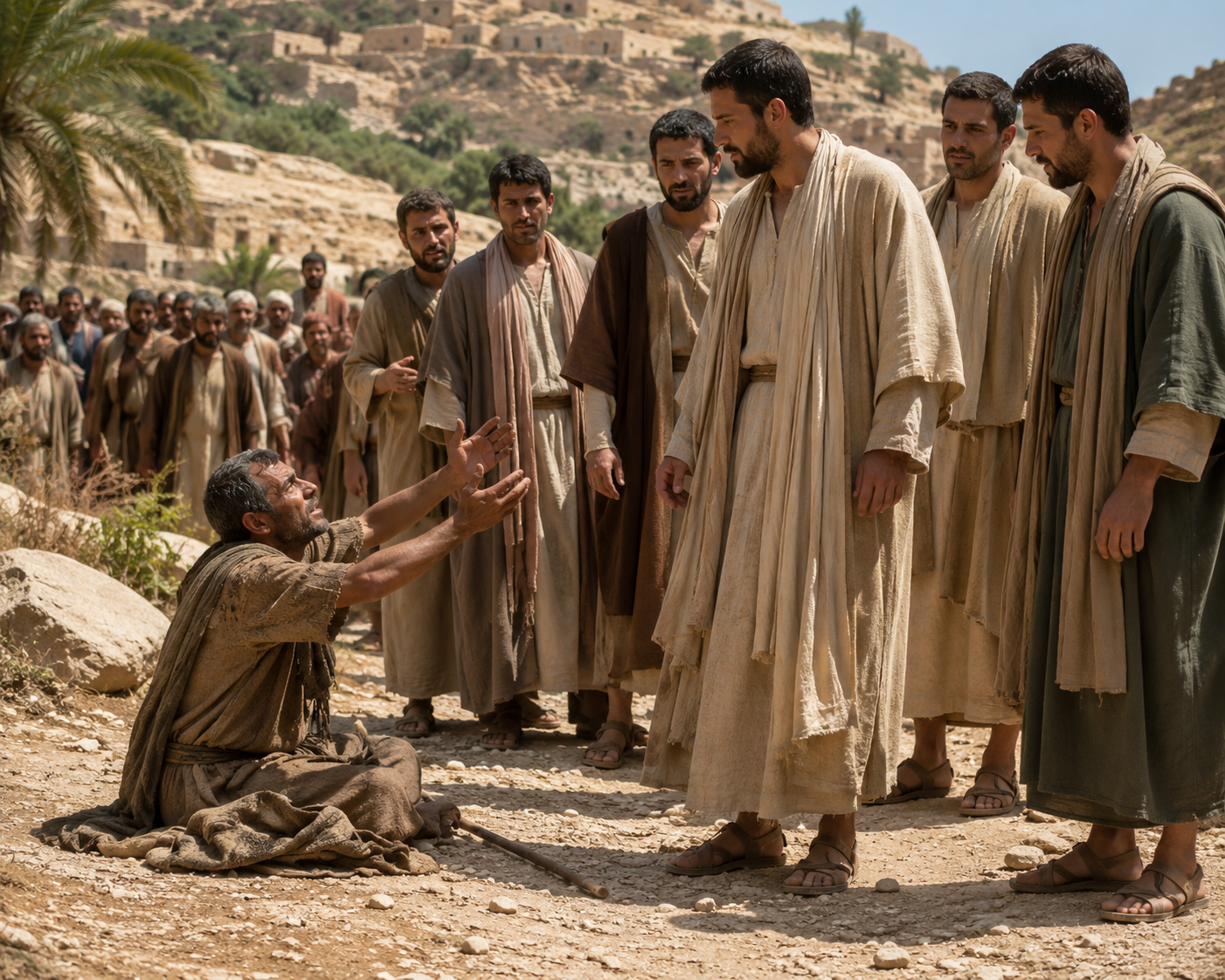
Blind Bartimaeus, “the son of Timaeus,” sits by the highway begging (Mark 10:46). Hearing that Jesus of Nazareth is passing, he cries:
“Jesus, thou Son of David, have mercy on me.” — Mark 10:47
Many tell him to be quiet, “but he cried the more a great deal” (Mark 10:48).
Jesus stops.
Bartimaeus is called, casts away his garment, rises, and comes to Christ.
Jesus asks:
“What wilt thou that I should do unto thee?” — Mark 10:51
Bartimaeus answers:
“Lord, that I might receive my sight.”
Jesus replies:
“Go thy way; thy faith hath made thee whole.” — Mark 10:52
Immediately he receives his sight and follows Jesus “in the way.”
The power is not in faith considered as a psychological force. Christ is the One who heals. Bartimaeus’ faith brings him to the merciful Son of David.
Key People and Places
- Jesus Christ — The beloved Son of the Father, the coming suffering Son of man, divine Teacher, Healer, Servant, and the One who gives His life “a ransom for many.”
- Peter, James, and John — The three disciples taken with Christ onto the high mountain for the Transfiguration.
- Moses and Elias — Appear with Christ during the Transfiguration.
- The Father — Speaks from the cloud concerning Christ: “This is my beloved Son: hear him.”
- The afflicted boy and his father — The boy is delivered by Christ; his father cries, “Lord, I believe; help thou mine unbelief.”
- The disciples — Repeatedly instructed concerning prayer, faith, humility, service, Christ’s death and resurrection, marriage, riches, and spiritual leadership.
- The scribes — Found questioning with the disciples in Mark 9.
- The unnamed man casting out devils in Christ’s name — John reports that the disciples forbade him because “he followeth not us.”
- The Pharisees — Question Jesus concerning divorce while “tempting him.”
- Little children — Received and blessed by Christ.
- The man with great possessions — Runs to Jesus asking about eternal life but goes away grieved after Christ confronts him concerning his possessions.
- James and John — Ask for honored positions beside Christ in His glory.
- Bartimaeus — Blind beggar at Jericho who calls Jesus “Son of David,” receives his sight, and follows Him.
- The unnamed high mountain — Site of the Transfiguration. Mark does not identify the mountain by name.
- Galilee — Region through which Jesus passes while privately instructing His disciples concerning His death and resurrection.
- Capernaum — Where Christ confronts the disciples over their dispute concerning who should be greatest.
- Judaea — Region entered in Mark 10.
- The farther side of Jordan — Geographic description associated with the opening of Mark 10.
- Jerusalem — Destination toward which Christ deliberately travels while predicting His coming suffering, death, and resurrection.
- Jericho — Location associated with the healing of Bartimaeus.
Main Doctrinal or Spiritual Themes
1. The supreme glory and authority of Jesus Christ
At the Transfiguration, Moses and Elias appear, but the Father directs the disciples to His Son:
“This is my beloved Son: hear him.” — Mark 9:7
The chapter does not present Christ as merely one religious teacher among several. The Father commands that Christ be heard.
2. Christ’s death and resurrection are central to His mission
Jesus repeatedly tells His disciples that He will be killed and rise again. His death is not disconnected from His mission; Mark 10:45 explains that He gives His life “a ransom for many.”
The cross is therefore at the heart of the Gospel.
3. Salvation is impossible through human ability
The disciples ask:
“Who then can be saved?”
Christ answers:
“With men it is impossible, but not with God.” — Mark 10:27
Human achievement cannot produce salvation. Salvation must come from God.
4. Faith depends upon Christ, not upon human confidence
The father in Mark 9 does not pretend to possess flawless faith. He turns his weakness toward Christ:
“Lord, I believe; help thou mine unbelief.”
Bartimaeus likewise cries for mercy.
Biblical faith does not boast in itself; it looks to Christ.
5. Prayer and fasting are serious spiritual disciplines
Christ explicitly tells the disciples:
“This kind can come forth by nothing, but by prayer and fasting.” — Mark 9:29
Spiritual work must not be attempted in fleshly self-confidence.
6. Greatness in Christ’s order is measured through service
The disciples argue about greatness, and James and John later seek honored positions. Christ repeatedly reverses their earthly thinking.
“Whosoever of you will be the chiefest, shall be servant of all.” — Mark 10:44
Christ Himself is the supreme example.
7. Hell is real and eternally serious
Mark 9 repeatedly speaks of:
“the fire that never shall be quenched”
and:
“Where their worm dieth not, and the fire is not quenched.”
There is no warrant in the plain wording of the passage to minimize eternal judgment.
8. Sin must be treated seriously
Christ’s severe language about the hand, foot, and eye teaches that sin and stumbling blocks are not matters for casual compromise.
Nothing in this earthly life is worth exchanging for eternal destruction.
9. God established marriage as a male-female, one-flesh union
Jesus appeals directly to creation:
“God made them male and female.” — Mark 10:6
And:
“They twain shall be one flesh.” — Mark 10:8
Marriage is therefore rooted in the order God established from creation, rather than in changing human customs.
10. Children are precious to Christ
Jesus is “much displeased” when the disciples hinder children from coming to Him.
He receives them, embraces them, and blesses them.
Nothing in the passage teaches infant baptism. It does teach that children are not to be treated as spiritual inconveniences.
11. Riches can become a powerful spiritual snare
Christ specifically warns about those who “trust in riches.”
The issue is not merely possessing something, but trusting what one possesses instead of depending upon God.
12. Christian leadership rejects worldly lordship
Jesus contrasts Gentile rulers who “exercise lordship” with His followers:
“But so shall it not be among you.” — Mark 10:43
Biblical leadership is not built upon pride, domination, prestige, or the craving to be recognized. It is service under Christ.
13. Christ’s death is a ransom
Mark 10:45 is among the clearest statements of Christ’s saving purpose:
“to give his life a ransom for many.”
Christ’s sacrifice is not merely an example of courage. It is a saving, sacrificial giving of His life for others.
Practical Applications or Lessons
Listen to Christ above human opinion. The Father’s command is simple: “hear him.” The believer must submit thought, doctrine, practice, and conduct to the words of Christ and the written Word of God.
Do not confuse spiritual privilege with spiritual maturity. Peter, James, and John saw Christ transfigured, yet the disciples still struggled with pride, misunderstanding, fear, and rivalry. Great experiences do not replace obedience and spiritual growth.
Bring weak faith to Christ rather than hiding it. “Lord, I believe; help thou mine unbelief” remains a fitting prayer when a believer knows what God has said but recognizes weakness in his own heart.
Spiritual battles require spiritual dependence. Mark 9:29 warns against ministering through mere ability, personality, method, or experience. Prayer and fasting express dependence upon God.
Reject the desire to be important. The disciples repeatedly wanted to know who was greatest. Christ repeatedly pointed them toward being servants.
The Christian question should not be, “How high can I rise?” but, “Whom can I serve for Christ?”
Do not despise faithful service simply because it is outside your immediate circle. The disciples objected that a man “followeth not us.” Christ corrected them. Loyalty to sound doctrine remains necessary, but personal or institutional rivalry must not be mistaken for biblical separation.
Take sin seriously before sin destroys. Christ’s language concerning hand, foot, eye, and hell allows no casual attitude toward temptation. Believers should remove influences that repeatedly lead them into sin rather than asking how closely they can approach sin without consequence.
Honor God’s design for marriage. Christ goes behind contemporary arguments to the creation order: male, female, husband, wife, one flesh. Christian marriage should therefore be governed by God’s Word rather than cultural fashion.
Do not hinder children from Christ. Parents, churches, and believers should make it easier, not harder, for children to hear God’s Word and learn of Christ.
Do not mistake morality for salvation. The wealthy man could point to outward commandment observance, yet something fundamental remained wrong. External morality cannot regenerate the sinner.
Never trust riches. Wealth may give an appearance of security while becoming a competitor to faith in God. Christ specifically warns against trusting riches.
Remember that salvation is God’s work.
“With men it is impossible, but not with God.”
This guards the Gospel against every attempt to make salvation rest upon works, wealth, ritual, religious achievement, or self-reformation.
Expect service to involve sacrifice. Christ promises blessing to those who sacrifice for Him and the Gospel, but Mark 10:30 explicitly includes “persecutions.” Biblical discipleship does not promise a trouble-free earthly life.
Follow Christ’s pattern of ministry.
“For even the Son of man came not to be ministered unto, but to minister.”
The Christian life is not fundamentally about being noticed, honored, accommodated, or served.
Keep the ransom at the center of the Gospel. Christ came “to give his life a ransom for many.” The sinner’s hope is the finished saving work of Christ, not the sinner’s own goodness.
Cry to Christ for mercy despite opposition. People tried to silence Bartimaeus, but “he cried the more a great deal.” He knew where mercy was found.
After receiving mercy, follow Christ. Bartimaeus received his sight and “followed Jesus in the way.” Grace should produce grateful discipleship, not indifference.
Overall Message
Mark 9–10 reveals the glory of Jesus Christ while steadily directing the reader toward His cross. The glorified Son on the mountain is the same Son of man who deliberately travels toward Jerusalem to be mocked, scourged, killed, and raised again.
The disciples think repeatedly about greatness; Christ speaks about service.
Men think about what they can do; Christ says salvation is impossible with men.
The wealthy man has possessions but walks away sorrowful; blind Bartimaeus has almost nothing, cries for mercy, receives sight, and follows Christ.
The controlling truth of these chapters is expressed by Christ Himself:
“For even the Son of man came not to be ministered unto, but to minister, and to give his life a ransom for many.” — Mark 10:45
Christ is glorious enough to be heard, powerful enough to deliver, holy enough to warn of judgment, wise enough to establish the order of home and discipleship, merciful enough to answer the needy, and sufficient to provide the ransom that sinful man could never provide for himself.
Comments are closed