Jesus Christ possesses authority that belongs to no ordinary man
 Mark 4–5 presents the Lord Jesus Christ teaching the Word, revealing truths concerning the kingdom of God, calming a violent storm, delivering a man possessed with unclean spirits, healing a woman suffering from a twelve-year issue of blood, and raising Jairus’s daughter from death. Across these two chapters, Christ demonstrates authority over the reception of the Word, the natural world, devils, disease, and death.
The chapters also repeatedly emphasize hearing, faith, fear, obedience, fruitfulness, and testimony. The plain wording of the KJV should control the interpretation. Where the text gives a fact, it may be stated confidently; where Scripture does not explicitly supply additional details, those details should not be treated as established facts.
Chapter Summaries
Mark 4 — Hearing the Word and the Authority of Christ
Mark 4 begins with Jesus teaching a great multitude beside the sea.
“And he began again to teach by the sea side: and there was gathered unto him a great multitude, so that he entered into a ship, and sat in the sea; and the whole multitude was by the sea on the land.”
— Mark 4:1
The chapter moves from Christ’s teaching concerning the Word and the kingdom of God to a practical demonstration of His authority over creation.
The Parable of the Sower — Mark 4:1–20
Jesus begins:
“Hearken; Behold, there went out a sower to sow:”
— Mark 4:3
The same seed falls upon four different kinds of ground.
The wayside seed is devoured by the fowls. The seed on stony ground springs up quickly but withers because it has no root. Seed among thorns is choked and becomes unfruitful. Seed falling upon good ground produces fruit, “some thirtyfold, some sixty, and some an hundred.”
Jesus later identifies the seed:
“The sower soweth the word.”
— Mark 4:14
The primary contrast is therefore not between different kinds of seed. The Word is the same. The difference lies in the response of those who hear it.
Concerning the wayside hearer, Jesus says:
“Satan cometh immediately, and taketh away the word that was sown in their hearts.”
— Mark 4:15
Concerning the stony-ground hearer:
“And have no root in themselves, and so endure but for a time…”
— Mark 4:17
Concerning the thorny ground:
“And the cares of this world, and the deceitfulness of riches, and the lusts of other things entering in, choke the word, and it becometh unfruitful.”
— Mark 4:19
Concerning the good ground:
“Such as hear the word, and receive it, and bring forth fruit…”
— Mark 4:20
The chapter therefore places great responsibility upon the hearer. It is not enough merely to be physically present where Scripture is preached. The Word must be heard and received.
The passage does not teach that Christian fruit earns salvation. Salvation is by grace through faith, apart from works. Fruit belongs to the sphere of spiritual response and usefulness; it is not the purchase price of eternal life.
Why Christ Used Parables — Mark 4:10–13
When Jesus is alone with the twelve and those around Him, they ask concerning the parable.
Jesus answers:
“Unto you it is given to know the mystery of the kingdom of God: but unto them that are without, all these things are done in parables:”
— Mark 4:11
He then describes those who see without perceiving and hear without understanding.
The passage should be allowed to stand exactly as Christ gave it. Parables reveal truth to receptive hearers while also leaving the spiritually resistant without understanding. At the same time, the chapter does not remove human responsibility. Jesus repeatedly commands men to hear:
“If any man have ears to hear, let him hear.”
— Mark 4:23
And:
“Take heed what ye hear…”
— Mark 4:24
A conservative reading should therefore preserve both truths: God reveals truth, and man remains responsible for how he hears the Word of God.
The Candle and the Measure — Mark 4:21–25
Jesus speaks of a candle that is not brought to be placed beneath a bushel or bed but upon a candlestick.
“For there is nothing hid, which shall not be manifested; neither was any thing kept secret, but that it should come abroad.”
— Mark 4:22
The immediate context continues the emphasis upon receiving revealed truth properly.
Jesus then warns:
“Take heed what ye hear: with what measure ye mete, it shall be measured to you…”
— Mark 4:24
Spiritual truth should not be treated carelessly. The person who listens attentively to the Word places himself in the position to receive further understanding, while careless hearing brings spiritual loss.
The Seed Growing — Mark 4:26–29
Jesus compares the kingdom of God to a man casting seed into the ground.
The man sleeps and rises while the seed springs and grows:
“he knoweth not how.”
— Mark 4:27
Then:
“For the earth bringeth forth fruit of herself; first the blade, then the ear, after that the full corn in the ear.”
— Mark 4:28
The passage emphasizes a process of growth that occurs beyond the farmer’s ability to produce by his own power.
A sound application is that servants of God are responsible to sow faithfully, but they cannot manufacture spiritual life or genuine spiritual growth. God must do what human labor cannot do.
The passage does not encourage laziness. The man first sows, and when harvest arrives he puts in the sickle. Human responsibility and divine working are presented together without confusion.
The Mustard Seed — Mark 4:30–32
Jesus compares the kingdom of God to a mustard seed, which is described as very small when sown but becoming great when grown.
The emphasis is upon a striking contrast between small beginnings and substantial development.
Claims beyond what Jesus actually states should be avoided. The passage itself does not require elaborate allegorical meanings for every branch, bird, or detail. The plain comparison concerns the growth of that which begins very small.
Christ Explains the Parables — Mark 4:33–34
Mark records:
“But without a parable spake he not unto them: and when they were alone, he expounded all things to his disciples.”
— Mark 4:34
This reinforces an important principle of Bible study: Christ is the authoritative interpreter of His own words. Where Scripture supplies its own explanation, that explanation must take precedence over imaginative interpretation.
Jesus Calms the Storm — Mark 4:35–41
The chapter closes with Jesus and His disciples crossing the sea.
“And there arose a great storm of wind, and the waves beat into the ship, so that it was now full.”
— Mark 4:37
Jesus is asleep in the hinder part of the ship.
The disciples awaken Him:
“Master, carest thou not that we perish?”
— Mark 4:38
Jesus arises:
“and rebuked the wind, and said unto the sea, Peace, be still.”
— Mark 4:39
The result is immediate:
“And the wind ceased, and there was a great calm.”
Jesus then asks:
“Why are ye so fearful? how is it that ye have no faith?”
— Mark 4:40
The disciples respond:
“What manner of man is this, that even the wind and the sea obey him?”
— Mark 4:41
The text explicitly establishes Christ’s authority over the wind and sea.
His sleeping demonstrates genuine human weariness in the narrative. His command over the storm demonstrates an authority no ordinary man possesses. In harmony with the rest of Scripture, the event is fully consistent with the deity of Jesus Christ.
The disciples had feared the storm; after the miracle they “feared exceedingly.” They were being confronted with the majesty and authority of the One who was in the ship with them.
Mark 5 — Christ’s Authority Over Devils, Disease, and Death
Mark 5 continues immediately after the crossing of the sea. The chapter contains three major accounts: the deliverance of the man possessed with unclean spirits, the healing of the woman with the issue of blood, and the raising of Jairus’s daughter.
Together they show that no realm confronted in the chapter lies beyond Christ’s authority.
The Man With the Unclean Spirit — Mark 5:1–20
Jesus and His disciples arrive:
“into the country of the Gadarenes.”
— Mark 5:1
A man comes from among the tombs:
“with an unclean spirit.”
— Mark 5:2
Mark describes his dreadful condition. He lived among the tombs. Chains had not been able to hold him. He cried continually and cut himself with stones.
The passage presents demon possession as an actual spiritual condition, not merely as a first-century description of psychological illness. Mark repeatedly and explicitly identifies “an unclean spirit” and later speaks of “the devils.”
When the man sees Jesus:
“he ran and worshipped him,”
— Mark 5:6
Jesus commands:
“Come out of the man, thou unclean spirit.”
— Mark 5:8
When Jesus asks the spirit’s name, the answer is:
“My name is Legion: for we are many.”
— Mark 5:9
The text explicitly states that many devils were involved. Scripture does not state the precise number of devils, so the approximate two thousand swine mentioned later should not automatically be treated as the number of devils.
The devils ask permission to enter a herd of swine.
Jesus gives them leave, and:
“the unclean spirits went out, and entered into the swine…”
— Mark 5:13
The herd, “about two thousand,” runs violently down a steep place into the sea and is drowned.
When people come to Jesus, they see the formerly possessed man:
“sitting, and clothed, and in his right mind…”
— Mark 5:15
The contrast is striking. The man whom human restraints could not control has been completely changed by the authority of Christ.
The people then:
“began to pray him to depart out of their coasts.”
— Mark 5:17
Scripture states their request but does not explicitly identify every motive behind it. Fear is expressly mentioned in verse 15, so fear was certainly present; additional explanations should be presented, if at all, only as possible inference.
The delivered man asks to accompany Jesus.
Jesus does not permit him, but commands:
“Go home to thy friends, and tell them how great things the Lord hath done for thee, and hath had compassion on thee.”
— Mark 5:19
He obeys:
“And he departed, and began to publish in Decapolis how great things Jesus had done for him…”
— Mark 5:20
There is a significant connection between verses 19 and 20. Jesus tells him to declare what “the Lord” has done; the man declares what “Jesus” has done. The wording strongly bears witness to the divine authority and identity of Christ without requiring speculation beyond the text.
Jairus Comes to Jesus — Mark 5:21–24
After Jesus passes again by ship to the other side, a great multitude gathers.
A man named Jairus comes.
Mark specifically identifies him as:
“one of the rulers of the synagogue.”
— Mark 5:22
Jairus falls at Jesus’ feet and pleads:
“My little daughter lieth at the point of death…”
— Mark 5:23
He asks Jesus to lay His hands upon her so that she might be healed and live.
Jesus goes with him.
The Woman With the Issue of Blood — Mark 5:25–34
Before Jesus reaches Jairus’s house, Mark turns to a woman who:
“had an issue of blood twelve years,”
— Mark 5:25
The text carefully describes the seriousness of her condition.
She:
“had suffered many things of many physicians,”
had:
“spent all that she had,”
and:
“was nothing bettered, but rather grew worse.”
— Mark 5:26
Under the Mosaic law, an extended issue of blood carried ceremonial uncleanness; Leviticus 15:25–27 establishes that background. Mark, however, does not explicitly describe all of this woman’s personal social circumstances, so those details should not be invented.
She says:
“If I may touch but his clothes, I shall be whole.”
— Mark 5:28
She touches His garment:
“And straightway the fountain of her blood was dried up…”
— Mark 5:29
Jesus knows:
“that virtue had gone out of him,”
— Mark 5:30
and asks who touched His clothes.
The woman finally comes:
“fearing and trembling,”
falls before Him, and:
“told him all the truth.”
— Mark 5:33
Jesus answers:
“Daughter, thy faith hath made thee whole; go in peace, and be whole of thy plague.”
— Mark 5:34
In context, “made thee whole” concerns the healing just described. The passage demonstrates faith directed toward Christ and His power, but the statement should not be detached from its context and made into a detailed formula concerning justification.
The woman did not possess healing power in her own faith. Christ possessed the power; faith looked to Him.
The Death of Jairus’s Daughter — Mark 5:35–43
While Jesus is still speaking, messengers arrive from Jairus’s house:
“Thy daughter is dead: why troublest thou the Master any further?”
— Mark 5:35
Jesus immediately tells Jairus:
“Be not afraid, only believe.”
— Mark 5:36
Jesus permits Peter, James, and John to accompany Him.
At the house, there is weeping and wailing.
Jesus says:
“Why make ye this ado, and weep? the damsel is not dead, but sleepeth.”
— Mark 5:39
The surrounding people laugh Him to scorn.
The passage has already explicitly stated in verse 35 that the girl was dead. Therefore Christ’s reference to sleep must not be used to deny her actual physical death. Scripture itself sometimes uses sleep as a figure for physical death.
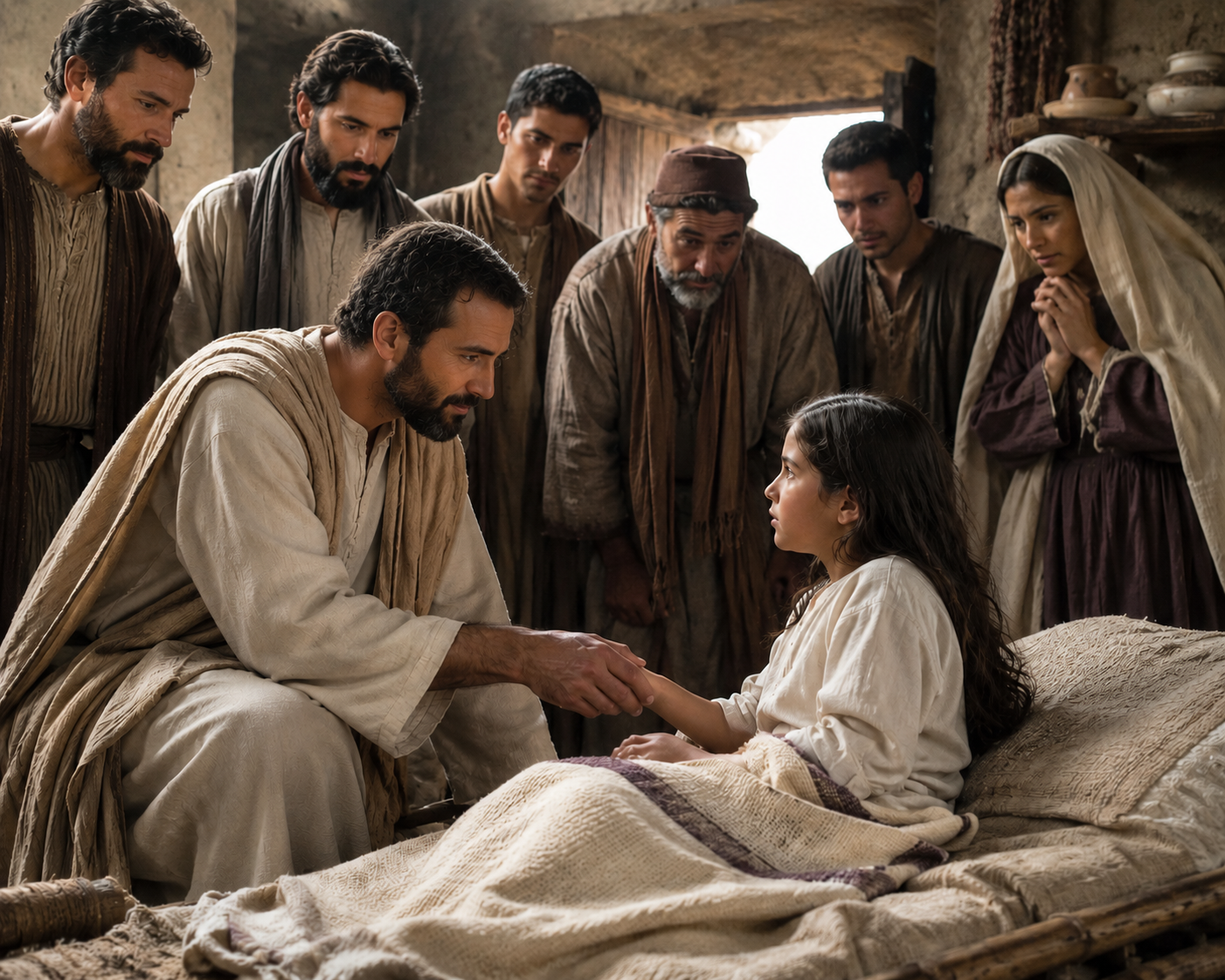
Jesus takes the child by the hand:
“Talitha cumi; which is, being interpreted, Damsel, I say unto thee, arise.”
— Mark 5:41
The response is immediate:
“And straightway the damsel arose, and walked…”
— Mark 5:42
Mark adds:
“for she was of the age of twelve years.”
The people are:
“astonished with a great astonishment.”
Jesus then commands that something be given her to eat.
The account demonstrates Christ’s authority over physical death. The girl does not revive through medicine, human persuasion, or natural recovery. Christ speaks, and she arises.
This miracle also points consistently toward the greater biblical truth that Jesus Christ has authority over life and death.
Key People and Places
Jesus Christ
The central Person throughout both chapters. He teaches with authority, explains divine truth, commands the wind and sea, casts out unclean spirits, heals disease, and raises the dead.
These chapters do not portray Jesus merely as a moral teacher. His words and works display extraordinary authority that is fully consistent with the New Testament revelation that He is God manifest in the flesh.
The Twelve and Other Disciples
They receive private explanation concerning the parables. They also witness the calming of the storm.
Their fear during the storm becomes an occasion for Christ to challenge their faith:
“Why are ye so fearful? how is it that ye have no faith?”
— Mark 4:40
The Sower
The sower in Christ’s explanation sows “the word.” The emphasis falls upon the proclamation of the Word and the differing responses of hearers.
The Man Possessed With Unclean Spirits
He is found among the tombs in the country of the Gadarenes. No human restraint had subdued him, but Christ delivers him.
Afterward he is:
“sitting, and clothed, and in his right mind.”
He then becomes a public witness in Decapolis concerning what Jesus had done for him.
Legion
This is the name given in the response to Jesus:
“My name is Legion: for we are many.”
— Mark 5:9
The word communicates plurality. Scripture does not specify the exact number of unclean spirits.
Jairus
Mark identifies Jairus as “one of the rulers of the synagogue.”
He comes personally to Jesus, falls at His feet, and pleads for his dying daughter.
When news of her death arrives, Christ commands him:
“Be not afraid, only believe.”
Jairus’s Daughter
She is twelve years old and is explicitly reported dead before Jesus reaches the house. Jesus takes her by the hand, commands her to arise, and she immediately rises and walks.
The Woman With the Issue of Blood
She had suffered for twelve years. Human treatment had exhausted her resources without curing her.
She comes to Christ believing that touching His clothes would bring healing. Christ heals her and publicly addresses her with compassion.
Peter, James, and John
These three disciples are specifically permitted to accompany Christ when He enters the house of Jairus.
The text records their presence without stating that the other disciples were spiritually inferior because they were not taken inside.
The Sea
Mark 4 repeatedly refers simply to “the sea.” Jesus teaches beside it, crosses it by ship, and exercises complete authority over its storm.
The wider Gospel setting identifies this ministry with the region around the Sea of Galilee, but Mark 4 itself commonly uses the shorter designation “the sea.”
Country of the Gadarenes
Explicitly named in Mark 5:1 as the destination reached after crossing the sea.
It is there that Jesus encounters and delivers the man with the unclean spirit.
The Tombs
The possessed man had his dwelling among the tombs. They emphasize the miserable condition in which he was found before Christ delivered him.
Decapolis
After his deliverance, the man:
“began to publish in Decapolis how great things Jesus had done for him.”
The text presents him as openly testifying concerning Christ’s work.
Main Doctrinal or Spiritual Themes
The Supreme Importance of the Word of God
Mark 4 begins with hearing.
“Hearken…”
— Mark 4:3
The seed is explicitly identified as “the word.”
Spiritual fruitfulness is therefore inseparably connected with one’s response to God’s Word.
A church may employ many methods, programs, personalities, and activities, but none can replace the preaching and teaching of the Scriptures.
Human Responsibility in Hearing
Jesus repeatedly commands:
“If any man have ears to hear, let him hear.”
And:
“Take heed what ye hear.”
Men are accountable for their response to divine truth.
The distractions Christ identifies remain spiritually dangerous: affliction, persecution, worldly cares, deceitfulness of riches, and other lusts.
Satanic Opposition to the Word
Jesus explicitly says:
“Satan cometh immediately, and taketh away the word that was sown in their hearts.”
Satan opposes the reception of biblical truth.
This reinforces the importance of clear preaching, attentive listening, prayer, and guarding the heart against distraction.
Spiritual Fruitfulness
The good-ground hearers:
“hear the word, and receive it, and bring forth fruit.”
Fruitfulness is a proper result of receiving divine truth.
The believer should desire more than exposure to Scripture. He should desire the Word to govern his thinking, conduct, priorities, service, and testimony.
The Danger of Worldliness
Jesus names:
“the cares of this world,”
“the deceitfulness of riches,”
and:
“the lusts of other things.”
These enter in and choke the Word.
The passage therefore warns not only against openly scandalous sins but also against ordinary worldly concerns becoming spiritually dominant.
Something need not appear wicked to become a hindrance if it crowds the Word of God out of a believer’s life.
Divine Growth
The seed of Mark 4:26–29 grows in a manner the sower himself cannot produce.
God’s servants sow and labor, but spiritual life cannot be manufactured by emotional pressure, entertainment, manipulation, or human technique.
The servant should faithfully sow the Word and depend upon God for the increase.
Christ’s Authority Over Creation
When Jesus commands:
“Peace, be still,”
the wind ceases and there is a great calm.
Creation obeys Him.
The miracle is not presented merely as encouragement to remain emotionally calm during difficulty. It is first a historical display of Christ’s actual authority over the physical creation.
Devotional application is legitimate only after the historical event has first been allowed to mean what the text says.
Faith Versus Fear
Jesus asks the disciples:
“Why are ye so fearful? how is it that ye have no faith?”
He tells Jairus:
“Be not afraid, only believe.”
Fear repeatedly confronts faith in these chapters.
Biblical faith is not confidence that circumstances will always develop according to our wishes. It is confidence in the Lord Himself.
The Reality of Satan and Unclean Spirits
Mark 5 presents devils as real personal spiritual beings.
Christ does not negotiate as an equal with them. He commands them.
A conservative reading should neither deny the reality of demonic powers nor become preoccupied with speculative demonology beyond what Scripture reveals.
Christ is the dominant Person in the passage.
Christ’s Absolute Authority Over Devils
The unclean spirits recognize Jesus’ authority and require His permission before entering the swine.
The delivered man provides visible evidence that their power is subordinate to Christ.
The believer therefore has no reason to treat Satan as an equal opposite to God. Satan is a creature; Christ is Lord.
The Compassion of Christ
Jesus tells the delivered man to testify concerning:
“how great things the Lord hath done for thee, and hath had compassion on thee.”
The chapter joins power with compassion.
Christ is mighty enough to deliver, yet compassionate toward the individual.
Personal Testimony
Jesus commands:
“Go home to thy friends, and tell them how great things the Lord hath done for thee…”
The man obeys.
A biblical testimony centers upon what the Lord has done rather than upon glorifying the sinner’s former life.
Christ’s Authority Over Disease
The woman had suffered twelve years and had not been cured by human physicians.
Christ heals her immediately.
The passage does not condemn legitimate medicine merely because her physicians had failed. Scripture simply reports that their efforts had not cured her condition.
Nor does the passage promise that every believer will receive immediate physical healing in the present age. It records a specific miracle performed by Christ.
Christ’s Authority Over Death
The final enemy confronted in Mark 5 is death itself.
Jesus says:
“Damsel, I say unto thee, arise.”
She arises.
Disease does not limit Him. Devils do not limit Him. Nature does not limit Him. Death does not limit Him.
Salvation Is Not Earned by Works
Although Mark 4–5 emphasizes fruit, obedience, hearing, and faith, nothing in these chapters teaches salvation by human merit.
Scripture elsewhere plainly teaches salvation by grace through faith, apart from works. Good works and spiritual fruit should follow the believer’s relationship with God; they do not purchase eternal life.
Practical Applications or Lessons
Hear the Bible Carefully
Christ’s warning remains direct:
“Take heed what ye hear.”
The believer should approach Scripture reverently rather than casually.
Bible preaching should not become background noise. The Word deserves attention, meditation, obedience, and remembrance.
Guard the Word From Competing Influences
Christ specifically identifies things that choke spiritual fruitfulness.
A believer should examine whether work, finances, possessions, entertainment, ambitions, worries, or personal desires are crowding Scripture out of his life.
The problem is not always rejection of the Bible. Sometimes the Word is simply crowded until it becomes practically unfruitful.
Sow the Word Faithfully
The sower’s responsibility is to sow.
Christians cannot force another person to believe, and no preacher can produce genuine conversion through personality or pressure.
The believer’s responsibility is to give the gospel faithfully and trust God with the results.
Do Not Judge the Power of God’s Work by Its Beginning
The mustard seed begins small.
Faithfulness should not be measured merely by immediate size, visibility, or applause.
What God purposes to accomplish does not depend upon impressive human beginnings.
Remember Who Is in the Ship
The disciples looked at the storm and feared destruction while Christ was present with them.
The passage does not promise believers an absence of storms. The disciples encountered the storm while obeying Christ’s command to cross the sea.
Obedience therefore does not guarantee easy circumstances.
But trouble never places Christ beyond His authority.
Bring Fear Under the Authority of Faith
Jesus does not congratulate fearful unbelief.
He confronts it:
“Why are ye so fearful?”
And later:
“Be not afraid, only believe.”
The answer to fear is not pretending danger does not exist. Jairus’s daughter really had died. The storm really was violent.
Faith rests upon Christ despite the seriousness of the circumstances.
Never Assume a Person Is Beyond Christ’s Reach
The Gadarenes had a man whom chains could not control.
Jesus required no chain.
Human inability is not divine inability.
No sinner should be considered too hardened, ruined, enslaved, or hopeless for Christ to save.
Do Not Become Fascinated With Darkness
Mark gives enough information to establish the reality and destructive character of demonic activity, but the focus remains Christ.
Christians should not develop an unhealthy fascination with devils, occult practices, or speculative spiritual warfare.
The biblical emphasis is upon the superior authority of the Lord Jesus Christ.
Tell Others What the Lord Has Done
The delivered man wanted to remain physically with Jesus, but Jesus assigned him another task:
“Go home to thy friends, and tell them…”
His obedience is immediate.
Sometimes serving Christ means accepting the assignment He gives rather than the one we would personally prefer.
A saved person has a testimony worth telling.
Direct Attention Toward Jesus, Not Yourself
The delivered man:
“began to publish in Decapolis how great things Jesus had done for him.”
Christian testimony should magnify Christ.
The object is not to make the former sinner appear interesting. The object is to make the Saviour known.
Come to Christ With the Need You Actually Have
Jairus openly admits that his daughter is near death.
The woman admits her desperate condition through her actions.
The demon-possessed man has no ability to repair himself.
Each account demonstrates human need meeting Christ’s sufficiency.
There is no virtue in pretending spiritual strength that one does not possess.
Faith Must Have the Right Object
The woman’s faith did not possess independent miraculous power.
Jesus healed her.
Jairus’s faith was not faith in faith. Christ stood before him and said:
“Be not afraid, only believe.”
Biblical faith rests in the Person and promise of God.
Human Resources Have Limits
The woman had:
“spent all that she had,”
yet:
“rather grew worse.”
This does not teach Christians to reject physicians. It teaches plainly that human resources have limits.
There are needs only God can ultimately meet.
Christ Is Never Overwhelmed by an Interruption
While Jesus is going with Jairus, the woman approaches Him.
While He is speaking with her, news arrives that Jairus’s daughter has died.
What appeared to the people to be worsening circumstances never placed Christ outside His authority.
The believer should therefore resist the assumption that delay means divine helplessness.
Scripture does not explicitly tell us everything Jairus thought during the delay, so speculation about his private emotions should be avoided.
Death Does Not Have the Final Authority
The messengers concluded:
“Thy daughter is dead: why troublest thou the Master any further?”
From their human perspective, death ended the matter.
Jesus demonstrated otherwise.
Mark 5 does not give the complete New Testament doctrine of resurrection, but it unmistakably demonstrates that physical death is subject to Christ’s command.
Obey Even After the Miracle
After raising the girl, Jesus commands that something be given her to eat.
The spectacular work of God did not remove ordinary human responsibility.
The Lord who performs what man cannot do still expects men to do what they can do.
Overall Emphasis of Mark 4–5
Mark 4 begins with the Word being sown and repeatedly asks whether men will hear.
Mark 5 shows the authority of the One who speaks that Word.
He commands creation, and creation obeys.
He commands unclean spirits, and they depart.
Disease yields to His power.
Death yields to His voice.
The proper response is not merely amazement. These chapters call for attentive hearing, faith in Christ, obedience to His commands, spiritual fruitfulness, separation from the choking influences of the world, and faithful testimony concerning what the Lord has done.
The disciples asked:
“What manner of man is this, that even the wind and the sea obey him?”
Mark 4–5 supplies powerful evidence for the answer: Jesus Christ possesses authority that belongs to no ordinary man. He is the sovereign Lord whose Word must be heard and whose Person must be trusted.
Comments are closed