“Jesus Christ, the Son of God.”
Mark 1–3 presents the opening ministry of Jesus Christ with strong emphasis upon His identity, authority, preaching, miracles, calling of disciples, and growing conflict with religious opposition. Mark begins without recording the birth or genealogy of Christ and moves directly into the ministry of John the Baptist and the public ministry of the Lord Jesus.
The opening declaration establishes the subject plainly: “The beginning of the gospel of Jesus Christ, the Son of God” (Mark 1:1). Across these chapters, Christ demonstrates authority over unclean spirits, sickness, leprosy, sin, the sabbath, and the calling and commissioning of His servants. At the same time, Mark records increasing opposition from scribes and Pharisees, culminating in counsel with the Herodians concerning how they might destroy Him.
Chapter Summaries
Mark 1 — The Beginning of Christ’s Public Ministry
 Mark opens by identifying Jesus Christ as “the Son of God” (Mark 1:1).
John the Baptist appears in fulfillment of the prophets:
“Behold, I send my messenger before thy face, which shall prepare thy way before thee.
The voice of one crying in the wilderness, Prepare ye the way of the Lord, make his paths straight.”
— Mark 1:2–3
The wording corresponds with prophetic passages including Malachi 3:1 and Isaiah 40:3. Mark himself says these things were “written in the prophets.”
John preached “the baptism of repentance for the remission of sins” and directed attention away from himself toward One greater than himself:
“There cometh one mightier than I after me, the latchet of whose shoes I am not worthy to stoop down and unloose.”
— Mark 1:7
John baptized with water, but he declared concerning Christ:
“he shall baptize you with the Holy Ghost.”
— Mark 1:8
Jesus came from Nazareth of Galilee and was baptized of John in Jordan. When He came up out of the water, the Spirit descended upon Him “like a dove,” and the Father’s voice declared:
“Thou art my beloved Son, in whom I am well pleased.”
— Mark 1:11
The passage distinctly presents the Son, the Spirit, and the Father’s voice. This is consistent with the biblical doctrine of the Trinity without confusing the Persons of the Godhead.
Immediately afterward, “the Spirit driveth him into the wilderness.” Jesus was there forty days, tempted of Satan, “and was with the wild beasts; and the angels ministered unto him” (Mark 1:12–13). Mark does not give the individual temptations recorded elsewhere, so they should not be inserted into Mark’s account as though Mark himself records them.
After John was put into prison, Jesus came into Galilee preaching:
“The time is fulfilled, and the kingdom of God is at hand: repent ye, and believe the gospel.”
— Mark 1:15
Repentance and faith stand prominently at the beginning of Christ’s preaching.
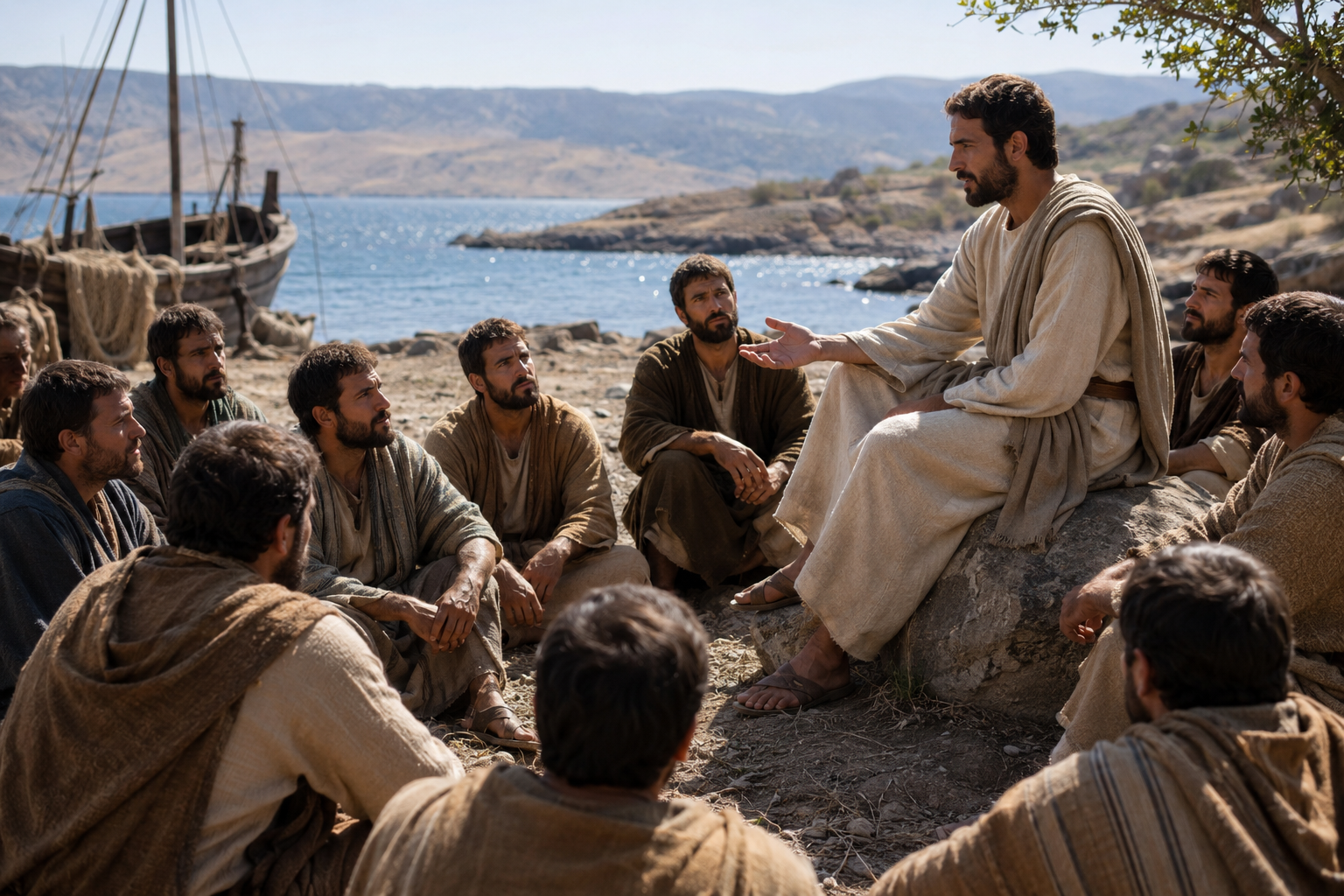
Walking beside the Sea of Galilee, Jesus called Simon and Andrew:
“Come ye after me, and I will make you to become fishers of men.”
— Mark 1:17
They “straightway forsook their nets, and followed him.”
Jesus then called James and John, the sons of Zebedee. They left their father Zebedee “in the ship with the hired servants” and went after Christ.
At Capernaum Jesus entered the synagogue on the sabbath and taught. The people were astonished because:
“he taught them as one that had authority, and not as the scribes.”
— Mark 1:22
An unclean spirit recognized Him and cried:
“I know thee who thou art, the Holy One of God.”
— Mark 1:24
Jesus rebuked the spirit and commanded it to come out. The people again recognized His unusual authority.
Jesus then entered the house of Simon and Andrew with James and John. Simon’s wife’s mother was sick of a fever. Christ took her by the hand, lifted her up, and the fever left her. Mark immediately states, “she ministered unto them.”
That evening many sick and demon-possessed people were brought to Christ. He healed many and cast out many devils. Mark specifically says that Christ “suffered not the devils to speak, because they knew him” (Mark 1:34).
Early the next morning:
“rising up a great while before day, he went out, and departed into a solitary place, and there prayed.”
— Mark 1:35
Even amid an expanding ministry, Christ gave deliberate place to prayer.
When His disciples found Him, Jesus said:
“Let us go into the next towns, that I may preach there also: for therefore came I forth.”
— Mark 1:38
His healing ministry was tremendous, but preaching remained central.
The chapter concludes with a leper coming to Christ and saying:
“If thou wilt, thou canst make me clean.”
— Mark 1:40
Mark specifically states that Jesus was “moved with compassion.” Christ touched him and said:
“I will; be thou clean.”
— Mark 1:41
The leprosy immediately departed.
Jesus then commanded the man to say nothing to anyone, but to show himself to the priest and offer what Moses commanded. Instead, the man “began to publish it much.” As a result, Jesus “could no more openly enter into the city,” but remained in desert places while people continued coming to Him.
Because Christ plainly commanded silence and the man instead published the matter widely, it is reasonable to describe his conduct as disobedience to that particular command. The text itself records both the command and the contrary action.
Mark 2 — Forgiveness, Calling Sinners, and the Lord of the Sabbath
Jesus returned to Capernaum, and it was reported that He was in the house. So many gathered that there was no room even near the door.
Four men brought a man sick of the palsy. Unable to reach Jesus because of the crowd, they uncovered the roof and lowered the man down.
Mark records:
“When Jesus saw their faith, he said unto the sick of the palsy, Son, thy sins be forgiven thee.”
— Mark 2:5
Certain scribes reasoned within themselves:
“Why doth this man thus speak blasphemies? who can forgive sins but God only?”
— Mark 2:7
Their theological premise that God has authority to forgive sins underscores the significance of what follows.
Jesus knew what they were reasoning and asked whether it was easier to pronounce forgiveness or to command the man to rise and walk. He then explained His purpose:
“But that ye may know that the Son of man hath power on earth to forgive sins…”
— Mark 2:10
He commanded the paralytic to arise, take up his bed, and go home. The man immediately arose.
The miracle therefore served as a visible demonstration accompanying Christ’s explicit claim that “the Son of man hath power on earth to forgive sins.”
Jesus later saw Levi, the son of Alphaeus, “sitting at the receipt of custom,” and commanded:
“Follow me.”
— Mark 2:14
Levi arose and followed Him.
Jesus subsequently ate in company with many publicans and sinners. The scribes and Pharisees objected to His association with them.
Christ answered:
“They that are whole have no need of the physician, but they that are sick: I came not to call the righteous, but sinners to repentance.”
— Mark 2:17
Christ did not approve sin by receiving sinners. His stated purpose was to call sinners “to repentance.”
A question then arose concerning fasting. The disciples of John and the Pharisees fasted, while Christ’s disciples did not at that time.
Jesus used the figure of a bridegroom and explained:
“Can the children of the bridechamber fast, while the bridegroom is with them?”
— Mark 2:19
He then said that days would come when the bridegroom would be taken away, “and then shall they fast in those days.”
Christ followed this with the illustrations of new cloth on an old garment and new wine in old bottles. The immediate context concerns the question regarding fasting. Applications beyond that context should therefore be made cautiously rather than turning the illustrations into unsupported allegories.
Another controversy arose when Christ’s disciples plucked ears of corn while passing through the fields on the sabbath.
The Pharisees challenged their conduct. Jesus referred them to David’s eating of the shewbread and then declared:
“The sabbath was made for man, and not man for the sabbath:”
— Mark 2:27
He concluded:
“Therefore the Son of man is Lord also of the sabbath.”
— Mark 2:28
The declaration is another direct statement of Christ’s authority.
The passage occurs in the setting of Christ’s earthly ministry among Israel and repeated disputes over the Jewish sabbath. Mark 2 itself should not be made to say more concerning later church practice than it actually states.
Mark 3 — Sabbath Conflict, the Twelve, and Opposition to Christ
Jesus again entered the synagogue, where there was a man with a withered hand.
His opponents watched Him to see whether He would heal on the sabbath “that they might accuse him.”
Jesus asked:
“Is it lawful to do good on the sabbath days, or to do evil? to save life, or to kill?”
— Mark 3:4
They remained silent.
Mark then gives a striking description of Christ:
“And when he had looked round about on them with anger, being grieved for the hardness of their hearts…”
— Mark 3:5
Christ’s anger was not sinful passion. The text explicitly connects His anger and grief with “the hardness of their hearts.”
Jesus commanded the man to stretch forth his hand, and it was restored whole.
Immediately afterward:
“the Pharisees went forth, and straightway took counsel with the Herodians against him, how they might destroy him.”
— Mark 3:6
Mark names the Herodians but does not explain their organization, complete beliefs, or motives beyond their participation in this counsel. Further claims concerning their political or religious position would require historical information outside this passage and should not be treated as though Mark explicitly supplies it.
Jesus withdrew toward the sea, followed by a great multitude from Galilee and Judaea, Jerusalem, Idumaea, beyond Jordan, and the regions around Tyre and Sidon.
The multitude was so great that Jesus instructed His disciples that a small ship should wait on Him because of the crowd.
Unclean spirits again recognized His identity:
“Thou art the Son of God.”
— Mark 3:11
Jesus charged them that they should not make Him known.
He then went up into a mountain:
“and calleth unto him whom he would: and they came unto him.”
— Mark 3:13
Christ ordained twelve for several expressly stated purposes:
“that they should be with him, and that he might send them forth to preach,
And to have power to heal sicknesses, and to cast out devils.”
— Mark 3:14–15
The twelve named are Simon, whom Christ surnamed Peter; James the son of Zebedee; John the brother of James; Andrew; Philip; Bartholomew; Matthew; Thomas; James the son of Alphaeus; Thaddaeus; Simon the Canaanite; and Judas Iscariot.
Mark specifically identifies Judas as the one “which also betrayed him.”
James the son of Alphaeus in Mark 3:18 should not automatically be identified with Levi the son of Alphaeus in Mark 2:14. They share the same patronymic, but Mark does not explicitly state that they were brothers.
The multitude again gathered so densely that Jesus and those with Him “could not so much as eat bread.”
His friends heard of it and went out to lay hold on Him, saying:
“He is beside himself.”
— Mark 3:21
Scripture records their statement. Mark does not affirm that their judgment about Christ was correct.
Scribes who came down from Jerusalem accused Him:
“He hath Beelzebub, and by the prince of the devils casteth he out devils.”
— Mark 3:22
Jesus answered by showing the contradiction in their accusation:
“How can Satan cast out Satan?”
— Mark 3:23
A kingdom divided against itself cannot stand. Neither can a divided house stand. Christ then used the illustration of binding a strong man before spoiling his house.
Jesus issued a solemn warning concerning blasphemy against the Holy Ghost:
“But he that shall blaspheme against the Holy Ghost hath never forgiveness, but is in danger of eternal damnation:”
— Mark 3:29
Mark immediately explains the setting:
“Because they said, He hath an unclean spirit.”
— Mark 3:30
Therefore, the warning must first be interpreted according to that explicit context. These scribes were attributing Christ’s work to an unclean spirit.
The passage should not be carelessly used to convince a troubled believer that some accidental statement, unwanted thought, or momentary fear has automatically placed him beyond salvation. Mark specifically connects Christ’s warning with the accusation, “He hath an unclean spirit.”
The chapter closes with Christ’s mother and brethren standing outside and calling for Him.
Jesus asked:
“Who is my mother, or my brethren?”
— Mark 3:33
Looking upon those sitting around Him, He said:
“Behold my mother and my brethren!
For whosoever shall do the will of God, the same is my brother, and my sister, and mother.”
— Mark 3:34–35
Christ was emphasizing the reality of spiritual relationship through obedience to God. The text does not say that natural family relationships ceased to exist, nor does it explicitly state that Christ was repudiating His mother. Those conclusions should not be imposed upon the passage.
Key People and Places
Jesus Christ — Introduced as “Jesus Christ, the Son of God.” He preaches repentance and faith, calls disciples, teaches with authority, forgives sins, heals disease, casts out devils, declares Himself Lord of the sabbath, and appoints the twelve.
John the Baptist — The wilderness preacher who prepared the way of the Lord. He preached repentance, baptized, and pointed men to the One mightier than himself.
Simon Peter — Originally called Simon in these chapters. Christ called him from fishing and later surnamed him Peter.
Andrew — Simon’s brother, called with him beside the Sea of Galilee.
James and John — Sons of Zebedee. Christ called them from their fishing occupation. In Mark 3:17 He surnamed them “Boanerges, which is, The sons of thunder.”
Zebedee — Father of James and John. Mark records that his sons left him in the ship with hired servants when Christ called them.
Simon’s wife’s mother — Healed by Christ of a fever and afterward ministered unto them.
The leper — Came believing Christ had the power to cleanse him and appealed to Christ’s will. Jesus was moved with compassion and cleansed him.
The man sick of the palsy — Brought to Christ by four men. Christ forgave his sins and healed him.
Levi the son of Alphaeus — Found sitting at the receipt of custom. Christ commanded him, “Follow me,” and he arose and followed Him.
The scribes — Questioned Christ’s authority to forgive sins and later accused Him of casting out devils through Beelzebub.
The Pharisees — Objected to Christ’s association with publicans and sinners, questioned sabbath conduct, watched for grounds of accusation, and took counsel concerning His destruction.
The Herodians — Joined the Pharisees in counsel against Christ. Mark does not give further explanation of their identity in these chapters.
The man with the withered hand — Healed by Christ in the synagogue on the sabbath.
The Twelve — Chosen to be with Christ, to preach, to heal sicknesses, and to cast out devils.
Judas Iscariot — Included among the twelve and explicitly identified by Mark as the one “which also betrayed him.”
Nazareth of Galilee — The place from which Jesus came to be baptized by John.
Jordan — The river associated with John’s baptizing ministry and Christ’s baptism.
The wilderness — The setting of John’s ministry and also the place where Christ was tempted forty days.
Galilee — A principal region of Christ’s early preaching and ministry in these chapters.
Sea of Galilee — The location where Christ called Simon, Andrew, James, and John.
Capernaum — Repeatedly appears as a setting for Christ’s teaching, healing, and conflict with religious leaders.
Judaea and Jerusalem — Regions from which people came to John and later from which multitudes came to Christ.
Idumaea — Named among the regions represented in the great multitude following Christ.
Beyond Jordan — Another region from which people came to Him.
Tyre and Sidon — Coastal areas whose surrounding population heard of Christ’s works and came unto Him.
Main Doctrinal or Spiritual Themes
The Deity and Identity of Jesus Christ
Mark opens by calling Him “the Son of God.” The Father calls Him “my beloved Son.” An unclean spirit calls Him “the Holy One of God.” Other unclean spirits cry, “Thou art the Son of God.”
These descriptions are not supplied merely by later theological interpretation; they appear directly in the KJV text.
The Authority of Christ
Authority dominates Mark 1–3.
Christ possesses authority in teaching. He commands unclean spirits. He heals sickness and disease. He cleanses leprosy. He forgives sins. He commands the palsied man to walk. He calls disciples with authority. He declares Himself “Lord also of the sabbath.”
The works do not create His identity; rather, they reveal the authority He already possesses.
Repentance and Faith
Christ’s early preaching is direct:
“repent ye, and believe the gospel.”
— Mark 1:15
Biblical repentance and faith should not be separated from the gospel message.
Repentance is not meritorious works offered to purchase salvation. Salvation throughout Scripture is by God’s grace through faith and not earned by works. Mark’s own emphasis here is that Christ calls “sinners to repentance.”
Christ’s Authority to Forgive Sin
Mark 2 goes beyond physical healing. Christ deliberately forgives the paralytic before healing him and then performs the visible miracle:
“that ye may know that the Son of man hath power on earth to forgive sins.”
— Mark 2:10
The central problem of mankind is therefore deeper than physical affliction. Man needs forgiveness of sin.
Christ’s Compassion
Mark does not require us to guess about Christ’s attitude toward the leper:
“Jesus, moved with compassion…”
— Mark 1:41
His compassion is holy compassion. He does not excuse sin; He explicitly calls sinners to repentance.
Prayer
Mark 1:35 presents Christ rising “a great while before day” and going into a solitary place to pray.
If the sinless Son of God gave deliberate place to prayer during active ministry, believers have no biblical basis for treating prayer as unnecessary simply because they are busy in Christian service.
Preaching
Christ said:
“Let us go into the next towns, that I may preach there also: for therefore came I forth.”
— Mark 1:38
Miracles drew crowds, but preaching remained central.
Likewise, one of the stated purposes for choosing the twelve was that Christ might “send them forth to preach.”
A biblical ministry cannot substitute entertainment, popularity, or religious activity for the preaching of God’s Word.
Separation From Sin Without Isolation From Sinners
Jesus ate among publicans and sinners, but He did not redefine their condition.
He said:
“I came not to call the righteous, but sinners to repentance.”
— Mark 2:17
Biblical separation does not require believers to pretend lost sinners do not exist. Neither does compassion require believers to approve their sin. Christ received sinners while calling sinners to repentance.
The Danger of Religious Hardness
Some of the most severe opposition in these chapters came from religious men.
Mark 3 explicitly says Christ was:
“grieved for the hardness of their hearts.”
These men could watch a suffering man receive healing and still concentrate upon finding grounds to accuse Christ.
Religious knowledge without a tender heart toward God’s truth can become deeply dangerous.
The Sabbath and the Authority of Christ
Jesus declared:
“The sabbath was made for man, and not man for the sabbath.”
— Mark 2:27
He immediately added:
“Therefore the Son of man is Lord also of the sabbath.”
— Mark 2:28
The central doctrinal emphasis of the passage is not human authority over God’s commandments but Christ’s authority as Lord.
Spiritual Opposition Is Real
Mark plainly presents Satan, temptation, unclean spirits, and demon possession as realities. These passages should not be reduced to symbolic descriptions of psychological conditions, because Mark explicitly speaks of unclean spirits as personal beings that speak, recognize Christ, obey His commands, and are cast out.
At the same time, Scripture gives no warrant for speculative fascination with demons. Mark’s emphasis is Christ’s absolute authority over them.
The Seriousness of Blaspheming the Holy Ghost
Mark 3:22–30 must be interpreted in its stated setting.
The scribes said that Christ possessed Beelzebub and cast out devils through the prince of devils. Christ’s warning concerning blasphemy against the Holy Ghost follows this accusation, and Mark explains:
“Because they said, He hath an unclean spirit.”
Any doctrine of the unpardonable sin must respect that explicit textual connection rather than being built upon fear, superstition, or speculation.
Discipleship Begins With Christ
Jesus did not first call the twelve to build personal ministries.
Mark says He ordained them:
“that they should be with him.”
Fellowship with and submission to Christ precedes useful service for Christ.
Practical Applications or Lessons
Respond promptly when Christ’s Word is clear. Simon and Andrew “straightway forsook their nets.” James and John likewise responded when Christ called them. Obedience should not be deliberately postponed when God’s command is plain.
Make prayer a genuine priority. Mark 1:35 shows Christ seeking a solitary place for prayer before the demands of the day overtook Him.
Keep gospel preaching central. Christ healed multitudes, yet He specifically said He must go into other towns “that I may preach there also.” A ministry may perform many good works while still failing its biblical purpose if the preaching of truth becomes secondary.
Bring needy people to Christ. The four who carried the paralytic refused to let the crowd stop them. Mark records that Jesus “saw their faith.” Believers should be earnest about bringing others under the hearing of Christ’s Word.
Do not confuse physical relief with man’s greatest need. Before healing the paralytic, Jesus addressed his sins. A man can have an improved earthly condition and still need forgiveness before God.
Never let religious tradition become an excuse for hardness of heart. The Pharisees could watch Christ restore a withered hand and still use the event as grounds for opposition. Truth should produce humility and compassion, not cold pride.
Obey Christ even when personal enthusiasm seems well-intentioned. The cleansed leper had received a tremendous blessing, but Christ had given him a specific command. His enthusiasm did not cancel Christ’s words.
Do not measure truth by popularity. Great multitudes followed Jesus, but influential religious leaders opposed Him. Neither crowds nor opposition determine truth. God’s Word does.
Stay close to Christ before attempting service for Christ. The twelve were first appointed “that they should be with him,” and then that He might send them forth to preach.
Expect opposition when truth confronts hardened hearts. Mark 3 shows opposition progressing from questioning Christ to watching Him for accusation and finally taking counsel concerning His destruction. Scripture does not promise that faithful ministry will always receive favorable treatment.
Guard against attributing God’s truth to evil. The scribes witnessed Christ’s works and attributed them to an unclean spirit. Their example demonstrates the terrible danger of hardened resistance to clear truth.
Remember that spiritual relationship with Christ produces obedience. Jesus said:
“whosoever shall do the will of God, the same is my brother, and my sister, and mother.”
— Mark 3:35
Obedience does not purchase salvation, but those who belong to God should take His will seriously.
Overall Message of Mark 1–3
Mark 1–3 introduces Jesus Christ as the authoritative Son of God. He preaches repentance and faith, calls men to follow Him, exercises authority over disease and devils, forgives sins, teaches with divine authority, claims lordship over the sabbath, and appoints men to preach.
At the same time, the chapters reveal sharply differing responses to Christ.
Some forsake their nets and follow Him.
Some bring their helpless friend to Him.
Some crowd around Him seeking help.
Some marvel and glorify God.
Some question Him.
Some watch Him in order to accuse Him.
Some attribute His works to Satan.
And some begin planning His destruction.
The central question running beneath these chapters is therefore not merely what Jesus can do, but who Jesus is.
Mark answers from his opening verse:
“Jesus Christ, the Son of God.”
Comments are closed