
Chapter Summaries
Lamentations 3
 This chapter is the heart of the book. The speaker, traditionally understood to be Jeremiah, speaks as “the man that hath seen affliction by the rod of his wrath” (3:1). The chapter moves through deep personal sorrow, a sense of divine chastening, and then rises into one of the clearest declarations of hope in all the book.
The opening section describes intense suffering under the hand of God. The writer says, “He hath led me, and brought me into darkness, but not into light” (3:2). He speaks of broken bones, fenced-up paths, bitterness, wormwood, and being filled with grief. This is not mere human disappointment; it is the sorrow of one who knows Jerusalem’s destruction came under the righteous hand of the LORD because of sin. The language is vivid and heavy, showing that God’s judgment against Judah was not accidental, but deliberate and holy.
Then comes the great turning point in verses 21–24: “This I recall to my mind, therefore have I hope. It is of the LORD’S mercies that we are not consumed, because his compassions fail not. They are new every morning: great is thy faithfulness. The LORD is my portion, saith my soul; therefore will I hope in him.” This is not shallow optimism. It is faith rising in the middle of ruin. The city is still broken, the suffering is still real, yet hope is found in the unchanging character of God. His mercies are the reason the remnant still exists at all.
The chapter then teaches that “The LORD is good unto them that wait for him” (3:25), and “It is good that a man should both hope and quietly wait for the salvation of the LORD” (3:26). There is strong emphasis on humble submission under chastening. “It is good for a man that he bear the yoke in his youth” (3:27). The proper response to divine correction is not rebellion, but repentance, silence, self-examination, and renewed dependence upon God.
The chapter also guards God’s character carefully. Though He causes grief, “yet will he have compassion according to the multitude of his mercies” (3:32). “For he doth not afflict willingly nor grieve the children of men” (3:33). That does not mean judgment is absent, but that judgment is never cruel, arbitrary, or unjust. God remains righteous even when He chastens.
The closing portion calls the people to examine themselves: “Let us search and try our ways, and turn again to the LORD” (3:40). This is one of the great revival verses of the Old Testament. The chapter ends with prayer for divine regard, justice, and recompense against enemies. So chapter 3 moves from affliction, to hope, to repentance, to prayer.
Lamentations 4
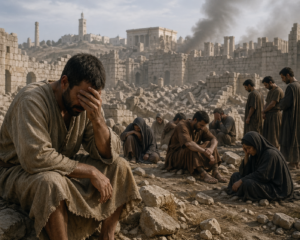
Chapter 4 returns to a more public lament over Jerusalem’s fall. It contrasts what Jerusalem once was with what she has become. “How is the gold become dim! how is the most fine gold changed!” (4:1). The imagery suggests sacred beauty, dignity, and privilege now defiled and ruined. The precious sons of Zion, once “comparable to fine gold,” are now “esteemed as earthen pitchers” (4:2). The nation that had been set apart unto God had been brought very low.
The chapter describes terrible conditions during the siege. Mothers become pitiless through famine. Children faint in the streets. Those who were delicately reared perish in desolation. Those once clothed richly sit on dunghills. The horrors fulfill the covenant warnings that had long been given through Moses and the prophets. The suffering is not exaggerated poetry; it reflects the awful consequences of rebellion against God.
Verse 6 says, “For the punishment of the iniquity of the daughter of my people is greater than the punishment of the sin of Sodom.” Jerusalem had greater light, greater privilege, greater revelation, and therefore greater accountability. This is a sobering doctrinal truth: greater privilege brings greater responsibility.
The chapter also points to failed human leadership. Her Nazarites were once pure and honored, but are now unrecognizable from hunger and judgment. Her prophets and priests are blamed in verse 13: “For the sins of her prophets, and the iniquities of her priests, that have shed the blood of the just in the midst of her.” Spiritual corruption in leadership helped bring national ruin. False religion and moral compromise had consequences far beyond the leaders themselves.
There is also disappointment in misplaced confidence. The people had looked for help from other nations, but vainly: “In our watching we have watched for a nation that could not save us” (4:17). Judah’s political hopes failed because no earthly alliance can deliver a people living under God’s judgment.
The chapter closes with mention of Edom, which had rejoiced over Judah’s calamity. Edom is warned that her own judgment would come. So while Zion suffers for her sin, the enemies of God’s people will not escape divine justice either. Chapter 4 emphasizes the visible humiliation of sin, the failure of corrupt leadership, and the certainty of God’s moral government.
Lamentations 5
Chapter 5 is a closing prayer rather than an acrostic lament like the earlier chapters. It is a corporate plea: “Remember, O LORD, what is come upon us: consider, and behold our reproach” (5:1). The people describe their desolation in plain language. Their inheritance has passed to strangers, their houses to aliens, and they are left as orphans and widows. The chapter is less poetic in structure, but deeply earnest in spirit.
The prayer rehearses the nation’s humiliations: paying for water and wood, being pursued, ruled over by servants, risking life for bread because of the sword in the wilderness, and enduring disgrace, oppression, and mourning. The crown has fallen from their head, and they confess plainly, “Woe unto us, that we have sinned!” (5:16). That statement is central. The chapter does not merely complain about hardship; it acknowledges guilt.
There is a generational note as well: “Our fathers have sinned, and are not; and we have borne their iniquities” (5:7). This does not deny personal responsibility, but recognizes the continuing effects of inherited national sin and accumulated rebellion. A nation can suffer from both present sins and the consequences of prior generations’ disobedience.
Mount Zion is desolate, and foxes walk upon it (5:18). The place associated with God’s earthly dwelling among His covenant people lies in ruin. Yet the book does not end with despair about God Himself. It ends with one of the strongest affirmations of divine sovereignty in the book: “Thou, O LORD, remainest for ever; thy throne from generation to generation” (5:19). Jerusalem’s throne had fallen, but God’s throne had not. The city was broken, but heaven was not shaken.
The closing plea is, “Turn thou us unto thee, O LORD, and we shall be turned; renew our days as of old” (5:21). That is a cry for restoration rooted in repentance and divine grace. It recognizes that true turning begins with God’s working. The book ends with sorrow still present, but with the prayer directed toward the eternal King. That is a fitting close: grief honestly expressed, sin openly confessed, and hope placed in God alone.
Key People and Places
Jeremiah / the afflicted speaker
Traditionally understood as the human writer and voice of the lament. In chapter 3 especially, the speaker embodies both personal grief and the sorrow of the faithful remnant.
The daughter of Zion / Jerusalem
The city of Jerusalem personified as a suffering woman. She represents the covenant people under judgment because of national sin.
The LORD
The central Person throughout these chapters. He is shown as holy, righteous in judgment, merciful in compassion, faithful in covenant character, and sovereign over all generations.
Prophets
Mentioned especially in chapter 4 as part of the reason for Jerusalem’s ruin. Their sins and falsehood helped deepen the nation’s guilt.
Priests
Also condemned in chapter 4. Those who should have upheld holiness instead contributed to corruption and bloodshed.
Nazarites
Referred to in chapter 4 as once-pure and honored persons now ruined by the calamity, showing how total the judgment had become.
Edom / daughter of Edom
A neighboring people condemned for rejoicing in Judah’s downfall. Their mention reminds the reader that God judges both His people and their enemies.
Zion
The hill and sacred center of Jerusalem, often standing for the whole city and nation in covenant relation to God.
Jerusalem
The principal setting of the book, now devastated by Babylon because of Judah’s long rebellion.
Mount Zion
Mentioned in chapter 5 as desolate, with foxes walking upon it, stressing the visible ruin of what had been a place of worship and national identity.
Main Doctrinal or Spiritual Themes
God’s righteous judgment
These chapters strongly teach that Judah’s suffering was not random. God judged His people because of real covenant-breaking sin. His holiness required judgment.
God’s mercy in the middle of judgment
Lamentations 3 contains one of the clearest statements of divine mercy in the Old Testament. The people were not consumed because His compassions fail not. Judgment is real, but mercy remains.
The faithfulness of God
“Great is thy faithfulness” stands out as a doctrinal anchor. Even when the nation collapses, the LORD remains constant in character.
Hope rooted in God, not circumstances
Hope appears not because conditions improve, but because God is unchanging. Biblical hope is theological before it is emotional.
Repentance and self-examination
“Let us search and try our ways, and turn again to the LORD” teaches that chastening should lead to honest confession and turning back to God.
The danger of corrupt spiritual leadership
Chapter 4 shows that unfaithful prophets and priests help bring judgment upon a people. Leadership matters greatly before God.
The vanity of human dependence
Judah watched for help from nations that could not save. Trusting earthly power instead of God leads to disappointment and ruin.
The permanence of God’s throne
Earthly kingdoms fall, cities burn, and crowns tumble, but “Thou, O LORD, remainest for ever.” This gives stability to the believer in times of upheaval.
Corporate consequences of sin
These chapters show that sin affects families, cities, leadership, worship, and future generations. Sin is never private in its final reach.
Restoration depends on God’s grace
“Turn thou us unto thee” shows that true recovery is not merely external rebuilding, but inward turning produced by God.
Practical Applications or Lessons
Believers should not deny sorrow, but bring it to God honestly
Lamentations does not pretend pain is small. God’s people may grieve deeply and still speak by faith.
The character of God is the believer’s anchor in dark times
When circumstances are confusing, the soul must return to truths such as God’s mercy, compassion, faithfulness, and sovereignty.
Chastening should produce repentance, not bitterness
When God deals with His people, the right response is to examine our ways, confess sin, and return to Him.
Hope can live in the middle of ruin
Lamentations 3 teaches that faith does not wait for outward improvement before trusting God.
Spiritual leadership carries grave responsibility
Pastors, teachers, and leaders should take warning from the sins of prophets and priests. Corrupt leadership harms many people.
Privilege increases accountability
Jerusalem’s greater judgment reminds us that those with greater light must not trifle with truth.
Human help is limited; God alone is ultimate refuge
Nations, systems, and alliances fail. The believer must not place final confidence in earthly strength.
Sin brings reproach and devastation
These chapters show the ugliness of sin’s consequences. They are a warning against backsliding, compromise, and rebellion.
God remains on the throne when everything else collapses
This is a precious truth for believers facing loss, national decline, church troubles, or personal affliction.
Restoration begins with turning back to the LORD
The closing prayer is still timely: “Turn thou us unto thee, O LORD.” Revival, renewal, and usefulness begin there.
Comments are closed