
When Every Man Did What Was Right in His Own Eyes
Judges 17-19 describes religious corruption, tribal violence, and grievous wickedness within Israel. Micah establishes his own religious arrangements, the Danites take his images and priest, and a Levite’s journey ends in an atrocity at Gibeah. These chapters show how deeply a people can depart from God’s commandments while retaining religious language and outward forms of worship.
The controlling statement appears in Judges 17:6: “In those days there was no king in Israel, but every man did that which was right in his own eyes.” Judges 18:1 and 19:1 also mention the absence of a king. Yet Israel already possessed God’s commandments. The lack of a human king did not make idolatry, theft, or violence permissible.
Chapter Summaries
Judges 17: Micah’s Images and His Hired Priest
Stolen silver is returned and then used for forbidden worship.
Micah, a man of mount Ephraim, confesses that he took eleven hundred shekels of silver from his mother. She had pronounced a curse concerning the money, and Micah had heard it. When he admits the theft, she answers, “Blessed be thou of the LORD, my son” (Judges 17:1-2).
His mother declares that she had dedicated the silver to the LORD to make “a graven image and a molten image.” After Micah returns the money, she gives two hundred shekels to the founder, who makes the images. They are placed in Micah’s house (Judges 17:3-4).
The passage identifies eleven hundred shekels as the amount returned and two hundred as the amount given to the founder. It does not explain what happened to the remaining silver.
Her reference to the LORD does not make the images acceptable. God had expressly forbidden the making and worshiping of graven images (Exodus 20:4-5; Deuteronomy 27:15). This is a clear example of religious language being joined to conduct contrary to God’s Word.
Micah creates his own religious establishment.
Micah has “an house of gods,” makes an ephod and teraphim, and consecrates one of his sons to serve as his priest (Judges 17:5). Immediately afterward, Scripture states that every man did what was right in his own eyes (Judges 17:6).
Israel’s priesthood was not something a household could establish according to personal preference. God had appointed Aaron and his sons to the priest’s office (Exodus 28:1; Numbers 3:10). Micah’s arrangements therefore lacked the authority of God’s command.
A Levite receives employment and becomes Micah’s priest.
A young Levite from Bethlehemjudah leaves that city to find a place to sojourn. He comes to Micah’s house, where Micah offers him ten shekels of silver a year, clothing, and food. Micah asks him to be “a father and a priest” to him (Judges 17:7-10).
The Levite agrees and becomes “unto him as one of his sons.” Micah consecrates him, and the young man serves as his priest (Judges 17:11-12).
Micah concludes, “Now know I that the LORD will do me good, seeing I have a Levite to my priest” (Judges 17:13).
That statement records Micah’s confidence, not God’s approval. Being a Levite did not authorize a man to serve in an idolatrous household shrine. Nor did membership in the tribe of Levi, by itself, establish a right to the Aaronic priesthood.
The chapter exposes the danger of treating religious personnel and ceremonies as guarantees of God’s blessing while disregarding His commandments.
Judges 18: Dan Takes Micah’s Religion
Five Danite scouts seek territory and consult Micah’s priest.
The Danites send five men from Zorah and Eshtaol to search the land. Judges 18:1 says that their inheritance had not fallen to them “unto that day.” Joshua 19:40-48 also records an allotted inheritance for Dan and the taking of Leshem. These passages should be read together rather than using Judges 18:1 to claim that Dan had never received a territorial allotment.
The scouts lodge at Micah’s house and recognize the young Levite’s voice. After learning about his employment, they ask him to inquire of God concerning their journey. He answers, “Go in peace: before the LORD is your way wherein ye go” (Judges 18:3-6).
Scripture records his answer but does not state that the LORD gave him this message. His assurance must not be presented as a verified divine commission.
Laish appears vulnerable to conquest.
The scouts reach Laish and observe that its inhabitants live “quiet and secure.” They are far from the Zidonians and have no business with other people. The scouts return to their brethren and describe the land as spacious and lacking nothing (Judges 18:7-10).
They declare, “God hath given it into your hands” (Judges 18:10). Again, this is the scouts’ statement. The chapter does not record a command from God authorizing this expedition.
Six hundred armed Danites set out from Zorah and Eshtaol. They camp near Kirjathjearim and then travel to Micah’s house in mount Ephraim (Judges 18:11-13).
The Danites steal the images and recruit the priest.
The five scouts tell their brethren about Micah’s religious objects. They enter the house and take the graven image, the ephod, the teraphim, and the molten image (Judges 18:14-18).
When the priest challenges them, they offer him a larger position: “Is it better for thee to be a priest unto the house of one man, or that thou be a priest unto a tribe and a family in Israel?” (Judges 18:19).
“The priest’s heart was glad,” and he accompanies them with the religious objects (Judges 18:20). The larger opportunity pleases him, although it involves participation in theft and the continuation of forbidden worship.
Micah and his neighbors pursue the Danites. Micah protests, “Ye have taken away my gods which I made, and the priest, and ye are gone away: and what have I more?” (Judges 18:24).
His words expose the helplessness of his religious system. The objects he made and depended upon cannot prevent their own removal. Threatened by the stronger Danite company, Micah returns home (Judges 18:25-26).
The captured city becomes a center of idolatry.
The Danites attack Laish, kill its inhabitants, and burn the city. No deliverer comes because the city is far from Zidon and has no business with other people. The Danites rebuild it and rename it Dan after their ancestor (Judges 18:27-29).
They establish the graven image. The KJV identifies Jonathan as “the son of Gershom, the son of Manasseh,” and says that he and his sons serve as priests to the tribe until “the day of the captivity of the land” (Judges 18:30). This verse does not identify that captivity by a named ruler or date.
The chapter closes by stating that Micah’s image remained established “all the time that the house of God was in Shiloh” (Judges 18:31). Their unauthorized worship existed while God’s house was elsewhere.
A household’s idolatry has become a tribal institution. Its acceptance by more people does not change its character before God.
Judges 19: The Wickedness of Gibeah
A Levite travels to recover his concubine.
An unnamed Levite living on the side of mount Ephraim takes a concubine from Bethlehemjudah. The text states that she “played the whore against him” and returned to her father’s house, where she remained four months (Judges 19:1-2).
Her husband goes to “speak friendly unto her, and to bring her again.” Her father welcomes him and repeatedly urges him to remain. They eventually leave late in the day with the Levite’s servant and two asses (Judges 19:3-10).
This Levite is not identified as the priest of Judges 17-18. Scripture does not establish that they are the same man.
They choose Gibeah rather than a city of strangers.
Near Jebus, which is Jerusalem, the servant suggests stopping for the night. The Levite refuses to lodge in “the city of a stranger, that is not of the children of Israel.” He chooses to continue toward Gibeah or Ramah (Judges 19:10-13).
They reach Gibeah, a city belonging to Benjamin, but no one initially receives them into a house. An old man, originally from mount Ephraim and sojourning in Gibeah, returns from his work in the field and offers hospitality (Judges 19:14-21).
The Levite’s choice makes the subsequent events especially sobering: the violence occurs within an Israelite community.
Wicked men attack the household.
Men described as “certain sons of Belial” surround the house and demand that the visitor be brought out so they may “know him.” The host calls their demand wickedness and folly (Judges 19:22-23).
The host then offers his daughter and the Levite’s concubine.  outside, and the men abuse her through the night (Judges 19:24-25).
These actions are recorded as part of a terrible account of wickedness. The narrative provides no basis for treating the surrender of a woman to violence as righteous hospitality or an acceptable means of protecting a guest.
The aftermath confronts Israel with an appalling crime.
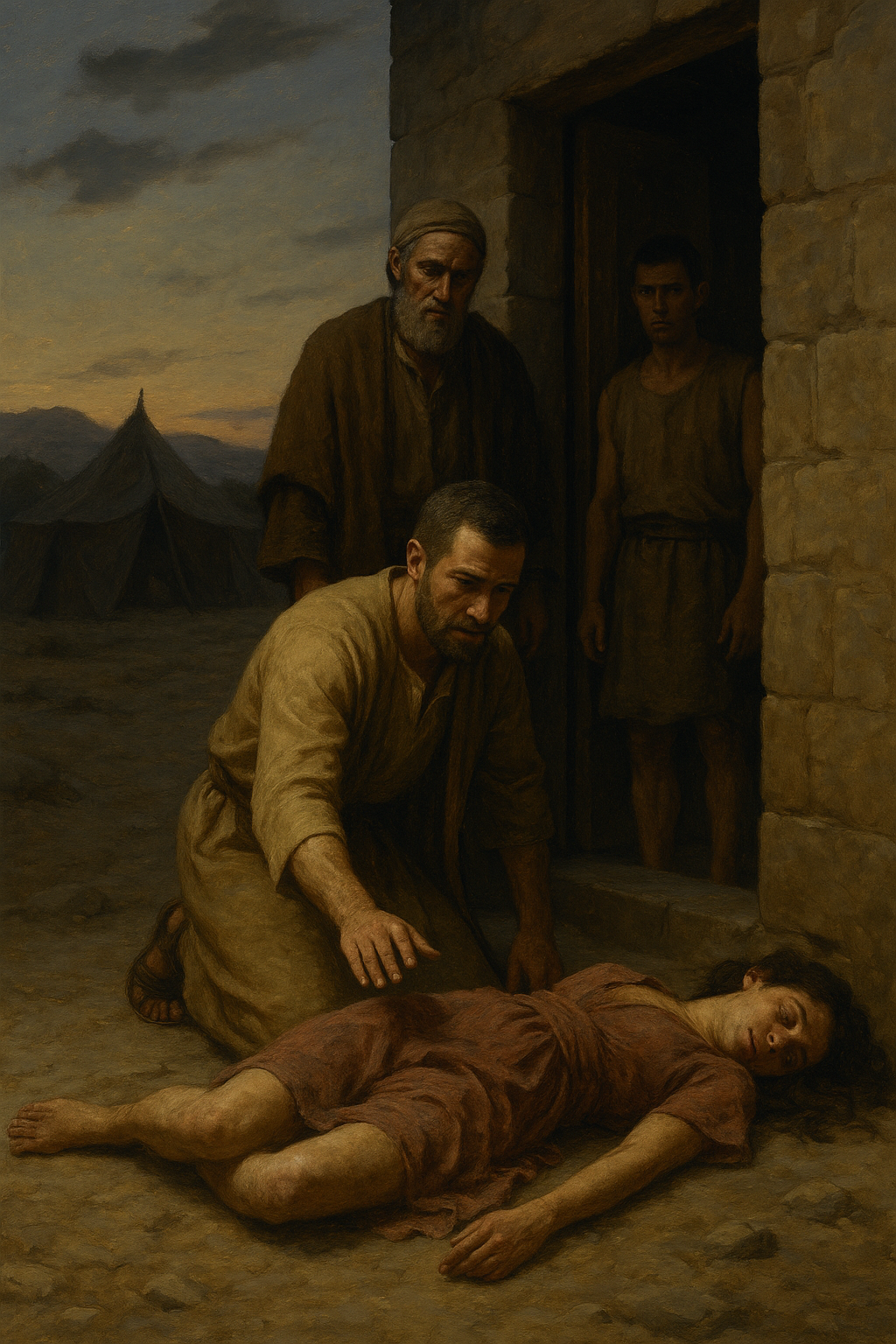
At daybreak, the woman returns and falls at the doorway, with her hands upon the threshold. When the Levite tells her to rise, there is no answer. He places her on an ass and returns home (Judges 19:26-28).
He then divides her body into twelve pieces and sends them throughout Israel (Judges 19:29). Judges 19 does not specify the exact moment of her death. In his subsequent account, the Levite states that the men abused her “that she is dead” (Judges 20:5). The text should not be expanded into a claim that she was alive when he divided her body.
Those who see what has happened recognize its extraordinary horror. The chapter ends with the appeal, “consider of it, take advice, and speak your minds” (Judges 19:30).
The response of the tribes and the resulting conflict belong to the following chapters. Judges 19 itself ends by confronting Israel with the seriousness of the crime.
Key People and Places
- Micah: An Ephraimite who returns stolen silver, maintains images and religious objects, and appoints priests in his household (Judges 17:1-13).
- Micah’s mother: Dedicates silver in the LORD’s name for the making of forbidden images (Judges 17:2-4).
- The young Levite: Accepts Micah’s support and serves as his priest, then gladly joins the Danites (Judges 17:7-12; 18:18-20).
- Jonathan: Named in connection with the priesthood established by Dan; his sons also serve as priests (Judges 18:30).
- The Danites: Send scouts, take Micah’s religious objects, conquer Laish, and establish idolatrous worship (Judges 18:1-31).
- The unnamed Levite of Judges 19: Travels to Bethlehemjudah to bring back his concubine and afterward sends the evidence of the atrocity throughout Israel.
- The concubine: The Levite’s companion who suffers the violence at Gibeah. Her earlier sin does not authorize or excuse the crime committed against her.
- The old man: An Ephraimite living in Gibeah who receives the travelers but also makes a grievously wrong proposal to the violent men (Judges 19:16-24).
- Mount Ephraim: The region associated with Micah’s household and the residence of the Levite in Judges 19.
- Bethlehemjudah: The former residence of Micah’s Levite and the home of the concubine’s father.
- Zorah and Eshtaol: The places from which the Danite scouts and armed company depart.
- Laish, renamed Dan: The city conquered and rebuilt by the Danites.
- Shiloh: The location of the house of God mentioned in contrast with Dan’s established image.
- Jebus, or Jerusalem: The city where the Levite declines to spend the night.
- Gibeah: The Benjamite city where the travelers lodge and the atrocity occurs.
Main Doctrinal or Spiritual Themes
God’s Word Governs Worship
Micah’s household uses the LORD’s name while practicing what the LORD forbids. Worship must be governed by God’s revealed will, not by personal preference, family tradition, or the confidence of the worshiper.
Deuteronomy 12:32 states, “What thing soever I command you, observe to do it: thou shalt not add thereto, nor diminish from it.”
Religious Confidence Can Be Misplaced
Micah assumes that employing a Levite guarantees good from the LORD. The Danites receive a favorable answer from that priest and proceed with their expedition. Neither confidence nor an encouraging religious message proves God’s approval.
For believers today, salvation rests in the Lord Jesus Christ, not in religious objects, paid religious services, or association with a minister. Ephesians 2:8-9 teaches salvation by grace through faith, “not of works, lest any man should boast.”
Human Preference Cannot Replace Divine Authority
Judges 17:6 describes people doing what is right in their own eyes. Their personal judgments do not overturn God’s commands.
The same principle applies to the church: doctrine and conduct must be tested by Scripture. Second Timothy 3:16-17 identifies Scripture as God’s provision for doctrine, reproof, correction, and instruction in righteousness.
Religious Office Does Not Excuse Compromise
The priest’s heart is glad when the Danites offer a broader role. His participation illustrates that religious service can coexist with serious disobedience.
The practical warning is that greater influence, compensation, or recognition cannot justify wrongdoing. First Corinthians 4:2 states, “Moreover it is required in stewards, that a man be found faithful.”
God Condemns Wickedness Within His People
The crime at Gibeah occurs among Israelites. Their national identity does not excuse their conduct.
Judges 19 requires readers to acknowledge evil within the community rather than assume that religious association guarantees righteous behavior. Membership in a church, religious knowledge, and outward respectability cannot substitute for obedience to God.
Scripture Records Sin Without Approving It
These chapters describe idolatry, theft, threats, destructive violence, and sexual abuse. Recording these actions does not authorize them.
Interpretation must distinguish between what a character says or does and what God commands or approves. Micah’s confidence, the priest’s assurance, and the host’s proposal must each be evaluated by God’s Word.
Practical Applications or Lessons
- Test religious practices by Scripture. Ask whether God has authorized a practice, rather than whether it feels meaningful or enjoys widespread acceptance.
- Do not treat religious connections as spiritual guarantees. Knowing a preacher, supporting a ministry, or belonging to a church does not make disobedience acceptable.
- Examine attractive opportunities carefully. A larger position may appeal to the heart while requiring compromise. Faithfulness must govern decisions about ministry and employment.
- Do not equate success with God’s approval. The Danites obtain the city they sought, but their achievement does not validate their theft or idolatry.
- Reject the spread of error at its beginning. What exists in Micah’s house becomes established among the Danites. An error does not become truth when it gains followers.
- Protect vulnerable people. The account at Gibeah offers no justification for sacrificing another person’s safety to preserve one’s own. Biblical love “worketh no ill to his neighbour” (Romans 13:10).
- Do not use someone’s previous sin to excuse mistreatment. The concubine’s wrongdoing and the crime committed against her must each be judged truthfully. One person’s sin does not authorize another person’s cruelty.
- Face serious wrongdoing honestly. Judges 19 ends with a call to consider and respond. Believers should seek truth and act justly rather than conceal evil for the sake of reputation.
- Submit personal judgment to God’s commandments. The recurring problem is doing what seems right in one’s own eyes. The believer’s daily question should be whether a decision agrees with what God has written.
Comments are closed