
Samson: Strength, Compromise, and God’s Mercy in Judges 14-16
 Judges 14-16 records Samson’s conflicts with the Philistines, his failures in personal conduct, and his final appeal to God. His extraordinary strength came from the Lord, but his strength did not make every decision righteous. These chapters distinguish between God’s power working through a man and God’s approval of that man’s conduct.
The background appears in Judges 13:1-5. Israel had done evil, and the Lord delivered them into the hand of the Philistines for forty years. Before Samson’s birth, God declared that he would be a Nazarite unto God and would “begin to deliver Israel out of the hand of the Philistines” (Judges 13:5). His assigned work was to begin that deliverance. These chapters do not say that he completely freed Israel from Philistine rule.
Chapter Summaries
Judges 14: Samson’s Marriage Request and the Wedding Riddle
Samson went down to Timnath and saw a woman of the daughters of the Philistines. He asked his parents to obtain her as his wife. They questioned why he would seek a wife among “the uncircumcised Philistines” rather than among his own people. Samson answered:
“Get her for me; for she pleaseth me well.”
Judges 14:3
His stated reason centered on his own pleasure. The account does not describe him seeking God’s direction concerning this woman.
Judges 14:4 adds an essential explanation: his parents did not know “that it was of the LORD, that he sought an occasion against the Philistines.” The verse establishes God’s purpose in the coming conflict. It does not state that every motive or action of Samson pleased God. God’s sovereign direction of events must not be confused with His approval of everything people do within those events.
As Samson traveled toward Timnath, a young lion roared against him. “The Spirit of the LORD came mightily upon him,” and he tore the lion apart with nothing in his hand (Judges 14:5-6). Scripture expressly identifies the source of his strength.
When Samson returned to take the woman, he turned aside to see the lion’s carcass. He found bees and honey there, took the honey in his hands, and ate it. He also gave some to his parents without telling them where it came from (Judges 14:8-9).
This incident raises questions concerning uncleanness and Samson’s separation unto God. Leviticus 11:27-28 addresses uncleanness through contact with the carcasses of certain animals. However, Judges does not explicitly pronounce a particular violation here, and the Nazarite prohibition in Numbers 6:6 specifically concerns a “dead body.” We should not confidently describe this episode as breaking every aspect of his Nazarite separation.
At the wedding feast, Samson proposed a riddle to thirty companions:
“Out of the eater came forth meat, and out of the strong came forth sweetness.”
Judges 14:14
The answer concerned the lion and the honey. Unable to solve it, the companions threatened to burn Samson’s wife and her father’s house unless she obtained the answer. She wept before Samson, and he eventually told her. She then disclosed it to her people (Judges 14:15-17).
When the men answered the riddle, Samson recognized that they had obtained the answer through his wife. The Spirit of the Lord came upon him, and he went to Ashkelon, killed thirty men, and took their garments to fulfill the wager. He returned to his father’s house in anger. His wife was given to the companion whom he had treated as his friend (Judges 14:19-20).
The chapter combines God’s stated purpose against the Philistines with human threats, manipulation, anger, and broken relationships. The presence of God’s providence does not turn the misconduct recorded in the narrative into examples for believers to follow.
Judges 15: Conflict with the Philistines and Deliverance at Lehi
During wheat harvest, Samson returned with a kid to visit his wife. Her father refused him entrance, explaining that he thought Samson hated her and had therefore given her to Samson’s companion. He offered her younger sister instead (Judges 15:1-2).
Samson retaliated against the Philistines. He caught three hundred foxes, joined them tail to tail with firebrands between them, and released them into the Philistines’ crops. The fire destroyed shocks, standing corn, vineyards, and olives (Judges 15:4-5).
The Philistines responded by burning Samson’s wife and her father. The very harm threatened in Judges 14:15 was inflicted despite her earlier cooperation with the men who threatened her. Samson then struck the Philistines “hip and thigh with a great slaughter” and went to dwell in the top of the rock Etam (Judges 15:6-8).
When the Philistines came into Judah, three thousand men of Judah confronted Samson:
“Knowest thou not that the Philistines are rulers over us? what is this that thou hast done unto us?”
Judges 15:11
Their words acknowledge Philistine rule. They came to bind Samson and deliver him to the Philistines. This may suggest that they considered submission safer than supporting his resistance, but Scripture does not explain every motive behind their decision.
After obtaining their promise not to kill him themselves, Samson allowed the men of Judah to bind him with two new cords. At Lehi, the Philistines shouted against him. The Spirit of the Lord came mightily upon him, and his bonds became as flax burned with fire. He found a new jawbone of an ass and killed a thousand men with it (Judges 15:14-16).
After this victory, Samson became desperately thirsty. He called upon the Lord:
“Thou hast given this great deliverance into the hand of thy servant: and now shall I die for thirst, and fall into the hand of the uncircumcised?”
Judges 15:18
Here Samson explicitly credited God with the deliverance. God supplied water, and Samson’s spirit revived (Judges 15:19). The man who had defeated a thousand enemies still depended upon God for something as basic as water.
The chapter closes by stating that Samson judged Israel “in the days of the Philistines twenty years” (Judges 15:20).
Judges 16: Delilah, Captivity, and Samson’s Final Prayer
The chapter begins with Samson going to Gaza, seeing a harlot, and going in unto her (Judges 16:1). Scripture records his conduct without offering any approval of it.
The Gazites planned to kill him in the morning. At midnight, however, Samson arose, removed the city gate doors, the two posts, and the bar, and carried them to the top of a hill “that is before Hebron” (Judges 16:2-3). The verse does not provide the distance he carried them.
Afterward, Samson loved a woman in the valley of Sorek named Delilah. The Philistine lords offered her eleven hundred pieces of silver each if she would discover how to overcome and bind him (Judges 16:4-5). Scripture does not explicitly identify Delilah as Samson’s wife or call her a harlot.
Samson repeatedly gave false explanations of how his strength could be overcome. Delilah tested his statements involving seven green withs, new ropes, and the weaving of his seven locks into a web. Each attempt failed (Judges 16:6-14).
Her persistent pressure continued until “his soul was vexed unto death” (Judges 16:16). Samson then told her all his heart:
“There hath not come a razor upon mine head; for I have been a Nazarite unto God from my mother’s womb: if I be shaven, then my strength will go from me, and I shall become weak, and be like any other man.”
Judges 16:17
Delilah called the Philistine lords. While Samson slept upon her knees, she called for a man to shave off the seven locks of his head. His strength departed.
When she announced the Philistines’ approach, Samson expected to escape as before:
“And he wist not that the LORD was departed from him.”
Judges 16:20
This statement identifies the decisive loss. His hair was connected to the separation God had commanded, but the Lord was the source of his power.
The Philistines put out his eyes, brought him to Gaza, bound him with fetters of brass, and made him grind in the prison house (Judges 16:21). Scripture then states that his hair began to grow again. It does not say that hair growth automatically restored his strength.
The Philistine lords gathered to sacrifice to Dagon and celebrate Samson’s capture. They credited their false god with delivering Samson into their hands. Samson was brought out to make sport before them and was positioned between the pillars supporting the building (Judges 16:23-25).
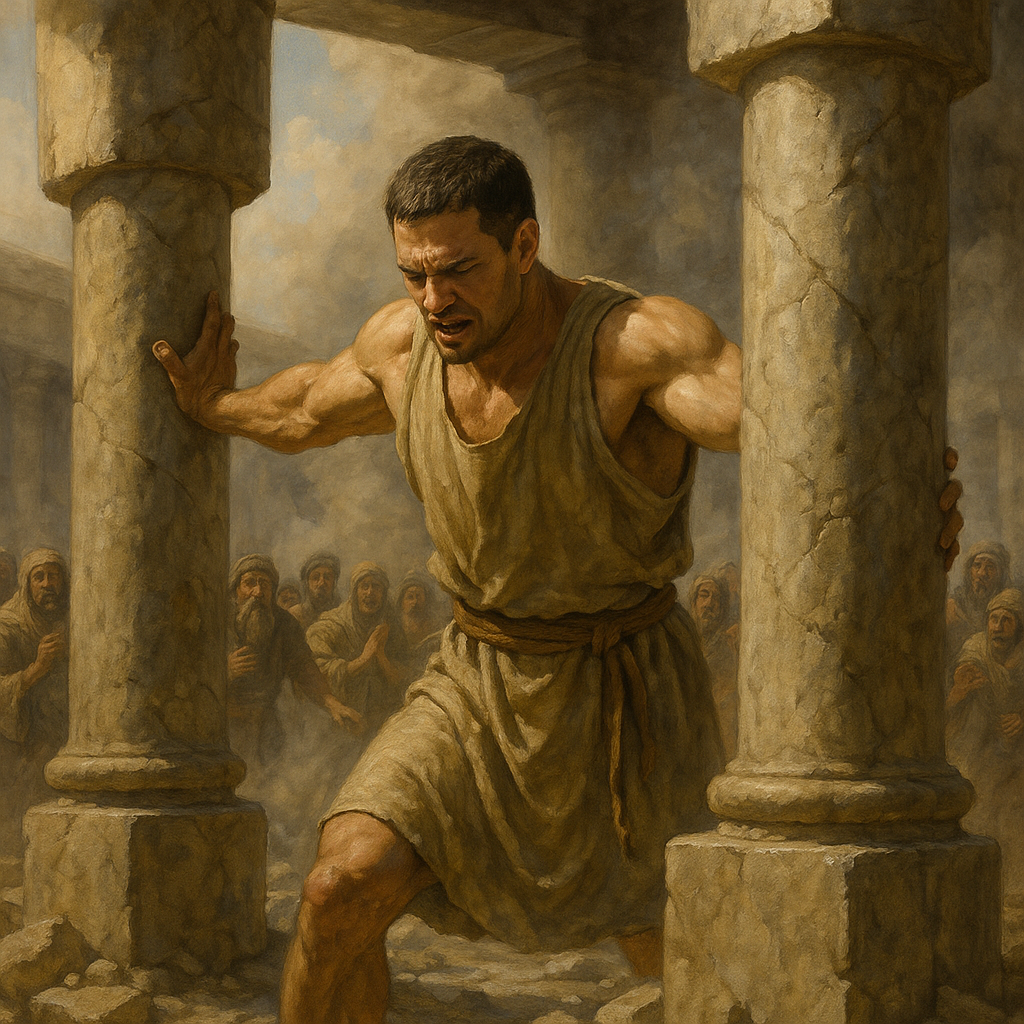
Samson asked the lad holding his hand to let him feel the pillars. With the building full of people, including the Philistine lords, Samson prayed:
“O Lord GOD, remember me, I pray thee, and strengthen me, I pray thee, only this once, O God, that I may be at once avenged of the Philistines for my two eyes.”
Judges 16:28
His prayer explicitly expressed dependence upon God and a desire for vengeance for his eyes. The passage does not record a confession of particular sins, so it should not be expanded into a detailed repentance speech that Scripture does not provide.
Samson took hold of the two middle pillars and bowed himself with all his might. The building fell upon the lords and the people. He died with the Philistines, killing more at his death than during his life (Judges 16:29-30).
His brethren and his father’s household recovered his body and buried him between Zorah and Eshtaol in the burying place of Manoah his father. Judges 16:31 repeats that he judged Israel twenty years; it does not describe an additional twenty-year judgeship.
Key People and Places
- Samson: Manoah’s son, separated unto God as a Nazarite from the womb. He judged Israel twenty years and began the work of deliverance from the Philistines.
- Samson’s parents: They questioned his choice of a Philistine wife. His mother is unnamed in these chapters; his father is identified as Manoah.
- The woman of Timnath: Samson’s Philistine wife, pressured by threats into obtaining the answer to his riddle. She and her father were subsequently killed by the Philistines.
- Samson’s companion: The man to whom Samson’s wife was given after Samson returned to his father’s house.
- The men of Judah: Three thousand men who bound Samson and delivered him to the Philistines.
- Delilah: The woman Samson loved in the valley of Sorek. She cooperated with the Philistine lords to discover how he could be overcome.
- The Philistine lords: Leaders who financed Delilah’s efforts and gathered at the celebration honoring Dagon.
- Timnath: The location associated with Samson’s marriage and wedding feast.
- Ashkelon: The city where Samson killed thirty men and obtained garments for his wager.
- Etam: The rock where Samson stayed following his conflict with the Philistines.
- Lehi: The location of Samson’s victory with the jawbone and God’s provision of water.
- Gaza: The city associated with the gate incident, Samson’s imprisonment, and his final act against the Philistines.
- The valley of Sorek: The location where Delilah lived.
- Zorah and Eshtaol: The places between which Samson was buried.
Main Doctrinal or Spiritual Themes
1. God Is the Source of Strength
Judges repeatedly attributes Samson’s extraordinary power to the Spirit of the Lord (Judges 14:6, 19; 15:14). His strength cannot be explained merely by physical ability or by treating his hair as a magical object.
His uncut hair belonged to the separation God commanded in Judges 13:5. Judges 16:20 places the emphasis upon the Lord’s departure, and Samson’s final prayer asks God Himself for strength.
2. God’s Providence Does Not Excuse Sin
Judges 14:4 explicitly places the developing conflict within God’s purpose against the Philistines. That does not make personal desire, sexual immorality, deception, or vindictive conduct righteous.
A related biblical principle appears in Genesis 50:20: human beings can intend evil while God works toward a good purpose. God’s sovereignty never removes human accountability.
3. Spiritual Power and Personal Obedience Must Be Distinguished
Samson performed extraordinary deeds, yet Scripture also records serious failures in his conduct. Visible ability or usefulness must not be treated as proof that every part of a person’s life is pleasing to God.
Believers are commanded to pursue holiness: “But as he which hath called you is holy, so be ye holy in all manner of conversation” (1 Peter 1:15).
4. Presumption Is Dangerous
Samson expected to escape as he had before, unaware that the Lord had departed from him (Judges 16:20). Past deliverances did not guarantee that he could disregard God’s command without consequences.
The corresponding warning for believers is direct: “Wherefore let him that thinketh he standeth take heed lest he fall” (1 Corinthians 10:12).
5. God’s Help Does Not Eliminate Every Consequence
Samson received strength for his final act, but the account does not record the restoration of his sight or his release to resume ordinary life. He died in the destruction of the building.
God’s mercy must never be presented as a promise that all earthly consequences of wrongdoing will disappear.
6. Samson’s Failures Do Not Cancel Scripture’s Testimony Concerning Faith
Hebrews 11:32 includes Samson among those named in its account of faith. That testimony must be retained alongside the failures recorded in Judges.
Likewise, “the LORD was departed from him” in Judges 16:20 should not be turned into a statement that Samson lost eternal salvation. In context, the passage concerns the loss of the strength by which he had escaped his enemies. The believer’s eternal security rests upon Christ’s promise, not upon an inference drawn from Samson’s physical defeat (John 10:27-29).
Practical Applications or Lessons
1. Do Not Make Personal Pleasure Your Final Authority
Samson’s words, “she pleaseth me well,” explain what attracted him to the woman of Timnath. For believers, attraction and desire must be governed by God’s Word.
The New Testament directs marriage “only in the Lord” (1 Corinthians 7:39). Personal preference does not override spiritual obedience.
2. Take Repeated Attempts to Harm You Seriously
Delilah repeatedly sought the means of binding and overcoming Samson. The narrative gives no basis for viewing her actions as harmless.
The practical lesson is to respond honestly to demonstrated danger. Affection does not make another person’s destructive conduct safe.
3. Do Not Confuse Ability with Maturity
A person may possess remarkable abilities while exercising poor judgment. Samson’s strength did not make every choice wise.
Christian service requires attention to conduct as well as usefulness. Paul instructed Timothy, “Take heed unto thyself, and unto the doctrine” (1 Timothy 4:16).
4. Depend upon God after Success
Samson’s thirst followed a great victory. His prayer acknowledged that the deliverance had come from God, and his need for water showed his continuing dependence.
Success does not make prayer unnecessary. We need the Lord in ordinary necessities as surely as in extraordinary trials.
5. Deal with Temptation before It Becomes Captivity
Samson’s encounters with Delilah ended in actual imprisonment. His account provides a sober warning against remaining in circumstances where disobedience and danger are repeatedly placed before us.
The believer’s instruction is plain: “Flee also youthful lusts” (2 Timothy 2:22). Wisdom includes leaving temptation rather than assuming that we can always escape its consequences.
6. Call upon God in Helplessness
Samson’s final prayer came from a position of profound weakness. He asked God to remember and strengthen him.
His specific act is not a pattern for personal revenge or self-destruction. Christians are commanded, “avenge not yourselves” (Romans 12:19). The applicable lesson is dependence upon God, whose mercy gives the helpless reason to call upon Him.
Tags: Judges, Judges 14, Judges 15, Judges 16, Samson, Delilah, Manoah, Philistines, Timnath, Ashkelon, Etam, Lehi, Gaza, Sorek, Hebron, Zorah, Eshtaol, Nazarite, KJV Bible Study, God’s Strength, Obedience, Temptation, Faith, God’s Mercy
Comments are closed