Civil War, Rash Vows, and Israel’s Need for God’s Rule
 Judges 20-21 records Israel’s response to the wickedness committed at Gibeah and the terrible consequences that followed. The nation assembled to address an evil that could not rightly be ignored. Benjamin refused to surrender the guilty men, and civil war brought the tribe close to destruction. Israel then sought to preserve Benjamin through measures that included further bloodshed and the taking of women as wives.
These chapters require a careful distinction between what God commanded and what Israel decided. The LORD explicitly directed Israel in the conflict with Benjamin, but the text does not record His approval of every oath, military action, or proposed solution described in these chapters.
The book closes with this judgment upon the condition of the nation:
“In those days there was no king in Israel: every man did that which was right in his own eyes.”
Judges 21:25
Chapter Summaries
Judges 20: Israel Assembles and Battles Benjamin
The congregation gathers at Mizpeh – Judges 20:1-11
The children of Israel assembled “as one man” before the LORD at Mizpeh. The gathering extended from Dan to Beersheba and included the land of Gilead. Four hundred thousand footmen who drew the sword presented themselves in the assembly (Judges 20:1-2).
The Levite whose concubine had died described the attack at Gibeah. He reported that the men of the city had surrounded the house, intended to kill him, and abused his concubine so that she died. He explained that he had divided her body and sent the pieces throughout Israel because of the wickedness committed there (Judges 20:4-6).
His report should be read alongside Judges 19:22-28. The earlier account states that the men demanded that the host bring out the Levite “that we may know him” and that the Levite brought his concubine outside to them. His speech in Judges 20 does not mention his own action in bringing her out. Scripture records this omission, but it does not explicitly explain his motive for omitting it.
The assembly resolved to act against Gibeah and arranged supplies for the army. Their stated purpose was to deal with the “folly” committed in Israel (Judges 20:9-11). Here, “folly” concerns grievous wickedness, not merely poor judgment.
Benjamin refuses to surrender the guilty – Judges 20:12-17
Before the battle, the tribes sent men throughout Benjamin with a specific demand:
“Now therefore deliver us the men, the children of Belial, which are in Gibeah, that we may put them to death, and put away evil from Israel.”
Judges 20:13
Benjamin would not listen. Instead, the Benjamites gathered at Gibeah to fight against the other tribes (Judges 20:13-14).
This refusal widened the conflict. The demand had concerned the wicked men of Gibeah, but Benjamin took up arms rather than surrender them.
Benjamin mustered twenty-six thousand swordsmen from its cities, besides seven hundred chosen men from Gibeah. The passage also identifies seven hundred chosen left-handed slingers who could “sling stones at an hair breadth, and not miss” (Judges 20:15-16). Israel’s opposing force numbered four hundred thousand swordsmen (Judges 20:17).
Israel inquires of God and suffers two defeats – Judges 20:18-25
Israel went to the house of God and asked which tribe should go up first against Benjamin. The LORD answered, “Judah shall go up first” (Judges 20:18).
Nevertheless, Benjamin killed twenty-two thousand Israelites in the first battle (Judges 20:21).
Israel then wept before the LORD until evening and asked whether they should again approach Benjamin in battle. The LORD answered, “Go up against him” (Judges 20:23). In the second battle, Benjamin killed another eighteen thousand Israelites (Judges 20:25).
The text does not explicitly explain why God permitted these two defeats. It would go beyond the passage to declare that a particular unmentioned sin, attitude, or failure caused them. What Scripture does state is that Israel sought God’s direction, received His answer, and still experienced severe losses.
God’s direction must not be confused with a promise that every stage of obedience will be easy or immediately successful.
Israel fasts, offers sacrifices, and receives a promise – Judges 20:26-28
Following the second defeat, all the children of Israel went to the house of God. They wept, sat before the LORD, fasted until evening, and offered burnt offerings and peace offerings (Judges 20:26).
The ark of the covenant of God was there, and Phinehas, the son of Eleazar and grandson of Aaron, stood before it in those days (Judges 20:27-28). This identifies the priest serving at the time; the chapter does not supply a calendar date for these events.
Israel asked whether to continue the battle or cease. This time, the LORD gave an explicit promise of victory:
“Go up; for to morrow I will deliver them into thine hand.”
Judges 20:28
Benjamin is defeated, and six hundred men escape – Judges 20:29-48
Israel placed men in ambush around Gibeah. The main force withdrew before Benjamin, drawing the defenders away from the city. The Benjamites believed they were defeating Israel as before, but they did not know that disaster was near (Judges 20:29-34).
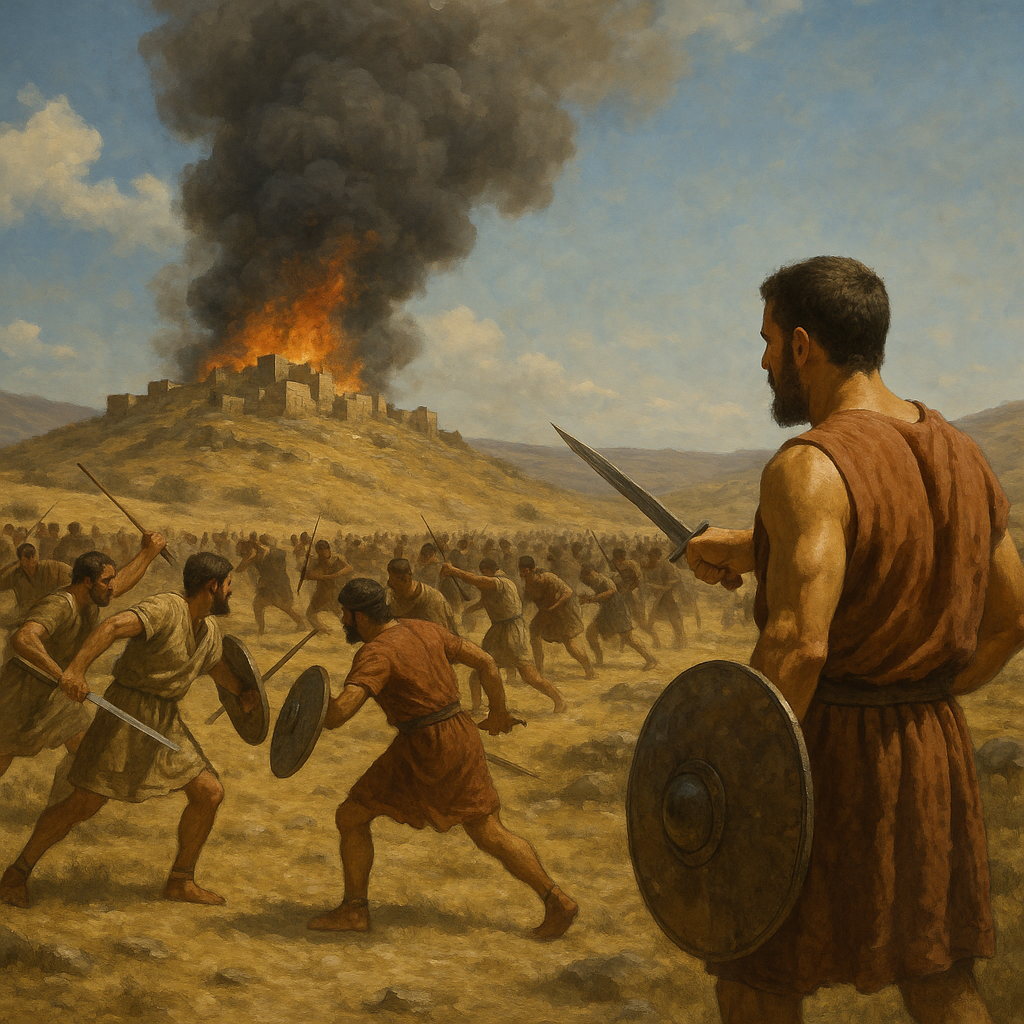
The men in ambush attacked Gibeah, and rising smoke signaled the city’s capture. When Benjamin saw the smoke and the Israelites turned against them, the Benjamites recognized their danger (Judges 20:38-41).
The chapter attributes the decisive defeat to God:
“And the LORD smote Benjamin before Israel.”
Judges 20:35
Judges 20:35 reports twenty-five thousand one hundred Benjamite swordsmen killed that day. Six hundred men escaped to the rock Rimmon and remained there for four months (Judges 20:47).
The Israelites also turned against the cities of Benjamin, killing inhabitants and beasts and setting the cities on fire (Judges 20:48). Although the LORD had commanded Israel to fight and promised victory, the recorded answers from God do not specifically command every destructive action described in verse 48. That distinction should be preserved.
Judges 21: Israel Seeks to Preserve Benjamin
Grief over the threatened loss of a tribe – Judges 21:1-7
The men of Israel had sworn at Mizpeh that none of them would give his daughter to a Benjamite as a wife (Judges 21:1).
After the fighting, the people came to the house of God, wept, and asked why one tribe should be lacking in Israel. They built an altar and offered burnt offerings and peace offerings (Judges 21:2-4).
Their grief was real: Scripture says they “repented them for Benjamin their brother” (Judges 21:6). In this context, the expression describes their sorrow and change of feeling concerning Benjamin’s plight. It should not automatically be expanded into a claim that they confessed every wrong committed during the conflict.
Their oath now complicated their desire to preserve the surviving Benjamites.
Jabesh-gilead is attacked – Judges 21:8-15
Israel had also sworn that anyone who failed to come up to the LORD at Mizpeh would be put to death (Judges 21:5). When the people were counted, they discovered that no one from Jabesh-gilead had attended the assembly (Judges 21:8-9).
The congregation sent twelve thousand fighting men against Jabesh-gilead. Their instructions required the killing of the males and women who had known a man, while preserving the young women who had not (Judges 21:10-11).
Four hundred young women were brought to the camp at Shiloh. Israel then proclaimed peace to the six hundred Benjamites at the rock Rimmon and gave them these women as wives. However, there were not enough wives for all the survivors (Judges 21:12-14).
The chapter records these instructions as the congregation’s decision. It does not record a command from the LORD authorizing this attack as the solution to Benjamin’s situation.
The remaining men take wives at Shiloh – Judges 21:16-24
The elders sought another means of providing wives while preserving their oath not to give their daughters to Benjamin.
They directed the remaining Benjamites to an annual feast of the LORD at Shiloh. The men were to hide in the vineyards and seize wives from the daughters of Shiloh when the women came out to dance (Judges 21:19-21).
The elders also proposed an answer to any protesting fathers or brothers. Their reasoning distinguished between giving daughters in marriage and having daughters taken, so that the families would not be considered guilty concerning the oath (Judges 21:22).
The Benjamites carried out the plan. They took wives, returned to their inheritance, repaired the cities, and lived in them. The rest of Israel returned to their own tribes and inheritances (Judges 21:23-24).
Scripture records the taking of these women but does not state that the women consented. Neither does it record God’s approval of the elders’ plan. The preservation of Benjamin should not be treated as proof that every means employed was righteous.
The book’s closing assessment – Judges 21:25
Judges ends by repeating that Israel had no king and that everyone did what was right in his own eyes.
The statement explicitly identifies the absence of a king, but it does not teach that any human king would automatically produce righteousness. God’s requirements for Israel’s future king included reading His law, fearing Him, and obeying His commandments (Deuteronomy 17:18-20).
The deeper moral issue is the substitution of human judgment for submission to God’s revealed will.
Key People and Places
- The children of Israel: The assembled tribes that demanded action against Gibeah, fought Benjamin, and afterward sought to preserve the surviving tribe (Judges 20:1-13; 21:6-24).
- The Levite: The man whose concubine had died following the abuse at Gibeah. He presented his account before the congregation (Judges 20:4-7).
- The men of Gibeah: The “children of Belial” whose wickedness prompted Israel’s demand for judgment (Judges 20:13).
- The tribe of Benjamin: Refused to surrender the guilty men and fought against the assembled tribes. Six hundred men escaped to the rock Rimmon (Judges 20:13-17, 47).
- Phinehas: The son of Eleazar and grandson of Aaron, who stood before the ark in those days (Judges 20:27-28).
- The elders of the congregation: Proposed the arrangement by which the remaining Benjamites took wives from the women at Shiloh (Judges 21:16-22).
- Mizpeh: The assembly place where Israel gathered before the LORD and made the oaths discussed in chapter 21 (Judges 20:1; 21:1, 5).
- Gibeah: The Benjaminite city where the original outrage occurred and around which the decisive battle developed (Judges 20:4-5, 29-43).
- The house of God: The place where Israel sought the LORD, wept, fasted, and offered sacrifices. The ark was there during the events of chapter 20 (Judges 20:18, 26-28).
- The rock Rimmon: The refuge of the six hundred surviving Benjamite men (Judges 20:47).
- Jabesh-gilead: The community that had not attended the assembly and was attacked under the congregation’s orders (Judges 21:8-12).
- Shiloh: The location of Israel’s camp in Judges 21:12 and the annual feast described in Judges 21:19-21.
- Dan, Beersheba, and Gilead: Places named to describe the broad extent of Israel’s gathering (Judges 20:1).
Main Doctrinal or Spiritual Themes
1. God’s People Must Take Wickedness Seriously
Israel’s demand to “put away evil from Israel” recognized that the crime at Gibeah required judgment (Judges 20:13). Benjamin’s refusal to surrender the offenders placed tribal solidarity above the demand to address their wickedness.
For the church, the New Testament likewise requires discipline concerning serious, unrepented sin (1 Corinthians 5:11-13). Church discipline, however, is not Israel’s civil warfare. Believers must follow the instructions given to the church rather than use these battles to justify physical force.
2. God’s Direction Does Not Guarantee an Easy Course
Israel received divine direction before battles in which it suffered terrible losses (Judges 20:18-25). Only before the third battle does the passage record the specific promise of victory the following day (Judges 20:28).
We should therefore distinguish between what God commands and what He promises. Faith obeys His revealed word without inventing assurances He has not given.
3. Religious Activity Does Not Validate Every Decision
These chapters contain prayer, tears, fasting, sacrifices, and vows. They also contain decisions for which no divine authorization is recorded.
The presence of religious activity must not be used to establish that every accompanying action pleased God. The broader biblical principle remains: “to obey is better than sacrifice” (1 Samuel 15:22).
4. Rash Vows Can Produce Further Trouble
The oath concerning marriage to Benjamin restricted Israel’s proposed response to the surviving men (Judges 21:1, 7, 18). Their additional oath concerning absence from the assembly became the basis for the attack on Jabesh-gilead (Judges 21:5-11).
Scripture elsewhere warns against hasty speech before God (Ecclesiastes 5:2-6). A solemn promise does not make an otherwise wrongful action righteous.
5. Human Reasoning Must Remain Under God’s Word
The elders’ solution at Shiloh depended upon a distinction between giving women and taking them (Judges 21:20-22). The text records the arrangement without declaring it righteous.
The practical warning is that preserving the wording of a commitment does not establish that one’s conduct is right before God. His commandments remain the standard.
6. God’s Sovereignty Does Not Remove Human Responsibility
Judges 20:35 states that the LORD defeated Benjamin. Judges 21:15 says that “the LORD had made a breach in the tribes of Israel.”
These statements must be retained alongside the record of human choices: Gibeah’s wickedness, Benjamin’s refusal, Israel’s oaths, and the congregation’s subsequent actions. God’s rule over events does not make every human decision in those events an example to follow.
Practical Applications or Lessons
Put truth above personal or group loyalty. Benjamin’s response warns against defending wrongdoing because the offenders belong to one’s own family, church, ministry, or circle. Loyalty must not become protection for unrepentant sin (Judges 20:12-14).
Hear an account carefully and compare it with the available facts. Reading the Levite’s speech alongside chapter 19 reveals an important omission. Proverbs 18:17 likewise warns that an initial presentation requires examination.
Do not invent explanations for suffering. The passage records Israel’s defeats without explicitly identifying God’s reason for permitting them. We should exercise the same restraint when explaining another believer’s hardship.
Seek God with humility and obey what He actually says. Israel wept, fasted, sacrificed, and asked whether to continue or cease (Judges 20:26-28). Our prayers should express willingness to submit, not merely a desire for God to endorse our existing plans.
Be slow to make sweeping promises. Words spoken under strong emotion can create serious obligations and painful consequences. Consider whether a proposed commitment agrees with Scripture before making it.
Do not compound one wrong while trying to repair another. Israel’s efforts to preserve Benjamin involved further killing and the taking of women. A desired outcome does not provide authority to disregard God’s moral requirements.
Allow compassion to be governed by truth. Israel grieved for Benjamin and proclaimed peace to the survivors (Judges 21:6, 13-15). Compassion is necessary, but proposed remedies still require moral examination.
Reject the rule of personal preference. Judges 21:25 confronts the habit of treating one’s own judgment as the final authority. For believers, Scripture must govern both our goals and the means we use to pursue them (2 Timothy 3:16-17).
Comments are closed