Israel’s Repentance, Jephthah’s Vow, and Samson’s Promised Birth
Chapter Summaries
Repeated Idolatry and God’s Compassion
Tola and Jair judge Israel (Judges 10:1-5).
 After Abimelech, Tola arises “to defend Israel” and judges the nation twenty-three years. He belongs to the tribe of Issachar but dwells in Shamir in mount Ephraim. After his death, Jair, a Gileadite, judges Israel twenty-two years.
Jair has thirty sons who ride thirty ass colts and possess thirty cities called Havothjair in Gilead. These details may indicate a family of considerable standing, but Scripture does not describe how Jair obtained that position or evaluate his sons’ spiritual condition.
The accounts of these judges are brief. Their brevity should not invite invented biographies. The text records their service, the length of their judgeships, and their burial places.
Israel forsakes the LORD (Judges 10:6-9).
Israel again does evil, serving Baalim, Ashtaroth, and the gods of surrounding peoples. The central charge is unmistakable: they “forsook the LORD, and served not him” (Judges 10:6).
This is covenant unfaithfulness. God had commanded Israel to have no other gods before Him and had forbidden the worship of idols (Exodus 20:3-5).
The LORD delivers Israel into the hands of the Philistines and the children of Ammon. The passage describes eighteen years of oppression affecting the Israelites in Gilead, east of Jordan. Ammon also crosses Jordan to fight Judah, Benjamin, and the house of Ephraim.
Confession is followed by the removal of idols (Judges 10:10-16).
Israel confesses:
“We have sinned against thee, both because we have forsaken our God, and also served Baalim” (Judges 10:10).
The LORD reminds them of His past deliverances and their repeated desertion. His command to seek help from their chosen gods exposes the helplessness of their idols.
Israel then acknowledges God’s right to deal with them:
“Do thou unto us whatsoever seemeth good unto thee; deliver us only, we pray thee, this day” (Judges 10:15).
They put away their strange gods and serve the LORD. Their response includes both confession and a change in conduct. The chapter then declares, “his soul was grieved for the misery of Israel” (Judges 10:16).
God’s compassion does not make their idolatry insignificant. The same passage records His anger against their sin and His concern for their suffering.
Gilead needs a leader (Judges 10:17-18).
The Ammonites assemble in Gilead, and Israel gathers at Mizpeh. Gilead’s leaders ask who will begin the fight against Ammon, promising that he will become head over the inhabitants of Gilead. This prepares the setting for Jephthah.
Judges 11: Jephthah’s Leadership, Victory, and Grievous Vow
An excluded man is summoned to lead (Judges 11:1-11).
Jephthah is introduced as “a mighty man of valour,” the son of Gilead and a harlot (Judges 11:1). His father’s other sons drive him away, denying him an inheritance because of his parentage.
He settles in the land of Tob, where “vain men” gather to him. Scripture does not describe every activity of this company, so their association should not be expanded into an unsupported account of criminal exploits.
When Ammon makes war, Gilead’s elders ask Jephthah to become their captain. He confronts them about his earlier rejection. They agree that he will be their head if he returns to fight, and Jephthah speaks his words “before the LORD in Mizpeh” (Judges 11:11).
Jephthah answers Ammon’s territorial claim (Judges 11:12-28).
Before fighting, Jephthah sends messengers to the Ammonite king. The king claims that Israel took his land when coming out of Egypt.
Jephthah replies by recounting Israel’s journey and the defeat of Sihon, king of the Amorites. Israel had requested passage, but Sihon fought against them. The LORD delivered Sihon and his land into Israel’s hand (Numbers 21:21-24; Judges 11:19-22).
Jephthah maintains that Israel did not take the land of Moab or Ammon. He also points to Israel’s three hundred years of occupation and asks why the claim had not been enforced during that time.
His reference to Chemosh addresses the king’s claim in terms of the god he invokes; it does not establish that Chemosh is a real deity with power equal to the LORD. Scripture declares that “the LORD he is God; there is none else beside him” (Deuteronomy 4:35).
Jephthah places the dispute before the true Judge:
“The LORD the Judge be judge this day between the children of Israel and the children of Ammon” (Judges 11:27).
The Ammonite king refuses to listen.
The Spirit’s empowerment precedes the vow (Judges 11:29-33).
“The Spirit of the LORD came upon Jephthah” before the text records his vow (Judges 11:29). Jephthah promises that, if the LORD gives him victory, whatever comes out of his house to meet him will belong to the LORD, “and I will offer it up for a burnt offering” (Judges 11:31).
God gives him victory over Ammon. However, Scripture does not say that God required the vow, approved its terms, or granted victory because of it. The Spirit’s empowerment must not be treated as divine approval of every decision Jephthah made.
Jephthah’s daughter meets him (Judges 11:34-40).
His daughter comes out with timbrels and dances. She is his only child. Jephthah tears his clothes and speaks of the vow he has made.
She requests two months to go with her companions and bewail her virginity. Afterward, she returns, and the text says that Jephthah “did with her according to his vow which he had vowed: and she knew no man” (Judges 11:39). Israel’s daughters subsequently go yearly to lament her four days.
This difficult passage requires careful wording. The vow explicitly includes a burnt offering, and verse 39 says that Jephthah performed his vow. Read together, these statements support the understanding that he sacrificed his daughter, although the passage does not separately narrate the act of killing or burning her.
Some interpreters understand her fate as lifelong virginity devoted to the LORD. The repeated attention to her virginity is part of their argument, but Scripture does not explicitly describe such an arrangement or say that she continued living in sanctuary service. That interpretation should not be presented as an established fact.
Whatever interpretive difficulty remains, God’s prohibition is clear: burning sons or daughters as sacrifices is an abomination to Him (Deuteronomy 12:31). A human vow cannot make something God forbids acceptable. Jephthah’s account gives no authority for human sacrifice or for obeying a sinful promise.
Judges 12: Civil Conflict and Three More Judges
Ephraim confronts Jephthah (Judges 12:1-7).
The men of Ephraim accuse Jephthah of fighting Ammon without calling them and threaten to burn his house upon him.
Jephthah replies that he called them, but they did not deliver him. He testifies that the LORD gave him victory when he crossed over against Ammon.
The dispute becomes warfare between Gilead and Ephraim. The Gileadites seize the passages of Jordan and identify fleeing Ephraimites by requiring them to pronounce “Shibboleth.” Those unable to pronounce it correctly say “Sibboleth.” Forty-two thousand Ephraimites fall in the conflict.
The pronunciation test functions as a means of identification. Scripture does not present the word itself as possessing spiritual power or as a test of doctrinal faithfulness.
This conflict follows deliverance from an outside enemy. The sequence shows how terribly Israelites could turn against one another, but the chapter does not explicitly assign every participant’s inner motive.
Jephthah judges Israel six years and dies.
Ibzan, Elon, and Abdon judge Israel (Judges 12:8-15).
Ibzan of Bethlehem judges seven years. He has thirty sons and thirty daughters, arranging marriages outside his family. The chapter does not identify the Bethlehem by tribe, so its location should not be stated more precisely than the text permits.
Elon, a Zebulonite, judges ten years and is buried in Aijalon in Zebulun.
Abdon, the son of Hillel, a Pirathonite, judges eight years. His forty sons and thirty nephews ride seventy ass colts. He is buried in Pirathon, in Ephraim, “in the mount of the Amalekites” (Judges 12:15).
These short records preserve their names, families, service, and burial places without providing detailed accounts of their spiritual character.
Judges 13: Samson’s Birth Announced
Israel again does evil (Judges 13:1).
Israel again sins, and the LORD delivers the nation into Philistine hands forty years. Unlike Judges 10, this chapter does not record a national cry of repentance before the announcement of a deliverer.
The angel of the LORD appears to Manoah’s wife (Judges 13:2-7).
Manoah is a Danite living in Zorah. His wife, whose name is not given, is barren. The angel of the LORD announces that she will bear a son.
She must abstain from wine and strong drink and eat nothing unclean. No razor is to come upon the child’s head, for he will be “a Nazarite unto God from the womb” (Judges 13:5).
Numbers 6:1-21 gives the law concerning Nazarite separation. Samson’s appointment is specifically announced before his birth. His mother reports that this separation will extend “to the day of his death” (Judges 13:7).
His assigned work is also carefully stated:
“He shall begin to deliver Israel out of the hand of the Philistines” (Judges 13:5).
The promise is that he will begin this deliverance. It does not say that he will complete it.
Manoah asks how to raise the child (Judges 13:8-14).
Manoah prays that the messenger will return and “teach us what we shall do unto the child that shall be born” (Judges 13:8).
God hears his prayer. When the angel returns, Manoah asks about the child’s manner of life and work. The angel repeats the instructions given to his wife.
The passage emphasizes receiving and obeying what God has revealed. Manoah’s questions do not produce a complete account of Samson’s future.
The offering and the angel’s departure (Judges 13:15-23).
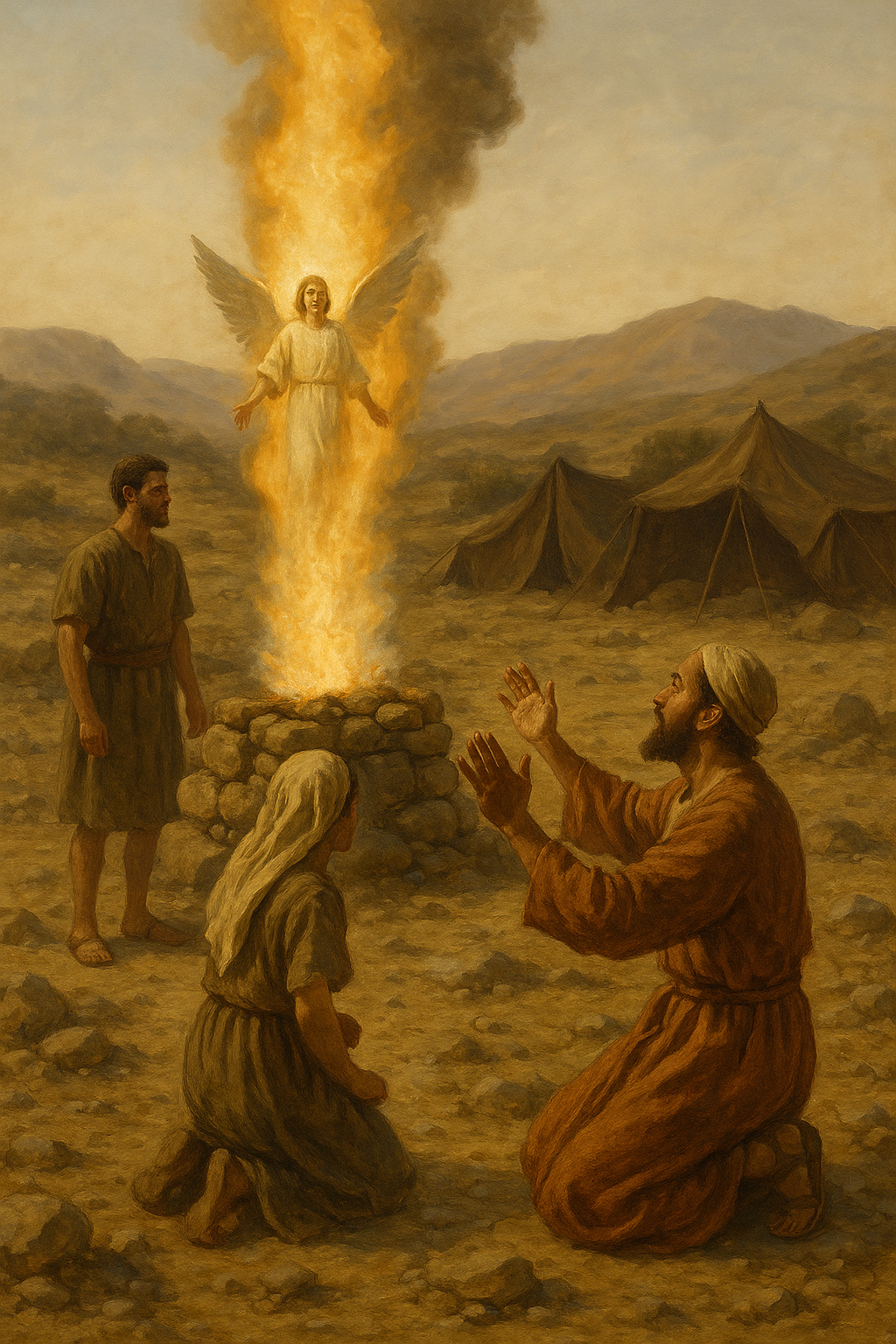
The angel declines Manoah’s food and directs him to offer a burnt offering to the LORD. When Manoah asks his name, the angel replies:
“Why askest thou thus after my name, seeing it is secret?” (Judges 13:18).
As the flame rises from the altar, the angel ascends in it. Manoah and his wife fall on their faces.
Manoah fears that they will die because they have seen God. His wife answers by reasoning from what the LORD has done: He accepted their offering, showed them these things, and gave them the announcement concerning their son.
The passage connects this appearance closely with God’s presence. Many conservative interpreters understand the angel of the LORD here as a preincarnate appearance of Christ. However, Judges 13 does not explicitly identify Him by the name Jesus Christ, so that identification should be distinguished from the passage’s direct wording.
Samson is born and blessed (Judges 13:24-25).
The woman bears a son and names him Samson. He grows, and the LORD blesses him.
The chapter closes with the Spirit of the LORD beginning to move him at times in the camp of Dan between Zorah and Eshtaol. God’s promised deliverer has been born, and divine activity in his life is explicitly recorded.
Key People and Places
People
- Tola: An Issacharite who judges Israel twenty-three years after Abimelech.
- Jair: A Gileadite judge whose thirty sons possess thirty cities.
- Jephthah: A mighty man of valor, rejected by his brothers and subsequently appointed leader in Gilead.
- Jephthah’s daughter: His unnamed, only child, whose coming to meet him brings the consequences of his vow into view.
- The king of Ammon: The ruler who rejects Jephthah’s answer concerning Israel’s possession of the disputed land.
- The Ephraimites: Israelites whose confrontation with Jephthah develops into a deadly conflict.
- Ibzan, Elon, and Abdon: Judges whose service is briefly recorded after Jephthah.
- Manoah: Samson’s father, who asks God for instruction concerning the promised child.
- Manoah’s wife: Samson’s unnamed mother, who receives the birth announcement and answers her husband’s fear with the evidence of God’s dealings.
- The angel of the LORD: The messenger who announces Samson’s birth and ascends in the altar’s flame.
- Samson: The promised son appointed to begin Israel’s deliverance from the Philistines.
Places
- Shamir in mount Ephraim: Tola’s dwelling and burial place.
- Gilead: The region east of Jordan central to the Ammonite oppression and Jephthah’s leadership.
- Havothjair: The name associated with the thirty cities possessed by Jair’s sons.
- Mizpeh: The gathering place where Jephthah speaks before the LORD.
- Tob: The land to which Jephthah flees after his brothers expel him.
- Arnon, Jabbok, and Jordan: Rivers marking the territory discussed in Jephthah’s answer to Ammon.
- The passages of Jordan: Crossing places controlled by Gilead during the conflict with Ephraim.
- Bethlehem, Aijalon, and Pirathon: Places connected with Ibzan, Elon, and Abdon.
- Zorah and Eshtaol: Places associated with Samson’s family and the Spirit’s early activity in his life.
Main Doctrinal or Spiritual Themes
1. God judges idolatry and covenant unfaithfulness
Israel’s oppression is directly connected with its evil and abandonment of the LORD (Judges 10:6-9; 13:1). God’s past mercies do not give His people permission to disregard His commands.
2. Repentance involves more than words
In Judges 10:10-16, Israel confesses its sin, puts away strange gods, and serves the LORD. The passage joins acknowledgment of wrongdoing with a changed response to God.
This national deliverance account should not be turned into a doctrine of salvation by works. Personal salvation is by grace through faith, “not of works” (Ephesians 2:8-9). Good works belong to the life God intends for those He saves (Ephesians 2:10).
3. God’s compassion is consistent with His holiness
The LORD’s grief over Israel’s misery does not cancel His condemnation of their idolatry. Judges 10 presents both His righteous judgment and His tender concern.
4. Divine usefulness does not make a person infallible
Jephthah receives the Spirit’s empowerment, and Hebrews 11:32 names him among examples of faith. Neither statement declares every action of his life righteous.
A believer must evaluate conduct by God’s Word, even when the person involved has shown courage, exercised faith, or held spiritual responsibility.
5. Vows remain subject to God’s commands
The seriousness of promises does not give them authority above Scripture. Ecclesiastes 5:2-5 warns against careless vows, while Deuteronomy 12:31 plainly condemns human sacrifice.
Religious sincerity cannot transform disobedience into obedience.
6. God appoints servants for His purposes
Samson’s birth and calling are announced before he is born. His appointment illustrates God’s authority to assign a particular work. The passage concerns his role in Israel’s deliverance; it does not teach that individuals are saved against their will or that Christ’s atonement is limited to selected people.
7. Parents need God’s instruction
Manoah asks how to care for the promised child. His prayer provides a fitting example of parental dependence upon God. The instructions concern this particular child, while the broader duty to teach God’s words to children is stated in Deuteronomy 6:6-7.
Practical Applications or Lessons
- Name sin honestly. Israel confesses both forsaking God and serving false gods. Honest confession should identify wrongdoing instead of disguising it with excuses.
- Act upon repentance. Putting away the strange gods accompanies Israel’s confession. Ask what conduct needs to change in response to what Scripture has shown you.
- Do not bargain with God through reckless promises. Jephthah’s vow was not commanded by the LORD. Obey what God has already said instead of inventing costly promises to secure a desired outcome.
- Do not confuse victory with approval of every decision. The LORD gave Jephthah victory, but the text does not endorse his vow. Success must never replace biblical examination.
- Let God’s Word judge admired leaders. Faith, courage, and usefulness do not remove a person’s accountability. Honor what is faithful without defending what Scripture condemns.
- Answer disputes carefully. Jephthah sends messengers and gives a reasoned account before fighting Ammon. This may provide a practical example of seeking to address a dispute through truthful explanation.
- Reject threats and destructive strife among brethren. Ephraim’s confrontation ends in tremendous loss. Believers are commanded to put away bitterness, wrath, and malice and to show kindness and forgiveness (Ephesians 4:31-32).
- Pray for wisdom in raising children. Manoah asks for instruction concerning his son. Parents should seek wisdom for their responsibility and faithfully teach what God has revealed.
- Meet fear with what God has actually said and done. Manoah’s wife answers his fear by recalling God’s acceptance of their offering and His announced purpose. Her reasoning encourages careful attention to God’s revealed truth.
- Respect the limits of the text. Where Scripture gives only a name, a brief record, or an unresolved detail, do not manufacture a fuller story. Spiritual depth comes from understanding God’s words faithfully.
Comments are closed