Jeremiah 44–47 Overview (KJV)
Chapter Summaries
Jeremiah 44
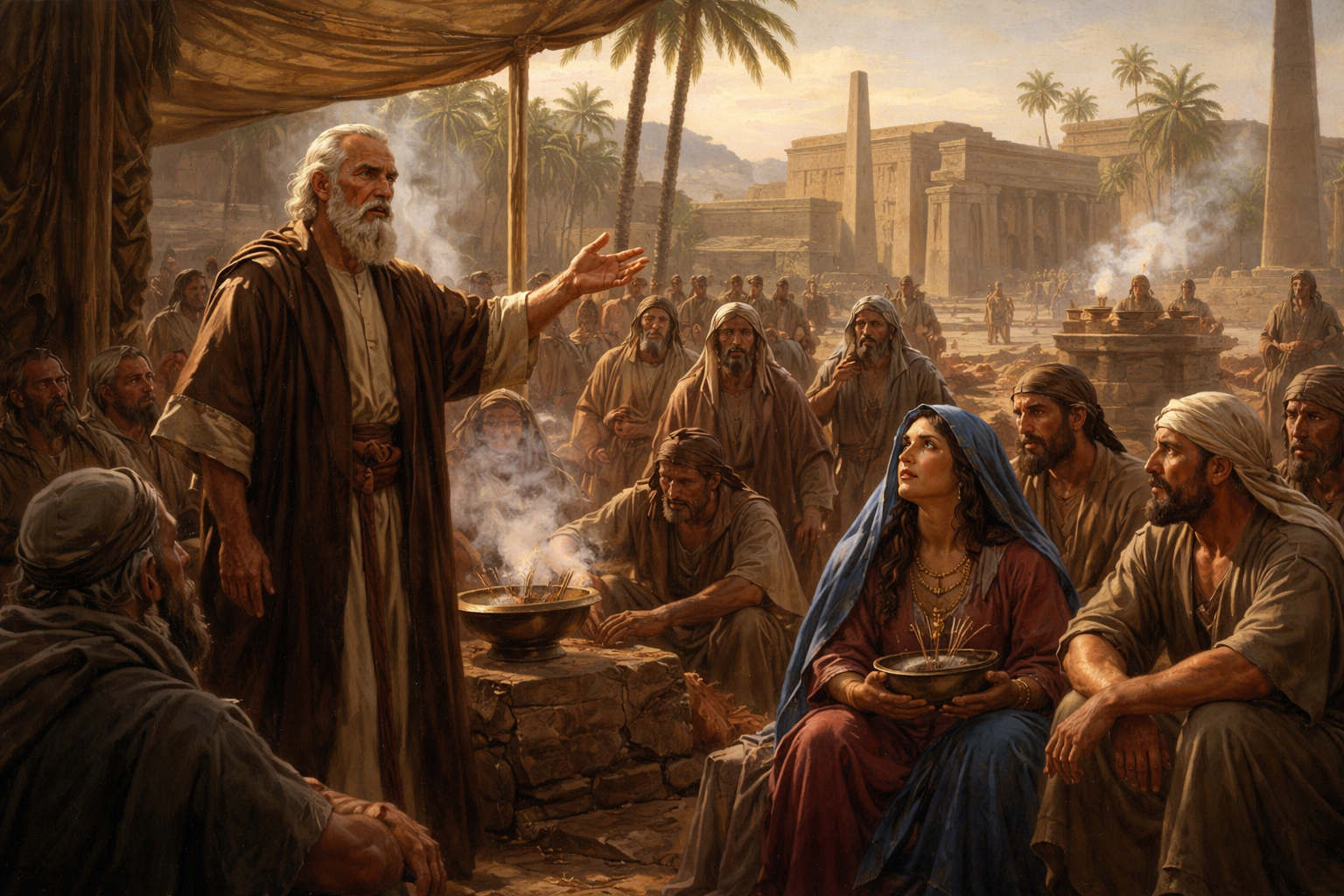
 This chapter records Jeremiah’s final known message to the remnant of Judah in Egypt, especially those dwelling in Migdol, Tahpanhes, Noph, and in the country of Pathros. The Lord reminds them why Jerusalem had been destroyed: “because of their wickedness which they have committed to provoke me to anger” (Jer. 44:3). Their fathers, kings, princes, and people had refused repeated warnings from the prophets and persisted in idolatry. Now, after having fled to Egypt in direct disobedience to God’s command, they are repeating the very sins that brought judgment on Judah in the first place.
Jeremiah rebukes them for burning incense to false gods in Egypt. The Lord asks, in effect, why they would commit “this great evil against your souls” (Jer. 44:7). The phrase is striking. Their sin was not only against God’s holiness but against their own well-being. Sin always carries a self-destructive element. They had escaped the sword of Babylon outwardly, but they could not escape the hand of God inwardly. The Lord declares that the remnant who fled to Egypt would not escape; they would be consumed there “by the sword and by the famine” (Jer. 44:12).
The people then openly reject Jeremiah’s preaching. The women, with the support of their husbands, insist that they will continue burning incense unto the queen of heaven, claiming that when they practiced idolatry they had plenty, and when they stopped they suffered want (Jer. 44:17-18). This is the blindness of apostasy: they interpreted God’s patience as proof that idolatry worked, and God’s chastening as proof that obedience failed. Jeremiah answers that their calamities came not because they stopped idolatry, but because they had long persisted in it (Jer. 44:21-23).
The chapter ends with a solemn sign of judgment. God says He will punish Pharaoh-hophra king of Egypt by delivering him into the hands of his enemies, just as He had delivered Zedekiah into Nebuchadnezzar’s hand (Jer. 44:30). This would serve as proof that Jeremiah’s word against the Jewish remnant in Egypt would surely come to pass. Doctrinally, the chapter is a powerful witness to God’s hatred of idolatry, the deceitfulness of the human heart, and the certainty that rebellion against revealed truth brings judgment.
Jeremiah 45
This brief chapter is a personal word to Baruch, Jeremiah’s faithful scribe, spoken “in the fourth year of Jehoiakim” (Jer. 45:1), though placed here near the close of the book. Baruch had written Jeremiah’s prophecies and had suffered with the prophet. Evidently he had become discouraged, wearied, and perhaps overwhelmed with grief and disappointment. He says, “Woe is me now! for the LORD hath added grief to my sorrow” (Jer. 45:3). He had laboured in a collapsing nation, among stubborn people, under the shadow of coming judgment.
The Lord’s answer is tender yet corrective. God reminds Baruch that He is overthrowing what He had built and plucking up what He had planted in the land (Jer. 45:4). In other words, national judgment is falling; this is not the time to seek personal advancement or earthly security. Therefore, the Lord asks, “And seekest thou great things for thyself? seek them not” (Jer. 45:5). This is not a condemnation of lawful diligence, but a rebuke to self-centered ambition in a time when God is bringing public chastisement.
Yet the Lord also gives Baruch a gracious promise: “thy life will I give unto thee for a prey in all places whither thou goest” (Jer. 45:5). Baruch would not necessarily have ease, wealth, or prominence, but he would have preservation by God’s mercy. This chapter gives a deeply practical lesson for servants of God: in times of spiritual declension and divine chastening, the believer must not measure blessing by earthly greatness. It is enough to be kept by God, used by God, and found faithful.
Jeremiah 46
This chapter begins a section of prophecies against the Gentile nations. The first nation addressed is Egypt. The opening portion concerns Egypt’s defeat at Carchemish by Nebuchadnezzar king of Babylon (Jer. 46:2). Egypt comes forward in military pride, with horses, chariots, bucklers, and helmets, but the Lord declares their retreat and humiliation. The vivid language shows the panic of battle: “the mighty men are beaten down, and are fled apace” (Jer. 46:5). Human strength cannot stand when the Lord has appointed a day of judgment.
Egypt is described as rising up “like a flood” (Jer. 46:8), imagining conquest and dominion. Yet the day belongs not to Egypt, but to “the Lord GOD of hosts, a day of vengeance” (Jer. 46:10). The battle is not merely political; it is theological. The Lord rules over nations and armies. He uses Babylon as His instrument to humble proud kingdoms. Egypt, long a symbol of worldly strength and false refuge in Scripture, is here shown to be unable to save itself, much less Judah.
The prophecy continues with words against Egypt’s land, cities, and gods. Noph is mentioned, and judgment is declared upon Amon of No and upon Pharaoh and Egypt’s gods (Jer. 46:25). The Lord is not merely judging men’s armies but also exposing the vanity of their idols and false confidence. Still, the chapter closes with a comforting word to Israel: “Fear not thou, O my servant Jacob” (Jer. 46:27). Though God will make “a full end of all the nations whither I have driven thee,” yet He will not make a full end of Jacob. He will correct His people “in measure,” but not leave them unpunished. This preserves both truths: divine chastening and covenant mercy. God disciplines His people, but He does not cast them off utterly.
Jeremiah 47
This chapter contains the word of the Lord against the Philistines, “before that Pharaoh smote Gaza” (Jer. 47:1). The judgment is pictured as waters rising out of the north, overflowing the land and all that is in it (Jer. 47:2). This likely refers to the Babylonian advance. The imagery of a flood communicates irresistibility, terror, and completeness. The Philistines had long been enemies of Israel, and though they were a historic people of power in the coastal plain, they too would fall under God’s sovereign hand.
The devastation is described in heartbreaking detail: fathers would not look back for their children because of the feebleness of hands (Jer. 47:3). Tyre and Zidon are also mentioned as connected powers or helpers who would be cut off from aiding the Philistines. Gaza, Ashkelon, and “the remnant of their valley” are singled out in lament and destruction. The chapter has the tone of a funeral dirge. God’s sword is not random violence but a commissioned instrument: “how can it be quiet, seeing the LORD hath given it a charge” (Jer. 47:7).
This chapter again teaches that the God of Israel is not tribal or local, but universal in His rule. The Philistines may not have possessed the covenants given to Israel, but they were still accountable to the Lord of all the earth. Nations rise and fall under His decree. It also reminds the reader that longstanding hostility to God’s people does not go unnoticed forever. Judgment may seem delayed, but it is never forgotten.
Key People and Places
Key People
- Jeremiah — The prophet of the Lord, faithfully delivering God’s word even when rejected.
- Baruch — Jeremiah’s scribe and companion; receives a personal word of correction and comfort in chapter 45.
- Pharaoh-hophra — King of Egypt in Jeremiah 44, used as a sign that God’s judgment would surely come.
- Nebuchadnezzar — King of Babylon, God’s appointed instrument to judge Judah, Egypt, and other nations.
- Jehoiakim — Mentioned in connection with the timing of the message to Baruch.
- Zedekiah — Mentioned as an example of a king delivered into enemy hands.
- The Jewish remnant in Egypt — A rebellious group refusing God’s word and persisting in idolatry.
- The women burning incense to the queen of heaven — Prominent in Jeremiah 44 as representatives of brazen idolatry and spiritual blindness.
Key Places
- Egypt — Place of disobedient refuge for Judah’s remnant; object of judgment in Jeremiah 44 and 46.
- Migdol, Tahpanhes, Noph, Pathros — Locations in Egypt where the Jewish remnant lived.
- Jerusalem / cities of Judah — Recalled as examples of judgment already suffered because of sin.
- Carchemish — Site of Egypt’s major defeat by Babylon.
- No (Thebes) — Egyptian center associated with idolatry and judgment.
- Gaza, Ashkelon — Major Philistine cities marked for destruction.
- Tyre and Zidon — Neighboring coastal cities mentioned in relation to the Philistine judgment.
- The north — Direction from which judgment commonly comes in Jeremiah, here associated with Babylonian invasion.
Main Doctrinal or Spiritual Themes
1. The certainty of judgment upon persistent sin
Jeremiah 44 strongly shows that repeated warnings rejected bring certain judgment. God had spoken “rising early and sending” His servants the prophets, but the people would not hear. Persistent rebellion hardens the heart and stores up judgment.
2. The wickedness and stupidity of idolatry
The people in Egypt openly defend worship of the queen of heaven. Idolatry is shown not merely as ceremonial error, but as moral insanity—crediting false gods for blessing while blaming the true God for judgment their own sins had caused.
3. The deceitfulness of the human heart
The remnant rewrites history to justify their sin. They interpret events according to their desires rather than according to God’s word. This is a warning that the heart, apart from submission to Scripture, will rationalize rebellion.
4. God’s sovereignty over nations
Jeremiah 46–47 makes plain that Egypt and Philistia are under God’s authority just as Judah is. The Lord governs battles, kings, borders, and outcomes. History is not ultimately directed by human rulers, but by the Lord GOD of hosts.
5. Chastening versus destruction for God’s people
In Jeremiah 46:27-28, Israel is corrected “in measure,” but not utterly destroyed. This reflects God’s covenant faithfulness. He disciplines His people, yet preserves them according to His purposes.
6. The danger of seeking greatness in a time of judgment
Baruch is told, “seekest thou great things for thyself? seek them not.” This is a timeless warning against personal ambition that is disconnected from God’s will and from the seriousness of the hour.
7. God’s mercy to the faithful remnant servant
Though Baruch must surrender dreams of earthly greatness, God graciously preserves his life. The Lord may not always give ease, but He gives sustaining mercy.
Practical Applications or Lessons
1. Partial obedience is still disobedience
The remnant had escaped one danger, but instead of returning to God, they ran to Egypt against His will. Believers today must not substitute human schemes for plain obedience to God’s word.
2. Do not blame God for the consequences of sin
The people claimed life was better when they served idols. Sinners often blame God, church, or righteousness for troubles actually caused by their own rebellion. Scripture must interpret our circumstances, not our feelings.
3. Beware of normalizing false worship
Jeremiah 44 shows whole households involved in idolatry. Error spreads easily when family, culture, and community all support it. Believers must test worship and practice by Scripture, not by tradition or popularity.
4. Faithfulness matters more than prominence
Baruch’s lesson is especially useful for ministers, workers, and believers serving in discouraging times. Not everyone is called to visible greatness. It is enough to be faithful where God has placed you.
5. God rules over world events
Jeremiah 46–47 reminds the believer not to fear earthly powers as though they were absolute. Nations may rage, armies may rise, but the Lord still governs. This gives stability in troubled times.
6. God’s people may be chastened, but not abandoned
The promise to Jacob offers comfort. The Lord may correct His people severely, but His correction is purposeful, measured, and covenantally faithful. For the believer, chastening is not rejection.
7. Long-delayed judgment is still judgment
The Philistines and Egyptians may have seemed secure for a time, but God’s word eventually came to pass. Men should not mistake delay for indifference.
8. A preserved life is a great mercy
To Baruch, survival itself was God’s gift. In proud times, men despise ordinary mercies. But life, preservation, and the continued opportunity to serve God are precious gifts.
Comments are closed