Chapter Summaries
Jeremiah 48
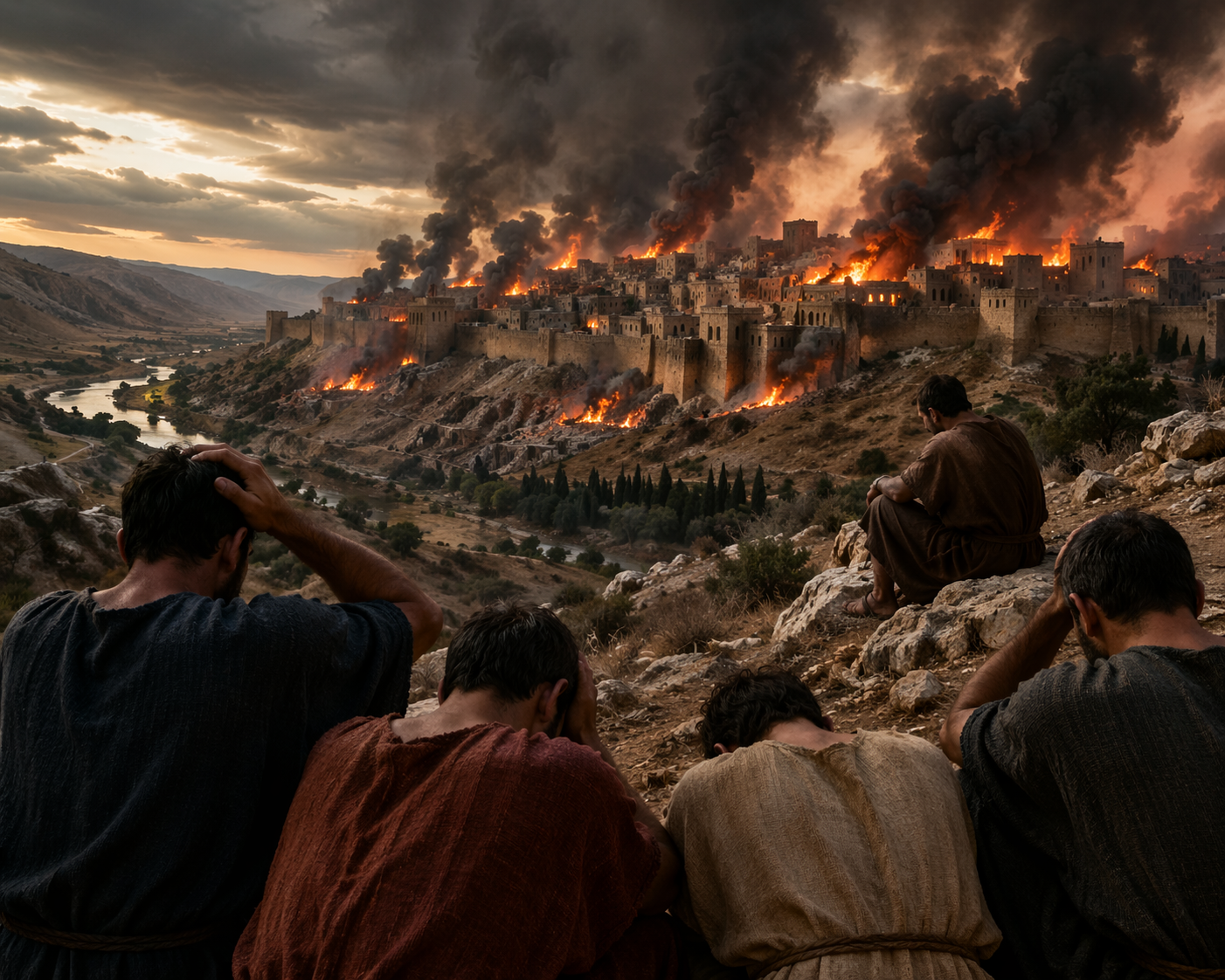
 This chapter is a long prophecy of judgment against Moab. The burden falls on city after city, showing that the Lord’s judgment is thorough, deliberate, and deserved. Moab had long been an enemy and a proud neighbor of Israel. The chapter opens with lamentation over Nebo, Kiriathaim, Misgab, Heshbon, and Madmen, showing that the whole land is to be broken down. “Moab is spoiled” and “the sword” is coming upon her.
A major theme in the chapter is pride. Verse 29 is especially important: “We have heard the pride of Moab, (he is exceeding proud) his loftiness, and his arrogancy, and his pride, and the haughtiness of his heart.” Moab was not merely politically threatened; she was spiritually swollen with self-confidence. She trusted in her works and in her treasures (v. 7), and also in her false god Chemosh, yet none of these could save her when the Lord visited judgment.
Verse 11 gives a vivid picture of Moab’s ease: “Moab hath been at ease from his youth… and hath not been emptied from vessel to vessel.” The image is of wine left settled on its lees, undisturbed and unpurged. Spiritually, this suggests complacency. Moab had not been humbled, shaken, or corrected, and so corruption remained. Conservative application has often seen here a warning that ease and worldly security can leave a people morally settled in sin.
The chapter also shows the completeness of divine judgment. The Lord calls for mourning over Dibon, Aroer, Horonaim, Luhith, Arnon, Bozrah, and many other places. The imagery is vivid: shaved heads, cut beards, sackcloth, broken vessels, wailing, and desolation. Moab’s “horn is cut off” and his “arm is broken” (v. 25), meaning strength and power are removed by God.
Yet this chapter is not only wrath. The Lord speaks with grief-like language over Moab. He says, “Therefore mine heart shall sound for Moab like pipes” (v. 36). This does not weaken His holiness; rather, it shows that divine judgment is not careless or unjust. God judges righteously, and even when nations fall under His hand, He is not cruel.
The chapter closes with a remarkable note of mercy: “Yet will I bring again the captivity of Moab in the latter days, saith the LORD” (v. 47). Though Moab is judged, God still reserves the right to show mercy in His own time. That ending reminds us that judgment is His strange work, but mercy is never beyond His power.
Jeremiah 49
Jeremiah 49 contains a series of prophecies against several nations: Ammon, Edom, Damascus, Kedar, Hazor, and Elam. The chapter shows that the God of Israel is not a tribal deity but the Lord of all nations. He rules beyond Judah and holds every people accountable.
Against Ammon (49:1–6)
The prophecy begins with Ammon, descendants of Lot, who had taken advantage of Israel’s trouble, especially concerning Gad. The question is pointed: “Hath Israel no sons? hath he no heir? why then doth their king inherit Gad?” Ammon had acted as though Israel was finished and her inheritance was up for seizure. Their god, called Malcam (or Molech), would not save them. Rabbah would become a desolate heap, and judgment would come because of covetous encroachment and pride.
Yet again, judgment is not the last word. Verse 6 says, “Afterward I will bring again the captivity of the children of Ammon, saith the LORD.” God remains sovereign even over pagan nations and can restore according to His will.
Against Edom (49:7–22)
The section against Edom is especially severe. Edom, descended from Esau, had a long history of hostility toward Israel. The prophecy addresses Teman, Dedan, and Bozrah. Edom was famous for wisdom, but the Lord asks whether wisdom has perished from Teman. Human cleverness cannot stand when God arises in judgment.
Edom also trusted in its defensible location and pride: “Thy terribleness hath deceived thee, and the pride of thine heart” (v. 16). Though they dwelt “in the clefts of the rock,” they would be brought down. The language anticipates total devastation, like the overthrow of Sodom and Gomorrah. The imagery of the eagle rising and spreading wings against Bozrah emphasizes the suddenness and force of judgment.
This is a strong warning that inherited privilege, strategic advantage, and reputation for wisdom are worthless when a nation sets itself against the Lord.
Against Damascus (49:23–27)
Next comes Damascus, one of the oldest and most prominent cities in Syria. The prophecy mentions Hamath and Arpad, indicating fear spreading through the region. Damascus is pictured as feeble, turning to flee, with anguish like a woman in travail. The “city of praise” would not be spared. Her young men would fall, and the palaces of Ben-hadad would be consumed by fire. The message is that old prestige and military history cannot preserve a people from God’s decree.
Against Kedar and Hazor (49:28–33)
These verses concern Kedar and the kingdoms of Hazor, desert peoples associated with nomadic wealth, flocks, tents, curtains, camels, and relative security. They lived with a sense of isolation and confidence, dwelling “without care.” Yet Nebuchadnezzar would smite them. Their possessions would be taken, and Hazor would become a dwelling place for dragons and perpetual desolation.
This section shows that neither settled cities nor wandering tribes are beyond God’s reach. No lifestyle—urban, rural, fortified, or mobile—places men outside His government.
Against Elam (49:34–39)
The chapter closes with Elam, east of Babylon, known especially for its bow. God declares, “I will break the bow of Elam, the chief of their might” (v. 35). Their military strength would fail, and they would be scattered “toward all those winds.” Disaster would come before their enemies, and God says He will set His throne in Elam, meaning He will manifest His royal authority in judgment there also.
Yet even here mercy appears at the end: “But it shall come to pass in the latter days, that I will bring again the captivity of Elam, saith the LORD” (v. 39). As with Moab and Ammon, God’s judgment is real, but He remains free to restore.
Taken together, Jeremiah 48–49 reveal the Lord as the righteous Judge of all the earth. He judges pride, idolatry, cruelty, false security, theft of inheritance, and confidence in human wisdom or strength. At the same time, glimpses of future mercy show that His sovereignty is not limited to destruction alone.
Key People and Places
Jeremiah — The prophet delivering God’s burden against the nations surrounding Judah.
Moab — Nation east of the Dead Sea, descended from Lot; judged for pride, idolatry, and false confidence.
Chemosh — The false god of Moab; unable to save his worshipers.
Nebo, Kiriathaim, Misgab, Heshbon, Dibon, Aroer, Horonaim, Bozrah, Luhith, Arnon — Moabite locations named to show the breadth of coming judgment.
Ammon — Nation also descended from Lot, east of Jordan; condemned for seizing Israel’s inheritance.
Malcam — False god associated with Ammon; powerless before the Lord.
Rabbah — Principal city of Ammon; marked for desolation.
Gad — Territory of Israel mentioned because Ammon had moved in upon it.
Edom — Nation descended from Esau; judged for pride and hostility.
Teman — Area in Edom known for wisdom; used to show the failure of human counsel under judgment.
Dedan — People linked to the Edomite oracle, called to flee from coming trouble.
Bozrah — Chief city in Edom, singled out in judgment.
Damascus — Capital city of Syria; ancient and prominent, yet not exempt from God’s hand.
Hamath and Arpad — Syrian cities mentioned as trembling at the report of disaster.
Ben-hadad — Dynastic name of Syrian kings; his palaces symbolize the strength of Damascus.
Kedar — Arabian nomadic people, known for flocks and tents.
Hazor — Desert settlements or kingdoms associated with the Arabian peoples in this context.
Nebuchadrezzar / Nebuchadnezzar king of Babylon — The earthly instrument God used in judgment on many nations.
Elam — Nation eastward, known for archers and military skill; scattered under God’s judgment.
Main Doctrinal or Spiritual Themes
1. God is sovereign over all nations
These chapters strongly teach that the Lord rules not only Judah but also Moab, Ammon, Edom, Syria, Arabian tribes, and Elam. National borders do not limit divine authority.
2. Pride brings judgment
Moab and Edom especially illustrate this truth. Pride of heart, self-exaltation, and false confidence invite the resistance of God.
3. Idolatry is vanity
Chemosh and Malcam are shown to be helpless. False gods cannot protect a people from the true and living God.
4. Carnal security is dangerous
Moab was “at ease,” Edom trusted in rocky strongholds, Kedar dwelt carelessly, and Elam trusted in the bow. All such confidences fail under divine visitation.
5. God uses earthly rulers as instruments of judgment
Babylon is not morally innocent, yet God employs Nebuchadnezzar to chasten nations. This matches the broader biblical truth that the Lord can use even pagan powers to accomplish His purposes.
6. Judgment does not cancel God’s freedom to show mercy
The promises concerning Moab, Ammon, and Elam show that God may wound and yet restore. His justice and mercy are both seen.
7. Sin has national as well as personal consequences
These prophecies are directed to peoples and kingdoms, showing that collective arrogance, violence, and idolatry bring real consequences in history.
Practical Applications or Lessons
1. Pride ruins individuals and nations
Moab and Edom stand as warnings. A lifted-up heart, whether in a man, a church, or a nation, invites God’s opposition. Believers should cultivate humility before the Lord.
2. Ease can become a spiritual danger
Moab had been undisturbed and settled on the lees. Times of comfort can produce complacency, dullness, and moral decline if we are not watchful.
3. Material resources and reputation cannot save
Treasures, fortified places, famous wisdom, military skill, and established cities all failed. Men still trust money, strategy, influence, and institutions, but none can replace repentance and obedience.
4. False religion offers no refuge in the day of trouble
Chemosh and Malcam did nothing for their people. Modern substitutes—self, success, pleasure, ideology, or empty religion—are equally powerless to save the soul.
5. God sees how people treat His inheritance and His people
Ammon’s seizure of Gad mattered to the Lord. God is not indifferent to injustice, exploitation, or opportunism.
6. The Lord’s judgments are righteous, not random
These prophecies are detailed and morally grounded. God judges for definite sins: pride, idolatry, cruelty, theft, and self-trust. This should move us to fear Him and walk uprightly.
7. There is still hope where God gives mercy
Even among Gentile nations under judgment, there are closing notes of restoration. That reminds us that no sinner is beyond hope if God is pleased to show mercy.
8. God’s rule over the nations should strengthen the believer
Jeremiah lived in days of upheaval, yet these chapters prove that history is not out of control. The Lord is still on the throne, ordering kingdoms according to His justice and purpose.
Comments are closed