 Hosea 1–7 opens the prophecy of Hosea, a prophet sent chiefly to the northern kingdom of Israel, often called Ephraim in the book. The setting is spiritual adultery: Israel had turned from the LORD to idols, false worship, political alliances, and moral corruption. Hosea’s own marriage becomes a living sign before the nation, showing both the shame of Israel’s unfaithfulness and the longsuffering mercy of God.
Hosea 1:1 gives the historical setting: “The word of the LORD that came unto Hosea” during the days of Uzziah, Jotham, Ahaz, and Hezekiah, kings of Judah, and “in the days of Jeroboam the son of Joash, king of Israel.” This places Hosea in the days before the Assyrian captivity of the northern kingdom. Israel was outwardly prosperous for a time, but inwardly rotten with idolatry and rebellion.
Chapter Summaries
Hosea 1 — Hosea’s Marriage and the Sign-Children
The book begins with the LORD commanding Hosea to take “a wife of whoredoms and children of whoredoms” because “the land hath committed great whoredom, departing from the LORD” (Hosea 1:2). Hosea marries Gomer, and the children born in the household become prophetic signs to Israel.
The first child is named Jezreel, for God says, “I will avenge the blood of Jezreel upon the house of Jehu” (Hosea 1:4). Jezreel points to judgment upon Israel’s ruling house and the coming breaking of Israel’s military strength.
The second child is named Lo-ruhamah, meaning “not having obtained mercy,” because God says, “I will no more have mercy upon the house of Israel; but I will utterly take them away” (Hosea 1:6). Yet God distinguishes Judah from Israel, saying, “I will have mercy upon the house of Judah, and will save them by the LORD their God” (Hosea 1:7).
The third child is named Lo-ammi, meaning “not my people,” for God says, “ye are not my people, and I will not be your God” (Hosea 1:9). This is severe covenant language. Israel had so departed from God that the LORD declares a judicial rejection.
Yet the chapter ends with mercy and future restoration. “Yet the number of the children of Israel shall be as the sand of the sea” (Hosea 1:10). God promises that those once called “not my people” shall be called “the sons of the living God.” This points beyond immediate judgment to future national restoration, consistent with God’s covenant promises to Israel. A conservative dispensational reading keeps Israel and the Church distinct while recognizing that God will yet fulfill His promises to Israel literally.
Hosea 2 — Israel’s Adultery, Chastening, and Future Restoration
Hosea 2 continues the marriage figure. Israel is pictured as an unfaithful wife who has gone after lovers. The LORD says, “Plead with your mother, plead: for she is not my wife, neither am I her husband” (Hosea 2:2). This describes Israel’s spiritual adultery through idolatry.
Israel wrongly credited her false gods for her blessings: “I will go after my lovers, that give me my bread and my water, my wool and my flax, mine oil and my drink” (Hosea 2:5). God answers by taking away the blessings she abused. He says, “I will also cause all her mirth to cease, her feast days, her new moons, and her sabbaths” (Hosea 2:11).
Yet judgment is not the final word. God says, “Therefore, behold, I will allure her, and bring her into the wilderness, and speak comfortably unto her” (Hosea 2:14). The LORD promises a future day when Israel will call Him “Ishi,” meaning husband, and no more “Baali” (Hosea 2:16). The names of Baalim will be removed from her mouth.
The chapter ends with covenant mercy: “I will betroth thee unto me for ever” (Hosea 2:19), and again, “I will say to them which were not my people, Thou art my people; and they shall say, Thou art my God” (Hosea 2:23). God’s chastening is severe, but His covenant faithfulness remains sure.
Hosea 3 — Hosea Redeems His Unfaithful Wife
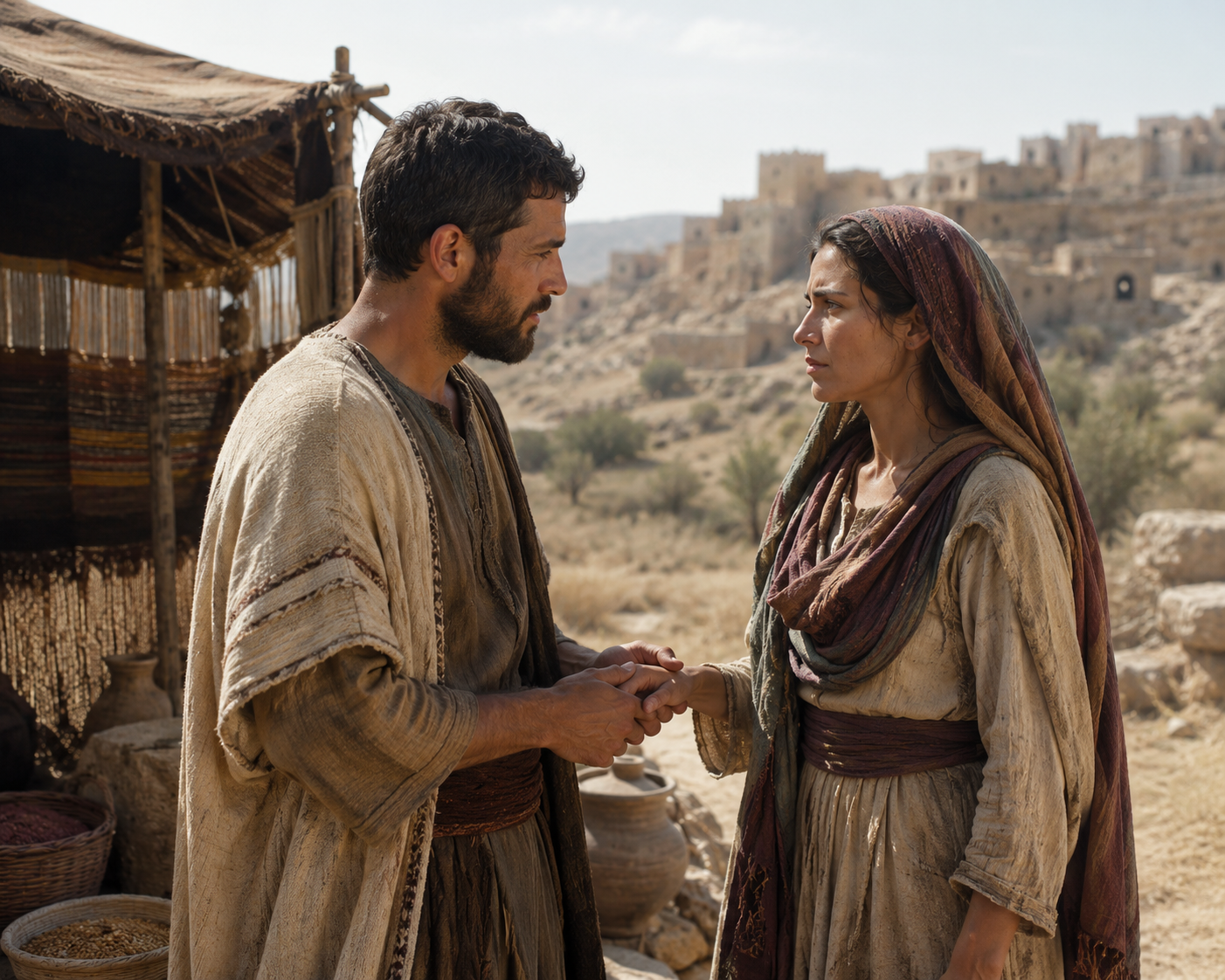
Hosea 3 is brief but deeply powerful. The LORD commands Hosea, “Go yet, love a woman beloved of her friend, yet an adulteress” (Hosea 3:1). Hosea buys her back: “So I bought her to me for fifteen pieces of silver, and for an homer of barley, and an half homer of barley” (Hosea 3:2).
This pictures God’s love toward Israel, even though Israel had turned to “other gods” and loved “flagons of wine” (Hosea 3:1). Hosea’s costly love illustrates redeeming love, though the doctrine of redemption is fully revealed in Christ. From a Baptist doctrinal standpoint, this does not teach salvation by works or sacraments. It shows the gracious character of God toward the undeserving.
The chapter also gives a prophetic outline of Israel’s long condition: “For the children of Israel shall abide many days without a king, and without a prince, and without a sacrifice” (Hosea 3:4). Then comes restoration: “Afterward shall the children of Israel return, and seek the LORD their God, and David their king” (Hosea 3:5). This looks forward to Israel’s latter-day repentance and kingdom restoration under the Messiah, the Son of David.
Hosea 4 — God’s Controversy with Israel
Hosea 4 begins like a courtroom indictment: “Hear the word of the LORD, ye children of Israel: for the LORD hath a controversy with the inhabitants of the land” (Hosea 4:1). The charge is plain: “there is no truth, nor mercy, nor knowledge of God in the land.”
The moral collapse is listed: “By swearing, and lying, and killing, and stealing, and committing adultery, they break out” (Hosea 4:2). Sin was not private only; it had filled the land.
A major verse is Hosea 4:6: “My people are destroyed for lack of knowledge.” This was not mere lack of information. It was rejection of God’s revealed truth: “because thou hast rejected knowledge, I will also reject thee.” The priests were guilty because they failed to teach and uphold God’s law. Religious leadership had become corrupt.
The chapter also condemns spiritual whoredom: “whoredom and wine and new wine take away the heart” (Hosea 4:11). Idolatry, immorality, and intoxication had robbed the people of spiritual understanding. God says, “Ephraim is joined to idols: let him alone” (Hosea 4:17). That is one of the most frightening judgments in Scripture: God giving a people over to what they insist on having.
Hosea 5 — Judgment on Priests, People, and Princes
Hosea 5 addresses the leadership directly: “Hear ye this, O priests; and hearken, ye house of Israel; and give ye ear, O house of the king” (Hosea 5:1). Religious leaders, common people, and civil rulers are all guilty.
God says, “I know Ephraim, and Israel is not hid from me” (Hosea 5:3). Their sin could not be concealed. The root problem is stated in Hosea 5:4: “they will not frame their doings to turn unto their God: for the spirit of whoredoms is in the midst of them.” Their trouble was not ignorance alone, but a stubborn refusal to return.
The chapter also warns against empty religion. “They shall go with their flocks and with their herds to seek the LORD; but they shall not find him” (Hosea 5:6). Sacrifice without repentance is unacceptable to God.
Israel also looked to political help instead of the LORD: “When Ephraim saw his sickness, and Judah saw his wound, then went Ephraim to the Assyrian” (Hosea 5:13). But Assyria could not heal what sin had caused. God Himself says, “I will go and return to my place, till they acknowledge their offence, and seek my face” (Hosea 5:15).
Hosea 6 — A Shallow Return and God’s Desire for Mercy
Hosea 6 opens with a call: “Come, and let us return unto the LORD” (Hosea 6:1). The language is beautiful: “he hath torn, and he will heal us; he hath smitten, and he will bind us up.” However, the chapter soon shows that Israel’s repentance was shallow and short-lived.
God says, “O Ephraim, what shall I do unto thee? O Judah, what shall I do unto thee? for your goodness is as a morning cloud, and as the early dew it goeth away” (Hosea 6:4). Their religious feeling vanished quickly. They had emotion, but not enduring obedience.
One of the key verses is Hosea 6:6: “For I desired mercy, and not sacrifice; and the knowledge of God more than burnt offerings.” This does not abolish sacrifice under the Mosaic law. Rather, it condemns ritual without heart obedience. God never accepted outward ceremony as a substitute for truth, mercy, repentance, and faith.
The chapter also states, “they like men have transgressed the covenant” (Hosea 6:7). Israel dealt treacherously with God. The cities and priests are described as morally polluted. Religion itself had become violent and corrupt.
Hosea 7 — Israel’s Corruption, Self-Deception, and False Confidence
Hosea 7 exposes the inward corruption of Israel. God says, “When I would have healed Israel, then the iniquity of Ephraim was discovered” (Hosea 7:1). Their sin kept coming to the surface.
The people forgot God’s omniscience: “they consider not in their hearts that I remember all their wickedness” (Hosea 7:2). This is a solemn truth: men may forget their sin, excuse their sin, or hide their sin from others, but God remembers.
The chapter uses several strong pictures. Israel is compared to an overheated oven of lust and conspiracy. Their rulers are corrupted. The people are morally inflamed. Then God says, “Ephraim, he hath mixed himself among the people; Ephraim is a cake not turned” (Hosea 7:8). Israel had mingled with heathen nations and had become spiritually half-baked: burned on one side, raw on the other, useless and ruined.
Another striking line is Hosea 7:9: “strangers have devoured his strength, and he knoweth it not: yea, gray hairs are here and there upon him, yet he knoweth not.” Israel was declining and did not even perceive it. Sin had made the nation spiritually blind.
Instead of returning to God, Israel ran between foreign powers: “Ephraim also is like a silly dove without heart: they call to Egypt, they go to Assyria” (Hosea 7:11). Their diplomacy was foolish because it replaced trust in the LORD. God says, “they have not cried unto me with their heart” (Hosea 7:14). Their prayers were not true repentance; they howled upon their beds but did not return to God.
Key People and Places
Hosea
The prophet of the LORD. His name is related to salvation or deliverance. He ministered to a rebellious Israel and was commanded to live out a painful sign before the nation through his marriage.
Gomer
Hosea’s wife, described in connection with whoredom. She becomes a living picture of Israel’s unfaithfulness to the LORD.
Jezreel
The name of Hosea’s first child. It points to judgment connected with the house of Jehu and also refers to a significant valley and place associated with bloodshed and national judgment.
Lo-ruhamah
The second child. Her name means that mercy would be withdrawn from the northern kingdom: “I will no more have mercy upon the house of Israel” (Hosea 1:6).
Lo-ammi
The third child. His name means “not my people,” expressing God’s judicial rejection of Israel in her rebellion.
Israel / Ephraim
The northern kingdom. Ephraim is often used as a representative name for the northern kingdom because it was a leading tribe. Hosea 1–7 focuses heavily on Israel’s idolatry, political folly, and coming judgment.
Judah
The southern kingdom. Hosea includes warnings to Judah also, but in these chapters Israel/Ephraim receives the primary emphasis.
Jezreel
A place associated with judgment, bloodshed, and future restoration language. Hosea 1:11 says, “great shall be the day of Jezreel.”
Assyria
The foreign power Israel foolishly looked to for help. Assyria would later become the instrument of judgment against the northern kingdom.
Egypt
Another foreign power Israel looked toward. Hosea uses Egypt as a picture of misplaced confidence and possible bondage.
Baal / Baalim
False gods connected to Israel’s spiritual adultery. God promises a future day when Israel will no more call Him “Baali” and the names of Baalim will be removed from her mouth.
Main Doctrinal or Spiritual Themes
1. The Holiness of God
God does not overlook sin. Israel’s idolatry is called whoredom because spiritual unfaithfulness is a grave offense against the LORD. The God of the Bible is not indifferent, permissive, or morally flexible. He is holy.
2. The Certainty of Judgment
Hosea 1–7 repeatedly shows that sin brings judgment. Israel’s outward prosperity could not protect her from God’s hand. Political strength, religious ritual, and national history could not excuse rebellion.
3. The Mercy and Longsuffering of God
Though judgment is severe, mercy shines throughout the passage. God promises that “Lo-ammi” will yet hear, “Thou art my people” (Hosea 2:23). God’s chastening is not the same as His covenant promises failing.
4. Spiritual Adultery Is Treachery Against God
Israel’s idolatry was not merely a mistake in worship style. It was covenant betrayal. God compares it to marital unfaithfulness because His people owed Him exclusive loyalty.
5. Religious Ritual Cannot Replace Repentance
Hosea 6:6 is central: “For I desired mercy, and not sacrifice; and the knowledge of God more than burnt offerings.” God never accepts ceremony as a substitute for obedience, truth, and a right heart.
6. Leadership Matters
Priests, princes, and kings are all addressed. Corrupt leadership helped ruin the nation. When preachers fail to teach truth, rulers embrace wickedness, and people follow sin, judgment follows.
7. The Danger of Rejecting Knowledge
“My people are destroyed for lack of knowledge” (Hosea 4:6). This is not a commendation of worldly education but a warning against rejecting God’s revealed truth. A people who despise the Word of God will decay morally and spiritually.
8. God Knows Hidden Sin
Hosea 7:2 says, “I remember all their wickedness.” Men may hide sin from family, church, or society, but nothing is hidden from God.
9. Israel’s Future Restoration
Hosea 1–3 contains promises that go beyond the immediate historical setting. Israel’s rejection is not final. Hosea 3:5 says, “Afterward shall the children of Israel return, and seek the LORD their God, and David their king.” This fits a premillennial, dispensational understanding: God will yet restore Israel nationally according to His covenant promises.
10. Salvation Is by Grace, Not Merit
The picture of Hosea loving and redeeming the unfaithful woman illustrates grace toward the undeserving. Israel did not earn restoration. Likewise, sinners are not saved by works, sacraments, or religious reform, but by God’s grace through faith. The full light of redemption is found in the Lord Jesus Christ.
Practical Applications or Lessons
1. Do Not Mistake Outward Prosperity for God’s Approval
Israel had periods of political and material strength, yet God was preparing judgment. A person, church, or nation may appear successful while spiritually declining.
2. Sin Always Redefines Blessing
Israel credited idols for bread, water, wool, flax, oil, and drink. Sin blinds people into thanking the wrong source. Every good thing comes from God, not from idols, luck, government, money, or human strength.
3. God’s People Must Practice Separation
“Ephraim, he hath mixed himself among the people” (Hosea 7:8). Israel’s compromise with heathen nations pictures the danger of worldly mixture. Believers today must live in the world without adopting its idols, values, and uncleanness.
4. A Shallow Return Is Not True Repentance
Israel could say, “Come, and let us return unto the LORD,” yet their goodness was “as a morning cloud” (Hosea 6:1, 4). Emotional religion that fades quickly is not the same as genuine repentance and obedience.
5. Religious Activity Cannot Cover a Rebellious Heart
Israel still had sacrifices, feast days, and religious language, but God rejected their hypocrisy. Church attendance, giving, singing, and service must never become a cover for private sin or disobedience.
6. Parents and Leaders Must Fear the Consequences of Sin
Hosea’s children bore names that testified of national judgment. Sin never stays isolated. The rebellion of leaders and parents affects children, homes, churches, and nations.
7. God’s Chastening Is Meant to Bring Return
God tore and smote Israel, but Hosea 6:1 says He could “heal” and “bind us up.” Divine chastening is not cruelty. It is God’s righteous dealing with sin, intended to bring His people back to truth.
8. Never Trust Human Alliances More Than God
Israel ran to Assyria and Egypt, but neither could heal her wound. Believers should use lawful means wisely, but confidence must be in the LORD, not in politics, money, medicine, personalities, or institutions.
9. Beware of Spiritual Decline You No Longer Notice
“Gray hairs are here and there upon him, yet he knoweth not” (Hosea 7:9). One of the dangers of backsliding is losing the ability to recognize it. Decline often happens gradually.
10. God’s Mercy Should Produce Faithfulness, Not Presumption
Hosea 1–7 shows both judgment and mercy. The right response is not to presume upon grace, but to return to the LORD with a sincere heart.
Closing Doctrinal Summary
Hosea 1–7 presents Israel as an unfaithful wife, guilty of spiritual adultery through idolatry, moral corruption, and political unbelief. God is holy and must judge sin, yet He remains faithful to His covenant promises. The chapters warn against empty religion, worldly compromise, corrupt leadership, and shallow repentance. They also reveal God’s astonishing mercy toward the undeserving.
From a conservative Baptist, KJV-based position, the plain teaching is clear: God’s Word is true, sin is deadly, judgment is certain, repentance must be real, and mercy is found only by returning to the LORD on His terms.
Comments are closed