
 Genesis 45–47 brings the Joseph narrative to its great family reconciliation and then records Jacob’s descent into Egypt. The chapters show God preserving Jacob’s household through famine, fulfilling His word concerning Israel, and placing the family in Goshen under Joseph’s protection.
A controlling truth appears in Joseph’s own words:
Genesis 45:7-8: “And God sent me before you to preserve you a posterity in the earth, and to save your lives by a great deliverance. So now it was not you that sent me hither, but God…”
Joseph does not deny his brothers’ guilt—he expressly says, “whom ye sold into Egypt” (Genesis 45:4). At the same time, he recognizes the overruling providence of God. Scripture therefore holds both truths together: men were responsible for their evil actions, while God sovereignly used those events to preserve life and continue His purposes for the family of Israel.
Chapter Summaries
Genesis 45 — Joseph Makes Himself Known
Joseph reveals his identity
After testing his brethren through the preceding chapters, Joseph can no longer restrain himself.
Genesis 45:1: “Then Joseph could not refrain himself before all them that stood by him…”
He orders the Egyptians from the room and reveals himself privately to his brothers.
Genesis 45:3: “And Joseph said unto his brethren, I am Joseph; doth my father yet live?”
The brothers are unable to answer:
“…for they were troubled at his presence.”
That response is explicitly stated. Scripture does not specify every thought producing their fear, so it would go beyond the text to describe their precise emotions beyond what God records.
Joseph then asks them to come near.
Genesis 45:4: “I am Joseph your brother, whom ye sold into Egypt.”
This is important. Joseph does not rewrite the past or pretend that the brothers had committed no wrong. Their responsibility is plainly acknowledged.
Yet Joseph also recognizes God’s providence:
Genesis 45:5: “…for God did send me before you to preserve life.”
And:
Genesis 45:7: “And God sent me before you to preserve you a posterity in the earth, and to save your lives by a great deliverance.”
Then:
Genesis 45:8: “So now it was not you that sent me hither, but God…”
These statements do not make the brothers innocent. Genesis 50:20 later confirms both sides:
“But as for you, ye thought evil against me; but God meant it unto good…”
That is the biblical balance: human responsibility and divine providence operate simultaneously without making God the author of sin.
Five more years of famine remain
Joseph explains that the famine has already lasted two years:
Genesis 45:6: “For these two years hath the famine been in the land: and yet there are five years, in the which there shall neither be earing nor harvest.”
“Earing” in the KJV concerns plowing or cultivating the ground. Joseph knows, by the revelation previously given concerning Pharaoh’s dreams, that the famine will continue.
Jacob is summoned to Egypt
Joseph commands his brothers to return quickly to Jacob:
Genesis 45:9: “Haste ye, and go up to my father… come down unto me, tarry not.”
Jacob and his household are to dwell in Goshen.
Genesis 45:10: “And thou shalt dwell in the land of Goshen, and thou shalt be near unto me…”
Joseph promises:
Genesis 45:11: “And there will I nourish thee; for yet there are five years of famine…”
Joseph then embraces Benjamin and afterward his other brothers.
Genesis 45:15: “Moreover he kissed all his brethren, and wept upon them: and after that his brethren talked with him.”
The reconciliation is genuine. Joseph, who possessed enormous civil authority over his brothers, uses that power to preserve rather than avenge himself.
Pharaoh welcomes Joseph’s family
When the news reaches Pharaoh, Pharaoh is pleased.
He commands that Jacob and the household be brought into Egypt and says:
Genesis 45:18: “…I will give you the good of the land of Egypt, and ye shall eat the fat of the land.”
Wagons are supplied for the journey.
Before the brothers leave, Joseph tells them:
Genesis 45:24: “See that ye fall not out by the way.”
The precise reason Joseph gives this warning is not explicitly stated. It may suggest that Joseph recognized the possibility of renewed contention among men who now had much from their past to discuss, but Scripture does not state the reason.
Jacob learns Joseph is alive
The brothers return and tell Jacob:
Genesis 45:26: “Joseph is yet alive, and he is governor over all the land of Egypt.”
Initially:
“…Jacob’s heart fainted, for he believed them not.”
But when he hears Joseph’s words and sees the wagons:
Genesis 45:27: “…the spirit of Jacob their father revived.”
Jacob responds:
Genesis 45:28: “It is enough; Joseph my son is yet alive: I will go and see him before I die.”
The chapter therefore moves from hidden identity to revelation, from fear to reconciliation, and from apparent bereavement to the promise of reunion.
Genesis 46 — Israel Goes Down Into Egypt
Jacob stops at Beersheba
Jacob begins his journey:
Genesis 46:1: “And Israel took his journey with all that he had, and came to Beersheba, and offered sacrifices unto the God of his father Isaac.”
Beersheba already had important associations with the patriarchs. Isaac had worshipped there:
Genesis 26:25: “And he builded an altar there, and called upon the name of the LORD…”
Thus Jacob does not simply rush into Egypt without reference to God. At Beersheba he sacrifices unto “the God of his father Isaac.”
God speaks to Jacob
God addresses him in “the visions of the night”:
Genesis 46:2: “Jacob, Jacob.”
Jacob answers:
“Here am I.”
God then says:
Genesis 46:3: “I am God, the God of thy father: fear not to go down into Egypt…”
The move into Egypt therefore has explicit divine approval.
God promises:
Genesis 46:3: “…for I will there make of thee a great nation.”
And:
Genesis 46:4: “I will go down with thee into Egypt; and I will also surely bring thee up again…”
The promise “I will also surely bring thee up again” must be understood according to Scripture rather than speculation. Jacob himself dies in Egypt, but his body is afterward carried back to Canaan (Genesis 50:13), and the nation descended from Jacob is eventually brought out of Egypt in Exodus.
The text can legitimately encompass God’s continuing covenant purpose beyond Jacob’s immediate journey, but we should not add details Genesis 46 itself does not state.
God also promises:
“…and Joseph shall put his hand upon thine eyes.”
This plainly assures Jacob that Joseph will be with him at his death.
The household enters Egypt
Jacob’s sons transport their father, their children, and their wives in Pharaoh’s wagons.
Genesis 46:6: “And they took their cattle, and their goods, which they had gotten in the land of Canaan, and came into Egypt…”
The chapter then carefully records the family of Israel.
Genesis 46:26 says:
“All the souls that came with Jacob into Egypt, which came out of his loins, besides Jacob’s sons’ wives, all the souls were threescore and six.”
Verse 27 then states:
“…all the souls of the house of Jacob, which came into Egypt, were threescore and ten.”
Those are the KJV’s explicit numbers. The wording of the verses distinguishes the particular group counted in verse 26 from the total house named in verse 27.
Judah is sent ahead
Genesis 46:28: “And he sent Judah before him unto Joseph, to direct his face unto Goshen…”
Judah therefore has a definite responsibility in arranging the family’s approach to Goshen.
Joseph and Jacob are reunited
Joseph prepares his chariot and meets his father:
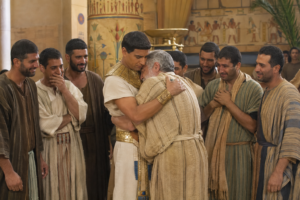
Genesis 46:29: “…and he fell on his neck, and wept on his neck a good while.”
Israel says:
Genesis 46:30: “Now let me die, since I have seen thy face, because thou art yet alive.”
This does not say Jacob died immediately or that he literally requested Joseph to kill him. It is an expression of satisfaction in having lived to see Joseph again. Genesis 47:28 explicitly tells us that Jacob lived seventeen years in Egypt.
Joseph prepares the family to meet Pharaoh
Joseph explains that he will tell Pharaoh that his brethren have arrived and that:
Genesis 46:32: “…the men are shepherds, for their trade hath been to feed cattle…”
Joseph instructs them to answer truthfully concerning their occupation:
Genesis 46:34: “Thy servants’ trade hath been about cattle from our youth even until now…”
The verse then gives the reason connected with their dwelling in Goshen:
“…that ye may dwell in the land of Goshen; for every shepherd is an abomination unto the Egyptians.”
That Egyptian attitude toward shepherds is explicitly stated. Scripture does not explain in this passage precisely why Egyptians regarded shepherds this way, so proposed cultural explanations should not be presented as biblical fact.
Genesis 47 — Israel Settles in Goshen
Joseph presents his family to Pharaoh
Joseph informs Pharaoh:
Genesis 47:1: “My father and my brethren, and their flocks, and their herds, and all that they have, are come out of the land of Canaan; and, behold, they are in the land of Goshen.”
Joseph selects five brothers and presents them to Pharaoh.
Pharaoh asks:
Genesis 47:3: “What is your occupation?”
They answer plainly:
“Thy servants are shepherds, both we, and also our fathers.”
They also explain why they have come:
Genesis 47:4: “For to sojourn in the land are we come; for thy servants have no pasture for their flocks; for the famine is sore in the land of Canaan…”
Notice their word “sojourn.” They have come into Egypt because of famine, but Canaan remains central to God’s promises concerning this family.
Pharaoh gives them Goshen
Pharaoh tells Joseph:
Genesis 47:6: “The land of Egypt is before thee; in the best of the land make thy father and brethren to dwell; in the land of Goshen let them dwell…”
He also instructs Joseph that capable men among them may oversee Pharaoh’s cattle.
The text therefore gives a straightforward reason for their favorable settlement: Pharaoh grants them land and recognizes their experience with livestock.
Jacob stands before Pharaoh
Joseph brings Jacob before Pharaoh.
Twice the chapter says that Jacob blesses Pharaoh:
- Genesis 47:7
- Genesis 47:10
Pharaoh asks Jacob his age.
Jacob answers:
Genesis 47:9: “The days of the years of my pilgrimage are an hundred and thirty years…”
Jacob calls his life a “pilgrimage.”
He continues:
“…few and evil have the days of the years of my life been…”
“Evil” here describes the grievous or troublesome character of many of his days, not a claim that Jacob had lived only in moral wickedness.
His life had indeed included many recorded sorrows and troubles: conflict with Esau, years with Laban, family strife, Rachel’s death, Dinah’s tragedy, Reuben’s sin, and his long grief concerning Joseph. Those events are explicitly recorded elsewhere in Genesis.
Israel receives a possession
Genesis 47:11: “And Joseph placed his father and his brethren, and gave them a possession in the land of Egypt, in the best of the land, in the land of Rameses, as Pharaoh had commanded.”
The verse names the location here as “the land of Rameses.” Scripture does not require us to construct an additional theory concerning that place-name in order to understand the narrative.
Joseph then provides for them:
Genesis 47:12: “And Joseph nourished his father, and his brethren, and all his father’s household, with bread, according to their families.”
God has therefore used the very son whom the brothers sold into Egypt to become the means of physically sustaining the entire household.
Joseph Administers Egypt During the Famine
The narrative then broadens beyond Jacob’s family.
Genesis 47:13: “And there was no bread in all the land; for the famine was very sore…”
Joseph first receives money for grain.
Genesis 47:14: “And Joseph gathered up all the money that was found in the land of Egypt, and in the land of Canaan…”
When their money is exhausted, the Egyptians exchange their livestock for food.
Genesis 47:17: “And they brought their cattle unto Joseph: and Joseph gave them bread in exchange for horses, and for the flocks, and for the cattle of the herds, and for the asses…”
When that resource is exhausted, the people themselves propose another arrangement:
Genesis 47:19: “Wherefore shall we die before thine eyes, both we and our land? buy us and our land for bread…”
Joseph then acquires the land for Pharaoh.
Genesis 47:20: “And Joseph bought all the land of Egypt for Pharaoh…”
The priests’ land is explicitly excepted:
Genesis 47:22: “Only the land of the priests bought he not…”
Joseph supplies seed and establishes a fifth part for Pharaoh:
Genesis 47:24: “…ye shall give the fifth part unto Pharaoh, and four parts shall be your own…”
The Egyptians respond:
Genesis 47:25: “Thou hast saved our lives…”
The passage records Joseph’s policy. Scripture does not explicitly command every later government to reproduce this Egyptian economic arrangement, nor does it identify the Egyptian governmental structure here as the permanent biblical pattern for civil government. Therefore, one should be cautious about making Genesis 47 into a universal political or economic program.
What the passage does show is Joseph administering Pharaoh’s resources during an extraordinary national famine and preserving life.
Israel Prospers in Goshen
The contrast is striking:
Genesis 47:27: “And Israel dwelt in the land of Egypt, in the country of Goshen; and they had possessions therein, and grew, and multiplied exceedingly.”
This begins to show the fulfillment of God’s promise in Genesis 46:3:
“I will there make of thee a great nation.”
The fuller multiplication continues into Exodus:
Exodus 1:7: “And the children of Israel were fruitful, and increased abundantly, and multiplied, and waxed exceeding mighty…”
This promise concerns Israel, the physical descendants of Jacob. A dispensational reading should not transfer Israel’s national promises to the New Testament Church.
Jacob Prepares for Death
Jacob lives seventeen years in Egypt.
Genesis 47:28: “And Jacob lived in the land of Egypt seventeen years: so the whole age of Jacob was an hundred forty and seven years.”
As his death approaches, he summons Joseph and asks:
Genesis 47:29: “…bury me not, I pray thee, in Egypt.”
Instead:
Genesis 47:30: “But I will lie with my fathers, and thou shalt carry me out of Egypt, and bury me in their buryingplace.”
Joseph swears to do so.
Jacob then:
Genesis 47:31: “…bowed himself upon the bed’s head.”
Jacob’s burial request displays his continuing identification with the land associated with God’s promises to Abraham, Isaac, and Jacob. Hebrews 11 places Jacob’s closing days in the context of faith:
Hebrews 11:21: “By faith Jacob, when he was a dying, blessed both the sons of Joseph; and worshipped…”
Key People and Places
| Person or Place | Significance in Genesis 45–47 |
|---|---|
| Joseph | Son of Jacob, brother whom his brethren sold into Egypt, and now “ruler throughout all the land of Egypt” (45:8). God uses him to preserve the family during famine. |
| Jacob / Israel | Father of Joseph and patriarch of the family. God commands him not to fear going into Egypt and promises to make of him “a great nation” there (46:3). |
| Benjamin | Joseph’s full brother through Rachel. Joseph weeps upon his neck at their reunion (45:14). |
| Judah | Sent ahead by Jacob “to direct his face unto Goshen” (46:28). |
| Joseph’s brethren | The men who had sold Joseph. They are reconciled to him and brought with their families into Egypt. |
| Pharaoh | Ruler of Egypt. He welcomes Joseph’s family and gives them the best of the land. |
| Egypt | The nation in which Joseph rules and where Israel will reside during the famine. |
| Goshen | The area assigned to Jacob and his household; they dwell there with their livestock and possessions. |
| Canaan | The land from which Jacob’s family comes because the famine is severe. It remains central to the patriarchal promises. |
| Beersheba | Location where Jacob sacrifices “unto the God of his father Isaac” before entering Egypt (46:1). |
| Land of Rameses | Genesis 47:11 names the possession given to Jacob’s family by this designation. |
Main Doctrinal or Spiritual Themes
1. The Providence of God
The dominant doctrinal truth is stated by Joseph himself:
Genesis 45:7: “And God sent me before you…”
Joseph’s suffering had included betrayal, slavery, false accusation, and imprisonment. Yet God had positioned him ahead of the family to preserve life.
Psalm 105 later gives inspired commentary on these events:
Psalm 105:16-17: “Moreover he called for a famine upon the land: he brake the whole staff of bread. He sent a man before them, even Joseph, who was sold for a servant.”
God was not defeated by the brothers’ wickedness. He overruled it without excusing it.
Doctrine: God’s providence does not erase human accountability.
2. God Can Overrule Evil for Good
Joseph does not call evil good. Selling their brother was still evil.
Yet Genesis 50:20 explains the theological meaning:
“Ye thought evil against me; but God meant it unto good…”
The same event involved wicked human intention and righteous divine purpose.
A believer therefore need not pretend that evil is harmless in order to believe that God can overrule it.
3. Forgiveness Without Denying Sin
Joseph says:
“I am Joseph your brother, whom ye sold into Egypt.” — Genesis 45:4
He plainly names what they did.
Yet he does not use his authority to destroy them.
This is genuine forgiveness—not rewriting history, but refusing personal vengeance.
Compare:
Romans 12:19: “Dearly beloved, avenge not yourselves…”
For the Christian, forgiveness is grounded finally in the grace God has shown us through Christ.
4. God Preserves Israel
God tells Jacob:
Genesis 46:3: “…I will there make of thee a great nation.”
Genesis 47:27 begins showing that multiplication:
“…they had possessions therein, and grew, and multiplied exceedingly.”
This is part of God’s covenant dealings with the descendants of Abraham, Isaac, and Jacob.
Dispensational distinction: Israel in these chapters is Israel. The passage does not redefine Jacob’s physical descendants as the Church.
5. God’s Presence Is Not Limited by Geography
God promises Jacob:
Genesis 46:4: “I will go down with thee into Egypt…”
Jacob is leaving Canaan, but he is not leaving God.
The believer likewise serves a God whose presence is not confined to one earthly location.
6. Faith Must Rest Upon God’s Word
Jacob understandably hesitates when first told Joseph is alive:
“…he believed them not.” — Genesis 45:26
But before entering Egypt, God personally confirms the course Jacob is to take:
“Fear not to go down into Egypt…” — Genesis 46:3
The strongest foundation for action is not human enthusiasm or circumstance but what God has actually said.
7. Family Responsibility
Joseph’s concern repeatedly turns toward his father and household.
He commands:
Genesis 45:9: “Haste ye, and go up to my father…”
And promises:
Genesis 45:11: “And there will I nourish thee…”
Genesis 47:12 says:
“And Joseph nourished his father, and his brethren, and all his father’s household…”
The passage gives a strong example of care for family, especially an aged parent.
8. God’s Purposes May Extend Far Beyond Present Understanding
For many years Jacob believed:
Genesis 42:36: “Joseph is not…”
But Joseph was alive, and God was using him in Egypt.
That does not mean every tragedy will receive an earthly explanation like Joseph’s. Scripture does not promise believers that they will understand every providence during this life.
It does establish that God may be working beyond what His people presently see.
9. The Believer Is a Pilgrim
Jacob calls his lifetime:
Genesis 47:9: “The days of the years of my pilgrimage…”
Hebrews employs the same pilgrim principle concerning the patriarchs:
Hebrews 11:13: “…and confessed that they were strangers and pilgrims on the earth.”
For the Christian, this principle is especially clear:
Philippians 3:20: “For our conversation is in heaven…”
Earthly possessions and positions are temporary; eternal matters deserve first priority.
10. Faith Looks Beyond Death
Jacob does not want Egypt to become the final resting place of his body.
Genesis 47:30: “…thou shalt carry me out of Egypt, and bury me in their buryingplace.”
His concern accords with his identification with the patriarchal promises.
The believer likewise faces death with hope because God’s promises extend beyond the grave.
Practical Applications or Lessons
Trust God without calling evil good
Joseph never says that selling him was righteous. He simply recognizes that God was greater than their sin.
Believers may say both:
“This was wrong,” and “God is still able to work.”
Those truths are not contradictory.
Do not seek personal vengeance
Joseph had the power to retaliate against his brothers. Instead he preserved them.
That anticipates the New Testament command:
Romans 12:21: “Be not overcome of evil, but overcome evil with good.”
Honor and care for parents
Joseph uses his position to provide for Jacob.
Christian responsibility toward parents does not disappear when children become adults.
1 Timothy 5:4: “…let them learn first to shew piety at home, and to requite their parents…”
Seek God before major decisions
Jacob stops at Beersheba and offers sacrifices before completing the descent into Egypt.
We should not invent a command that every decision requires a miraculous vision; Scripture does not teach that. But the principle is sound: major decisions should be approached prayerfully and according to God’s written Word.
Do not allow prosperity to erase spiritual identity
Israel receives “the best of the land,” yet Jacob still wants to be buried with his fathers.
Material provision in Egypt did not erase the promises associated with Canaan.
Likewise, believers should never allow earthly prosperity to replace spiritual priorities.
Speak truthfully about your calling and work
Joseph instructs his brothers to tell Pharaoh what they actually are:
“Thy servants’ trade hath been about cattle from our youth…” — Genesis 46:34
There is no attempt to disguise their occupation merely to gain social acceptance.
Integrity matters.
Remember that God may use ordinary means
God preserves Jacob’s family through very practical things:
- grain,
- wagons,
- land,
- governmental authority,
- transportation,
- livestock,
- and Joseph’s administrative work.
The supernatural providence of God does not mean He never works through ordinary means.
Steward authority for the preservation of others
Joseph has enormous power, but throughout these chapters he uses his position to preserve life.
Leadership should not merely ask, “What authority do I possess?” but, “How can I faithfully use what God has entrusted to me?”
Prepare spiritually for death
Jacob speaks plainly about his death and burial.
Biblical faith does not require pretending death does not exist. It allows a believer to face death while resting in God’s promises.
Overall Message of Genesis 45–47
Genesis 45–47 demonstrates that God had not lost control of Joseph’s story, Jacob’s family, the famine, or His promises concerning Israel.
Joseph’s brothers had sinned.
Joseph had suffered.
Jacob had grieved.
The famine was real.
Yet God had gone before them.
Genesis 45:7: “And God sent me before you to preserve you a posterity in the earth, and to save your lives by a great deliverance.”
Then God personally assures Jacob:
Genesis 46:3-4: “Fear not to go down into Egypt; for I will there make of thee a great nation: I will go down with thee into Egypt…”
And by the end of chapter 47:
Genesis 47:27: “And Israel dwelt in the land of Egypt, in the country of Goshen; and they had possessions therein, and grew, and multiplied exceedingly.”
The central lesson is not merely that Joseph rose from suffering to power. It is that the LORD faithfully preserved the family through whom He was carrying forward His covenant purposes. Human wickedness did not frustrate His plan, famine did not cancel His promises, and Egypt could not prevent Israel from becoming the nation God had said it would become.
Comments are closed