
Genesis 48–50 records the closing days of Jacob, his blessing of Joseph’s sons and his own sons, his death and burial in Canaan, Joseph’s reassurance of his fearful brethren, and finally Joseph’s death in Egypt. These chapters close Genesis with the family of Israel still in Egypt, yet looking by faith toward the land God had promised.
A central emphasis is the faithfulness and providence of God. Human weakness, family failure, suffering, and death do not overturn His purposes. Jacob dies resting upon God’s promises; Joseph dies believing that God will visit Israel and bring them out of Egypt.
Chapter Summaries
Genesis 48 — Jacob Blesses Ephraim and Manasseh
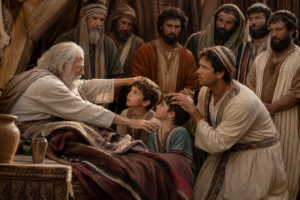 Jacob is told that Joseph has come
Joseph receives word that his father is sick and comes to him with his two sons:
- Manasseh
- Ephraim
Jacob strengthens himself and sits upon the bed (Genesis 48:1–2).
Jacob then reminds Joseph of God’s appearance to him at Luz in Canaan:
“God Almighty appeared unto me at Luz in the land of Canaan, and blessed me”
— Genesis 48:3, KJV
Jacob recalls God’s promise to make him fruitful, multiply him, and give the land to his seed “for an everlasting possession” (Genesis 48:4).
The emphasis is not merely upon Jacob’s approaching death. Jacob deliberately looks backward to God’s revealed promise and forward to what God will yet do.
Ephraim and Manasseh are received by Jacob
Jacob tells Joseph:
“And now thy two sons, Ephraim and Manasseh, which were born unto thee in the land of Egypt before I came unto thee into Egypt, are mine; as Reuben and Simeon, they shall be mine.”
— Genesis 48:5, KJV
This explicitly gives Ephraim and Manasseh a standing comparable to Jacob’s own sons.
In the later organization of Israel, both Ephraim and Manasseh appear as tribal divisions. Thus Joseph’s family is represented through these two sons.
Jacob also mentions Rachel’s death and burial near Ephrath, which is Bethlehem (Genesis 48:7). The memory is stated without further explanation concerning Jacob’s emotions beyond what the verse itself records.
Jacob sees Joseph’s sons
Because Jacob’s eyes are dim for age, he asks:
“Who are these?”
— Genesis 48:8, KJV
Joseph answers:
“They are my sons, whom God hath given me in this place.”
— Genesis 48:9, KJV
Joseph’s wording properly recognizes his children as gifts from God.
Jacob kisses and embraces the boys and says:
“I had not thought to see thy face: and, lo, God hath shewed me also thy seed.”
— Genesis 48:11, KJV
The text explicitly presents this as something beyond what Jacob had expected: he had once believed Joseph dead, yet God permitted him not only to see Joseph again but also Joseph’s children.
Jacob deliberately gives Ephraim the greater blessing
Joseph carefully positions Manasseh, the firstborn, toward Jacob’s right hand and Ephraim toward his left. Jacob deliberately crosses his hands:
“And Israel stretched out his right hand, and laid it upon Ephraim’s head, who was the younger, and his left hand upon Manasseh’s head, guiding his hands wittingly”
— Genesis 48:14, KJV
“Wittingly” shows that Jacob knew what he was doing.
Jacob blesses Joseph through the two sons, referring to:
- “God, before whom my fathers Abraham and Isaac did walk”
- “the God which fed me all my life long unto this day”
- “The Angel which redeemed me from all evil”
He prays:
“bless the lads; and let my name be named on them, and the name of my fathers Abraham and Isaac”
— Genesis 48:16, KJV
Jacob’s testimony, “the God which fed me all my life long,” is especially significant. After all of Jacob’s trials, failures, fears, travels, and sorrows, he testifies at the end of life to God’s lifelong care.
Joseph attempts to correct Jacob
Joseph is displeased when he sees Jacob place his right hand on Ephraim. He attempts to move his father’s hand to Manasseh.
Jacob refuses:
“I know it, my son, I know it”
— Genesis 48:19, KJV
Jacob explicitly says that Manasseh also will become a people and be great, but:
“truly his younger brother shall be greater than he”
— Genesis 48:19, KJV
Jacob therefore knowingly places Ephraim before Manasseh.
This continues a repeated pattern in Genesis in which the firstborn according to natural order does not automatically receive the chief place. However, Scripture does not teach that this establishes a universal rule that younger sons are spiritually superior to older sons.
Jacob looks beyond Egypt
Jacob says:
“Behold, I die: but God shall be with you, and bring you again unto the land of your fathers.”
— Genesis 48:21, KJV
This is one of the chapter’s strongest statements of faith.
Jacob does not deny death. He says plainly, “I die.” Yet his death cannot cancel the promises of God.
Genesis 49 — Jacob Blesses and Prophesies Concerning His Sons
Genesis 49 gathers Jacob’s sons around him:
“Gather yourselves together, that I may tell you that which shall befall you in the last days.”
— Genesis 49:1, KJV
This verse explicitly gives a prophetic character to what follows. Jacob is not merely offering personal observations; he speaks of what shall befall his sons and their descendants.
Reuben
Reuben is Jacob’s firstborn:
“my might, and the beginning of my strength”
— Genesis 49:3, KJV
Yet Jacob says:
“Unstable as water, thou shalt not excel”
— Genesis 49:4, KJV
The stated reason is Reuben’s sin concerning his father’s bed, previously recorded in Genesis 35:22.
This is a sober warning that privilege does not excuse moral corruption.
Simeon and Levi
Jacob joins Simeon and Levi together because of their violence:
“instruments of cruelty are in their habitations.”
— Genesis 49:5, KJV
Jacob says:
“Cursed be their anger, for it was fierce; and their wrath, for it was cruel”
— Genesis 49:7, KJV
He specifically curses their anger and wrath rather than declaring that the men themselves are beyond mercy.
Their violence refers back to the events involving Shechem in Genesis 34.
Jacob declares:
“I will divide them in Jacob, and scatter them in Israel.”
— Genesis 49:7, KJV
Later Scripture shows Simeon’s inheritance situated within Judah’s territory, while Levi receives cities throughout Israel rather than one contiguous tribal territory. Those later facts are consistent with Jacob’s words.
Judah
Judah receives a prominent blessing:
“Judah, thou art he whom thy brethren shall praise”
— Genesis 49:8, KJV
Jacob describes Judah as:
“a lion’s whelp”
— Genesis 49:9, KJV
Then comes the great royal prophecy:
“The sceptre shall not depart from Judah, nor a lawgiver from between his feet, until Shiloh come”
— Genesis 49:10, KJV
The verse explicitly connects Judah with rulership.
In the light of later KJV Scripture, this has clear importance concerning Christ’s royal lineage. Hebrews 7:14 states:
“For it is evident that our Lord sprang out of Juda”
Revelation 5:5 calls Christ:
“the Lion of the tribe of Juda”
Therefore the identification of Judah with the line through which Christ would come is directly supported by later Scripture.
“Shiloh” in Genesis 49:10 is traditionally understood in conservative interpretation as a Messianic reference. Genesis 49 itself does not explicitly say, “Shiloh is Jesus Christ,” so that identification should be stated as interpretation rather than as the exact wording of the verse. The royal and Messianic direction of Judah, however, is strongly established by comparing Scripture with Scripture.
Zebulun
Jacob says Zebulun:
“shall dwell at the haven of the sea”
— Genesis 49:13, KJV
The verse associates Zebulun with maritime location and activity. Claims beyond the wording of the verse should be treated cautiously unless established by later Scripture.
Issachar
Issachar is compared to:
“a strong ass couching down between two burdens”
— Genesis 49:14, KJV
Jacob says he sees that rest and the land are pleasant, bows his shoulder to bear, and becomes “a servant unto tribute” (Genesis 49:15).
The text gives the description; motives or detailed historical circumstances beyond it should not be asserted unless separately demonstrated from Scripture.
Dan
Jacob says:
“Dan shall judge his people, as one of the tribes of Israel.”
— Genesis 49:16, KJV
He is also compared to a serpent and an adder in the path.
Jacob then suddenly declares:
“I have waited for thy salvation, O LORD.”
— Genesis 49:18, KJV
Scripture does not explicitly explain why Jacob inserts this statement precisely here. It should therefore be allowed to stand without speculative reconstruction.
The spiritual truth of the statement itself is plain: Jacob’s hope is in the LORD’s salvation.
Gad
Jacob says:
“Gad, a troop shall overcome him: but he shall overcome at the last.”
— Genesis 49:19, KJV
Conflict is predicted, but so is eventual overcoming.
Asher
“Out of Asher his bread shall be fat, and he shall yield royal dainties.”
— Genesis 49:20, KJV
The blessing emphasizes abundance and desirable produce.
Naphtali
“Naphtali is a hind let loose: he giveth goodly words.”
— Genesis 49:21, KJV
Interpretations beyond this wording should be held cautiously because the verse itself gives no extended explanation.
Joseph
Jacob devotes considerable attention to Joseph:
“Joseph is a fruitful bough, even a fruitful bough by a well; whose branches run over the wall”
— Genesis 49:22, KJV
He also recalls Joseph’s affliction:
“The archers have sorely grieved him, and shot at him, and hated him”
— Genesis 49:23, KJV
Yet:
“his bow abode in strength”
— Genesis 49:24, KJV
The source of Joseph’s preservation is not presented as merely his own inner strength. Jacob immediately speaks of:
“the mighty God of Jacob”
and:
“the shepherd, the stone of Israel”
— Genesis 49:24, KJV
God’s blessing upon Joseph is described in unusually abundant terms in verses 25–26.
Benjamin
Benjamin is described:
“Benjamin shall ravin as a wolf”
— Genesis 49:27, KJV
The verse portrays strength and martial character. It does not by itself justify assigning particular later Benjamites to every detail of the prophecy unless Scripture establishes the connection.
The twelve tribes
Genesis 49:28 states:
“All these are the twelve tribes of Israel”
and:
“every one according to his blessing he blessed them.”
Some pronouncements contain rebuke as well as promise. Therefore biblical “blessing” does not necessarily mean that every spoken word is pleasant.
Jacob commands where he is to be buried
Jacob commands his sons to bury him in the cave of Machpelah:
“in the cave that is in the field of Machpelah, which is before Mamre, in the land of Canaan”
— Genesis 49:30, KJV
He specifically recalls that there were buried:
- Abraham
- Sarah
- Isaac
- Rebekah
- Leah
Jacob clearly desires burial in the land associated with God’s covenant promises.
Then:
“he gathered up his feet into the bed, and yielded up the ghost, and was gathered unto his people.”
— Genesis 49:33, KJV
Genesis records Jacob’s death with dignity, simplicity, and certainty.
Genesis 50 — Jacob’s Burial, Joseph’s Forgiveness, and Joseph’s Death
Joseph mourns for Jacob
Joseph responds immediately to his father’s death:
“Joseph fell upon his father’s face, and wept upon him, and kissed him.”
— Genesis 50:1, KJV
The Bible does not treat grief as incompatible with faith.
Joseph commands the physicians to embalm Jacob. The text specifies:
- forty days were fulfilled for the embalming;
- the Egyptians mourned for him seventy days.
These are explicit facts in Genesis 50:2–3.
Pharaoh permits the burial journey
Joseph asks Pharaoh’s household for permission to fulfill the oath he had sworn to Jacob.
Pharaoh answers:
“Go up, and bury thy father, according as he made thee swear.”
— Genesis 50:6, KJV
Joseph is accompanied by:
- Pharaoh’s servants,
- the elders of Pharaoh’s house,
- the elders of Egypt,
- Joseph’s household,
- his brethren,
- his father’s household,
- chariots,
- horsemen.
The text calls it:
“a very great company.”
— Genesis 50:9, KJV
Mourning at the threshingfloor of Atad
They come to the threshingfloor of Atad beyond Jordan and mourn seven days.
The Canaanites observe the mourning and say:
“This is a grievous mourning to the Egyptians”
— Genesis 50:11, KJV
The location is consequently called Abel-mizraim.
Jacob is buried at Machpelah
Jacob’s sons carry out his command:
“For his sons carried him into the land of Canaan, and buried him in the cave of the field of Machpelah”
— Genesis 50:13, KJV
Jacob’s burial therefore takes place exactly where he requested.
Joseph and the company then return to Egypt.
Joseph’s brethren fear revenge
With Jacob dead, Joseph’s brethren become afraid:
“Joseph will peradventure hate us, and will certainly requite us all the evil which we did unto him.”
— Genesis 50:15, KJV
Their fear is explicitly recorded. Scripture does not say that Joseph had threatened them or given them reason to expect revenge.
They send a message saying that Jacob had commanded Joseph to forgive their trespass and sin.
When Joseph hears their words:
“Joseph wept when they spake unto him.”
— Genesis 50:17, KJV
His brethren then fall before him and say:
“Behold, we be thy servants.”
— Genesis 50:18, KJV
This recalls the earlier dreams concerning his family bowing before him, though Genesis 50 itself does not stop to make that explanatory comment.
“Ye thought evil against me; but God meant it unto good”
Joseph answers:
“Fear not: for am I in the place of God?”
— Genesis 50:19, KJV
Then comes one of the strongest statements concerning divine providence in Genesis:
“But as for you, ye thought evil against me; but God meant it unto good”
— Genesis 50:20, KJV
Joseph does not call his brothers’ actions good.
The text maintains both truths:
- Their intention was evil: “ye thought evil against me.”
- God’s purpose was good: “God meant it unto good.”
This is biblical providence without making God the author of sin.
The specific good purpose stated in the verse is:
“to bring to pass, as it is this day, to save much people alive.”
Joseph then promises:
“Now therefore fear ye not: I will nourish you, and your little ones.”
— Genesis 50:21, KJV
And:
“he comforted them, and spake kindly unto them.”
This is genuine mercy toward those who had grievously wronged him.
Joseph’s final testimony of faith
Joseph lives to be 110 years old.
He sees:
“Ephraim’s children of the third generation”
— Genesis 50:23, KJV
and the children of Machir, Manasseh’s son, are brought up upon Joseph’s knees.
Near death Joseph tells his brethren:
“I die: and God will surely visit you, and bring you out of this land”
— Genesis 50:24, KJV
Notice the certainty:
“God will surely visit you.”
Joseph then requires an oath:
“God will surely visit you, and ye shall carry up my bones from hence.”
— Genesis 50:25, KJV
Hebrews 11:22 specifically identifies this as an act of faith:
“By faith Joseph, when he died, made mention of the departing of the children of Israel; and gave commandment concerning his bones.”
Genesis ends:
“So Joseph died, being an hundred and ten years old: and they embalmed him, and he was put in a coffin in Egypt.”
— Genesis 50:26, KJV
That is a striking ending.
Genesis begins with creation and life:
“In the beginning God created the heaven and the earth.”
It closes with:
“a coffin in Egypt.”
Sin has brought death into the human story, yet Genesis does not end without hope. Joseph’s coffin remains connected with his expectation that God will fulfill His promise and bring Israel out.
The fulfillment appears in Exodus 13:19, when Moses takes Joseph’s bones with Israel as they depart Egypt.
Key People and Places
Jacob / Israel
Patriarch and son of Isaac. In these chapters he blesses Ephraim and Manasseh, speaks prophetically concerning his twelve sons, commands that he be buried in Canaan, and dies.
His closing testimony particularly emphasizes God’s lifelong care:
“the God which fed me all my life long unto this day”
— Genesis 48:15, KJV
Joseph
Jacob’s son and ruler under Pharaoh in Egypt. He cares for Jacob, receives blessing concerning his sons, buries his father, forgives and comforts his brethren, and dies in faith concerning Israel’s future departure from Egypt.
Ephraim
Joseph’s younger son. Jacob deliberately places his right hand upon Ephraim and declares that he will be greater than Manasseh.
Manasseh
Joseph’s firstborn. Jacob blesses him and explicitly states that he also will become a people and will be great.
Reuben
Jacob’s firstborn. His moral failure is recalled, and Jacob says he will not excel.
Simeon and Levi
Rebuked for cruel anger and violence.
Judah
Receives the principal royal prophecy among Jacob’s sons. Later Scripture explicitly identifies Jesus Christ as coming from Judah.
The other sons of Jacob
Zebulun, Issachar, Dan, Gad, Asher, Naphtali, Benjamin, together with Joseph and the sons already discussed, receive prophetic words concerning themselves and their descendants.
Egypt
The land in which Jacob’s family is living during these chapters. Jacob dies there, and Joseph also dies there.
Canaan
The land God had promised to Abraham, Isaac, Jacob, and their seed. Jacob insists on burial there, and Joseph dies expecting Israel eventually to return there.
Luz
The place in Canaan where Jacob recalls that God Almighty appeared to him and promised blessing. Earlier Scripture identifies Luz with Bethel in the relevant patriarchal narrative.
Ephrath / Bethlehem
The region where Rachel died and was buried.
Machpelah
The burial place purchased by Abraham. Jacob is buried there with Abraham, Sarah, Isaac, Rebekah, and Leah.
Mamre
The location used to identify the field and cave of Machpelah.
Threshingfloor of Atad
The place where Joseph’s company mourns Jacob for seven days.
Abel-mizraim
The name associated with the great mourning observed there.
Main Doctrinal or Spiritual Themes
1. God Is Faithful to His Promises
Neither Jacob’s death nor Joseph’s death cancels God’s covenant promises.
Jacob says:
“God shall be with you, and bring you again unto the land of your fathers.”
— Genesis 48:21, KJV
Joseph says:
“God will surely visit you.”
— Genesis 50:24, KJV
God’s servants die. God’s Word does not.
This principle reaches far beyond the patriarchal history: our confidence must rest in what God has said rather than in the continued presence of any human leader.
2. God’s Providence Overrules Human Evil
Genesis 50:20 is foundational:
“ye thought evil against me; but God meant it unto good”
Joseph’s brothers remain responsible for their evil intention.
God remains sovereign in accomplishing His righteous purpose.
Sound doctrine must preserve both truths rather than destroying one in order to defend the other. The verse does not excuse the brothers’ sin, nor does it portray God as morally responsible for their wickedness.
3. Faith Looks Beyond Death
Jacob knows he is dying.
Joseph knows he is dying.
Neither man treats death as the end of God’s purposes.
Jacob speaks about the land.
Joseph speaks about Israel’s coming departure from Egypt.
Hebrews 11 specifically identifies Joseph’s command concerning his bones as faith.
Biblical faith believes God’s promise even when its complete fulfillment lies beyond one’s own earthly lifetime.
4. Natural Rank Does Not Control God’s Purposes
Joseph expects Manasseh, the firstborn, to receive the primary position beneath Jacob’s right hand.
Jacob deliberately gives it to Ephraim.
The text teaches that human expectations do not bind God’s purposes.
This does not establish a doctrine that God always chooses younger children over older children. Scripture teaches no such rule.
5. Sin Has Consequences
Reuben, Simeon, and Levi demonstrate that past conduct can produce lasting consequences.
Reuben possessed the natural dignity of the firstborn, yet Jacob says:
“Unstable as water, thou shalt not excel.”
Simeon and Levi hear:
“Cursed be their anger, for it was fierce; and their wrath, for it was cruel.”
Forgiveness does not mean that every earthly consequence of sin disappears.
6. Anger and Cruelty Are Dangerous
Genesis 49:7 does not merely condemn violence. Jacob specifically identifies the underlying moral evil:
“Cursed be their anger”
Uncontrolled anger is not a mark of spiritual strength.
A believer must never baptize bitterness, vengeance, or cruelty with religious language.
7. Judah Holds the Royal Line
Genesis 49 gives Judah unusual prominence:
“The sceptre shall not depart from Judah”
Later Scripture makes the Christological importance unmistakable:
“our Lord sprang out of Juda”
— Hebrews 7:14, KJV
and Christ is:
“the Lion of the tribe of Juda”
— Revelation 5:5, KJV
Thus the closing chapters of Genesis already direct attention toward the royal line from which the Lord Jesus Christ would come.
8. God Is the Shepherd and Sustainer of His People
Jacob describes God as:
“the God which fed me all my life long unto this day”
— Genesis 48:15, KJV
In Genesis 49:24 he speaks of:
“the shepherd, the stone of Israel.”
Jacob’s life contained many troubles, some caused by others and some connected with his own actions. Yet at its close his testimony is about God’s faithfulness.
9. Forgiveness Rejects Personal Vengeance
Joseph asks:
“am I in the place of God?”
He refuses to occupy the place of final Judge.
Joseph knows the difference between recognizing evil and personally avenging himself upon those who committed it.
His conduct illustrates the principle later stated in Romans 12:19:
“Vengeance is mine; I will repay, saith the Lord.”
10. Biblical Hope Rests on God’s Word
Joseph possesses no recorded visible evidence in Genesis 50 that Israel is about to leave Egypt.
Nevertheless:
“God will surely visit you.”
That assurance rests upon God’s promise, not upon current circumstances.
This is biblical faith: taking God at His Word.
Practical Applications or Lessons
Remember God’s faithfulness at the end of the journey
Jacob could have concentrated upon his sorrows.
Instead he testified concerning:
“the God which fed me all my life long unto this day.”
A mature believer should learn to look backward and recognize the hand of God’s provision, protection, correction, mercy, and faithfulness.
Do not mistake human expectations for God’s will
Joseph believed Jacob’s hands were positioned incorrectly.
Jacob answered:
“I know it, my son, I know it.”
There are times when something seems wrong simply because it does not follow our expected order.
Our standard must remain the revealed Word of God rather than tradition, seniority, custom, or personal preference.
Character matters more than position
Reuben had position.
He was the firstborn.
But privilege could not erase misconduct.
A Christian should never think that office, experience, family name, seniority, ministry position, or reputation makes holiness unnecessary.
Control anger before anger controls you
Jacob’s words concerning Simeon and Levi are severe:
“their wrath, for it was cruel.”
Anger can lead men into actions whose consequences continue long after the emotion itself has passed.
Ephesians 4:31 later commands believers to put away “wrath, and anger.”
Leave vengeance with God
Joseph possessed the power to punish his brothers.
Instead he said:
“Fear not: for am I in the place of God?”
The Christian may recognize wrongdoing plainly without becoming personally vindictive.
Forgiveness does not require calling evil good. Joseph plainly says:
“ye thought evil against me.”
Biblical forgiveness sees evil truthfully while refusing personal vengeance.
Trust God when His purpose is invisible
Joseph could now see something of what God had accomplished through his affliction:
“God meant it unto good.”
During the pit, slavery, false accusation, and imprisonment, Scripture does not record Joseph possessing a complete explanation of how all those circumstances would fit together.
We therefore should not claim that believers will always understand God’s purposes while suffering.
We may, however, trust the God whose character and Word are sure.
Parents and grandparents should deliberately transmit biblical faith
Jacob speaks to Joseph and Joseph’s sons about:
- God’s promises,
- God’s past dealings,
- God’s provision,
- and God’s future purpose.
Joseph likewise speaks to the next generation concerning what God will do after Joseph is dead.
A godly heritage requires more than leaving possessions. Believers should leave testimony concerning the truth and faithfulness of God.
Prepare for death by believing God
Jacob says:
“Behold, I die”
Joseph says:
“I die”
There is no denial of mortality.
But neither statement ends there.
Jacob continues:
“but God shall be with you”
Joseph continues:
“and God will surely visit you.”
The believer’s confidence is not that death will never come, but that death cannot make God unfaithful.
God’s work does not depend upon one man
Genesis closes with Jacob dead and Joseph dead.
Yet God’s covenant purpose continues.
This is especially important in ministry. God may greatly use a preacher, pastor, missionary, teacher, parent, or leader, but the work of God rests ultimately upon God Himself and His Word.
No faithful servant is indispensable to the fulfillment of God’s purposes.
The Closing Message of Genesis 48–50
These final chapters bring the book of Genesis to a sober but hopeful conclusion.
Jacob dies.
Joseph dies.
Israel remains in Egypt.
A coffin stands at the end of Genesis.
Yet God’s promise remains alive.
Jacob believes:
“God shall be with you.”
Joseph believes:
“God will surely visit you.”
And Joseph’s final command concerning his bones points Israel forward to a departure that he does not personally live to see.
The great lesson is therefore not that God’s servants avoid death, trouble, disappointment, or consequences. The lesson is that the promises and purposes of God outlive every generation of His servants.
Men pass away.
God remains faithful.
And the history that begins in Genesis continues because the God of Abraham, Isaac, and Jacob has not forgotten what He promised.
Comments are closed