
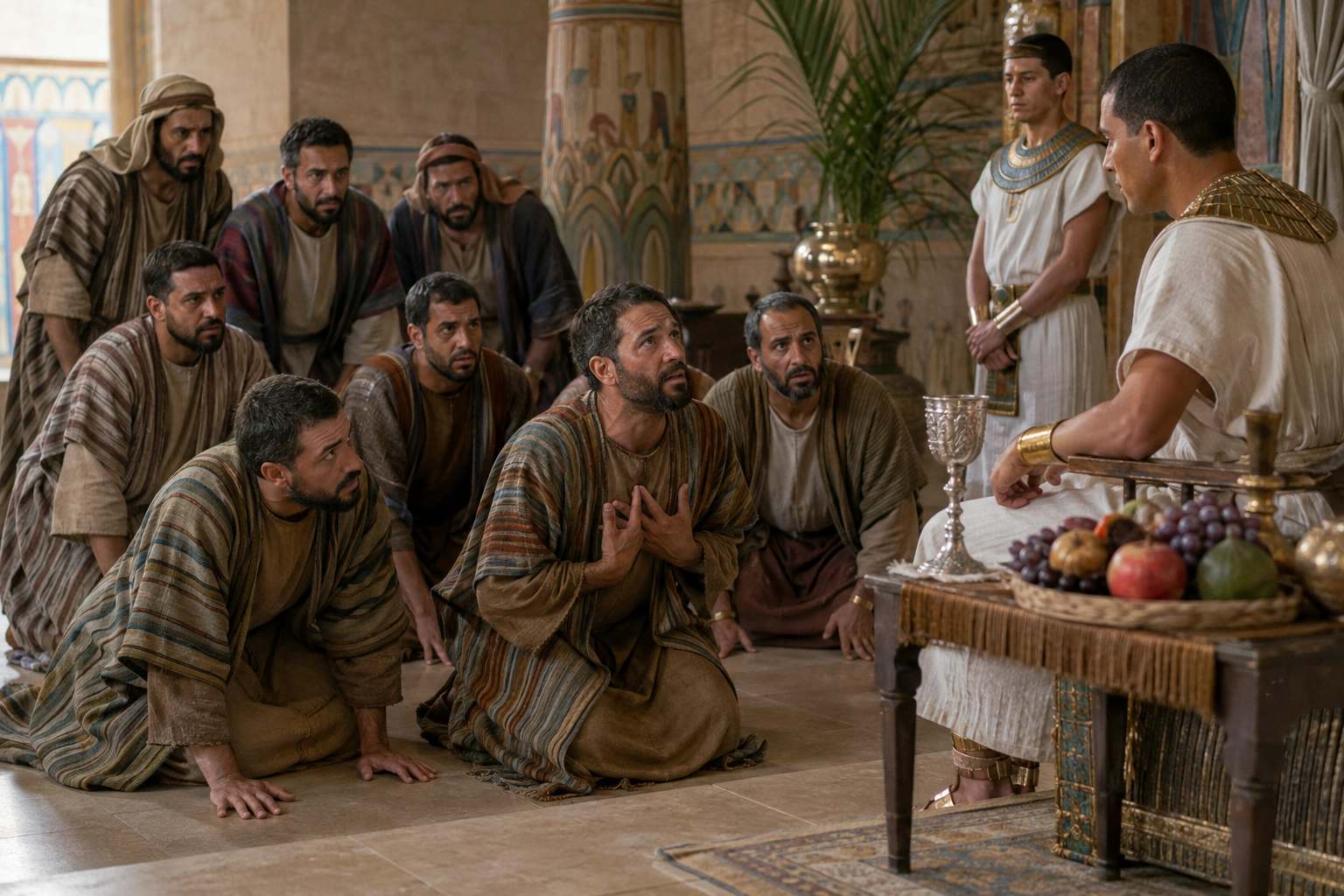
Genesis 42–44 records the first two journeys of Jacob’s sons into Egypt during the famine and Joseph’s dealings with them before revealing his identity. The narrative moves from fear and remembered guilt in chapter 42, to the return with Benjamin in chapter 43, and finally to the severe test involving Joseph’s silver cup in chapter 44.
Throughout these chapters, the KJV carefully shows what the brothers said, what Joseph did, and how Jacob responded. Joseph’s complete purpose behind every detail of his treatment of his brethren is not explicitly stated in chapters 42–44, so conclusions about his motives must be restrained. The text does explicitly say that Joseph “remembered the dreams which he dreamed of them” (Genesis 42:9), that he wept privately more than once, and that the brothers increasingly confronted the guilt of what they had done to Joseph years before.
Chapter Summaries
Genesis 42 — The First Journey into Egypt
 The famine that began in Genesis 41 now reaches Jacob’s household in Canaan. Jacob learns that there is corn in Egypt and tells his sons:
“Behold, I have heard that there is corn in Egypt: get you down thither, and buy for us from thence; that we may live, and not die.”
— Genesis 42:2
Ten of Joseph’s brethren travel to Egypt. Jacob does not send Benjamin, “for he said, Lest peradventure mischief befall him” (Genesis 42:4).
Joseph is now “the governor over the land,” and he is the one who sells corn to those coming to Egypt. When his brethren arrive:
“Joseph’s brethren came, and bowed down themselves before him with their faces to the earth.”
— Genesis 42:6
This plainly corresponds with the kind of submission Joseph had seen beforehand in his dreams in Genesis 37. Genesis 42:9 explicitly says:
“And Joseph remembered the dreams which he dreamed of them.”
Joseph recognizes his brethren, but they do not recognize him. He speaks roughly to them and charges them with being spies. They deny the accusation and explain their family situation: they are twelve brethren, the youngest remains with their father, and “one is not” (Genesis 42:13).
Joseph initially declares that they will be proved by having their youngest brother brought to Egypt. He places them together in ward for three days.
On the third day Joseph says:
“This do, and live; for I fear God.”
— Genesis 42:18
He modifies the arrangement. One brother will remain bound while the others take corn home, but Benjamin must be brought back to demonstrate the truth of their words.
At this point the brothers openly connect their present trouble with their former treatment of Joseph:
“We are verily guilty concerning our brother, in that we saw the anguish of his soul, when he besought us, and we would not hear; therefore is this distress come upon us.”
— Genesis 42:21
This is an explicit acknowledgment of guilt. The text does not use the word “repentance” here, but their words clearly demonstrate a troubled conscience and recognition of wrongdoing.
Reuben reminds them that he had warned them:
“Spake I not unto you, saying, Do not sin against the child; and ye would not hear?”
They do not know that Joseph understands them because he has been speaking through an interpreter. Joseph withdraws from them and weeps. He returns and takes Simeon from among them and binds him before their eyes.
Joseph commands that their sacks be filled with corn, that every man’s money be restored into his sack, and that they receive provision for their journey.
At the inn, one brother discovers his money in his sack. Their response is fear:
“And their heart failed them, and they were afraid, saying one to another, What is this that God hath done unto us?”
— Genesis 42:28
Notice the textual restraint necessary here: the brothers attribute the disturbing circumstance to God, but Genesis 42 has already told us that Joseph commanded the money to be restored (42:25).
When they return to Jacob, they explain what happened. Upon emptying their sacks, each man finds his bundle of money. Jacob is greatly distressed:
“Me have ye bereaved of my children: Joseph is not, and Simeon is not, and ye will take Benjamin away: all these things are against me.”
— Genesis 42:36
Jacob speaks according to what he presently sees and knows. Later Scripture will demonstrate that circumstances were not ultimately working against him.
Reuben offers his own two sons as a pledge if he fails to return Benjamin. Jacob refuses to send Benjamin.
Genesis 43 — Benjamin Goes to Egypt
The famine remains severe:
“And the famine was sore in the land.”
— Genesis 43:1
When the corn purchased in Egypt is consumed, Jacob tells his sons to return for more food.
Judah reminds his father that the Egyptian ruler had explicitly warned them:
“Ye shall not see my face, except your brother be with you.”
— Genesis 43:3
Jacob questions why they had told the man about Benjamin. The sons explain that the ruler had specifically questioned them concerning their father and whether they had another brother.
Judah then personally accepts responsibility for Benjamin:
“I will be surety for him; of my hand shalt thou require him.”
— Genesis 43:9
This is an important development in the narrative. Judah does not offer someone else’s life as security, as Reuben had done in Genesis 42:37. Judah places the responsibility upon himself.
Jacob finally consents. He instructs them to take a present consisting of “a little balm, and a little honey, spices, and myrrh, nuts, and almonds” (Genesis 43:11). He also tells them to take double money, including the money that had been returned in their sacks.
Jacob then says:
“And God Almighty give you mercy before the man, that he may send away your other brother, and Benjamin.”
— Genesis 43:14
This is Jacob’s expressed dependence upon God in the uncertainty of the situation.
When Joseph sees Benjamin with them, he commands the ruler of his house to bring the men into Joseph’s home and prepare a meal:
“Slay, and make ready; for these men shall dine with me at noon.”
— Genesis 43:16
The brothers become afraid when they are brought into Joseph’s house. They believe it may be because of the money that had previously been returned to their sacks and fear that they will be taken as bondmen.
They explain the matter to Joseph’s steward. He responds:
“Peace be to you, fear not: your God, and the God of your father, hath given you treasure in your sacks: I had your money.”
— Genesis 43:23
Simeon is then brought out to them.
When Joseph arrives, the brothers present their gift and again bow themselves to him. Joseph asks concerning Jacob:
“Is your father well, the old man of whom ye spake? Is he yet alive?”
— Genesis 43:27
They answer that he is alive and bow again.
Joseph then sees Benjamin:
“Is this your younger brother, of whom ye spake unto me?”
He says:
“God be gracious unto thee, my son.”
— Genesis 43:29
Joseph is deeply moved:
“Joseph made haste; for his bowels did yearn upon his brother: and he sought where to weep.”
He enters his chamber and weeps there privately. After washing his face and restraining himself, Joseph returns and commands that the meal be served.
The KJV specifically notes that Joseph, his brethren, and the Egyptians eat separately. Regarding the Egyptians:
“The Egyptians might not eat bread with the Hebrews; for that is an abomination unto the Egyptians.”
— Genesis 43:32
That cultural separation is explicitly stated. Scripture does not explain in this passage all of the historical reasons behind that Egyptian attitude, so it is safest not to add them as facts.
The brothers are seated before Joseph according to age:
“The firstborn according to his birthright, and the youngest according to his youth.”
They marvel at one another.
Benjamin receives:
“five times so much as any of theirs.”
The chapter closes:
“And they drank, and were merry with him.”
The situation appears peaceful, but Joseph’s dealings with them are not finished.
Genesis 44 — The Silver Cup and Judah’s Plea
Joseph commands his steward to fill the men’s sacks with food, restore every man’s money, and place Joseph’s silver cup in Benjamin’s sack.
After the brothers leave the city, Joseph commands the steward to pursue them and charge them concerning the cup.
The brothers are confident of their innocence. They remind the steward that they had voluntarily brought back the earlier money found in their sacks. They make an extremely strong declaration:
“With whomsoever of thy servants it be found, both let him die, and we also will be my lord’s bondmen.”
— Genesis 44:9
The steward does not accept the death penalty they proposed. Instead he declares that the person possessing the cup will become his servant, while the others will be blameless.
The search begins with the eldest and ends with the youngest:
“And the cup was found in Benjamin’s sack.”
— Genesis 44:12
The brothers respond:
“Then they rent their clothes, and laded every man his ass, and returned to the city.”
Their return together is significant because none of them abandons Benjamin.
That conduct may indicate a substantial change from their former willingness to dispose of Joseph, but Scripture does not explicitly state here, “They had now completely repented.” We should affirm the conduct the text records without claiming more than the text says.
When they return to Joseph, Judah and his brethren fall before him.
Judah says:
“What shall we say unto my lord? what shall we speak? or how shall we clear ourselves? God hath found out the iniquity of thy servants.”
— Genesis 44:16
Judah does not confess to stealing the cup. Rather, his reference to “the iniquity of thy servants” occurs against the larger background of the brothers’ already expressed guilt concerning Joseph in Genesis 42:21.
Joseph refuses to enslave all the brothers:
“The man in whose hand the cup is found, he shall be my servant; and as for you, get you up in peace unto your father.”
Judah then makes one of the most moving pleas in Genesis.
He approaches Joseph and carefully recounts their previous conversation. He explains Jacob’s attachment to Benjamin and says:
“his life is bound up in the lad’s life.”
— Genesis 44:30
Judah explains that he became surety for Benjamin:
“For thy servant became surety for the lad unto my father.”
He then offers himself:
“Now therefore, I pray thee, let thy servant abide instead of the lad a bondman to my lord; and let the lad go up with his brethren.”
— Genesis 44:33
Judah closes with concern for his father:
“For how shall I go up to my father, and the lad be not with me? lest peradventure I see the evil that shall come on my father.”
Genesis 44 ends there. Joseph’s response and revelation of his identity occur in Genesis 45 and therefore belong to the next chapter.
Key People and Places
Joseph
Jacob’s son and the governor of Egypt. He recognizes his brethren immediately, though they do not recognize him (42:7–8). He remembers his dreams (42:9), repeatedly controls the circumstances surrounding his brothers, and privately weeps when emotionally affected by them (42:24; 43:30).
The text does not explicitly explain every motive behind Joseph’s individual tests. They may indicate an effort to determine his brothers’ truthfulness and their treatment of Benjamin, but that conclusion should remain an inference rather than be presented as an explicit statement of Scripture.
Jacob / Israel
Father of Joseph, Benjamin, and their brethren. He fears losing Benjamin after believing Joseph already lost and with Simeon detained in Egypt. His statement, “all these things are against me” (42:36), expresses his limited human perspective.
Benjamin
Joseph’s full brother through Rachel. Jacob initially refuses to send him to Egypt. Joseph shows particular emotion upon seeing him and gives him five times the portion given to the other brothers (43:29–34). The silver cup is later deliberately placed in Benjamin’s sack.
Judah
He becomes the central spokesman in chapters 43–44. Judah personally guarantees Benjamin’s safe return and ultimately offers himself as a bondman in Benjamin’s place.
Reuben
Jacob’s eldest son. He reminds his brothers that he had warned them against sinning against Joseph (42:22). He also proposes that Jacob may kill his two sons if he fails to return Benjamin safely (42:37), but Jacob rejects the proposal.
Simeon
Joseph selects Simeon from among his brothers and binds him while the others return to Canaan (42:24). He is released when the brothers return with Benjamin (43:23).
Joseph’s Steward
Carries out Joseph’s commands concerning the brothers’ sacks and the silver cup. He also reassures the brothers when they express concern about the returned money (43:19–23).
Egypt
The location where grain is available during the famine. Joseph governs the land under Pharaoh’s authority, as established in Genesis 41.
Canaan
Jacob’s family remains in “the land of Canaan” (42:5, 29), where the famine forces them repeatedly to seek food from Egypt.
Joseph’s House
The location of the meal in Genesis 43 and the brothers’ return after Benjamin’s sack is found to contain the silver cup.
Main Doctrinal or Spiritual Themes
1. Sin Can Remain upon the Conscience
The brothers themselves make the connection between their present distress and their former sin:
“We are verily guilty concerning our brother.”
— Genesis 42:21
Years and changed circumstances had not made their deed righteous.
A conservative biblical principle is clear: time does not convert sin into innocence. Sin must be faced truthfully.
Proverbs 28:13 declares:
“He that covereth his sins shall not prosper: but whoso confesseth and forsaketh them shall have mercy.”
Genesis 42 explicitly shows acknowledgment of guilt; whether every brother had reached complete biblical repentance at that precise point is not explicitly stated.
2. The Fear of God Matters in Human Conduct
Joseph tells them:
“This do, and live; for I fear God.”
— Genesis 42:18
The fear of God is not presented as terror alone but as an acknowledgment that human conduct stands under God’s authority.
The biblical fear of God restrains evil and promotes righteousness.
“By the fear of the LORD men depart from evil.”
— Proverbs 16:6
3. Human Understanding Is Limited
Jacob declares:
“all these things are against me.”
— Genesis 42:36
From Jacob’s immediate perspective, Joseph was gone, Simeon was detained, and Benjamin was being demanded.
Yet Genesis will shortly reveal facts Jacob did not know.
This teaches an important biblical principle without requiring speculation: God’s people do not always possess enough information to interpret their circumstances correctly.
Later Joseph explicitly interprets the larger history:
“God did send me before you to preserve life.”
— Genesis 45:5
And:
“So now it was not you that sent me hither, but God.”
— Genesis 45:8
Those statements occur in the next chapter, but they provide Scripture’s own later explanation of the providential setting surrounding Genesis 42–44.
4. God’s Providence Can Operate Beyond Human Sight
Genesis 42–44 does not repeatedly stop to explain God’s hidden actions. Nevertheless, the larger Joseph narrative explicitly identifies God’s providence.
This should be stated carefully. We need not invent hidden revelations given to Joseph or claim that God directly instructed every detail of Joseph’s strategy. Scripture does not say that.
What Scripture does later say is enough: God used Joseph’s presence in Egypt “to preserve life” (45:5).
Biblical providence does not mean that man’s sinful actions become righteous. Joseph’s brethren remained guilty for their treatment of him. Yet God was able to accomplish His purpose without approving their sin.
Genesis 50:20 later gives the clearest inspired interpretation:
“But as for you, ye thought evil against me; but God meant it unto good.”
5. Personal Responsibility
Judah says:
“I will be surety for him; of my hand shalt thou require him.”
— Genesis 43:9
By Genesis 44, Judah does not merely repeat his promise. He is willing to bear the consequence himself:
“let thy servant abide instead of the lad a bondman to my lord.”
This plainly illustrates responsibility, faithfulness to one’s word, and self-sacrificial concern.
Some interpreters have drawn typological connections from Judah’s substitutionary offer. Scripture does not explicitly identify Judah’s action here as a prophetic type of Christ, so such a claim should not be treated as part of the direct meaning of Genesis 44.
The plainly stated lesson is already powerful: Judah had pledged himself for Benjamin and was willing to bear the cost of that pledge.
6. Genuine Concern Is Demonstrated by Conduct
In Genesis 37, Joseph’s brothers permitted Joseph to be carried away while they returned to their father.
In Genesis 44, when Benjamin is threatened with bondage, all the brothers return to the city with him, and Judah offers himself in Benjamin’s place.
That contrast may suggest a significant moral change in the brothers. Scripture unquestionably records different conduct; it does not explicitly provide a full spiritual diagnosis of each man’s heart at that moment.
7. God Remains the True Object of Dependence
Jacob finally says:
“And God Almighty give you mercy before the man.”
— Genesis 43:14
Jacob sends gifts, money, and Benjamin, but his expressed hope finally rests in “God Almighty.”
This remains a sound principle for believers: prudent action should never replace dependence upon God.
Practical Applications or Lessons
Deal Honestly With Past Sin
The brothers’ words in Genesis 42 are sobering:
“We are verily guilty.”
A believer should not excuse sin because it happened long ago. When the Holy Spirit uses the Word of God to expose sin, the biblical response is confession and forsaking.
“If we confess our sins, he is faithful and just to forgive us our sins.”
— 1 John 1:9
Keep Your Word
Judah promised:
“I will be surety for him.”
When the cost of that commitment became severe, Judah did not attempt to escape his responsibility.
Christians should be known for truthfulness, dependability, and integrity.
“Let your communication be, Yea, yea; Nay, nay.”
— Matthew 5:37
Do Not Judge God’s Work Solely by Present Circumstances
Jacob said:
“all these things are against me.”
His conclusion was understandable from what he could see, but it was incomplete because he lacked crucial information.
Believers should therefore be cautious about declaring what God is or is not doing when Scripture has not revealed it.
“For we walk by faith, not by sight.”
— 2 Corinthians 5:7
A Tender Heart Is Not Weakness
Joseph twice withdraws to weep—first after hearing his brothers discuss their guilt (42:24), and again after seeing Benjamin (43:30).
Scripture presents no contradiction between Joseph’s position of authority and his deep emotion.
Biblical strength does not require hardness of heart.
Fear God Above Circumstances
Joseph’s statement deserves emphasis:
“I fear God.”
Position, wealth, authority, and political power did not remove the importance of accountability before God.
“The fear of the LORD is the beginning of wisdom.”
— Proverbs 9:10
Family Responsibility Can Require Personal Sacrifice
Judah’s plea reaches its highest point when he asks to remain in Benjamin’s place.
Whatever additional lessons one might infer, the explicit moral fact is that Judah is willing to suffer loss personally rather than return home without the brother entrusted to him.
Faithfulness often has a cost.
Do Not Go Beyond What Scripture Says
These chapters are frequently used to construct elaborate explanations of Joseph’s psychology, strategy, or supposed secret intentions.
Some conclusions may be reasonable, but conservative Bible interpretation should distinguish between what is written and what is inferred.
For example:
- Explicit: Joseph recognized his brethren.
- Explicit: They did not recognize Joseph.
- Explicit: Joseph remembered his dreams.
- Explicit: Joseph accused them of being spies.
- Explicit: Joseph wept privately.
- Explicit: The brothers acknowledged guilt concerning Joseph.
- Explicit: Judah offered himself in Benjamin’s place.
- Possible inference: Joseph’s arrangements may have tested whether the brothers would abandon Benjamin as they had once abandoned Joseph.
- Not stated: Scripture does not explicitly tell us that this was Joseph’s complete motive for every action.
That distinction protects the authority of the text rather than replacing it with a familiar interpretation.
Overall Message of Genesis 42–44
Genesis 42–44 brings Joseph’s brethren face to face with circumstances that awaken their memory of former sin, while Joseph secretly observes and interacts with the family that had sold him away.
The movement of the passage is striking:
Genesis 42: guilt is remembered.
Genesis 43: Benjamin is brought to Joseph.
Genesis 44: Judah demonstrates willingness to sacrifice himself rather than abandon Benjamin.
Meanwhile Jacob sees only danger and loss, yet the reader knows Joseph is alive and in authority in Egypt. The next chapter will reveal what Jacob and the brethren cannot yet see.
Theologically, these chapters reinforce the fear of God, the seriousness of sin, personal responsibility, fidelity to one’s word, dependence upon God, and the limitation of human understanding. The broader Joseph narrative subsequently makes God’s providence explicit: what men intended for evil, God was able to use for preservation and good without becoming the author or approver of their sin.
Comments are closed