

Genesis 40–41 records Joseph’s final period in prison, his God-given interpretation of the dreams of Pharaoh’s officers, Pharaoh’s two dreams, Joseph’s sudden elevation to authority in Egypt, and the beginning of the great famine. The chapters emphasize that wisdom and interpretation belong to God, that earthly circumstances can change suddenly, and that God’s purposes are not hindered by imprisonment, neglect, or political power.
Chapter Summaries
Genesis 40 — Joseph Interprets the Dreams of Pharaoh’s Officers
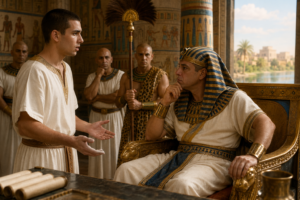 Genesis 40 opens with two officers of Pharaoh—the chief butler and the chief baker—offending their lord.
“And it came to pass after these things, that the butler of the king of Egypt and his baker had offended their lord the king of Egypt.”
— Genesis 40:1
Pharaoh placed both men in custody in the house of the captain of the guard, “into the prison, the place where Joseph was bound” (Genesis 40:3). The captain of the guard placed them under Joseph’s care, and Joseph served them.
The KJV does not state what offense the butler and baker committed. Any attempt to identify their crime would therefore be speculation and should be omitted.
After they had remained in custody for a period of time, both men dreamed on the same night. Each dream had its own meaning.
Joseph noticed that they appeared sad and asked:
“Wherefore look ye so sadly to day?”
— Genesis 40:7
They answered:
“We have dreamed a dream, and there is no interpreter of it.”
Joseph immediately directed attention away from himself and toward God:
“Do not interpretations belong to God? tell me them, I pray you.”
— Genesis 40:8
This statement establishes one of the central truths of these chapters: Joseph did not claim an independent supernatural ability. He attributed the interpretation of dreams to God.
The Chief Butler’s Dream
The chief butler saw a vine with three branches. It budded, blossomed, and produced ripe grapes. Pharaoh’s cup was in his hand, and he pressed the grapes into Pharaoh’s cup and gave the cup into Pharaoh’s hand.
Joseph interpreted the three branches as three days. Within three days Pharaoh would restore the chief butler to his former office.
Joseph then made a personal request:
“But think on me when it shall be well with thee, and shew kindness, I pray thee, unto me, and make mention of me unto Pharaoh, and bring me out of this house:”
— Genesis 40:14
Joseph also testified concerning his circumstances:
“For indeed I was stolen away out of the land of the Hebrews: and here also have I done nothing that they should put me into the dungeon.”
— Genesis 40:15
This is Joseph’s own explicit testimony that he had been wrongfully placed there.
His request to the butler is important. Trust in God did not prevent Joseph from making proper use of an ordinary human means of deliverance. There is no biblical reason to characterize his request as unbelief.
The Chief Baker’s Dream
When the chief baker saw that the first interpretation was favorable, he told Joseph his own dream. Three white baskets were upon his head, and the uppermost contained baked food for Pharaoh. Birds ate the food from the basket.
Joseph again interpreted the three as three days, but this interpretation was one of judgment:
“Yet within three days shall Pharaoh lift up thy head from off thee, and shall hang thee on a tree; and the birds shall eat thy flesh from off thee.”
— Genesis 40:19
Joseph did not alter the message simply because it was unpleasant. He faithfully gave both the favorable and unfavorable interpretation.
That principle is important in Bible teaching. A faithful servant of God must not alter truth according to whether men find it comforting.
The Interpretations Fulfilled
Three days later, on Pharaoh’s birthday, Pharaoh made a feast for his servants. The chief butler was restored to his position, while the chief baker was executed, exactly as Joseph had interpreted.
The chapter closes on a deliberately sober note:
“Yet did not the chief butler remember Joseph, but forgat him.”
— Genesis 40:23
Scripture explicitly states that the butler forgot Joseph.
It does not explicitly state that God caused the butler to forget Joseph for a predetermined length of time. The sequence of events may indicate providential timing, especially in light of what happens in Genesis 41, but that should be identified as an inference rather than stated as an explicit fact.
Genesis 41 — Pharaoh’s Dreams and Joseph’s Exaltation
Genesis 41 begins:
“And it came to pass at the end of two full years, that Pharaoh dreamed: and, behold, he stood by the river.”
— Genesis 41:1
Joseph therefore remained in his situation for another “two full years” after the events of Genesis 40.
The KJV calls the body of water simply “the river” in this passage. Because the setting is Egypt, it is commonly understood historically to be the Nile, but Genesis 41 itself does not name it as the Nile. The certainty of the biblical text should therefore remain primary.
Pharaoh’s First Dream
Pharaoh saw seven well-favored and fat kine come out of the river and feed in a meadow. After them came seven other kine described as:
“ill favoured and leanfleshed”
The seven lean kine devoured the seven fat kine. Pharaoh awoke.
Pharaoh’s Second Dream
Pharaoh then dreamed again. Seven good and full ears of corn came up upon one stalk. After them arose seven thin ears:
“blasted with the east wind.”
The seven thin ears devoured the seven full ears.
When Pharaoh awoke the second time, he recognized that he had dreamed.
His spirit was troubled, and he called for “all the magicians of Egypt, and all the wise men thereof.” Pharaoh told them his dreams:
“but there was none that could interpret them unto Pharaoh.”
— Genesis 41:8
Human wisdom in Pharaoh’s court was unable to supply the answer God was about to reveal through Joseph.
The Chief Butler Remembers Joseph
The crisis caused the chief butler to remember what had happened in prison.
He confessed:
“I do remember my faults this day:”
— Genesis 41:9
He recounted how he and the baker had dreamed and how:
“there was there with us a young man, an Hebrew, servant to the captain of the guard”
who had correctly interpreted both dreams.
Pharaoh immediately sent for Joseph.
Joseph was:
“brought him hastily out of the dungeon”
and after he had shaved himself and changed his clothing, he appeared before Pharaoh.
The shaving and change of clothing are explicitly stated. Explanations about particular Egyptian grooming customs may be historically plausible, but Scripture itself does not explain why those preparations were required.
Joseph Gives God the Glory
Pharaoh told Joseph:
“I have heard say of thee, that thou canst understand a dream to interpret it.”
Joseph answered with remarkable clarity:
“It is not in me: God shall give Pharaoh an answer of peace.”
— Genesis 41:16
Joseph refused to take credit for divine revelation.
This agrees perfectly with his statement in Genesis 40:8:
“Do not interpretations belong to God?”
Joseph’s circumstances had changed dramatically, but his testimony concerning the source of interpretation had not changed.
The Meaning of Pharaoh’s Dreams
After hearing Pharaoh recount the dreams, Joseph stated:
“The dream of Pharaoh is one: God hath shewed Pharaoh what he is about to do.”
— Genesis 41:25
The seven good kine and seven good ears represented seven years. The seven lean kine and seven empty ears represented seven years of famine.
There would first be:
“seven years of great plenty throughout all the land of Egypt”
followed by seven years of famine so severe that:
“all the plenty shall be forgotten in the land of Egypt; and the famine shall consume the land.”
— Genesis 41:30
Joseph further explained why Pharaoh received the revelation twice:
“And for that the dream was doubled unto Pharaoh twice; it is because the thing is established by God, and God will shortly bring it to pass.”
— Genesis 41:32
That explanation is not conjecture. The KJV explicitly gives the reason for the doubled dream.
Joseph Recommends Preparation
Joseph did more than interpret the coming events. He advised Pharaoh to appoint:
“a man discreet and wise”
over Egypt.
He recommended appointing officers throughout the land and taking up:
“the fifth part of the land of Egypt in the seven plenteous years.”
Food was to be gathered during the years of abundance and stored against the coming famine.
Biblical faith does not oppose prudent preparation. Because God had revealed what was coming, wisdom required action in accordance with that revelation.
Pharaoh Elevates Joseph
Pharaoh and his servants approved Joseph’s counsel.
Pharaoh said:
“Can we find such a one as this is, a man in whom the Spirit of God is?”
— Genesis 41:38
He then said to Joseph:
“Forasmuch as God hath shewed thee all this, there is none so discreet and wise as thou art:”
— Genesis 41:39
Joseph was placed over Pharaoh’s house and given extraordinary authority:
“Only in the throne will I be greater than thou.”
— Genesis 41:40
Pharaoh gave Joseph his ring, clothed him in fine linen, placed a gold chain about his neck, and caused him to ride in the second chariot.
The people were commanded:
“Bow the knee”
before him.
Pharaoh further declared:
“I am Pharaoh, and without thee shall no man lift up his hand or foot in all the land of Egypt.”
— Genesis 41:44
Joseph received the Egyptian name Zaphnath-paaneah, and Pharaoh gave him Asenath, daughter of Potipherah priest of On, as his wife.
Attempts to give a certain meaning to “Zaphnath-paaneah” vary among historical sources. Since Genesis 41 does not define the name, no proposed meaning should be presented as though Scripture explicitly supplies it.
Joseph at Thirty Years of Age
The text gives Joseph’s age precisely:
“And Joseph was thirty years old when he stood before Pharaoh king of Egypt.”
— Genesis 41:46
Genesis 37:2 says Joseph was seventeen when the earlier account of his conflict with his brethren began. Comparing the explicit ages shows a thirteen-year difference between those two stated ages.
Genesis 41 does not divide every one of those years between slavery and imprisonment, so a more detailed chronology should not be asserted without qualification.
The Seven Years of Plenty
The earth produced abundantly during the seven years of plenty.
Joseph gathered:
“corn as the sand of the sea, very much, until he left numbering; for it was without number.”
— Genesis 41:49
This fulfilled the first portion of the interpretation.
Manasseh and Ephraim
Before the famine began, Joseph and Asenath had two sons.
Joseph named the first Manasseh, saying:
“For God, said he, hath made me forget all my toil, and all my father’s house.”
— Genesis 41:51
This statement should not be stretched beyond its wording. It does not mean Joseph literally lost his memory of his father or family. The statement concerns what God had done regarding Joseph’s “toil” and “all my father’s house,” in the sense Joseph himself expresses.
His second son was Ephraim:
“For God hath caused me to be fruitful in the land of my affliction.”
— Genesis 41:52
Notice that even after attaining great authority, Joseph still called Egypt:
“the land of my affliction.”
His prosperity did not rewrite the reality of his suffering.
The Famine Begins
When the seven years of plenty ended:
“the seven years of dearth began to come, according as Joseph had said”
The text says:
“the dearth was in all lands; but in all the land of Egypt there was bread.”
— Genesis 41:54
When the Egyptians cried to Pharaoh for food, Pharaoh told them:
“Go unto Joseph; what he saith to you, do.”
Joseph opened the storehouses and sold grain to the Egyptians.
The chapter concludes:
“And all countries came into Egypt to Joseph for to buy corn; because that the famine was so sore in all lands.”
— Genesis 41:57
This prepares directly for Genesis 42, when Joseph’s brethren come into Egypt seeking food.
Key People and Places
Joseph
The son of Jacob who had been sold into Egypt and was imprisoned. In these chapters he interprets dreams by God’s revelation, advises Pharaoh concerning the coming famine, and is appointed ruler under Pharaoh.
His consistent testimony is crucial:
“Do not interpretations belong to God?” — Genesis 40:8
and:
“It is not in me: God shall give Pharaoh an answer of peace.” — Genesis 41:16
Pharaoh
The king of Egypt. Genesis 41 records his two divinely significant dreams and his elevation of Joseph to authority over Egypt.
The passage does not identify this Pharaoh by personal name. Attempts to assign him to a particular Egyptian dynasty go beyond what Genesis 40–41 explicitly states.
Chief Butler
An officer of Pharaoh responsible in connection with Pharaoh’s cup. He was imprisoned, received a favorable dream interpretation from Joseph, was restored to his position, forgot Joseph, and remembered him two full years later when Pharaoh required an interpreter.
Chief Baker
Another officer of Pharaoh who was imprisoned. Joseph correctly interpreted his dream as predicting his execution three days later.
Asenath
Joseph’s wife, explicitly identified as:
“the daughter of Potipherah priest of On”
— Genesis 41:45
Potipherah
The father of Asenath and “priest of On.”
He should not be confused merely by similarity of name with Potiphar unless the Scripture establishes an identification. Genesis does not state that they were the same man.
Manasseh
Joseph’s firstborn son. His name is associated in the text with Joseph’s statement that God had made him forget his toil and his father’s house.
Ephraim
Joseph’s second son. His name is associated with Joseph’s testimony:
“God hath caused me to be fruitful in the land of my affliction.”
Egypt
The principal geographic setting of both chapters. Joseph goes from imprisonment to ruling throughout the land under Pharaoh.
The Land of the Hebrews
Joseph uses this expression in Genesis 40:15 concerning the place from which he had been taken:
“I was stolen away out of the land of the Hebrews”
The verse itself supplies the designation.
On
The city or locality associated with Potipherah, who is called “priest of On.” Genesis 41 does not provide further geographical description in the chapter.
The River
Pharaoh stands beside “the river” in his dream. In the Egyptian setting it may reasonably be understood historically as the Nile, but Genesis 41 itself calls it simply “the river.”
Main Doctrinal or Spiritual Themes
1. God Is the Source of True Revelation
Joseph would not accept praise that belonged to God.
“Do not interpretations belong to God?”
— Genesis 40:8
“It is not in me: God shall give Pharaoh an answer of peace.”
— Genesis 41:16
Biblical ministry must have the same emphasis. The servant is not the source of divine truth. God has spoken, and the servant’s responsibility is to faithfully declare what God has revealed.
For believers today, our final written authority is not dreams, impressions, traditions, or human scholarship, but the written Word of God.
2. God’s Purposes Are Greater Than Human Circumstances
Joseph begins Genesis 40 in prison. By Genesis 41 he is:
“over all the land of Egypt.”
The transformation is remarkable.
The text clearly records the sequence. It does not explicitly say that every action of every person involved was directly caused by God. Nevertheless, Pharaoh himself acknowledged that God had shown Joseph what was coming, and Joseph repeatedly attributed the revelation to God.
The events therefore strongly demonstrate that imprisonment cannot prevent God from accomplishing what He has revealed.
3. God’s Word Is Certain
Joseph said:
“the thing is established by God, and God will shortly bring it to pass.”
— Genesis 41:32
The seven years of plenty came.
The seven years of famine came.
What God revealed happened exactly as He said.
God’s Word does not become true when circumstances confirm it. It is true because God has spoken.
4. Divine Sovereignty Does Not Eliminate Human Responsibility
God revealed that famine was coming, but Joseph did not tell Pharaoh to do nothing.
He recommended organized preparation.
The revelation produced responsible action.
This gives a sound biblical balance: confidence in God is not carelessness. Where God has made duty clear, faith obeys and prepares.
5. Wisdom Includes Stewardship
During abundance, Joseph stored food for future need.
“And let them gather all the food of those good years that come”
The principle is plain: abundance should not automatically produce wastefulness.
While Genesis 41 describes a unique national emergency revealed beforehand by God, the broader principle of wise stewardship is consistent with Scripture.
6. Faithfulness Includes Telling Unpleasant Truth
Joseph gave the butler good news.
He gave the baker dreadful news.
He did not modify either interpretation.
The messenger’s responsibility is faithfulness to the message.
This is particularly important in preaching. Biblical preaching must include both the gracious promises of God and His warnings of judgment.
7. Promotion Should Produce Humility, Not Self-Glory
When Pharaoh praised Joseph’s supposed ability, Joseph immediately answered:
“It is not in me”
That is the proper attitude of a servant of God.
Ability, opportunity, understanding, and usefulness should direct glory toward God rather than toward self.
8. God Can Give Wisdom Recognizable Even to Unbelieving Rulers
Pharaoh declared:
“Can we find such a one as this is, a man in whom the Spirit of God is?”
Whatever the full extent of Pharaoh’s theological understanding may have been, the text explicitly records his recognition that Joseph’s wisdom was connected with God.
Scripture does not state here that Pharaoh became a true worshiper of the LORD, so that conclusion should not be added to the passage.
9. Prosperity Does Not Erase the Reality of Affliction
Joseph named Ephraim because:
“God hath caused me to be fruitful in the land of my affliction.”
Egypt was simultaneously the place where Joseph prospered and:
“the land of my affliction.”
A believer does not have to deny suffering in order to acknowledge God’s blessings.
10. Waiting Does Not Mean God Has Lost Control
Genesis 41 begins:
“at the end of two full years”
From Joseph’s perspective, the chief butler’s forgetfulness meant continued confinement.
Scripture does not explicitly state why God permitted that two-year period. We therefore should not invent God’s undisclosed reasons.
What Scripture does show is that Joseph was still in the dungeon when the circumstance arose that brought him before Pharaoh.
The sequence may suggest providential timing, but the precise purpose of every day of the delay is not revealed.
Practical Applications or Lessons
Give God the credit.
Joseph’s words deserve to govern Christian service:
“It is not in me.”
A preacher, teacher, soul winner, parent, or Christian worker must resist the temptation to turn God’s work into personal glory.
Remain faithful where you are.
Joseph served while imprisoned. He did not possess Pharaoh’s authority in Genesis 40, but he could still faithfully perform the responsibility before him.
Present usefulness should not depend upon receiving a preferred position.
Pay attention to people.
Joseph noticed the countenances of the butler and baker:
“Wherefore look ye so sadly to day?”
He was suffering himself, yet he noticed the distress of others.
That is a valuable example of practical concern.
Tell the truth even when it is difficult.
Joseph could not give the baker the answer he wanted.
A Bible preacher has the same obligation. Scripture must not be softened to gain approval.
“Preach the word; be instant in season, out of season; reprove, rebuke, exhort with all longsuffering and doctrine.”
— 2 Timothy 4:2
Do not confuse being forgotten by people with being useless.
The chief butler:
“forgat him.”
Yet Joseph’s usefulness did not depend upon the butler’s memory.
People may neglect faithful service, but human recognition is not the measure of whether service matters.
Prepare wisely during seasons of abundance.
Joseph’s counsel concerning the seven prosperous years demonstrates prudent preparation rather than careless consumption.
Believers should exercise stewardship with money, possessions, opportunities, health, and time while those resources are available.
Character matters when responsibility increases.
Pharaoh described Joseph as:
“discreet and wise.”
Joseph’s advancement brought enormous responsibility. Biblical leadership requires more than talent; it requires wisdom and sound judgment.
Success must not replace remembrance of God.
Joseph’s naming of both sons refers explicitly to God:
“God… hath made me forget all my toil”
and:
“God hath caused me to be fruitful”
Joseph did not describe his prosperity as self-made.
Do not build doctrine upon details God has not revealed.
Genesis 40–41 contains many matters that invite curiosity: the exact identity of Pharaoh, the precise crime of the officers, the exact Egyptian meaning of Joseph’s new name, or God’s unrevealed reason for the two-year delay.
Conservative Bible interpretation should resist the urge to convert possibilities into facts.
“Every word of God is pure…”
— Proverbs 30:5
The safest position is to say what Scripture says with confidence and to stop where Scripture stops.
Overall Message of Genesis 40–41
Genesis 40 begins with Joseph serving prisoners.
Genesis 41 ends with nations coming to Joseph for food.
Between those two conditions stands the unmistakable testimony:
“It is not in me: God shall give Pharaoh an answer of peace.”
Joseph’s wisdom was not self-originating. Pharaoh’s dreams were not meaningless. The coming abundance and famine were not unknown to God.
God revealed what He was about to do, Joseph faithfully declared it, Pharaoh acted upon the counsel, and the predicted events came to pass.
From a conservative Baptist standpoint, Genesis 40–41 therefore emphasizes the certainty of God’s Word, the necessity of faithfulness, humility in service, wise stewardship, and confidence that human circumstances cannot overturn what God has established.
It should not be turned into speculative allegory. The historical events should first be understood as real events involving Joseph, Pharaoh, Egypt, seven years of plenty, and seven years of famine. Spiritual applications should arise from that plain historical meaning rather than replace it.
Comments are closed