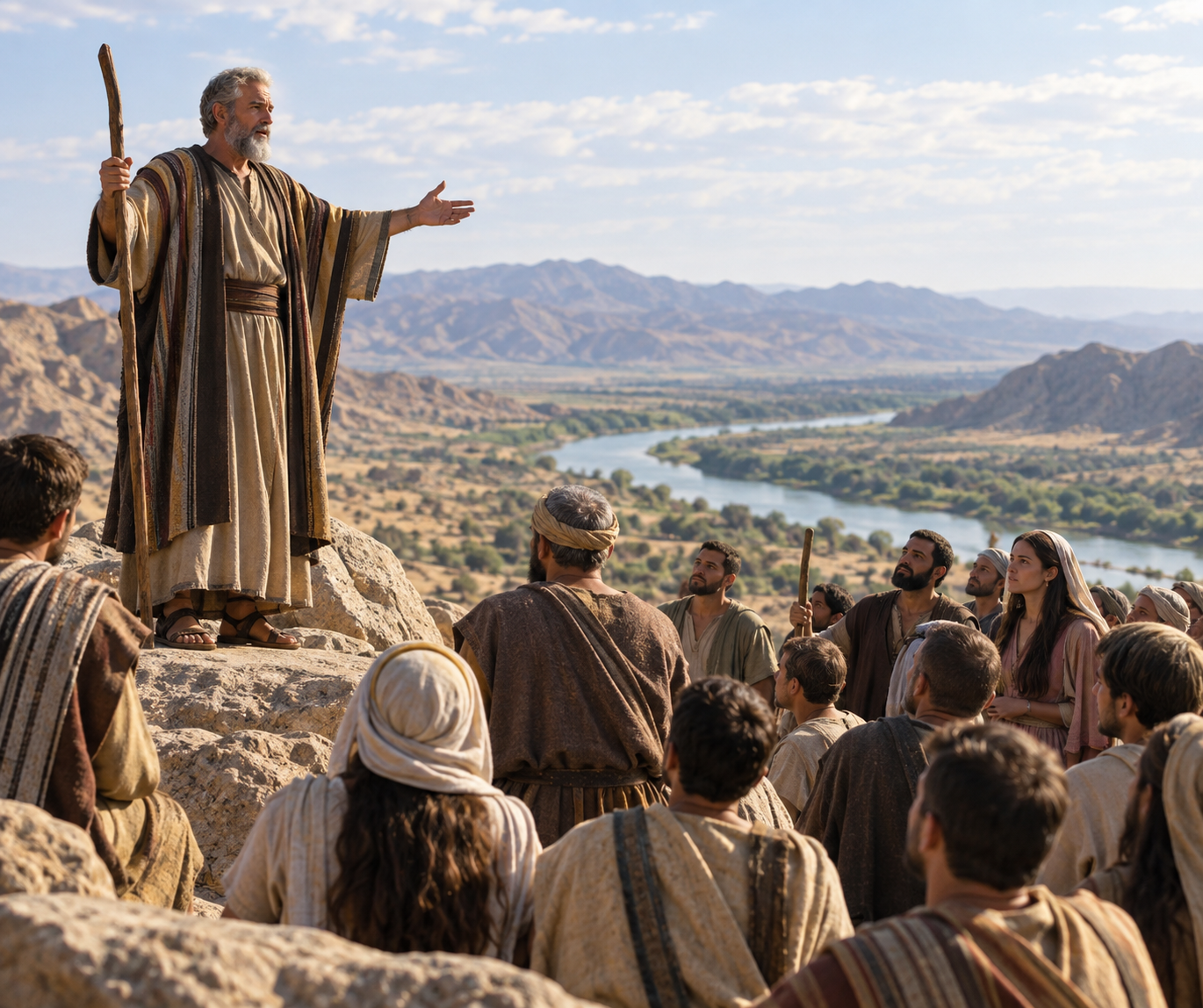
 Deuteronomy 11–13 continues Moses’ instruction to Israel before they cross Jordan into the land promised by the LORD. Deuteronomy 11:31 explicitly looks forward to that crossing: “For ye shall pass over Jordan to go in to possess the land which the LORD your God giveth you.” The emphasis throughout these chapters is unmistakable: Israel must love the LORD, obey His commandments, reject idolatry completely, worship according to His revealed order, and refuse every person or influence that would turn them after other gods.
These chapters also establish an important biblical principle: sincerity, impressive signs, family affection, majority opinion, and religious curiosity must never take precedence over the revealed Word of God. God Himself determines how He is to be worshipped.
Chapter Summaries
Deuteronomy 11 — Love, Obedience, Blessing, and the Choice Set Before Israel
Moses begins by joining love for God with obedience:
“Therefore thou shalt love the LORD thy God, and keep his charge, and his statutes, and his judgments, and his commandments, alway.” — Deuteronomy 11:1
The chapter first reminds Israel of what they themselves had seen of the LORD’s mighty works. Moses speaks of His acts in Egypt, His judgment upon Pharaoh and his army, His care for Israel in the wilderness, and what He did to Dathan and Abiram.
Deuteronomy 11:2 carefully distinguishes those addressed from children who had not personally known or seen all those judgments: “And know ye this day: for I speak not with your children which have not known, and which have not seen…” Moses therefore appeals to witnessed acts of God as grounds for faithful obedience.
The land Israel is entering is contrasted with Egypt. Egypt is described as a land where seed was watered “with thy foot, as a garden of herbs” (Deuteronomy 11:10), whereas Canaan is:
“A land of hills and valleys, and drinketh water of the rain of heaven: A land which the LORD thy God careth for…” — Deuteronomy 11:11–12
The theological emphasis is not merely agricultural. Israel’s prosperity in the land would depend upon the LORD’s favor. Obedience would be accompanied by rain and fruitful harvests; turning aside after other gods would bring divine judgment, including the withholding of rain.
Moses warns:
“Take heed to yourselves, that your heart be not deceived, and ye turn aside, and serve other gods, and worship them.” — Deuteronomy 11:16
That warning shows that apostasy begins in the heart before appearing openly in worship.
The words of God were to be laid up “in your heart and in your soul” (verse 18). They were to be taught diligently to their children, spoken of in the home and along the way, and kept continually before the nation.
The chapter then presents Israel with two clearly defined alternatives:
“Behold, I set before you this day a blessing and a curse; A blessing, if ye obey the commandments of the LORD your God… And a curse, if ye will not obey…” — Deuteronomy 11:26–28
Mount Gerizim is associated with the blessing and Mount Ebal with the curse. Moses gives geographic markers in verses 29–30, including Gilgal and “the plains of Moreh.”
The chapter closes with another command to observe all that God had given:
“And ye shall observe to do all the statutes and judgments which I set before you this day.” — Deuteronomy 11:32
The plain teaching is that love for God is not presented as mere emotion. In Israel’s covenant obligation, love is repeatedly connected with hearing, keeping, and doing what God commanded.
Deuteronomy 12 — The LORD Determines the Place and Manner of Worship
Chapter 12 turns especially to Israel’s worship after entering the land.
The first requirement is the complete destruction of the places where the nations served their false gods:
“Ye shall utterly destroy all the places, wherein the nations which ye shall possess served their gods…” — Deuteronomy 12:2
Israel was commanded to overthrow altars, break pillars, burn groves, hew down graven images, and destroy the names associated with false worship.
The next statement is crucial:
“Ye shall not do so unto the LORD your God.” — Deuteronomy 12:4
Israel was not permitted to adopt pagan worship methods and simply attach the LORD’s name to them. The LORD prescribed the manner of His own worship.
Instead, they were to seek the place:
“Which the LORD your God shall choose out of all your tribes to put his name there…” — Deuteronomy 12:5
Deuteronomy 12 itself does not name that location. Therefore, it would go beyond this chapter to identify the unnamed place solely from the wording here. The chapter’s explicit point is that God, not Israel, would choose it.
Burnt offerings, sacrifices, tithes, heave offerings, vows, freewill offerings, and firstlings were connected with the place chosen by the LORD.
Moses warns Israel not to behave according to individual preference:
“Ye shall not do after all the things that we do here this day, every man whatsoever is right in his own eyes.” — Deuteronomy 12:8
Once God established His order in the land, worship was to conform to His revealed command rather than personal judgment.
The chapter also distinguishes ordinary eating of meat from sacrificial worship. Israel could kill and eat flesh within their gates according to the LORD’s blessing, but they were repeatedly forbidden to eat blood:
“Only be sure that thou eat not the blood: for the blood is the life; and thou mayest not eat the life with the flesh.” — Deuteronomy 12:23
Another major warning concerns curiosity about pagan religion. Israel was specifically forbidden from asking how the nations worshipped their gods in order to imitate those practices:
“Take heed to thyself that thou be not snared by following them… and that thou enquire not after their gods, saying, How did these nations serve their gods? even so will I do likewise.” — Deuteronomy 12:30
The reason is given plainly: those nations committed things that were abominable to the LORD.
The chapter closes with a fundamental principle of biblical obedience:
“What thing soever I command you, observe to do it: thou shalt not add thereto, nor diminish from it.” — Deuteronomy 12:32
God’s people were neither to enlarge His commands according to human preference nor reduce them when obedience became inconvenient.
Deuteronomy 13 — Testing Religious Claims and Rejecting Apostasy
Chapter 13 addresses three possible sources of temptation toward idolatry: a prophet or dreamer, a close loved one or friend, and an entire city.
The standard remains the revealed command of God.
The prophet or dreamer — Deuteronomy 13:1–5
A prophet or dreamer might give a sign or wonder, and the sign might even come to pass. Yet if he then says:
“Let us go after other gods, which thou hast not known, and let us serve them” — Deuteronomy 13:2
Israel was commanded:
“Thou shalt not hearken unto the words of that prophet, or that dreamer of dreams…” — Deuteronomy 13:3
This is an extraordinarily important doctrinal principle. A supernatural-looking event, fulfilled prediction, sign, or wonder does not have authority to overturn what God has already spoken.
The verse gives an explicit reason such a test could occur:
“For the LORD your God proveth you, to know whether ye love the LORD your God with all your heart and with all your soul.” — Deuteronomy 13:3
Israel was instead commanded to walk after the LORD, fear Him, keep His commandments, obey His voice, serve Him, and cleave unto Him.
Under Israel’s Mosaic covenant law, the false prophet who sought to turn Israel from the LORD was to be put to death. The stated purpose was:
“So shalt thou put the evil away from the midst of thee.” — Deuteronomy 13:5
This civil penalty belonged to Israel under the law given through Moses. Scripture does not give the New Testament church authority to establish Israel’s national judicial system or carry out Israel’s civil penalties. The spiritual principle against false doctrine remains, but the church and Israel must not be confused.
The close relative or friend — Deuteronomy 13:6–11
The next danger is intensely personal. Moses mentions a brother, son, daughter, wife, or a friend “which is as thine own soul.”
Even the closest earthly relationship could not justify apostasy.
If such a person secretly urged:
“Let us go and serve other gods…” — Deuteronomy 13:6
Israel was commanded not to consent, hearken, pity, spare, or conceal the matter.
The lesson is severe but plain: loyalty to the LORD stands above even the strongest natural affection when someone attempts to lead a person into idolatry.
The judicial command given to Israel included death by stoning, with the witness taking the leading role. The intended result included public fear:
“And all Israel shall hear, and fear, and shall do no more any such wickedness as this is among you.” — Deuteronomy 13:11
Again, this is an explicit command within Israel’s covenant government. It should not be transferred to the New Testament church as a civil enforcement command.
An apostate city — Deuteronomy 13:12–18
The third situation concerns reports that men described as “certain men, the children of Belial” had drawn away the inhabitants of a city to serve other gods.
Importantly, Israel was not commanded to act on rumor alone.
They were to:
“Enquire, and make search, and ask diligently…” — Deuteronomy 13:14
Only “if it be truth, and the thing certain” was judgment to proceed.
This establishes a principle of careful verification. Serious accusations were not to be treated as proven merely because they had been reported.
If the charge was established, the Mosaic law required the city to be utterly destroyed and burned, and Israel was forbidden from keeping the condemned spoil.
The chapter ends by returning to obedience:
“When thou shalt hearken to the voice of the LORD thy God, to keep all his commandments which I command thee this day, to do that which is right in the eyes of the LORD thy God.” — Deuteronomy 13:18
The repeated standard is not what appears right to man, but what is right “in the eyes of the LORD.”
Key People and Places
- Moses — The speaker delivering the LORD’s statutes and judgments to Israel. Deuteronomy 11:31 shows that the crossing of Jordan is still future within this address.
- The LORD God — The covenant God whom Israel is commanded to love, fear, obey, serve, and worship exclusively.
- The children of Israel — The people receiving these commands before entering the land.
- Pharaoh and the Egyptians — Recalled in Deuteronomy 11 as examples of God’s mighty acts and judgment.
- Dathan and Abiram — Mentioned in Deuteronomy 11:6 as men upon whom God brought judgment. The verse names them as “the sons of Eliab, the son of Reuben.”
- Jordan — The river Israel is explicitly said to be preparing to cross in Deuteronomy 11:31.
- Egypt — The land from which the LORD delivered Israel and which Moses contrasts agriculturally with the land Israel is entering.
- The promised land — Described as “a land of hills and valleys” that “drinketh water of the rain of heaven” and which the LORD cares for.
- Mount Gerizim — The mountain upon which the blessing was to be set.
- Mount Ebal — The mountain upon which the curse was to be set.
- Gilgal — A geographic reference used in locating Gerizim and Ebal in Deuteronomy 11:30.
- The plains of Moreh — Another geographical marker in Deuteronomy 11:30.
- Canaanites — Mentioned geographically in Deuteronomy 11:30.
- False prophet or dreamer of dreams — A person whose sign may come to pass but whose message seeks to turn Israel after other gods.
- Close family member or friend — Used in Deuteronomy 13 as an example showing that personal affection cannot supersede loyalty to God.
- Children of Belial — The expression used in Deuteronomy 13:13 for certain wicked men who sought to draw a city into idolatry.
Main Doctrinal or Spiritual Themes
1. Love for God produces obedience
Deuteronomy 11 does not separate loving the LORD from keeping His commandments:
“Therefore shall ye keep all the commandments which I command you this day…” — Deuteronomy 11:8
Biblical love for God cannot rightly be defined in a manner that dismisses His revealed Word.
2. God alone has the right to define acceptable worship
Deuteronomy 12 rejects the idea that man may borrow pagan practices and redirect them toward the LORD.
“Ye shall not do so unto the LORD your God” is a powerful boundary against man-made worship.
The application for believers is not that every detail of Israel’s ceremonial law is binding upon the church. Rather, the abiding truth is that God is not honored by disobedience disguised as worship.
3. Separation from idolatry is commanded
Israel was not told to preserve pagan religious systems for religious cooperation. Their covenant command was separation and destruction of idolatrous worship within the land God gave them.
For the New Testament believer, separation is spiritual and ecclesiastical rather than the execution of Israel’s national penalties. The church is commanded to reject false doctrine and separation from spiritual uncleanness is taught plainly in passages such as 2 Corinthians 6:14–18.
4. Obedience brings blessing; rebellion brings consequences
In Deuteronomy 11 this principle is given specifically to Israel concerning life in the land. It should therefore not be converted into a promise that every obedient Christian will receive agricultural or material prosperity.
The broader spiritual truth remains that God approves obedience and condemns rebellion.
5. God’s Word stands above signs and wonders
Deuteronomy 13 makes this explicit. Even when a sign comes to pass, its apparent success does not validate a message that contradicts God.
Experience must be judged by Scripture; Scripture must not be reinterpreted to accommodate experience.
6. Truth takes precedence over relationships
Deuteronomy 13:6–11 shows that even the closest human relationship cannot justify disloyalty to the LORD.
No pastor, family member, teacher, friend, or religious leader has authority to lead a believer contrary to Scripture.
7. Serious accusations require diligent inquiry
Deuteronomy 13:14 commands:
“Then shalt thou enquire, and make search, and ask diligently…”
This does not permit careless rumor, emotional reaction, or unverified accusation. The text explicitly requires certainty before Israel carried out judgment.
8. God requires exclusive worship
The repeated danger in all three chapters is departure after “other gods.”
Biblical faith permits no divided allegiance between the LORD and idols.
9. Scripture must neither be added to nor diminished
Deuteronomy 12:32 establishes a vital principle:
“What thing soever I command you, observe to do it: thou shalt not add thereto, nor diminish from it.”
Human tradition has no authority to correct, weaken, enlarge, or override what God has spoken.
10. Israel and the Church must be distinguished
Deuteronomy 11–13 contains covenant commands given directly to Israel concerning the land, its national life, worship regulations, and civil judgments.
The New Testament church is not national Israel and has not been commissioned to administer Israel’s Mosaic civil penalties. Nevertheless, these passages remain “profitable for doctrine, for reproof, for correction, for instruction in righteousness” according to 2 Timothy 3:16, and their moral and spiritual truths remain instructive.
That distinction preserves the plain meaning of the passage without either discarding its teaching or wrongly transferring Israel’s national law to the church.
Practical Applications or Lessons
- Keep God’s Word in the heart. Deuteronomy 11:18 says, “Therefore shall ye lay up these my words in your heart and in your soul.” A believer should not be satisfied merely to possess a Bible; Scripture should shape thought, conviction, worship, and conduct.
- Teach Scripture deliberately in the home. Israel was commanded to teach God’s words to their children and speak of them during ordinary life. Christian parents likewise have a serious responsibility to instruct their children from Scripture.
- Do not allow prosperity to produce spiritual forgetfulness. Deuteronomy 11 connects blessing with the danger of the heart being deceived. Material provision must never become a substitute for dependence upon God.
- Reject worship based merely upon personal preference. “Every man whatsoever is right in his own eyes” is expressly rejected in Deuteronomy 12:8. Worship and doctrine must be governed by Scripture rather than convenience, novelty, or popularity.
- Do not imitate false religion in order to make true worship more attractive. Deuteronomy 12:30 specifically warns against investigating pagan worship for the purpose of doing likewise.
- Judge spiritual claims by Scripture rather than spectacular results. A fulfilled prediction, powerful personality, emotional atmosphere, apparent supernatural event, or impressive religious following cannot make false doctrine true.
- Do not follow error because someone you love teaches it. Deuteronomy 13 makes the issue deliberately personal. Family affection is precious, but God must remain first.
- Verify accusations carefully. “Enquire, and make search, and ask diligently” should restrain believers from spreading unverified reports.
- Do not treat doctrinal compromise lightly. Deuteronomy 13 shows how seriously God regards attempts to turn His people from Him. Although the church does not administer Israel’s civil penalties, false doctrine remains spiritually dangerous.
- Choose obedience consciously. Deuteronomy 11 places blessing and curse before Israel. The believer likewise should never regard obedience as accidental. God’s Word is to be heard, believed, and obeyed deliberately.
- Remain loyal to God when pressure comes from respected religious voices. The false prophet of Deuteronomy 13 appeared to possess convincing evidence. The decisive question was still whether his teaching agreed with what God had already commanded.
- Refuse both addition to Scripture and subtraction from Scripture. Faithfulness does not require improving God’s Word. It requires believing and obeying what He has given.
Overall Message
Deuteronomy 11–13 presents a sustained call to wholehearted loyalty to the LORD.
Chapter 11 sets before Israel love, obedience, blessing, and warning.
Chapter 12 establishes God’s exclusive authority over worship and forbids adopting the religious practices of the surrounding nations.
Chapter 13 demands discernment and separation from apostasy, whether error comes through an impressive religious figure, a beloved family member, a close friend, or widespread community influence.
The unifying principle is expressed well in Deuteronomy 13:4:
“Ye shall walk after the LORD your God, and fear him, and keep his commandments, and obey his voice, and ye shall serve him, and cleave unto him.”
The conservative Baptist position is therefore clear: God’s written Word stands above religious experience, human affection, cultural pressure, signs and wonders, and man-made traditions. The believer must measure doctrine and practice by Scripture and remain faithful to the LORD without compromise.
Comments are closed