Holiness, Giving, Worship, Justice, and Godly Government
 Deuteronomy 14–17 forms part of Moses’ instruction to Israel concerning how they were to live as a people separated unto the LORD in the land He was giving them. These chapters move from personal separation and dietary regulations, to giving and care for the needy, to Israel’s appointed feasts, and finally to the administration of justice and the regulation of kingship.
A repeated emphasis is that Israel belonged uniquely to God. Deuteronomy 14:2 declares, “For thou art an holy people unto the LORD thy God, and the LORD hath chosen thee to be a peculiar people unto himself, above all the nations that are upon the earth.” Their worship, diet, finances, treatment of servants, courts, and rulers were therefore all to be governed by the revealed Word of God.
From a dispensational, conservative Baptist standpoint, these commandments were given directly to Israel under the Mosaic covenant. The church is not Israel, and Israel’s ceremonial and national civil regulations must not simply be transferred to the New Testament church. Nevertheless, the holiness, righteousness, generosity, reverence, and submission to God’s Word revealed in these chapters provide abiding spiritual instruction.
Chapter Summaries
Deuteronomy 14 — A Holy People, Clean and Unclean Meats, and Tithes
The chapter begins with Israel’s distinct relationship to God:
“Ye are the children of the LORD your God.” — Deuteronomy 14:1
Because they belonged to Him, they were forbidden to imitate mourning practices that involved cutting themselves or making baldness between the eyes for the dead. The reason given is not speculation about surrounding customs but Israel’s stated position before God: “thou art an holy people unto the LORD thy God” (14:2).
The LORD then distinguishes between animals Israel might eat and those they were forbidden to eat. Among the land animals, the permitted animal was to divide the hoof and chew the cud. The ox, sheep, goat, hart, roebuck, fallow deer, wild goat, pygarg, wild ox, and chamois are listed as clean.
The camel, hare, and coney are forbidden because, although described as chewing the cud, they did not divide the hoof. The swine was forbidden because it divided the hoof but did not chew the cud. Israel was commanded, “ye shall not eat of their flesh, nor touch their dead carcase” (14:8).
The same principle of distinction continues with creatures of the waters and with birds. Creatures having fins and scales could be eaten, while those lacking them could not. Various birds were specifically forbidden.
These dietary distinctions were explicitly part of Israel’s holy separation. The passage does not say that merely eating one of these creatures makes a person morally sinful in every dispensation. In the New Testament church, believers are told, “Let no man therefore judge you in meat, or in drink” (Colossians 2:16), and, “For every creature of God is good, and nothing to be refused, if it be received with thanksgiving” (1 Timothy 4:4). Thus the church should learn the principle of holiness without placing itself back under Israel’s dietary code.
Verse 21 again connects Israel’s conduct to holiness:
“for thou art an holy people unto the LORD thy God.”
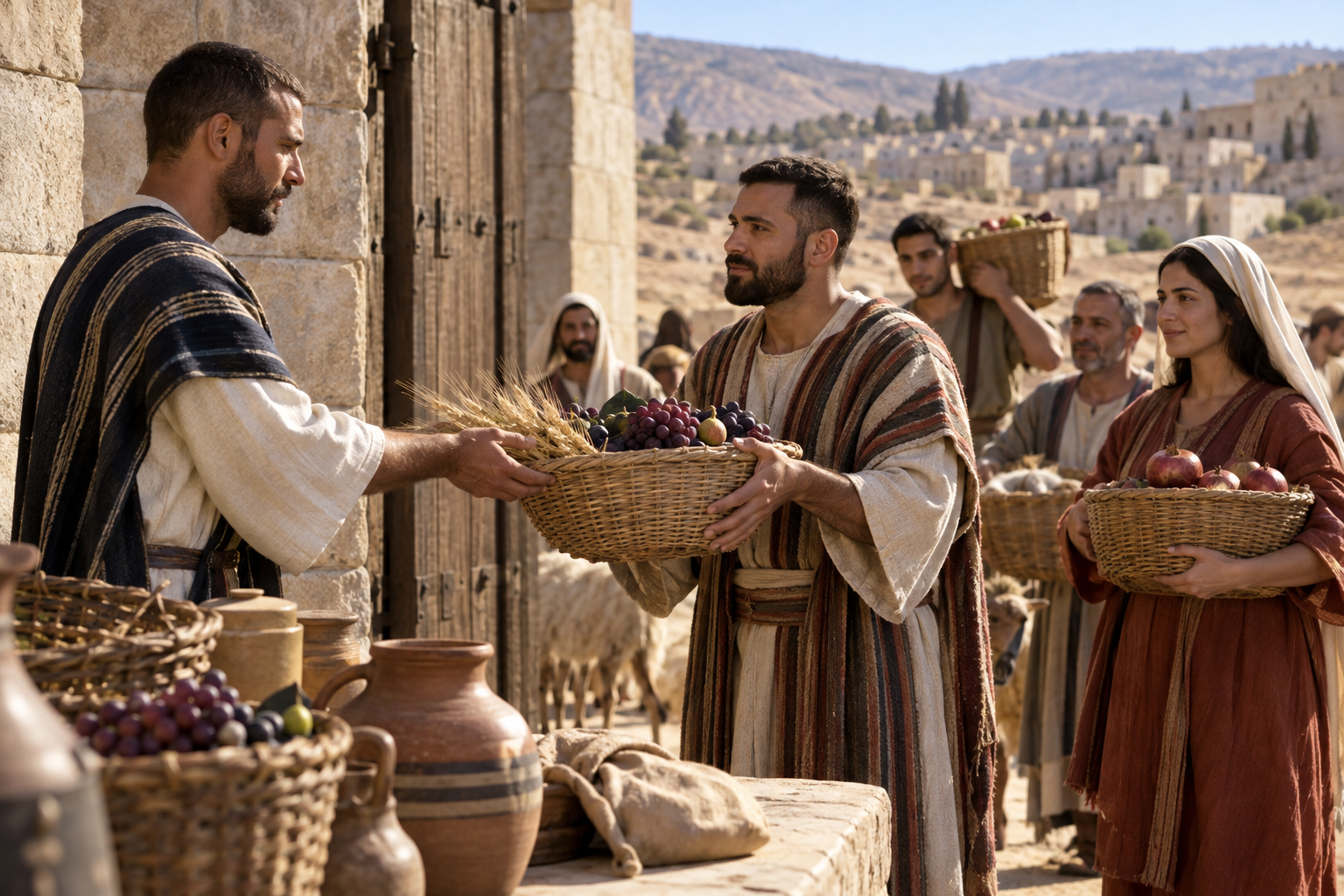
The latter portion of the chapter concerns tithing. Israel was commanded to tithe the increase of the seed from year to year and to eat before the LORD at “the place which he shall choose to place his name there” (14:23).
The chapter itself does not identify that place by city name. It should therefore simply be called, as the KJV does, “the place which the LORD thy God shall choose.”
If the distance was too great to transport the tithe, the Israelite could convert it into money, carry the money to the chosen place, and purchase the required provisions there. Deuteronomy 14:26 explicitly mentions oxen, sheep, wine, strong drink, and other things desired. The presence of these words in the text should neither be erased nor used to contradict the Bible’s warnings against drunkenness. Scripture plainly condemns drunkenness elsewhere (Proverbs 20:1; 23:29–35; Ephesians 5:18).
The Levite was not to be forsaken, because “he hath no part nor inheritance with thee” (14:27).
At the end of three years, the tithe was to be stored “within thy gates” so that the Levite, stranger, fatherless, and widow could eat and be satisfied. Thus Israel’s giving included worship before God and provision for those without the ordinary means of support.
The chapter explicitly regulates Israel’s tithes. It does not, by itself, establish every detail of New Testament church giving. The New Testament believer’s giving is addressed in such passages as 1 Corinthians 16:2 and 2 Corinthians 9:6–7. Nevertheless, Deuteronomy 14 clearly teaches that God’s people should honor God with their substance and should not neglect those genuinely in need.
Deuteronomy 15 — The Year of Release, Care for the Poor, Hebrew Servants, and Firstlings
Chapter 15 opens:
“At the end of every seven years thou shalt make a release.” — Deuteronomy 15:1
An Israelite creditor was required to release what was owed by his brother at the appointed time. A foreigner could still be compelled to pay, but the debt of an Israelite brother was treated according to the law of release.
Verses 4–6 describe the blessing God would give Israel “if only thou carefully hearken unto the voice of the LORD thy God.” This conditional promise should be kept in view when reading verse 4 concerning there being no poor among them.
Later, verse 11 states plainly:
“For the poor shall never cease out of the land.”
There is no need to force a contradiction between the statements. Verses 4–5 connect abundant national blessing with careful obedience, while verse 11 gives the practical command necessary in the continuing presence of poverty: “Therefore I command thee, saying, Thou shalt open thine hand wide unto thy brother, to thy poor, and to thy needy, in thy land.”
Israel was specifically warned not to harden the heart when the seventh year approached. A man was not to refuse assistance simply because the year of release might prevent him from recovering what he had lent.
The LORD looks not merely at outward transactions but at the disposition behind them. Verse 9 warns against allowing “a thought in thy wicked heart” to produce coldness toward a poor brother.
The principle of openhanded generosity is therefore unmistakable.
The chapter next deals with a Hebrew man or woman who had been sold as a servant. After six years of service, the servant was to be released in the seventh year.
The master was specifically commanded:
“And when thou sendest him out free from thee, thou shalt not let him go away empty.” — Deuteronomy 15:13
He was to supply the departing servant liberally from his flock, floor, and winepress.
The stated reason was Israel’s own history:
“And thou shalt remember that thou wast a bondman in the land of Egypt, and the LORD thy God redeemed thee.” — Deuteronomy 15:15
Grace received was to affect mercy shown.
If the servant voluntarily declared, “I will not go away from thee,” because of love for the master and his household, the master was instructed to put an awl through his ear into the door, and the servant would remain with him permanently. The same provision is stated regarding a maidservant.
The chapter concludes with the firstlings of the herd and flock. The firstborn male was to be sanctified unto the LORD. A blemished firstling was not to be sacrificed.
Blood was again forbidden as food:
“Only thou shalt not eat the blood thereof; thou shalt pour it upon the ground as water.” — Deuteronomy 15:23
Deuteronomy 16 — Passover, the Three Feasts, Judges, and Pure Worship
Chapter 16 begins with the Passover:
“Observe the month of Abib, and keep the passover unto the LORD thy God.”
The stated historical reason is explicit:
“for in the month of Abib the LORD thy God brought thee forth out of Egypt by night.” — Deuteronomy 16:1
Passover therefore looked back to an actual historical deliverance from Egypt.
Israel was to eat unleavened bread for seven days, called “the bread of affliction,” so that they would “remember the day when thou camest forth out of the land of Egypt all the days of thy life” (16:3).
The Passover sacrifice was not to be offered anywhere Israel chose. It was connected with “the place which the LORD thy God shall choose to place his name in” (16:6).
Again, this chapter does not name a particular city.
The second major observance is the feast of weeks. Seven weeks were counted from the beginning of putting the sickle to the corn. Israel was then to give “a tribute of a freewill offering of thine hand” according to the blessing God had given.
The worshiper was specifically commanded to rejoice before God, along with his son, daughter, manservant, maidservant, Levite, stranger, fatherless, and widow.
Once again God reminded them:
“And thou shalt remember that thou wast a bondman in Egypt.” — Deuteronomy 16:12
The third major observance is the feast of tabernacles, kept seven days after the gathering from the cornfloor and winepress.
Rejoicing is repeatedly commanded. Biblical holiness was not intended to produce a joyless people. Their joy, however, was God-centered and connected with His blessing and appointed worship.
Three times each year Israel’s males were required to appear before the LORD:
- the feast of unleavened bread,
- the feast of weeks,
- the feast of tabernacles.
They were not to appear empty-handed:
“Every man shall give as he is able, according to the blessing of the LORD thy God which he hath given thee.” — Deuteronomy 16:17
The chapter then moves from worship to justice.
Judges and officers were to be appointed “in all thy gates.” They were commanded to “judge the people with just judgment” (16:18).
Three corruptions of justice are expressly forbidden:
“Thou shalt not wrest judgment; thou shalt not respect persons, neither take a gift.”
A bribe could distort even the judgment of wise men:
“for a gift doth blind the eyes of the wise, and pervert the words of the righteous.” — Deuteronomy 16:19
The chapter ends by prohibiting the planting of a grove near the LORD’s altar and forbidding the setting up of an image which the LORD hated. Worship was not to be reshaped according to human preference or neighboring religious practice. God determined how Israel approached Him.
For the church, Passover also has an explicitly revealed New Testament significance because Paul writes:
“For even Christ our passover is sacrificed for us.” — 1 Corinthians 5:7
That connection is not speculation; the New Testament itself makes it.
Deuteronomy 17 — Acceptable Sacrifice, Idolatry, Courts of Judgment, and the King
Chapter 17 begins by forbidding the offering of an ox or sheep having a blemish or other evilfavouredness:
“for that is an abomination unto the LORD thy God.”
God was not to receive a deliberately defective sacrifice.
The chapter then addresses apostasy and idolatry. If a man or woman within Israel’s gates was found to have gone and served other gods, including the sun, moon, or heavenly host, the matter was to be investigated carefully.
The KJV says:
“Then shalt thou inquire, and make search, and ask diligently.” — Deuteronomy 17:4
The accusation itself was not enough.
If the matter was established as true, the guilty individual faced the civil penalty God prescribed for Israel.
The law required multiple witnesses:
“At the mouth of two witnesses, or three witnesses, shall he that is worthy of death be put to death; but at the mouth of one witness he shall not be put to death.” — Deuteronomy 17:6
Furthermore, “The hands of the witnesses shall be first upon him to put him to death” (17:7). A witness therefore bore grave responsibility for his testimony.
These are civil judicial commands given to the nation of Israel. The New Testament church is not given authority to execute offenders. Church discipline and civil government are separate matters. The church exercises spiritual discipline according to passages such as Matthew 18:15–17 and 1 Corinthians 5, while Romans 13:1–4 speaks of the civil ruler bearing the sword.
Beginning in verse 8, difficult legal cases were to be taken to “the place which the LORD thy God shall choose.” The priests, Levites, and judge were to give judgment according to God’s law.
The people were commanded not to act presumptuously against the authorized judgment.
This was intended to restrain self-willed lawlessness:
“And all the people shall hear, and fear, and do no more presumptuously.” — Deuteronomy 17:13
The remainder of the chapter concerns Israel’s future king.
The text anticipates the circumstance in which Israel would say:
“I will set a king over me, like as all the nations that are about me.” — Deuteronomy 17:14
The passage does not say that Israel was free to choose just any ruler. God said:
“Thou shalt in any wise set him king over thee, whom the LORD thy God shall choose.” — Deuteronomy 17:15
He had to be “one from among thy brethren.” A stranger who was not Israel’s brother could not be placed over them.
The king was then placed under significant restrictions.
He must not:
- multiply horses to himself,
- cause the people to return to Egypt in order to multiply horses,
- multiply wives to himself,
- greatly multiply silver and gold to himself.
The law therefore placed restraints upon military power, personal indulgence, wealth, and royal self-exaltation.
Most importantly, the king himself was placed under the written Word of God.
He was commanded to write a copy of the law:
“And it shall be with him, and he shall read therein all the days of his life.” — Deuteronomy 17:19
The stated purposes are explicit:
“that he may learn to fear the LORD his God”
and
“to keep all the words of this law and these statutes, to do them.”
God’s Word was above the throne.
The king also needed Scripture so:
“That his heart be not lifted up above his brethren.” — Deuteronomy 17:20
Biblical authority therefore does not permit a ruler to imagine himself morally superior to those he governs. Israel’s king remained accountable to the LORD and His written revelation.
Deuteronomy 17 regulates kingship; the chapter itself does not state that every later act associated with Israel’s monarchy was approved by God. Conclusions about later kings must be drawn from the passages that specifically describe them.
Key People and Places
The LORD God — The sovereign Lawgiver throughout all four chapters. He chooses Israel, determines clean and unclean meats, commands worship, provides blessing, establishes justice, and determines the qualifications of Israel’s king.
The children of Israel — Explicitly called “the children of the LORD your God” and “an holy people” in Deuteronomy 14:1–2. These covenant laws were addressed to them.
Moses — The human speaker through whom these commandments are being delivered to Israel in Deuteronomy. The laws themselves are repeatedly presented as commandments of “the LORD thy God.”
The Levite — Repeatedly protected because he had no ordinary tribal inheritance comparable to the other Israelites. Israel was commanded not to forsake him.
The stranger — Included among those who could receive provision and participate in rejoicing in Israel’s appointed gatherings.
The fatherless and widow — Specifically named as people Israel was required to remember and assist.
The poor and needy brother — Deuteronomy 15 commands Israel to open the hand rather than harden the heart against him.
The Hebrew servant — Could be released after six years of service and was not to be sent away empty.
Judges and officers — Appointed in Israel’s gates to execute “just judgment.”
The priests the Levites — Participated in deciding difficult matters brought to the place chosen by the LORD.
The witnesses — Two or three were required in a capital case, and they bore direct responsibility for their testimony.
The king — Had to be an Israelite chosen according to God’s direction and was himself subject to the written law of God.
Egypt — The land from which the LORD had delivered Israel. Israel was repeatedly commanded to remember its former bondage. The king was also forbidden to cause the people to return to Egypt for the multiplication of horses.
“The land which the LORD thy God giveth thee” — The inheritance in which these national laws were to operate.
“Within thy gates” — A repeated expression referring to the communities where Israel lived, administered justice, and provided for the needy.
“The place which the LORD thy God shall choose” — The divinely appointed center associated with sacrifice and Israel’s major feasts. These chapters do not explicitly name the city, so no city should be inserted into the text as though Moses named it here.
Main Doctrinal or Spiritual Themes
1. God Requires Holiness and Separation
Deuteronomy 14:2 establishes the foundation:
“For thou art an holy people unto the LORD thy God.”
Israel was not to determine holiness according to surrounding nations. God Himself defined the distinctions He required.
For Christians, separation is likewise grounded in belonging to God, though the particular Mosaic dietary regulations are not transferred to the church. The New Testament command remains:
“But as he which hath called you is holy, so be ye holy in all manner of conversation.” — 1 Peter 1:15
2. Redemption Should Produce Compassion
Deuteronomy 15 repeatedly connects Israel’s treatment of others with its own deliverance:
“thou shalt remember that thou wast a bondman in the land of Egypt, and the LORD thy God redeemed thee.”
Remembered redemption ought to produce mercy rather than hardness.
A Christian who remembers the grace of God in salvation should likewise be characterized by generosity, compassion, and forgiveness.
3. God Condemns Covetousness and Hardheartedness
The approach of the year of release could tempt a lender to withhold assistance. God explicitly called such thinking “a thought in thy wicked heart” (15:9).
Sin therefore concerns not merely outward acts but inward motives.
4. Biblical Giving Recognizes God as the Source of Blessing
The repeated principle is:
“according to the blessing of the LORD thy God which he hath given thee.”
Israel’s giving acknowledged that its increase came from God.
New Testament giving likewise proceeds from willing devotion rather than compulsion:
“God loveth a cheerful giver.” — 2 Corinthians 9:7
5. Worship Must Follow Divine Revelation
Israel could not invent its own sacrifices, locations, images, or religious practices. God determined the acceptable manner of worship.
The underlying lesson remains vital: sincerity does not make unauthorized worship acceptable. God’s Word governs worship.
6. Biblical Worship Includes Remembrance
The feasts repeatedly reminded Israel of actual acts of God in history, especially the Exodus.
Biblical faith is rooted in God’s revealed acts, not mystical imagination.
7. God Is Concerned With Just Judgment
Deuteronomy 16:20 commands:
“That which is altogether just shalt thou follow.”
Justice must not be manipulated by personality, money, social standing, or personal advantage.
8. Serious Accusations Require Reliable Evidence
Deuteronomy 17 requires diligent inquiry and more than one witness in a capital matter.
The principle demonstrates how seriously God regards both justice and testimony.
9. Idolatry Is Rebellion Against God
Worshiping the sun, moon, heavenly host, or other gods was not treated as an innocent alternative spirituality. Israel belonged to Jehovah and was forbidden to give His worship to another.
For the Christian:
“Little children, keep yourselves from idols.” — 1 John 5:21
10. Human Authority Must Remain Under Divine Authority
Perhaps the most striking political truth of Deuteronomy 17 is that the king himself needed the Book.
His crown did not place him above Scripture.
His continual reading was intended:
- to teach him the fear of God,
- to produce obedience,
- to restrain pride,
- to prevent departure from God’s commandments.
A ruler may possess authority over men, but he never possesses authority over God.
11. Scripture Should Produce Humility
The king was warned:
“That his heart be not lifted up above his brethren.”
Knowledge of God’s Word should not produce arrogance. Proper exposure to Scripture reminds a man that he is accountable to God.
12. Israel and the Church Must Remain Distinct
These chapters contain:
- national dietary legislation,
- agricultural tithes,
- sabbatical debt release,
- Israelite servant regulations,
- annual pilgrimage feasts,
- civil courts,
- capital penalties,
- laws governing an Israelite monarchy.
These plainly belong to Israel’s national covenant administration.
The church should learn from “all scripture” (2 Timothy 3:16) without pretending that the church has become Mosaic Israel. Spiritual principles may rightly be applied where Scripture warrants them, but the civil and ceremonial structure of Israel must not be imposed upon the local New Testament church.
Practical Applications or Lessons
Live like someone who belongs to God. Israel’s holiness began with its relationship to Jehovah: “Ye are the children of the LORD your God.” For the believer, holy living should flow from belonging to Christ rather than merely keeping an outward religious image.
Do not imitate sinful practices simply because they are culturally accepted. Israel lived among other nations but was commanded to obey God. Popularity never establishes righteousness.
Do not allow money to make the heart hard. Deuteronomy 15 exposes the danger of calculating personal financial advantage while ignoring genuine need.
Give with gratitude rather than resentment. God repeatedly connected giving with His prior blessing.
Remember those whom society easily overlooks. The Levite, stranger, fatherless, widow, poor, and servant repeatedly appear in these chapters. God noticed them and commanded His people to do the same.
Treat those under your authority generously. The released servant was not to be sent away empty. Biblical authority is never permission for selfish exploitation.
Remember what God has done for you. Israel repeatedly heard, “thou shalt remember.” Forgetting God’s mercy encourages pride and hardness.
Worship according to Scripture rather than personal invention. God did not permit Israel to decide for itself how He should be worshiped.
Rejoicing has a proper place in the service of God. Deuteronomy 16 repeatedly commands Israel to rejoice before the LORD. Biblical separation is not biblical misery.
Refuse favoritism. “Thou shalt not respect persons.” A Christian should not change moral standards according to wealth, friendship, family connection, influence, or social status.
Reject bribery in every form. A gift given to corrupt judgment is explicitly condemned. The principle applies wherever personal benefit threatens honesty.
Investigate before condemning. Deuteronomy 17 says, “inquire, and make search, and ask diligently.” Serious charges should never be accepted merely because they are repeated loudly or frequently.
Guard your testimony. A witness before Israel’s court bore grave responsibility. Christians likewise ought to remember, “Wherefore putting away lying, speak every man truth with his neighbour” (Ephesians 4:25).
Leaders especially need continual exposure to Scripture. The king was commanded to read the law “all the days of his life.” No pastor, parent, teacher, magistrate, or other leader becomes spiritually mature enough to outgrow the Bible.
Power must be restrained by truth. Israel’s king could not simply accumulate horses, wives, wealth, or political strength without divine limitation. Human authority becomes dangerous when separated from submission to God.
Spiritual leadership must remain humble. God specifically warned against the king’s heart being “lifted up above his brethren.” Office never makes a man intrinsically better than those he serves.
The central lesson of Deuteronomy 14–17 is that every sphere of life belongs under the authority of God’s Word. Israel’s food, money, treatment of the poor, worship, courts, testimony, rulers, and national life were not separated into “religious” and “nonreligious” compartments. Jehovah claimed authority over all of it.
For the believer today, the particular covenant administration differs, but the underlying truth remains: God is holy, His Word is authoritative, His people should obey Him, and no individual or ruler is above what God has spoken.
Comments are closed