
Remember the LORD, Reject Pride, and Fear God
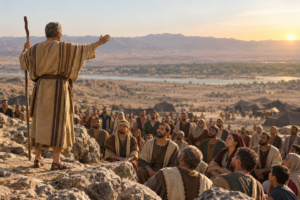 Deuteronomy 8–10 records Moses’ solemn instruction to Israel concerning remembrance, humility, obedience, and covenant faithfulness. The chapters look backward to the LORD’s dealings with Israel in the wilderness and forward to Israel’s possession of the land which God had sworn to their fathers.
A central emphasis is that Israel must never attribute God’s blessings to its own power, righteousness, or goodness. The wilderness demonstrated Israel’s dependence upon God; the golden calf demonstrated Israel’s stubbornness; and the renewal of the tables demonstrated the LORD’s mercy. The section concludes with a direct call to fear the LORD, love Him, serve Him, obey Him, and “cleave” unto Him.
These chapters speak directly to Israel as a covenant nation. They should not be interpreted as though Israel and the New Testament church are the same body. Nevertheless, the spiritual truths concerning humility, dependence upon God, obedience, gratitude, chastening, and the danger of pride remain instructive for believers today.
Chapter Summaries
Deuteronomy 8 — Remember the LORD in Prosperity
The chapter begins with obedience:
“All the commandments which I command thee this day shall ye observe to do, that ye may live, and multiply, and go in and possess the land which the LORD sware unto your fathers.”
— Deuteronomy 8:1
Moses commands Israel to remember the LORD’s dealings with them during the forty years in the wilderness.
“And thou shalt remember all the way which the LORD thy God led thee these forty years in the wilderness, to humble thee, and to prove thee, to know what was in thine heart, whether thou wouldest keep his commandments, or no.”
— Deuteronomy 8:2
The KJV explicitly gives several purposes for Israel’s wilderness experience: “to humble thee,” “to prove thee,” and to reveal whether Israel would keep God’s commandments.
God allowed Israel to experience hunger and then fed them with manna.
“And he humbled thee, and suffered thee to hunger, and fed thee with manna, which thou knewest not, neither did thy fathers know; that he might make thee know that man doth not live by bread only, but by every word that proceedeth out of the mouth of the LORD doth man live.”
— Deuteronomy 8:3
This verse establishes an important doctrine of dependence upon the Word of God. Physical bread is necessary for the body, but man’s life is ultimately dependent upon God and what proceeds from His mouth.
The Lord Jesus Christ later quoted this very statement when tempted by the devil:
“Man shall not live by bread alone, but by every word that proceedeth out of the mouth of God.”
— Matthew 4:4
Thus Scripture itself confirms the continuing spiritual importance of Deuteronomy 8:3.
God also preserved Israel physically:
“Thy raiment waxed not old upon thee, neither did thy foot swell, these forty years.”
— Deuteronomy 8:4
Moses then explains divine chastening:
“Thou shalt also consider in thine heart, that, as a man chasteneth his son, so the LORD thy God chasteneth thee.”
— Deuteronomy 8:5
The text presents God’s chastening as purposeful rather than meaningless hardship.
Moses describes the land into which Israel was going as:
“a good land, a land of brooks of water, of fountains and depths that spring out of valleys and hills”
— Deuteronomy 8:7
The description continues with wheat, barley, vines, fig trees, pomegranates, olive oil, honey, iron, and brass. The emphasis is unmistakable: Israel was moving from wilderness dependence into material abundance.
That abundance created a spiritual danger.
“When thou hast eaten and art full, then thou shalt bless the LORD thy God for the good land which he hath given thee.”
— Deuteronomy 8:10
Prosperity was not to produce independence from God but thanksgiving to God.
The warning follows:
“Beware that thou forget not the LORD thy God, in not keeping his commandments, and his judgments, and his statutes, which I command thee this day:”
— Deuteronomy 8:11
The danger was that, after houses, herds, flocks, silver, and gold multiplied, Israel’s heart might become lifted up.
Moses reminds them who delivered them from Egypt, who led them through the wilderness, who protected them amid “fiery serpents, and scorpions,” and who brought water “out of the rock of flint.”
Then comes one of the chapter’s strongest warnings against human pride:
“And thou say in thine heart, My power and the might of mine hand hath gotten me this wealth.”
— Deuteronomy 8:17
The corrective is immediate:
“But thou shalt remember the LORD thy God: for it is he that giveth thee power to get wealth…”
— Deuteronomy 8:18
The passage does not condemn material blessing itself. It condemns forgetting the One who gave the ability and opportunity by which those blessings were obtained.
The chapter closes with a severe warning that turning after other gods would result in destruction.
Deuteronomy 9 — Israel Possesses the Land by God’s Grace, Not Its Righteousness
Moses turns from the danger of prosperity to the danger of self-righteousness.
Israel was about to face nations described as:
“greater and mightier than thyself, cities great and fenced up to heaven,”
— Deuteronomy 9:1
The children of Anak are specifically mentioned in verse 2.
Yet Israel’s victory would depend upon the LORD:
“Understand therefore this day, that the LORD thy God is he which goeth over before thee; as a consuming fire he shall destroy them…”
— Deuteronomy 9:3
God immediately guards Israel against a false interpretation of that victory.
“Speak not thou in thine heart, after that the LORD thy God hath cast them out from before thee, saying, For my righteousness the LORD hath brought me in to possess this land…”
— Deuteronomy 9:4
Moses repeats the point even more explicitly:
“Not for thy righteousness, or for the uprightness of thine heart, dost thou go to possess their land…”
— Deuteronomy 9:5
Two reasons are stated in the text: the wickedness of the nations and the LORD’s determination to perform the word He had sworn unto Israel’s fathers.
Therefore Moses declares:
“Understand therefore, that the LORD thy God giveth thee not this good land to possess it for thy righteousness; for thou art a stiffnecked people.”
— Deuteronomy 9:6
This is one of the strongest passages in Deuteronomy against national boasting and self-righteousness.
Moses then supports his charge by rehearsing Israel’s rebellion.
At Horeb, Moses had remained before the LORD forty days and forty nights. He received the tables of stone:
“written with the finger of God”
— Deuteronomy 9:10
While Moses was on the mount, Israel corrupted itself and made a molten image. Moses descended, saw Israel’s sin, and broke the tables before them.
He then says:
“And I fell down before the LORD, as at the first, forty days and forty nights…”
— Deuteronomy 9:18
Moses interceded because of the LORD’s anger against Israel. Aaron is specifically mentioned:
“And the LORD was very angry with Aaron to have destroyed him: and I prayed for Aaron also the same time.”
— Deuteronomy 9:20
Moses destroyed the calf, burned it, stamped it, ground it, and cast its dust into the brook descending from the mount.
Other places of rebellion are then named: Taberah, Massah, Kibroth-hattaavah, and Kadesh-barnea.
At Kadesh-barnea, the LORD had commanded Israel to go up and possess the land, but Moses says:
“Then ye rebelled against the commandment of the LORD your God, and ye believed him not, nor hearkened to his voice.”
— Deuteronomy 9:23
The verse directly connects rebellion with unbelief and refusal to hearken to God.
Moses concludes his rehearsal of Israel’s conduct with the severe statement:
“Ye have been rebellious against the LORD from the day that I knew you.”
— Deuteronomy 9:24
The latter part of the chapter emphasizes Moses’ intercession. His prayer appeals to Israel’s relationship to God as His people and inheritance, to God’s former deliverance of them from Egypt, and to His promises.
“Yet they are thy people and thine inheritance, which thou broughtest out by thy mighty power and by thy stretched out arm.”
— Deuteronomy 9:29
The chapter therefore destroys the idea that Israel’s privileges resulted from Israel’s moral superiority. The KJV text plainly says otherwise.
Deuteronomy 10 — Renewed Tables, the Levites, and What God Requires
After recounting Israel’s sin, Moses describes the LORD’s command concerning two new tables of stone.
“At that time the LORD said unto me, Hew thee two tables of stone like unto the first, and come up unto me into the mount, and make thee an ark of wood.”
— Deuteronomy 10:1
God said:
“And I will write on the tables the words that were in the first tables which thou brakest…”
— Deuteronomy 10:2
Verse 4 specifically identifies what was written:
“And he wrote on the tables, according to the first writing, the ten commandments…”
— Deuteronomy 10:4
Moses then placed the tables in the ark as God had commanded him.
Verses 6–7 record Israel’s movements through several locations. Aaron’s death and Eleazar’s succession are mentioned:
“there Aaron died, and there he was buried; and Eleazar his son ministered in the priest’s office in his stead.”
— Deuteronomy 10:6
Deuteronomy 10:6 associates this statement with Mosera, while Numbers 20:27–28 explicitly records Aaron’s death on Mount Hor. Scripture does not explicitly explain the precise geographical relationship between those designations in these verses; therefore it is best not to assert details beyond what the KJV states.
Moses next explains the LORD’s separation of the tribe of Levi:
“At that time the LORD separated the tribe of Levi, to bear the ark of the covenant of the LORD, to stand before the LORD to minister unto him, and to bless in his name, unto this day.”
— Deuteronomy 10:8
Because of this service, Levi had no territorial inheritance comparable to the other tribes:
“the LORD is his inheritance”
— Deuteronomy 10:9
Moses again refers to his forty days and forty nights before the LORD and states:
“and the LORD hearkened unto me at that time also, and the LORD would not destroy thee.”
— Deuteronomy 10:10
The chapter then moves from historical rehearsal to direct spiritual obligation.
“And now, Israel, what doth the LORD thy God require of thee…”
— Deuteronomy 10:12
The answer is:
“but to fear the LORD thy God, to walk in all his ways, and to love him, and to serve the LORD thy God with all thy heart and with all thy soul,”
— Deuteronomy 10:12
and:
“To keep the commandments of the LORD, and his statutes, which I command thee this day for thy good?”
— Deuteronomy 10:13
Notice that obedience is not presented as an injury to Israel. God’s commandments are said to be “for thy good.”
God’s absolute ownership and greatness are then declared:
“Behold, the heaven and the heaven of heavens is the LORD’S thy God, the earth also, with all that therein is.”
— Deuteronomy 10:14
Yet the LORD had placed His love upon Israel’s fathers and chosen their seed after them.
This national choice should not be confused with the doctrine of individual salvation. The passage is addressing God’s covenant dealings with Israel as a people.
The proper response was inward as well as outward:
“Circumcise therefore the foreskin of your heart, and be no more stiffnecked.”
— Deuteronomy 10:16
The verse uses physical circumcision as the basis for a direct command concerning the heart. Scripture itself makes that connection; therefore this is not an imposed allegory.
God is then described magnificently:
“For the LORD your God is God of gods, and Lord of lords, a great God, a mighty, and a terrible, which regardeth not persons, nor taketh reward:”
— Deuteronomy 10:17
His greatness is joined to His righteousness and compassion. He executes judgment for the fatherless and widow and loves the stranger.
Israel is therefore commanded:
“Love ye therefore the stranger: for ye were strangers in the land of Egypt.”
— Deuteronomy 10:19
The chapter closes by calling Israel to fear, serve, cleave to, praise, and remember the LORD.
“He is thy praise, and he is thy God, that hath done for thee these great and terrible things, which thine eyes have seen.”
— Deuteronomy 10:21
Israel’s fathers had gone into Egypt with seventy persons, but God had multiplied them:
“as the stars of heaven for multitude.”
— Deuteronomy 10:22
Key People and Places
Moses — The speaker throughout these chapters. He reminds Israel of God’s wilderness dealings, recounts Israel’s rebellion at Horeb, describes his intercession, and calls the nation to fear and obey the LORD.
The LORD God — The central Person of the passage: Israel’s Deliverer, Provider, Chastener, Lawgiver, Judge, Defender, and covenant God.
Israel — The nation being addressed. Moses repeatedly warns Israel against forgetfulness, pride, unbelief, idolatry, and self-righteousness.
Aaron — His involvement in the Horeb rebellion is recalled in Deuteronomy 9:20, where Moses states that the LORD was angry with him and that Moses prayed for him. His death and burial are recorded in Deuteronomy 10:6.
Eleazar — Aaron’s son, who “ministered in the priest’s office in his stead” after Aaron’s death.
The tribe of Levi — Separated by the LORD to bear the ark, minister before Him, and bless in His name.
Children of Anak — A people described in Deuteronomy 9:2 as “great and tall.” Scripture records that Israel knew the saying, “Who can stand before the children of Anak!”
Egypt — The land from which the LORD delivered Israel “through that great and terrible wilderness” (Deuteronomy 8:15).
The wilderness — The setting of Israel’s forty years of humbling, proving, provision, chastening, and repeated rebellion.
Horeb — The place where Israel provoked the LORD and made the molten calf.
Jordan — The boundary Israel was preparing to pass over in order to confront stronger nations.
Taberah — Named in Deuteronomy 9:22 as one of the places where Israel provoked the LORD.
Massah — Another location connected with Israel provoking the LORD.
Kibroth-hattaavah — Also named among Israel’s wilderness provocations.
Kadesh-barnea — The place where Israel refused the command to go possess the land and “believed him not.”
Mosera — Named in Deuteronomy 10:6 in connection with Aaron’s death and burial.
Gudgodah — A location in Israel’s journey listed in Deuteronomy 10:7.
Jotbath — Described as “a land of rivers of waters” in Deuteronomy 10:7.
Main Doctrinal or Spiritual Themes
Remembering God
“Remember” is one of the great spiritual ideas of Deuteronomy 8. Israel’s danger was not merely lack of information but forgetfulness of the God who had delivered, led, fed, protected, and enriched them.
Biblical remembrance affects conduct. Forgetting the LORD leads toward disobedience and idolatry.
Dependence Upon the Word of God
Deuteronomy 8:3 teaches:
“man doth not live by bread only, but by every word that proceedeth out of the mouth of the LORD doth man live.”
God’s people must never regard His Word as an optional addition to life. The Lord Jesus confirmed the authority and continuing spiritual force of this statement in Matthew 4:4.
For the believer, this underscores the necessity of receiving, believing, obeying, and living by the Word of God.
Divine Chastening
Deuteronomy 8:5 compares the LORD’s chastening to a father chastening his son.
Chastening is not evidence that God has lost control. In the immediate context, God used Israel’s wilderness experience to humble and prove them.
For New Testament believers, Hebrews 12 also teaches that the Lord chastens His children. This should produce submission and holiness rather than bitterness.
The Danger of Prosperity
One of the strongest lessons of chapter 8 is that adversity is not the believer’s only spiritual danger.
Israel had depended upon God in the wilderness, but abundance could tempt them to say:
“My power and the might of mine hand hath gotten me this wealth.”
Prosperity can expose pride just as hardship can expose unbelief.
God Is the Source of Ability and Provision
Deuteronomy 8:18 says:
“it is he that giveth thee power to get wealth”
Man may labor, plan, build, sow, reap, and manage, but God remains the ultimate source of life, strength, opportunity, and ability.
That truth should destroy boasting and produce gratitude.
God’s Blessing Is Not Proof of Human Merit
Deuteronomy 9 repeatedly denies that Israel possessed the land because of its righteousness.
This does not mean that Israel’s obedience was unimportant; these chapters repeatedly command obedience. It means that Israel could not claim the land as a reward for superior national righteousness.
The text itself describes them as:
“a stiffnecked people.”
The lesson strongly opposes spiritual pride.
The Seriousness of Unbelief
At Kadesh-barnea Moses says:
“ye believed him not, nor hearkened to his voice.”
Unbelief was not an innocent intellectual uncertainty. In this context, it resulted in direct disobedience to a clear command from God.
Biblical faith takes God at His Word.
The Sin of Idolatry
The golden calf stands as a powerful reminder of the corruption of false worship.
Israel had received extraordinary revelation from God, yet still turned to a molten image.
Spiritual privilege does not make rebellion harmless.
Intercessory Prayer
Moses repeatedly fell before the LORD and interceded for Israel.
The passage does not teach that Moses manipulated God. Rather, Scripture explicitly says:
“the LORD hearkened unto me”
Prayer matters because God has ordained that His servants should call upon Him.
The Holiness and Justice of God
Deuteronomy 10:17 describes the LORD as:
“a great God, a mighty, and a terrible”
He:
“regardeth not persons, nor taketh reward”
God cannot be bribed and does not pervert judgment based on worldly status.
God’s Concern for the Vulnerable
The same God who is “mighty, and terrible” also:
“doth execute the judgment of the fatherless and widow, and loveth the stranger”
Biblical holiness and biblical compassion are not opposites. They meet perfectly in the character of God.
Fear, Love, and Obedience Belong Together
Deuteronomy 10:12 joins several responsibilities:
- Fear the LORD.
- Walk in His ways.
- Love Him.
- Serve Him.
- Serve with all the heart and soul.
Biblical love for God is therefore not mere emotion. It is inseparably connected with reverence, service, and obedience.
Separation Unto God
The LORD “separated the tribe of Levi” for particular service.
The exact Levitical calling belonged to Israel under the Mosaic order and should not simply be transferred to the church. Nevertheless, the principle that service to God demands devotion to God is consistent throughout Scripture.
Israel and the Church Must Remain Distinct
These chapters concern Israel’s land, Israel’s fathers, Israel’s Levites, Israel’s national covenant responsibilities, and Israel’s wilderness history.
The church should learn from these things, but it should not take Israel’s national identity or promised land for itself.
Paul teaches concerning Israel’s wilderness history:
“Now these things were our examples…”
— 1 Corinthians 10:6
Christian application is therefore proper, but replacement of Israel with the church is not required by the text.
Practical Applications or Lessons
Remember what God has done. Forgetfulness often precedes disobedience. Regularly remembering God’s provision, protection, answers to prayer, and truth helps guard the heart against pride.
Do not despise seasons of testing. Deuteronomy 8 explicitly says that God used Israel’s wilderness experience “to humble thee, and to prove thee.” Hard circumstances may expose what prosperity conceals.
Live by the Word of God. Material necessities are real, but they are not sufficient for the spiritual life. God’s Word must govern convictions, doctrine, priorities, worship, and conduct.
Receive chastening humbly. God’s correction should lead His children toward obedience rather than resentment.
Beware when life becomes comfortable. Moses particularly warns Israel about forgetting God after eating, building, multiplying possessions, and becoming wealthy.
A believer may be spiritually endangered not only when he has too little, but when he thinks he no longer needs anything.
Never take credit for what ultimately came from God. The warning, “My power and the might of mine hand,” remains searching. Ability itself is a gift from God.
Reject spiritual pride. Israel could not say, “For my righteousness.” Neither should a Christian boast as though spiritual privilege originated in personal superiority.
Salvation for the believer is:
“by grace… through faith”
— Ephesians 2:8
and:
“Not of works, lest any man should boast.”
— Ephesians 2:9
Good works follow salvation; they do not purchase it.
Take unbelief seriously. Israel’s refusal at Kadesh-barnea is described as both rebellion and unbelief. Faith obeys what God has plainly said.
Flee idolatry. Anything that receives the worship, trust, loyalty, or devotion belonging to God occupies a forbidden place.
Pray for others. Moses’ intercession demonstrates the seriousness and value of standing before God on behalf of others.
Fear God more than man. Deuteronomy 10:17 presents the LORD as “God of gods, and Lord of lords.” No earthly person deserves the reverence belonging to Him.
Treat people without partiality. God “regardeth not persons.” Wealth, popularity, position, education, or influence do not alter His standard of righteousness.
Show compassion to the vulnerable. The God who cares for the fatherless, widow, and stranger teaches His people not to despise the weak or helpless.
Love God with the whole life. Deuteronomy 10:12 does not permit a divided Christianity. Israel was commanded to fear, walk, love, and serve “with all thy heart and with all thy soul.”
Cleave unto the LORD.
“Thou shalt fear the LORD thy God; him shalt thou serve, and to him shalt thou cleave…”
— Deuteronomy 10:20
The believer should cultivate steadfast loyalty to God rather than drifting with the world.
Overall Message of Deuteronomy 8–10
The three chapters form a powerful progression.
Deuteronomy 8: Do not forget God when He blesses you.
Deuteronomy 9: Do not imagine that His blessings prove your own righteousness.
Deuteronomy 10: Fear, love, obey, serve, and cleave to the God who has shown both holiness and mercy.
Israel’s history had demonstrated that man is prone to forget, boast, rebel, and turn aside. Yet God remained faithful to His word.
The proper response was neither self-confidence nor despair, but humble dependence upon the LORD:
“He is thy praise, and he is thy God…”
— Deuteronomy 10:21
The great practical lesson is therefore clear: remember the LORD when He provides, humble yourself when He prospers you, believe Him when He commands you, and serve Him with all the heart.
How useful was this post?
Click on a star to rate it!
Average rating 0 / 5. Vote count: 0
No votes so far! Be the first to rate this post.
We are sorry that this post was not useful for you!
Let us improve this post!
Tell us how we can improve this post?
Comments are closed