Chapter Summaries
Daniel 1 — Faithfulness in Babylon
 Daniel opens during the judgment of God upon Judah. “In the third year of the reign of Jehoiakim king of Judah came Nebuchadnezzar king of Babylon unto Jerusalem, and besieged it” (Daniel 1:1). This was not merely a political defeat; it was divine chastening. The text says, “the Lord gave Jehoiakim king of Judah into his hand” (Daniel 1:2). Babylon was powerful, but God was sovereign.
Nebuchadnezzar carried away part of the vessels of the house of God and placed them “in the treasure house of his god” (Daniel 1:2). This shows Babylon’s pride and idolatry, but it also sets the stage for God to prove that He, not Babylon’s gods, rules over kings and kingdoms.
The king selected certain Hebrew youths “of the king’s seed, and of the princes” (Daniel 1:3), children “in whom was no blemish, but well favoured, and skilful in all wisdom” (Daniel 1:4). They were to be taught “the learning and the tongue of the Chaldeans” (Daniel 1:4), given Babylonian names, and fed from the king’s table. This was an attempt at cultural and spiritual assimilation.
Among them were Daniel, Hananiah, Mishael, and Azariah. Their names were changed to Belteshazzar, Shadrach, Meshach, and Abednego (Daniel 1:6–7). Babylon could change their names, their location, their education, and their outward circumstances, but it could not change their God if they remained faithful.
The key verse of the chapter is Daniel 1:8: “But Daniel purposed in his heart that he would not defile himself with the portion of the king’s meat.” Daniel’s stand was not rash rebellion, but settled conviction. He respectfully requested that he might not defile himself. This reflects biblical separation: firm obedience to God with a right spirit.
God honored Daniel’s faithfulness. “God had brought Daniel into favour and tender love with the prince of the eunuchs” (Daniel 1:9). After ten days of pulse and water, Daniel and his companions appeared “fairer and fatter in flesh” than those who ate the king’s meat (Daniel 1:15). At the end of their training, the king found them “ten times better than all the magicians and astrologers that were in all his realm” (Daniel 1:20).
Daniel 1 teaches that a believer can live clean in a corrupt world. Babylon was pagan, proud, and powerful, but Daniel remained separated unto God.
Daniel 2 — Nebuchadnezzar’s Dream and God’s Kingdom
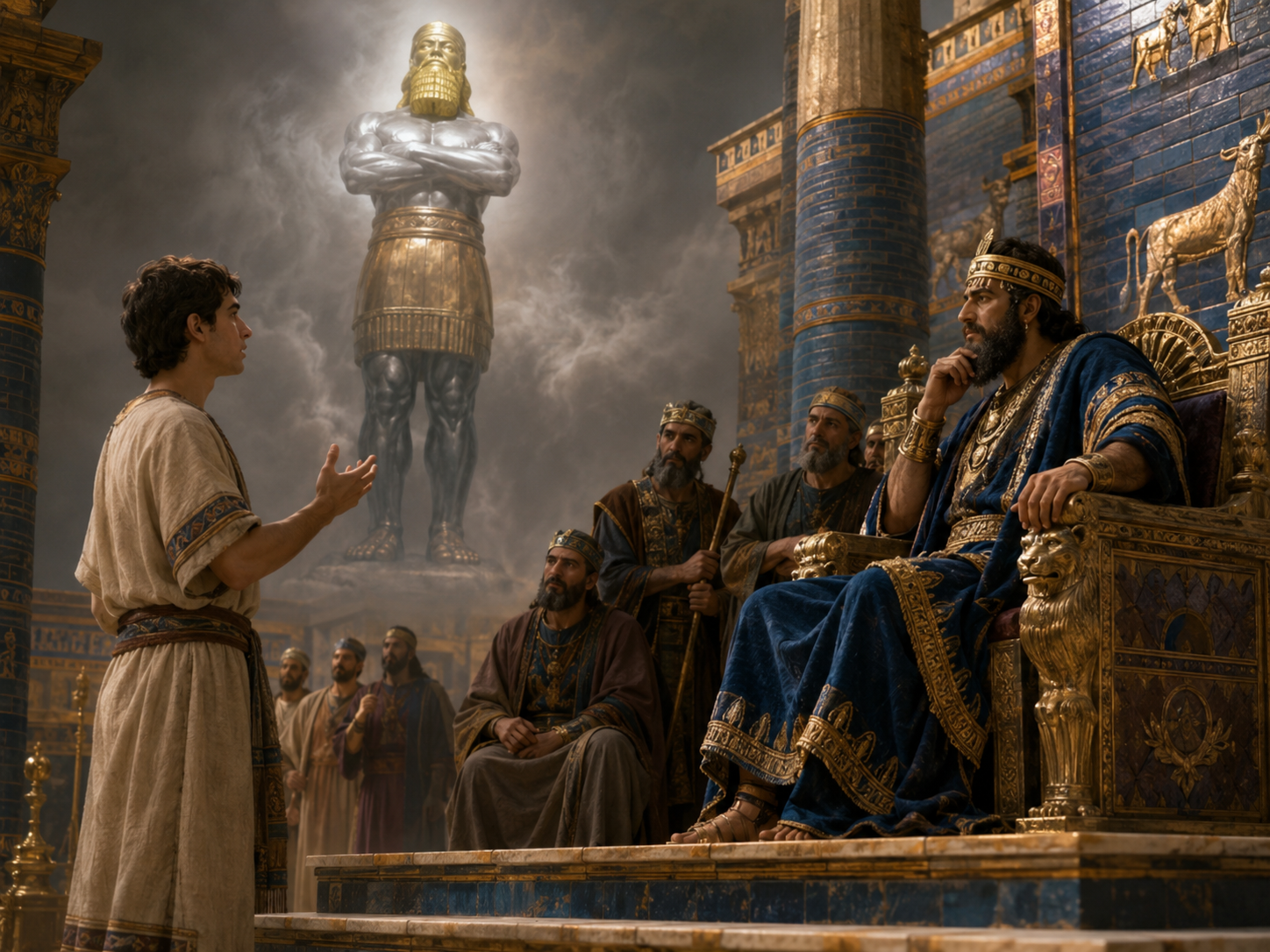
Daniel 2 begins with Nebuchadnezzar troubled by dreams. “His spirit was troubled, and his sleep brake from him” (Daniel 2:1). The king called the magicians, astrologers, sorcerers, and Chaldeans to show him the dream and its interpretation. They could not. They admitted, “there is none other that can shew it before the king, except the gods, whose dwelling is not with flesh” (Daniel 2:11). Their false religion failed at the moment of need.
Nebuchadnezzar, in wrath, commanded that the wise men of Babylon be destroyed. Daniel and his companions were included in that decree. Daniel answered with wisdom and discretion and asked for time. He then gathered Hananiah, Mishael, and Azariah, “that they would desire mercies of the God of heaven concerning this secret” (Daniel 2:18).
God revealed the secret to Daniel “in a night vision” (Daniel 2:19). Daniel did not exalt himself. He blessed God and said, “Blessed be the name of God for ever and ever: for wisdom and might are his” (Daniel 2:20). He confessed that God “changeth the times and the seasons: he removeth kings, and setteth up kings” (Daniel 2:21). This is one of the central doctrines of Daniel: God rules over human government.
Daniel appeared before Nebuchadnezzar and plainly said that no human wisdom could reveal the dream. “But there is a God in heaven that revealeth secrets” (Daniel 2:28). Daniel gave God the glory before giving the interpretation.
The dream was of a great image:
The head of gold represented Nebuchadnezzar and Babylon: “Thou art this head of gold” (Daniel 2:38).
The breast and arms of silver represented a kingdom after Babylon.
The belly and thighs of brass represented a third kingdom.
The legs of iron, and feet part of iron and part of clay, represented a fourth kingdom and its divided final form.
Conservative dispensational interpretation commonly understands these kingdoms as Babylon, Medo-Persia, Greece, and Rome, with the feet and toes pointing to a later divided form related to the final stage of Gentile world power. The chapter looks beyond Daniel’s day to the course of Gentile dominion, often called “the times of the Gentiles.”
The most important part of the dream is the stone. Daniel said, “a stone was cut out without hands” (Daniel 2:34), and it smote the image upon its feet. The image was destroyed, and “the stone that smote the image became a great mountain, and filled the whole earth” (Daniel 2:35). Daniel explained, “the God of heaven” shall “set up a kingdom, which shall never be destroyed” (Daniel 2:44).
This points to the literal, future, earthly kingdom of the Lord Jesus Christ. The kingdoms of men rise and fall, but Christ’s kingdom shall stand forever. This fits the premillennial understanding of Scripture: Christ will return, overthrow the kingdoms of this world, and reign in righteousness.
Nebuchadnezzar responded by honoring Daniel and acknowledging Daniel’s God as “a God of gods, and a Lord of kings” (Daniel 2:47). Daniel was promoted, and he requested that Shadrach, Meshach, and Abednego be set over the affairs of Babylon, while Daniel sat “in the gate of the king” (Daniel 2:49).
Daniel 2 teaches that history is not random. God knows the future, reveals truth, rules kings, and will establish His everlasting kingdom.
Key People and Places
Daniel
A faithful Hebrew captive in Babylon. He was young, intelligent, and trained in Babylonian learning, yet he purposed not to defile himself. God gave him wisdom, understanding, and prophetic insight.
Hananiah, Mishael, and Azariah
Daniel’s three Hebrew companions, later called Shadrach, Meshach, and Abednego. They stood with Daniel in separation and prayer. Their faithfulness in chapter 1 prepares for their greater test in chapter 3.
Nebuchadnezzar
King of Babylon. He was proud and powerful, yet God used him as an instrument of judgment upon Judah. In Daniel 2, God showed him the future course of Gentile kingdoms.
Ashpenaz
The master of Nebuchadnezzar’s eunuchs. He was responsible for training the Hebrew youths. God gave Daniel favor with him.
Arioch
The captain of the king’s guard. He was sent to destroy the wise men of Babylon but became the one through whom Daniel gained access to the king.
Jehoiakim
King of Judah when Nebuchadnezzar came against Jerusalem. His defeat shows the spiritual decline and judgment of Judah.
Jerusalem
The city of God’s earthly covenant people, judged because of sin and rebellion. Its fall reminds us that privilege does not excuse disobedience.
Babylon
The center of Gentile power, idolatry, pride, and human glory. In Daniel, Babylon is both a literal empire and a picture of worldly opposition to God.
Shinar
The land where Nebuchadnezzar carried the vessels of the house of God. This connects Babylon with ancient rebellion, recalling Genesis 11 and the tower of Babel.
Main Doctrinal or Spiritual Themes
1. The Sovereignty of God Over Nations
Daniel 1:2 says, “the Lord gave Jehoiakim king of Judah into his hand.” Nebuchadnezzar conquered, but God ruled. Daniel 2:21 says God “removeth kings, and setteth up kings.” Human government is real, but it is never ultimate.
This truth is vital in prophecy. Kingdoms rise and fall by God’s permission. Babylon, Medo-Persia, Greece, Rome, and all future Gentile powers are under the hand of God.
2. Biblical Separation
Daniel “purposed in his heart that he would not defile himself” (Daniel 1:8). Separation begins in the heart before it appears in conduct. Daniel did not need Jerusalem’s temple, a godly king, or a friendly culture in order to obey God. He lived holy in Babylon.
Biblical separation is not pride; it is obedience. The believer is not called to blend with the world, but to stand for God with humility, wisdom, and conviction.
3. God Honors Faithfulness
Daniel and his companions were tested, and God blessed them. They were not weakened by obedience; they were strengthened. “As for these four children, God gave them knowledge and skill in all learning and wisdom” (Daniel 1:17).
Faithfulness does not always bring immediate promotion, but God always sees it. Daniel 1 shows that obedience in private prepares a man for usefulness in public.
4. Prayer and Dependence Upon God
When death threatened Daniel and the wise men, Daniel did not trust Babylonian learning. He gathered his companions to pray. They sought “mercies of the God of heaven” (Daniel 2:18).
This is a strong lesson in dependence. Daniel had wisdom, but he still needed God. Spiritual men do not lean on intellect alone; they seek the Lord.
5. True Wisdom Comes From God
Babylon had magicians, astrologers, sorcerers, and Chaldeans, but they could not reveal the king’s dream. Daniel confessed, “there is a God in heaven that revealeth secrets” (Daniel 2:28).
The wisdom of this world fails before divine revelation. God’s people must not be ashamed to say that truth comes from God and His Word.
6. The Failure of False Religion
The Chaldeans admitted their helplessness. Their gods could not speak. Their system could not reveal truth. Babylonian religion had ceremony, learning, and prestige, but no living God.
Daniel’s God revealed the secret. The God of the Bible is not an idol, force, or idea. He is the living God who speaks, rules, reveals, and judges.
7. The Coming Kingdom of Christ
The stone “cut out without hands” points to a kingdom of divine origin, not human invention. Daniel 2:44 says, “the God of heaven” shall “set up a kingdom, which shall never be destroyed.”
This is not fulfilled by human progress, political reform, or the church conquering the world. It points to the future reign of Christ. The kingdoms of men will be broken, and Christ’s kingdom will stand forever.
8. Israel and the Gentile Powers
Daniel concerns Israel in exile under Gentile dominion. The Church is not in Daniel 1–2. The prophecy concerns the course of Gentile world empires and God’s future kingdom. A sound dispensational reading keeps Israel, the Gentile nations, and the Church distinct.
Practical Applications or Lessons
1. Purpose in the Heart Before the Test Comes
Daniel did not decide his convictions at the king’s table. He had already purposed in his heart. Believers today need settled convictions before pressure comes. A Christian who waits until temptation arrives to decide what he believes is already in danger.
2. Young People Can Stand for God
Daniel and his companions were young captives, far from home, surrounded by pagan influence. Yet they stood. Youth is no excuse for compromise. God can use young believers who will be clean, faithful, and courageous.
3. Live Right Even in Babylon
Daniel did not control his government, his school, his food assignment, or his name change. But he could control whether he defiled himself. A believer may not be able to change the world around him, but he can still obey God where he is.
4. Conviction Should Be Joined With Wisdom
Daniel did not act foolishly or disrespectfully. He made a request. He showed discretion. He trusted God while dealing wisely with authority. Biblical courage is not the same as fleshly rashness.
5. Prayer Should Be the First Resort, Not the Last
When the crisis came, Daniel called his friends to prayer. Families, churches, and believers need this same instinct. Trouble should drive God’s people to the Lord, not to panic.
6. Give God the Glory
Daniel said the answer did not come from himself: “this secret is not revealed to me for any wisdom that I have more than any living” (Daniel 2:30). Spiritual usefulness requires humility. God does not reveal truth so men can exalt themselves.
7. Worldly Kingdoms Are Temporary
Nebuchadnezzar’s image was impressive, but it was destroyed. Gold, silver, brass, iron, and clay all gave way before the stone. Every human empire, ideology, and system will fall before Christ.
8. God’s People Should Have Confidence in Prophecy
Daniel 2 shows that God knows the future before it happens. Bible prophecy is not guesswork. The believer can trust the Scripture because the God who gave it declares “the latter days” before they come to pass.
9. Faithfulness in Small Matters Prepares for Greater Use
Daniel’s stand over food in chapter 1 prepared him for prophetic ministry in chapter 2. Small compromises weaken future usefulness; small obediences strengthen it.
10. Christ’s Kingdom Is the Final Answer
The hope of the world is not Babylon improved, politics perfected, or man-made unity. The hope of the world is the return and reign of the Lord Jesus Christ. “The dream is certain, and the interpretation thereof sure” (Daniel 2:45).
Comments are closed